Key Takeaways
If quotes look far apart, the gap is usually hidden complexity rather than agency margin.
- Platform choice matters, but scope matters more. A simple Shopify build can cost less than a heavily customised WooCommerce project, and the reverse is also true.
- Custom trading logic moves price quickly. B2B pricing, approvals, subscriptions, permissions, and checkout changes create edge cases that need engineering and deeper QA.
- Integrations and migration are common budget traps. API quality, field mapping, failure handling, redirects, SEO data, and legacy workarounds often add more effort than teams expect.
- Cheap quotes often shift responsibility back to you. Data clean-up, testing, vendor coordination, launch support, and post-launch fixes are frequently excluded unless written down.
The platform is not the main price driver in an eCommerce build. Complexity is – and complexity is rarely what the headline scope suggests.
The short answer: What changes the price of an eCommerce development project is the hidden engineering work beneath the visible features: custom pricing logic, B2B account rules, integration complexity, data migration quality, QA depth, and who owns risk when things go wrong. Two projects that sound identical at brief stage can diverge significantly once real workflows, integrations, and support requirements are properly scoped.
That is why two proposals for what sounds like the same build can be miles apart. If you are comparing a brochure-level Shopify build with a properly scoped trading platform, the quotes will not match – and they should not. If you want a clearer sense of cost before speaking to an eCommerce development agency in London, you need to know which decisions create engineering effort and long-tail cost.
Why two eCommerce development quotes can be miles apart
Most quote gaps are not about hourly rate. They come from different assumptions about complexity, risk, and ownership.
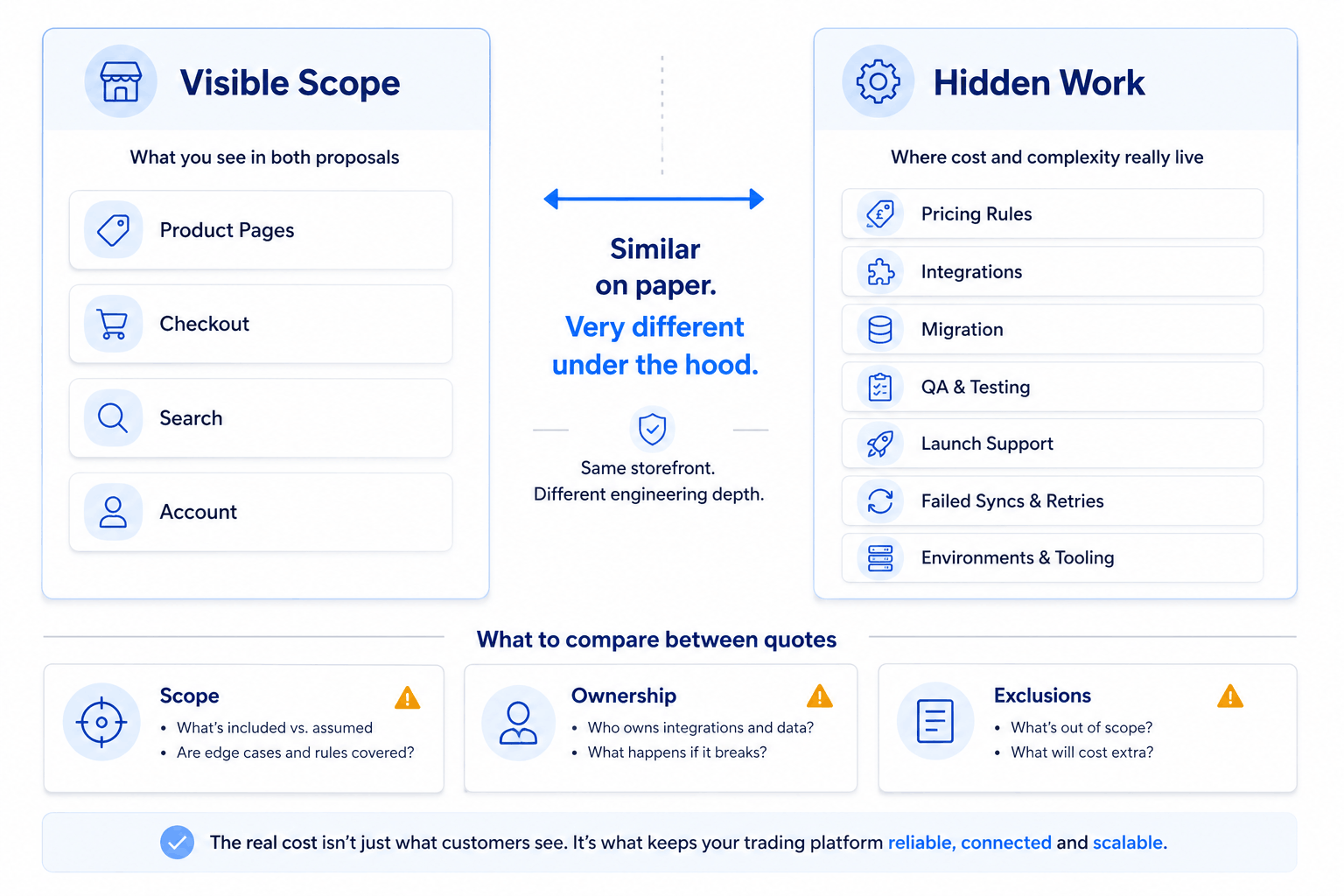
Visible features are not the full scope. Two agencies can both list product pages, checkout, search, and account areas, yet one has priced the edge cases and the other has not. If your store has trade pricing, approval flows, subscription logic, inventory sync, or CMS dependencies, that hidden architecture changes the build far more than the homepage design.
Compare exclusions before you compare totals. Ask who owns data mapping, failed sync handling, payment edge cases, staging, launch support, and post-launch fixes. If a quote is light on assumptions and heavy on confidence, treat that as a warning sign.
Responsibility changes price. A lean quote often assumes your team will resolve content issues, test business rules, clean data, and manage third-party vendors. Do not assume those tasks are included unless they are written down.
The cost drivers that usually move price the most
The eCommerce platform matters, but it is rarely the main reason a project gets expensive.
Platform choice: Shopify, WooCommerce, Magento, and headless commerce setups each bring different constraints, app models, and customisation limits. Keep this in proportion. A standard Shopify build can cost less than a heavily customised WooCommerce build, and the reverse is equally true. The question is not which platform sounds premium, but which one fits the logic you actually need.
Custom functionality: B2B pricing rules, customer-specific catalogues, subscriptions, checkout changes, account permissions, and app dependencies move price quickly because they create edge cases. In Vamsi’s experience reviewing scope documents and agency shortlists, integration complexity and custom workflows consistently move project cost faster than any brochure-level feature list. Agencies that price this correctly upfront are the ones worth shortlisting.
Design and catalogue complexity: Custom front-end behaviour, layered filters, variant-heavy products, bundles, and awkward product structures all add build and QA effort. Separate must-have operational logic from nice-to-have requests. If a feature does not change conversion or operations, push on whether it belongs in phase one.
If you are weighing WooCommerce for a more flexible content and trading setup, a WooCommerce development agency should be able to tell you where plugin convenience ends and custom engineering begins.

Not sure which parts of your scope are driving cost
We can review your feature list, integrations, migration needs, and support assumptions to show what is genuinely adding engineering effort and what can likely be phased.
Useful if quotes feel far apart
How integrations and migration change the budget
This is where apparently tidy projects get expensive. Integrations are rarely clean once real data and real workflows show up.
Integration scope: ERP, CRM, inventory sync, payment gateways, shipping tools, CMS integration, and third-party apps all carry dependency risk. Cost depends on API quality, rate limits, field mapping, business rules, retries, and failure handling. Ask what happens when inventory does not match, an order fails mid-sync, or a refund needs to update three systems instead of one.
Migration scope: Content and data migration can be light, or it can be a full clean-up project wearing a migration label. Product data, customer accounts, order history, redirects, SEO metadata, and media assets all need checking. Product count does not tell you the effort – structure quality matters more than volume.
If your legacy store has years of manual workarounds, the migration cost is often really the cost of untangling old business rules.
Ask for sample migration logic, not vague reassurance. Check whether the quote includes validation, rollback planning, and replatforming support – or whether those become change requests later.
Cost-driver matrix: what raises price a little and what raises it a lot
If you want a fast sense check, use this matrix. It is not a price list. It is a way to spot which combinations create compounding cost.
| Scope item | Technical complexity | Pricing impact | What you should check |
|---|---|---|---|
| Platform choice alone | Low to medium | Low to medium | Check fit with your trading model, not brand preference |
| Custom B2B pricing and account rules | High | High | Ask how customer groups, approvals, tax, and discounts interact |
| Subscriptions or recurring orders | High | High | Check edge cases around failed payments, pauses, and renewals |
| ERP, CRM, inventory, or CMS integrations | High | High | Ask who handles sync failures, mapping, and testing |
| Large or messy catalogue structure | Medium to high | Medium to high | Check variants, bundles, filters, and data quality |
| Custom design and front-end interactions | Medium to high | Medium to high | Ask what is templated versus fully bespoke |
| Migration from a legacy platform | Medium to high | High | Check redirects, SEO data, order history, and validation |
| QA, load testing, and multiple environments | Medium | Medium | Do not let this be treated as optional admin work |
| Compliance and handover support | Medium | Medium | Ask what is included after launch and who owns fixes |
If several high-impact rows apply to your project, expect the quote to move accordingly. If they apply and the quote still looks suspiciously cheap, check what has been excluded.
What a cheaper quote is really telling you
The honest problem is not that cheaper quotes are always wrong. It is that they often transfer risk to you without naming it.
The exclusions that matter most are not always the obvious ones. QA depth, load testing, staging and production environments, and launch support are frequently stripped from lean proposals. So are checkout UX validation, compliance checks, handover documentation, and post-launch defect ownership. These are not admin extras. They are what separates a store that holds up under real traffic from one that creates problems the week after go-live.
When you are comparing shortlisted agencies, ask for a written list of exclusions and post-launch responsibilities. Specifically:
- Who monitors and responds at launch?
- Who owns defects found after sign-off?
- Who manages updates when payment gateway or inventory sync behaviour changes?
- What is the process when something breaks on a Friday evening?
Agencies that cannot answer these questions clearly have not priced for them. That is what false savings look like before they appear in the budget.
If you are close to supplier selection, ask for a scoping review before you commit. A good eCommerce development company should be able to tell you which parts of your scope are true cost drivers, which can be phased, and which are quietly carrying technical debt into your next budget cycle.
Common questions about eCommerce website development cost
These are the questions buyers usually ask when they are trying to understand why quotes vary so much.
1. Why can two eCommerce development quotes be so different for what looks like the same project?
Because the visible feature list rarely shows the full scope. One quote may include custom business rules, integrations, migration validation, QA, launch support, and post-launch fixes, while another assumes your team will handle those separately. The price gap usually comes from different assumptions about complexity, risk, and ownership.
2. Is platform choice the main driver of eCommerce website development cost?
No, platform choice is usually not the main driver on its own. The bigger cost drivers are custom workflows, integration complexity, catalogue structure, migration quality, and testing depth. A standard build on one platform can easily cost less than a heavily customised build on another if the underlying trading logic is simpler.
3. What parts of an eCommerce project usually push the budget up fastest?
Custom functionality and integrations usually push the budget up fastest. B2B pricing rules, approvals, subscriptions, account permissions, ERP or CRM sync, and checkout changes all create edge cases that need engineering, testing, and failure handling. Migration from a messy legacy setup can also add significant cost very quickly.
4. Why do integrations make eCommerce projects more expensive?
Integrations add cost because they involve more than connecting systems. A proper integration needs field mapping, business rule handling, retries, error states, testing, and a plan for what happens when data does not sync cleanly. If orders, stock, refunds, or customer records touch multiple systems, the risk and engineering effort rise sharply.
5. Does a larger product catalogue always mean a more expensive build?
No, product count alone does not tell you the real effort. Catalogue complexity matters more than volume. Variant-heavy products, bundles, layered filters, inconsistent data, and awkward product structures usually create more build and QA work than a larger catalogue with clean, simple data.
6. What do cheaper eCommerce quotes often leave out?
Cheaper quotes often leave out the work that protects stability after launch. Common exclusions include deeper QA, load testing, staging environments, compliance work, launch monitoring, handover documentation, and post-launch support. Those items may not look exciting in a proposal, but they are often where false savings show up later.
Conclusion
If you want a realistic budget, do not anchor on the visible storefront. The real cost of eCommerce website development usually sits in the business rules, integrations, migration quality, QA depth, and post-launch ownership that keep the site working once trading starts.
A better buying move is to compare assumptions before you compare totals. Ask what has been excluded, who owns the awkward operational work, and which parts of the scope can sensibly be phased. A more expensive quote is not automatically better, but a cheaper one is rarely cheaper if it leaves the hardest risks unresolved.
Need a clearer estimate for your eCommerce build and delivery scope
Our eCommerce development team helps you separate real cost drivers from vague line items, then scope the right platform, integrations, migration, QA, and post-launch support.
View eCommerce developmentNot ready for that yet