Key Takeaways
The safest eCommerce budgets are built around release sequencing, not one oversized scope.
- Fund revenue-critical journeys first: checkout UX, payments, product discovery, stock accuracy, shipping, tax rules, CMS workflows, and testing belong in phase 1 if they affect trading.
- Use three budget buckets: MVP, phase 2, and scale-up. That forces clearer decisions and stops every feature being treated as equally urgent.
- Delay visible but non-essential complexity: deep personalisation, advanced automation, design flourishes, and headless builds can usually wait unless there is a clear commercial case now.
- Score work by impact and dependency: if an item is low impact but high overhead, it should not slip into release 1 by default.
- Keep budget back after launch: support, bug fixing, monitoring, and optimisation are part of a sensible launch plan, not optional extras.
A smarter phased plan often beats a bigger project budget. Teams load the 1st release with features that look convincing in a demo, then discover they have underfunded checkout UX, payment gateways, inventory sync, CMS workflows, testing, and the edge cases that decide whether orders actually go through.
The short answer: Phase eCommerce development spend by protecting revenue-critical journeys first – checkout UX, payment gateways, inventory sync, and core fulfilment logic. Defer deep personalisation, headless commerce, and non-essential automation until the store is proven stable. Reserve a portion of your total budget for post-launch stabilisation and optimisation. That sequencing protects launch dates and commercial outcomes without requiring a larger upfront commitment.
Whether you are working with Shopify, WooCommerce, Magento, or broader ecommerce development services, the discipline is the same: fund revenue-critical journeys first, delay avoidable complexity, and hold budget back to improve the site after launch – when real user behaviour can tell you where the next pound should go.
Start with a phased budget, not one big scope
A single all-in scope hides bad decisions because it makes every feature look equally urgent, which it never is.
Split spend into three buckets: MVP, phase 2, and scale-up. MVP is what must work for launch and revenue protection. Phase 2 improves efficiency, content control, or conversion once the core store is stable. Scale-up is where you place bigger bets that add complexity and overhead.
If you are planning a WooCommerce build, this is the point where a WooCommerce agency in London should be helping you challenge scope – not simply price whatever landed in the backlog. Score each item against four filters: revenue impact, launch dependency, operational efficiency, and technical overhead. If an item scores low on impact but high on complexity, it does not belong in release 1 by default.
One useful rule: if the feature mainly helps the pitch deck, not the customer journey or operations team, it belongs in a later phase.
What belongs in release 1 for a commercially optimised launch
Release 1 is not the smallest possible site. It is the smallest sensible site that can sell reliably.
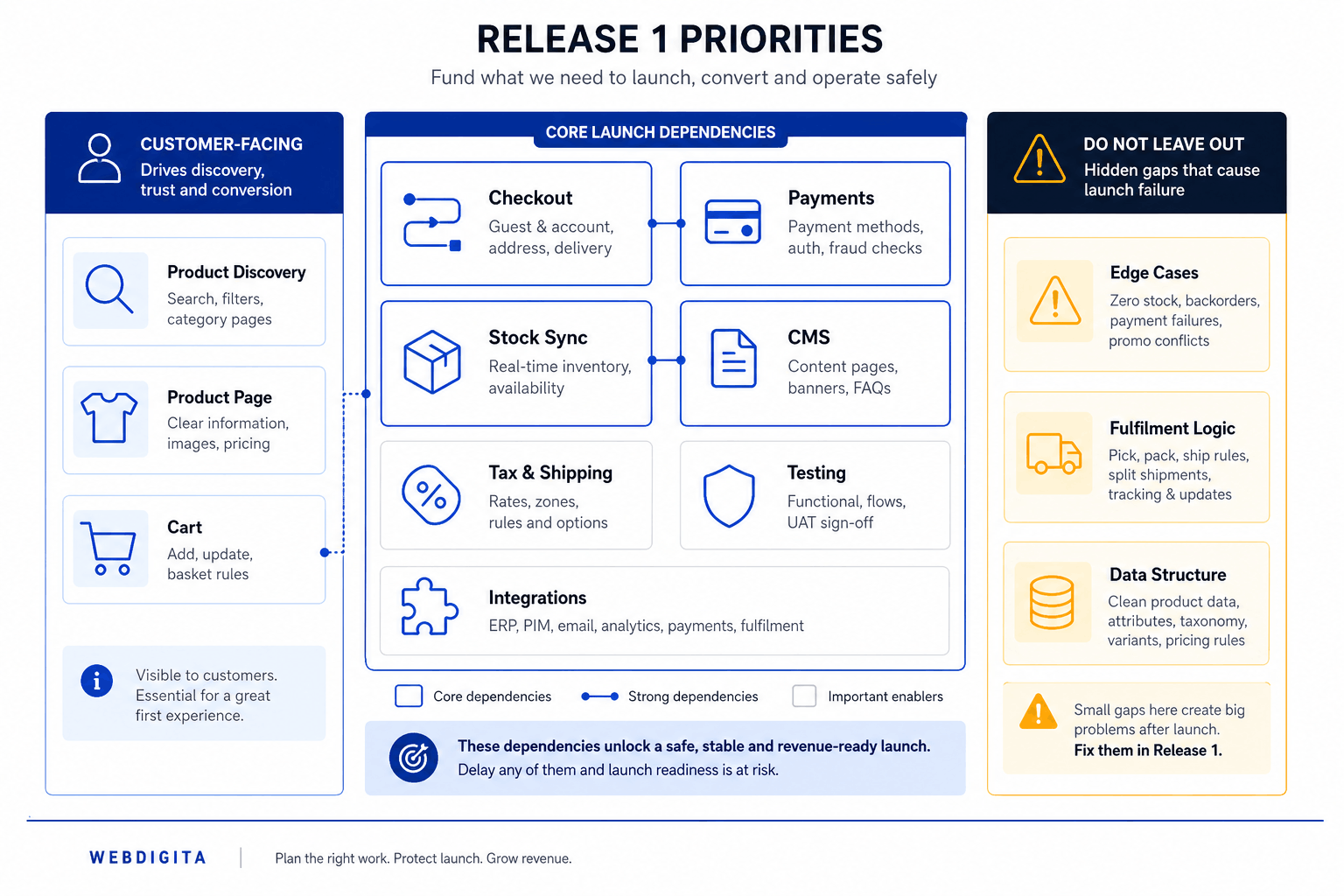
Fund the journeys that directly affect conversion and order completion: product discovery, search and filtering where needed, product detail pages, cart, checkout UX, payment setup, and core account flows. Include the less visible work that stops the store breaking under real use – tax and shipping rules, stock accuracy, CMS integration, and testing around edge cases.
Do not assume architecture can wait if it affects stability. If poor data structure, brittle plugins, or weak integration logic will create failure modes at launch, that is release 1 work. If content updates, inventory sync, or fulfilment logic can block trading, treat those as day-one dependencies, not backlog items.
Ask this before approving scope: if we remove this item, can we still take orders accurately, update content cleanly, and fulfil without manual chaos? If the answer is no, keep it in.
What to delay without weakening the outcome
This is where most budgets get rescued – not by cutting blindly, but by cutting the right things.
You can usually defer deep personalisation, advanced content experiences, non-essential automation, design flourishes, and broad experimentation layers that add operational overhead before the basics are proven. Be particularly wary of headless commerce in release 1 unless there is a clear commercial reason for it now – serious content complexity, multi-channel demands, or a hard performance case your current architecture cannot meet.
Having reviewed a lot of release 1 scopes, my view is that anything which looks impressive but does not clearly improve conversion, average order value, or operational control in the first release should be pushed back. Headless commerce is the obvious example. It can be the right move, but it brings more architecture, dependency management, and maintainability cost. If you cannot explain the payback in plain commercial terms, delay it.
Pretty front ends have a habit of surviving budget reviews. Stability work usually has to fight for its life. That is backwards.

Not sure what belongs in phase 1 and what waits
We can review your backlog, flag launch-risk items, and map MVP, phase 2, and scale-up work around revenue impact, dependencies, and operational reality.
Useful if scope is growing faster than budget
Score every feature against commercial impact before release 1
When budget conversations stall, it is usually because there is no agreed framework for deciding what belongs in release 1. The scoring board below resolves that. It gives stakeholders a shared language for the only question that matters at this stage: does this item protect revenue, or does it serve ambition?
Run this in your next scope review. If nobody can articulate why an item scores high on business impact and launch dependency, it moves to a later phase. The conversation that follows is usually more useful than the board itself.
| Work item | Business impact | Dependency risk | Cost level | Recommended phase |
|---|---|---|---|---|
| Checkout UX and payment setup | High | High | Medium | Phase 1 |
| Inventory sync | High | High | Medium to High | Phase 1 |
| CMS integration and content workflows | Medium to High | Medium | Medium | Phase 1 |
| Advanced bundling or upsell logic | Medium | Low to Medium | Medium | Phase 2 |
| Headless commerce front end | Variable | High | High | Phase 2 or 3 |
| Advanced CRO experiments | Medium | Low | Low to Medium | Phase 3 |
Watch for this: items with low dependency risk often get mistaken for urgent because they are visible in the front end. Visibility is not the same as commercial priority.
Protect launch dates by phasing integrations and hidden dependency work
Integrations are where budgets and timelines quietly go to pieces. The visible build is rarely the real risk. The dependency map is.
Separate must-work-on-day-one integrations from nice-to-have data flows. Payment gateways, inventory sync, ERP links, shipping logic, and CMS integration often decide the launch date more than the front end does. Ask what happens if each integration fails, delays, or returns bad data. If the answer is missed orders, wrong stock, or manual workarounds your team cannot sustain, fund it early.
The pattern that consistently emerges from phased builds is this: they protect launch dates because they stop teams overbuilding release 1 while still funding the dependencies that actually matter. That is not a theoretical preference – it is the difference between a store that goes live and trades, and one that is delayed by dependencies nobody mapped until week eight.
If your store is already carrying update risk or plugin sprawl, structured WooCommerce maintenance services can help you identify what needs hardening before you add more scope. Treat any integration with unclear ownership, weak documentation, or manual fallback as a warning sign – not a task to defer.
Keep budget back for support and post-launch optimisation
Going live is not the finish line. It is when the evidence starts arriving.
Reserve budget for support cover, bug fixing, monitoring, and release 1 stabilisation. If you spend everything before launch, you leave no room to respond when real customers expose friction, edge cases, or operational gaps. That is how technical debt gets locked in early and costs significantly more to address later.
You also need a post-launch optimisation reserve for measured improvements to CRO, SEO, search, merchandising, and UX. Your first release will not have perfect answers. Real user behaviour will tell you where the next pound should go – and that is almost always a better use of budget than forcing speculative features into launch scope.
For Shopify stores, planned Shopify maintenance services can make that post-launch period far less chaotic. If you want a clearer split between MVP, phase 2, and scale-up, get a personalised roadmap or a scoping review before the backlog turns into an expensive wish list.
Questions buyers ask about eCommerce website development budget planning
These are the practical questions that usually come up when teams are deciding what belongs in launch scope and what should wait.
1. What is the biggest mistake in eCommerce website budget planning?
The biggest mistake is funding the wrong work first. Teams often spend too much on visible features and not enough on checkout, payments, integrations, content workflows, testing, and edge cases. That creates a launch that looks complete but struggles to trade reliably once real customers start using it.
2. What should be included in phase 1 of an eCommerce development?
Phase 1 should include the work needed to sell reliably from day one. That usually means product discovery, product pages, cart, checkout UX, payment setup, tax and shipping rules, stock accuracy, CMS workflows, and any architecture or integration work that could break trading if left until later.
3. What can usually be delayed until phase 2 or 3?
You can usually delay features that add complexity before the basics are proven. That often includes deep personalisation, advanced content experiences, non-essential automation, design flourishes, broad experimentation layers, and in many cases a headless front end unless there is a clear commercial reason to do it now.
4. Why do eCommerce integrations cause so many budget and timeline problems?
Integrations cause problems because they hide dependency risk. Payment gateways, stock sync, ERP links, shipping logic, and CMS workflows often affect launch readiness more than the front end does. If an integration fails or returns bad data, the result is usually missed orders, wrong stock, or manual work your team cannot sustain.
5. Should post-launch support be part of the original budget?
Yes, post-launch support should be part of the original budget. Going live is when real user behaviour exposes bugs, friction, and operational gaps. If all budget is spent before launch, teams have no room to stabilise the site, fix issues quickly, or invest in the improvements that matter most once evidence starts coming in.
6. How do you decide whether a feature belongs in the 1st release?
A feature belongs in release 1 if removing it would weaken trading, fulfilment, content control, or launch stability. A simple way to judge this is to score each item by revenue impact, launch dependency, operational efficiency, and technical overhead. Low-impact, high-complexity items should usually move out of the first release.
Conclusion
If your eCommerce project budget is being pulled in every direction, the fix is usually not a bigger number. It is a better order of decisions. The teams that launch more safely tend to protect the work that keeps orders flowing, operations stable, and post-launch learning possible.
Before you approve scope, separate what must work on day one from what can prove itself later. That means being harder on impressive features, more honest about integration risk, and disciplined enough to keep budget in reserve once the site is live. A phased plan will not make every trade-off easy, but it will make the important ones visible before they become expensive.
Need a clearer eCommerce roadmap before release 1 scope expands
Our ecommerce development services help you prioritise revenue-critical work, phase integrations properly, and avoid spending release 1 budget on complexity that can wait.
See Our eCommerce Development ServicesNot ready for that yet