Key Takeaways
If the build is complex, the real question is not who pitches best. It is who can deliver when integrations, scope pressure and launch risk start to bite.
- Judge delivery fit first: Test whether the agency understands the specific failure points in your build, from ERP and PIM dependencies to migration windows and B2B logic.
- Push past vague technical claims: Ask how they handle failed integrations, regression control, rollback planning and traffic-readiness, not just platform familiarity.
- Clarify ownership early: You need named responsibility for solution design, QA, release decisions, scope control and post-launch support.
- Use a weighted scorecard: Compare agencies on platform fit, integration capability, QA, ownership, support and evidence quality before price starts distorting the decision.
- Treat case studies with caution: Polished outcomes matter less than how the team handled constraints, risk and post-launch reality.
Complex ecommerce builds rarely fail in the first few months. They fail much later – when a brittle ERP integration starts dropping orders, nobody owns release decisions, and the agency that looked polished becomes hard to pin down. A polished sales deck tells you nothing about delivery maturity.
The short answer: Evaluate an eCommerce development agency on integration capability, QA depth, delivery ownership, and post-launch support – not on platform familiarity or pitch quality alone. Ask how they have handled failed integrations, scoped risky migrations, and managed post-launch incidents. The team structure, governance model, and recovery record tell you far more than any case-study outcome claim.
If you are choosing an eCommerce development agency for a serious build, treat the process as due diligence, not theatre. You need to test whether they can handle architecture, dependencies, QA, launch risk, and the messier parts of support. If you want to avoid a wrong-fit shortlist and long-tail cost, this is the lens I would use.
Start with delivery fit, not the sales deck
Most agencies can talk well about growth, UX, and platform capability. That is not the same as proving they can deliver a complex build with integrations, migration risk, custom workflows, and traffic pressure.
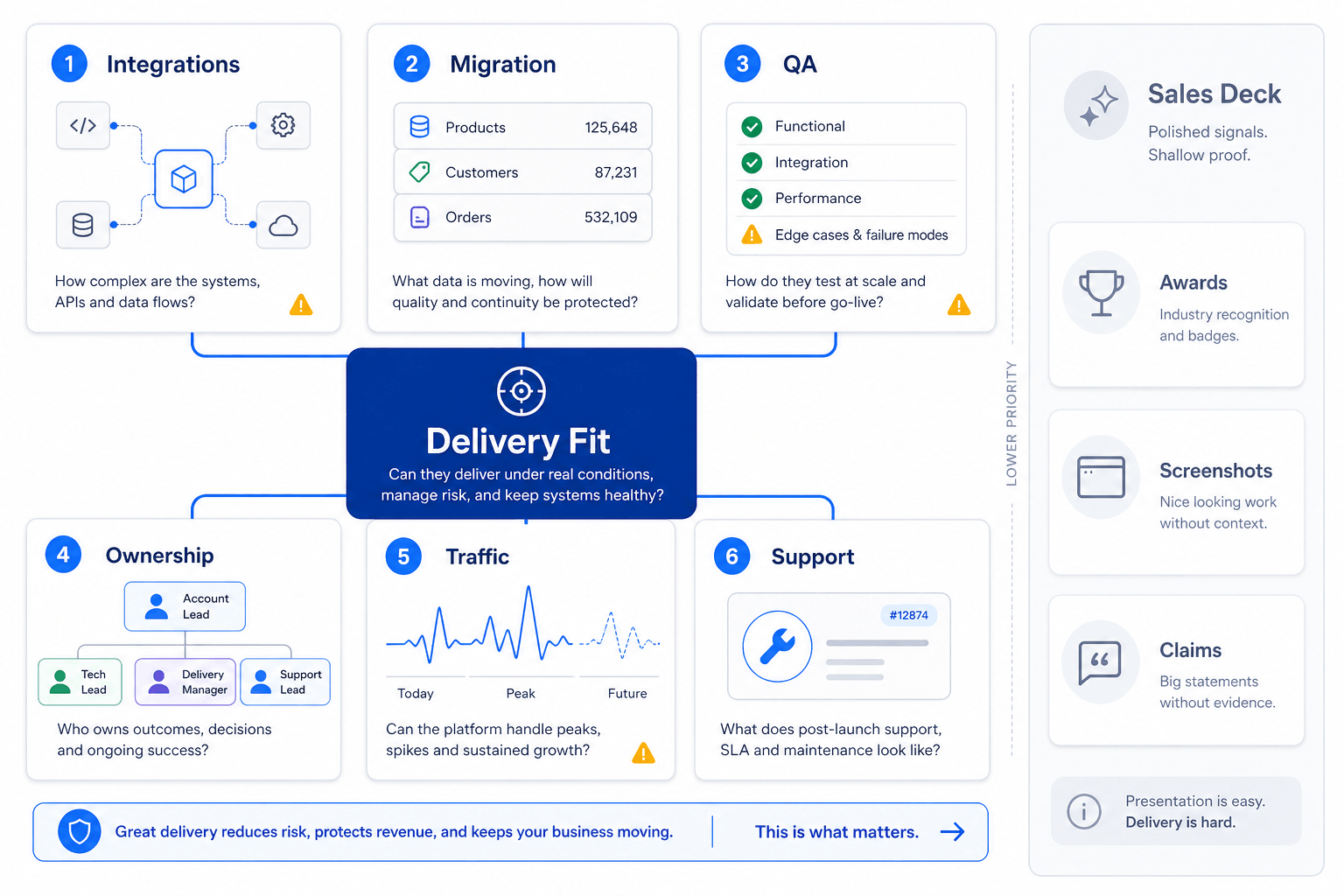
Start by defining what makes your project hard. Is it multi-system integration, catalogue complexity, B2B logic, subscription behaviour, international tax, or a risky migration window? If an agency cannot talk clearly about those specific failure modes, broad platform familiarity is not enough to carry you through.
Fit beats polish: ask whether they have handled similar delivery conditions before, not whether they have worked on the platform in general. And if your shortlist already includes teams offering website maintenance services, check whether that support mindset shows up before launch as well – because maintainability is usually visible in the way they scope and challenge work.
You should also ask what they would worry about first in your build. The honest answer matters. A serious team will surface dependencies, data quality, release risk, and ownership gaps before it starts selling certainty.
Check whether they can handle the technical load
This is where weak agencies start sounding vague. They will say they can integrate anything, test thoroughly, and scale later. Edge cases tend to ruin that story.
You need to ask how they approach platform choice for your specific build, not in the abstract. If they push one platform regardless of your operational model, push back on that. Ask how they handle ERP, PIM, payment, shipping, middleware, and third-party dependencies when one of them behaves badly – because one of them usually will.
QA and launch readiness: ask what gets tested beyond the happy path. You want to hear about regression control, release checklists, rollback planning, and traffic-readiness – not only browser testing and sign-off rounds. If you are comparing providers for developing an eCommerce website in London or elsewhere in the UK, ask for one example of a failed integration, launch issue, or scaling problem they had to recover from. How they describe the recovery tells you more than the original success.
Pretty demos survive ideal conditions. Real eCommerce project delivery is about what happens when dependencies misbehave.
Look at who will actually do the work
A complex build can go wrong even with decent developers if ownership is blurry. Sales teams often look senior, but delivery teams are where the real answer sits.
My view, having assessed agency shortlists across custom builds, audits, and multi-platform projects, is that ownership gaps are almost always the root cause when a build derails – not developer skill. Ask who will be involved after contract signature, by role and level: who owns solution design, QA, project management, release decisions, and post-launch support. If that answer stays fuzzy, treat it as a warning sign.
Outsourcing risk: ask directly whether critical work is subcontracted and which parts stay in-house. Hidden outsourcing is not automatically bad, but hidden accountability usually is. I would also ask who tracks scope drift, dependency risk, and escalation when timelines slip – because governance is what stops a serious build turning into expensive improvisation.
Do not assume the person winning your confidence in the pitch will be the person protecting your project later. Ask to meet the delivery lead, not only the commercial lead.

Not sure which agency risks matter most for your build
We can review your shortlist against integration risk, QA depth, delivery ownership, and support model so you can spot weak-fit agencies before procurement drifts further.
Speak to a senior team about delivery fit
Use a weighted scorecard before you compare proposals
If you compare agencies on chemistry and price first, you will almost certainly reward the best presentation, not the best operator. Score each agency against the same criteria before commercial negotiation starts.
Keep it simple. You are not building procurement theatre. You are trying to make weak-fit agencies easier to spot.
Agency evaluation scorecard for a complex ecommerce build
| Criteria | Weight | What you should check |
|---|---|---|
| Platform fit | 15% | Can they explain why the platform suits your workflows, integrations, and growth model? |
| Integration capability | 25% | Have they handled ERP, PIM, payment, shipping, or middleware complexity like yours? |
| QA and launch readiness | 20% | Do they show regression control, rollback planning, edge-case testing, and traffic-readiness? |
| Delivery ownership | 15% | Is there clear accountability for architecture, scope, risk, and escalation? |
| Support model | 10% | What happens after launch when defects, updates, or operational issues appear? |
| Evidence quality | 15% | Do case studies show constraints, team involvement, and post-launch reality – not only outcomes? |
Score every agency out of 10 on each line, then weight the result. Do not let a cheap proposal outrank a weak technical score unless you are comfortable paying for the rebuild later.
Verify case studies and spot proposal red flags
Case studies are designed to remove friction from the sale, not to help you assess delivery risk. Screenshots and revenue claims tell you almost nothing about architecture, maintainability, or what happened in the three months after go-live.
The audit lens I apply to every case study review comes down to four questions:
- What made the project difficult? If the answer is fluent but vague, the agency is selling an outcome, not sharing a reality.
- Who was actually on the team, and at what level? If the senior names in the pitch did not appear in delivery, ask why.
- What did support look like in the first 90 days post-launch? Defect volume, escalation paths, and response times reveal more than any go-live announcement.
- What would they do differently? A team that has nothing to say here has either never been seriously tested or is not being honest with you.
This is the filter that separates real operators from presentation-heavy agencies – and it is more reliable than references, because references are curated.
Proposal red flags: watch for fixed certainty too early, thin discovery, no mention of dependency risk, and support that only appears once something breaks. Be wary of proposals that skip over QA ownership or treat integrations as routine because an API exists. They rarely are.
If the agency cannot show how it manages risk, ownership, and post-launch stability, it should not make your final shortlist. And if the build will need structured support after launch, ask how that maps into ongoing eCommerce maintenance services before you sign anything.
Questions buyers ask about choosing an ecommerce development agency
These are the practical checks that matter when the build involves integrations, migration risk and post-launch complexity.
1. What matters most when choosing an ecommerce development agency for a complex build?
The most important factor is delivery fit. A strong agency should understand the exact risks in your build, such as ERP integration, migration complexity, custom workflows, QA depth and launch pressure. Broad platform experience helps, but it is not enough if the team cannot show how it handles the conditions that make your project difficult.
2. How can you tell if an agency can handle complex integrations?
You can tell by how specifically the agency talks about integration failure, not just integration capability. Ask how the team manages ERP, PIM, payment, shipping or middleware dependencies when one system behaves badly. A credible answer should cover testing, escalation, rollback planning and recovery, rather than vague claims that everything can be connected through an API.
3. Should you meet the delivery team before signing with an agency?
Yes, you should meet the delivery lead before signing. Sales teams often create confidence, but delivery teams carry the real accountability once the project starts. You need clarity on who owns architecture, QA, project management, release decisions and support, because unclear ownership is one of the fastest ways a complex build becomes expensive and unstable.
4. Why is a weighted scorecard useful when comparing ecommerce agencies?
A weighted scorecard is useful because it makes weak-fit agencies easier to spot. Without one, buyers often overvalue chemistry, presentation quality or headline price. Scoring each agency against the same criteria, such as platform fit, integration capability, QA, ownership, support and evidence quality, gives you a more disciplined way to compare proposals.
5. Are case studies a reliable way to assess an ecommerce agency?
Case studies are useful, but they are not reliable on their own. Many case studies are designed to support the sale rather than expose delivery risk. The better approach is to ask what made the project difficult, what constraints existed, who actually worked on it and what happened after launch. Those details reveal far more than polished screenshots or growth claims.
6. What are the biggest red flags in an ecommerce agency proposal?
The biggest red flags are early certainty, thin discovery, vague QA ownership and little detail on dependency risk. You should also be cautious if support only appears after something breaks or if integrations are treated as routine simply because an API exists. Those signs usually point to under-scoped delivery and higher long-tail cost later.
Conclusion
A complex ecommerce build usually goes wrong in predictable places: weak integration planning, blurry ownership, thin QA and support that only appears after the damage is done. That is why agency selection needs to be a delivery decision, not a presentation contest.
If you are narrowing a shortlist, ask each agency to show how it handles risk when conditions are not ideal. The stronger partner will usually be the one that talks clearly about constraints, accountability and recovery, not the one that sounds most certain. That shift alone can save a lot of cost, delay and avoidable rework later.
Need an agency that can deliver beyond the proposal stage
If your build involves integrations, migration risk, custom workflows, or post-launch support needs, see how our ecommerce development service is structured around delivery ownership and technical reality.
Checkout our ecommerce development servicesSpeak to an expert