Key Takeaways
If you are planning to push harder on organic growth, the audit needs to test whether the site can actually support that spend.
- Check the base first: crawlability, indexation, rendering, canonicals, redirects, internal linking, sitemap health and tracking integrity all affect whether growth work can land.
- Prioritise structural drag over surface errors: template logic, duplicate URL patterns, weak internal linking and JavaScript rendering issues usually do more damage than isolated page-level mistakes.
- Modern stacks need deeper review: React, Next.js and headless builds can work well, but only if Google reliably receives content, links and metadata.
- Treat SEO as a release risk: if templates or canonical logic can change without QA, visibility can slip quietly between deployments.
- A good audit should change the roadmap: it should separate blockers from hygiene and show what must be fixed before scaling content or spend.
More SEO spend does not fix a weak technical base – it usually scales the waste. If search engines are crawling the wrong pages, rendering key templates badly, or getting mixed signals from canonicals, redirects and internal links, extra content just gives the problem more surface area.
That is the mistake serious teams make under growth pressure. The site looks fine in demos, the dev team is capable, reporting says pages are live, yet search performance drags. We see this often when running a technical SEO audit agency in London – particularly on larger brochure sites, lead-gen builds and complex eCommerce website development projects, especially where React, Next.js or headless decisions were made for good reasons but SEO was never built into release ownership.
Quick answer: A serious technical SEO audit should review crawlability, indexation, rendering, internal linking, canonicals, redirects, XML sitemap health, log file analysis, Core Web Vitals risk and tracking integrity. This article explains what each layer means in practice and why the order of fixes matters as much as the fixes themselves.
What a serious technical SEO audit in London should review before you scale
A real audit is not about collecting 47 or 75 issues in a spreadsheet. It is about checking whether Google can crawl, render, index and trust the pages that actually matter, then deciding what blocks growth first. Treat this as an 80/20 exercise: a few structural checks usually explain most of the drag.
If you are reviewing an audit proposal, ask whether it covers crawlability, indexation, rendering, internal linking, canonicals, redirects, XML sitemap health, log file analysis, Core Web Vitals risk and tracking integrity. If one of those is missing, the audit is already too shallow for a serious scaling decision.
- Crawl and index control: robots.txt, sitemap quality, status codes, canonical logic, log file analysis and index bloat.
- Rendering and template behaviour: whether important content, links and metadata are reliably available to search engines.
- Authority flow: internal linking paths, orphaned pages and template-level leakage.
- Performance and trust: CWV risk, redirect chains and server response consistency.
- Measurement: tracking integrity, so you can trust what changed after fixes go live.
Do not add more landing pages if those basics are unstable. You will just create more crawl waste, noisier reporting and more low-fit traffic.
Structural drag matters more than surface errors
Surface errors get attention because they are easy to spot. Structural drag does the real damage because it repeats across templates, sections and releases. You need to know the difference before you approve more SEO budget.
Surface issues are the obvious ones: a broken title tag, a missing alt attribute, a stray redirect. Structural drag is slower and more expensive: faceted or duplicate URLs getting indexed, weak internal linking that strands commercial pages, JavaScript rendering delays, or template logic that keeps rewriting canonicals in ways nobody notices for weeks.
If you are seeing decent content output but weak ranking movement, push on structural causes first. Treat crawl waste, rendering drag and indexation confusion as commercial problems, not technical housekeeping.
What changes after a technical audit fixes the base?
Before the audit, the site often looks active but leaks authority and discovery. After the right fixes, priorities change fast: content plans get trimmed, template work moves up the queue, and reporting becomes more believable because the underlying signals are cleaner.
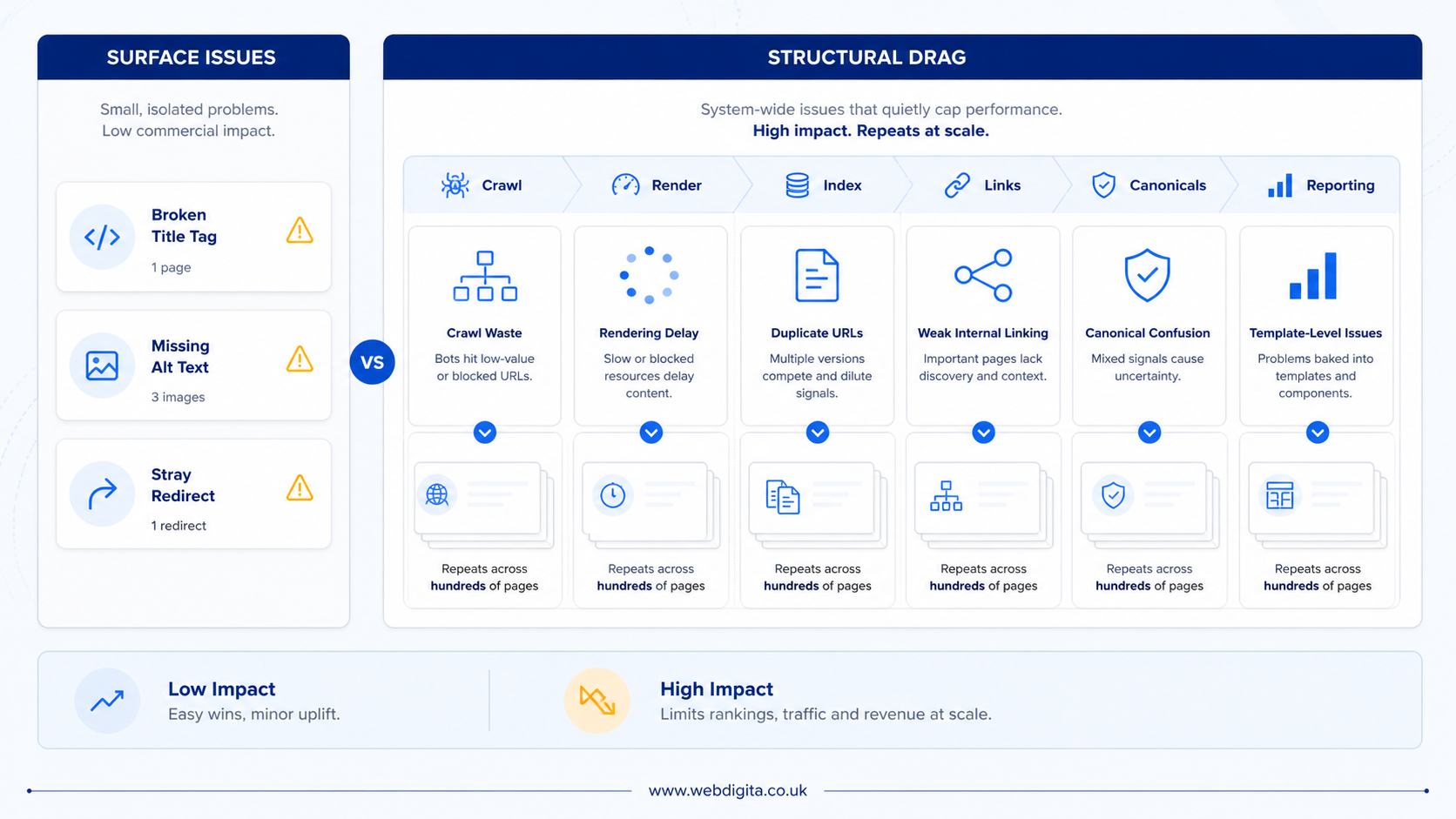
That shift matters. In our experience, audits have repeatedly changed investment priorities by exposing crawl waste, rendering drag, weak internal linking, SEO-blind deployment issues and indexation confusion before more content spend went live.
Structural drag is costing you rankings before a single new page goes live. If that sounds like your situation, get a free SEO audit with the help of our technical SEO service experts – we identify the blockers before more budget goes in.
Why London sites on modern stacks need a different level of audit
In London sectors like B2B, SaaS, property and professional services, small technical losses compound faster because the competition is dense and the margin for wasted authority is thin. Do not judge readiness by whether the site feels modern or the build quality looks strong. Search visibility can still be fragile underneath.
The density is sharpest in corridors like Old Street and the City, where SaaS and fintech teams are often running Next.js or headless builds shipped by strong engineering teams who have never had search in their QA checklist. React, Next.js and headless setups are not the problem by themselves. The problem starts when rendering, hydration, link generation or metadata handling are treated as dev details instead of search-critical behaviour. You need to check what Google actually receives, not what your browser eventually assembles.
We also see good engineering teams ship SEO-blind changes because nobody owns search checks in QA or deployment. If templates, canonicals or internal linking logic can change without review, treat that as a release risk, not a minor oversight. If measurement is patchy, ask for tracking validation as part of the audit, because broken attribution can hide both fixes and failures.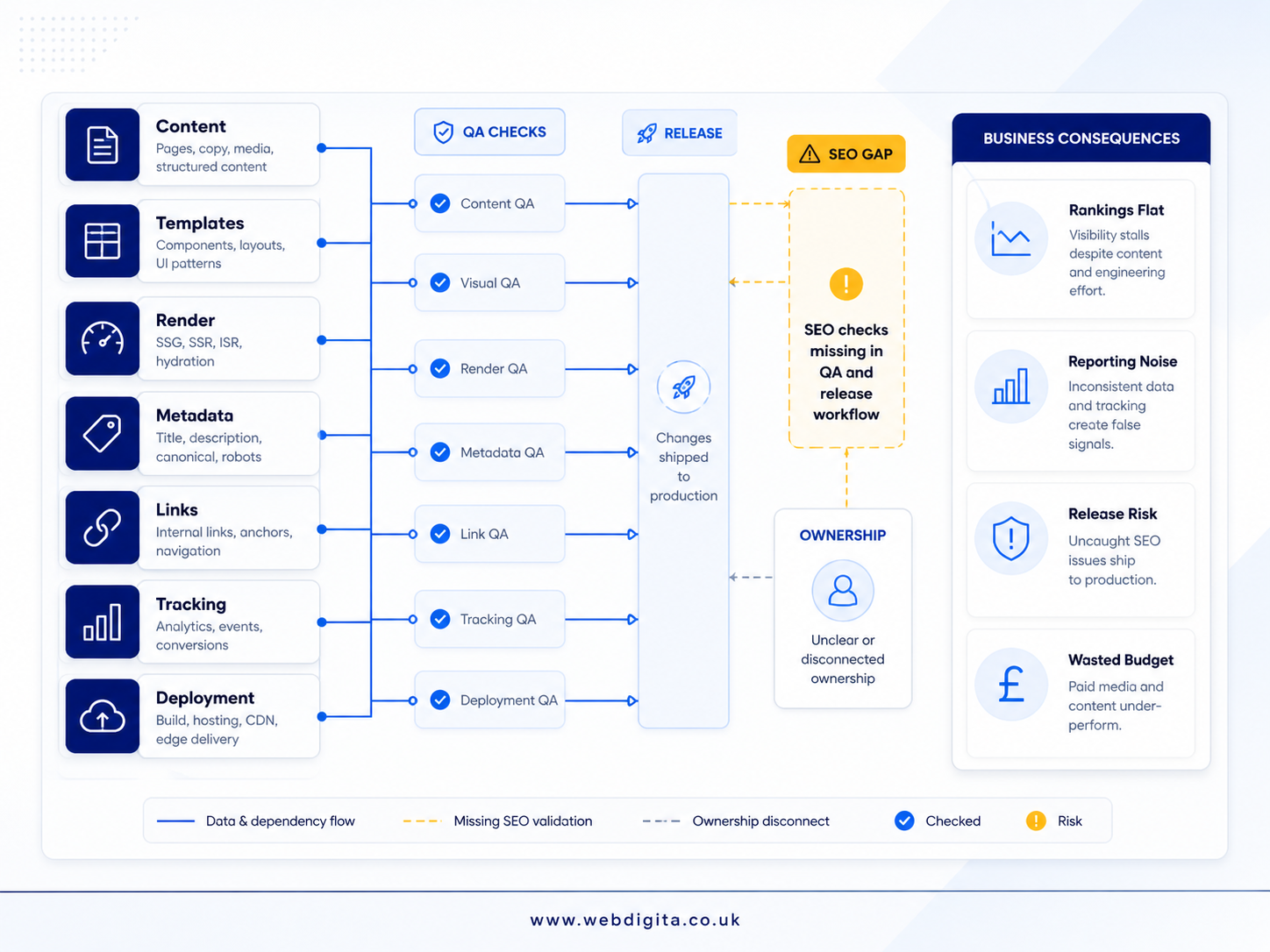
A common scenario runs like this: the growth team increases content output, rankings stay flat, and each release quietly changes template behaviour. If that sounds familiar, pause and get the assumptions mapped properly in a project discovery workshop in London before more budget gets burned.
Use an audit to change priorities, not just produce a report
A serious technical SEO audit should reorder the roadmap. You should expect it to separate blockers from hygiene, show ownership clearly, and tell you what must be fixed before scaling search. If the output is just a crawler export with no prioritisation, do not mistake that for due diligence.
Is your site actually ready to scale search? The pre-scale audit framework
| Audit layer | What to review | What can go wrong | Business impact |
|---|---|---|---|
| Crawl | robots.txt, status codes, crawl paths, sitemap accuracy, log file analysis | Wasted crawl budget, blocked sections, poor discovery | Important pages stay under-seen |
| Indexation | Canonical tags, duplicate URLs, noindex logic, hreflang signals | Index bloat, wrong pages ranking, diluted relevance | Weak-fit traffic and muddled reporting |
| Rendering | JS output, metadata availability, link rendering | Content or links missed by search engines | Good pages underperform despite content spend |
| CWV | LCP, CLS, template speed risk | Slow or unstable page experience | Lower throughput and weaker conversion support |
| Internal linking | Navigation, contextual links, orphaned pages | Authority trapped in low-value areas | Commercial pages struggle to rank |
| Deployment risk | Release QA, template ownership, rollback checks | SEO-blind changes break visibility | Repeated rework and unstable growth |
| Commercial risk | Tracking integrity, priority mapping, ownership | Wrong fixes get funded first | Budget goes into noise, not leverage |
What usually changes after a proper audit is not glamorous: content spend may pause, template fixes move up, deployment controls tighten, and ownership gets clearer between marketing, SEO and engineering. That is a good outcome, because it shows where the real drag sits.
If you are about to scale and want a sober view of risk, get the technical base checked before you add more fuel. And if the issue is wider than SEO alone – with architecture, vendor decisions or release governance in play – bring in fractional CTO support in London so the fixes do not die between teams.
The right next step for a technical SEO audit in London is a free audit or a direct conversation with a technical SEO expert. You do not need another checklist. You need clarity on whether the site is actually ready to carry more search investment. Get in touch for a free technical SEO audit.
Frequently asked questions: technical SEO audits for London businesses
These are the issues teams usually want clarified before they commit more budget to search growth.
1. What does a technical SEO audit cover?
A technical SEO audit reviews crawlability, indexation, rendering, internal linking, canonical logic, redirect chains, XML sitemap health, log file analysis, Core Web Vitals and tracking integrity. The goal is to identify which structural issues are suppressing search performance before more content or budget is added.
2. How is a technical SEO audit different from an SEO report?
An audit diagnoses root causes and prioritises fixes by business impact. An SEO report describes what is happening. Most crawler exports are closer to reports - they surface symptoms without separating structural blockers from low-priority hygiene issues.
3. When should a London business get a technical SEO audit?
Before scaling content output, after a site migration, after moving to a headless or JavaScript-heavy stack, or when content investment is not producing ranking movement. In competitive London markets - B2B, SaaS, property, professional services - structural drag compounds quickly, so earlier is almost always better.
4. Do React, Next.js or headless websites need a different kind of SEO audit?
Yes, modern stacks often need a deeper technical SEO audit. The main risk is not the framework itself but how content, links and metadata are rendered and delivered to search engines. A serious review should check what Google actually receives, not just what appears in a fully loaded browser session.
5. How can a technical SEO audit change business priorities?
A good audit can change priorities by showing that the real blocker is not content volume but technical readiness. That often means pausing lower-value SEO activity, moving template fixes higher up the queue, tightening deployment checks and clarifying ownership between marketing, SEO and engineering. The result is usually a cleaner roadmap and more believable reporting.
6. When is a technical SEO audit too shallow to trust?
It is too shallow when it reads like a crawler export with no prioritisation or commercial context. If the audit does not assess crawl control, rendering, indexation, internal linking, performance risk and measurement, it is unlikely to support a serious scaling decision. You need a view of what blocks growth first, not a spreadsheet full of minor defects.
Conclusion
A technical SEO audit is worth doing before scale only if it helps you make better decisions, not just spot defects. The real question is whether the site can crawl cleanly, render reliably, pass authority to the right pages and hold steady through releases.
If the answer is unclear, pause before adding more content or budget. Get the structural risks mapped, assign ownership across marketing and engineering, and fix the issues that distort visibility first. That usually leads to a less exciting roadmap in the short term, but a far more credible one when growth spend increases.
Need technical SEO support that connects engineering decisions to search performance
If crawl waste, rendering issues or template logic are limiting growth, our technical SEO service helps prioritise fixes, reduce release risk and support cleaner scaling.
View technical SEO serviceNot ready for the service page