Key Takeaways
Stronger SEO in high-ticket B2B is less about volume and more about whether search demand, page depth and qualification logic create a believable path to sales-ready conversations. If traffic is rising while SQL quality stays weak, treat that as a commercial signal problem rather than a simple visibility win.
| What to review | What it usually tells you |
|---|---|
| Keyword targeting | Broad educational terms often inflate visits without bringing in-market buyers. |
| Core page content | Shallow pages create interest but do not answer the questions serious buyers need resolved. |
| Conversion path | Generic forms increase noise when visitors cannot self-qualify for fit or urgency. |
| Sales and CRM handoff | Weak SQL definitions make it hard to tell whether SEO is underperforming or routing is. |
It is frustrating when organic traffic is climbing, rankings look healthier, and sales still says the same thing: the leads are weak, the timing is off, or nothing is turning into a real opportunity. In high-ticket B2B, that usually does not mean SEO has failed. It means the programme is attracting attention without creating enough commercial signals.
The short answer: More SEO traffic fails to produce better pipeline in high-ticket B2B because most programmes optimise for search volume and broad reach rather than SERP intent alignment, buyer readiness, and qualification. The result is a funnel filled with the wrong people at the wrong stage – not a shortage of clicks.
That gap matters more than most teams admit. You can grow sessions, publish more content, and improve visibility for broad terms, then still end up with a flat pipeline because the wrong people arrived, the right people were too early, or the path from search to qualification was too thin.
This guide is for founders, CMOs, and demand leaders who need clarity before reviewing SEO performance, fixing weak SQL quality, or deciding what to change in a revenue-led search programme. And also for people searching for the best-fit SEO agency based in london for their B2B SEO needs
Why traffic growth can still leave pipeline flat
Traffic is an activity signal, not the business outcome you are buying SEO for. If you sell a high-ticket service or solution, pipeline depends on fit, timing, buying-stage alignment, and whether multiple stakeholders can move forward – not raw visit volume.
A simple example: you rank for broad educational terms, sessions rise, and form fills tick up. But the SERP intent behind those terms is informational, and sales hears the same pattern every week: wrong company size, weak urgency, no budget, or no clear problem owner. That is a demand-quality issue, not a visibility win.
- Traffic rises, but SQL rate stays flat or drops.
- Lead volume improves, but sales rejects more enquiries.
- Organic reporting looks strong, but pipeline contribution barely moves.
If you are seeing those signs, do not assume the answer is more content or more keyword coverage. Ask whether your SEO is reaching in-market buyers or simply collecting low-cost attention.
What revenue-focused SEO actually requires
Revenue-focused SEO is not about chasing less traffic. It is about three specific shifts that most programmes avoid because they make reporting harder in the short term.
1. SERP intent over search volume. The keywords you rank for are a proxy for the buyers you attract. Most keyword research optimises for volume. Revenue-focused keyword research filters for intent that reflects active problem awareness, solution evaluation, or vendor comparison. Broad informational terms fill the funnel with people who are learning. Commercial intent terms fill it with people who are deciding.
2. Topical authority in buying-stage content, not just category coverage. Ranking on adjacent topics builds sessions. Building topical authority on the specific questions a buying committee asks before shortlisting builds pipeline. The difference is whether your content clusters are organised around what attracts attention or around what moves a qualified prospect toward a conversation.
3. Qualification UX that earns the right conversion, not just the next click. If every page drives to the same generic CTA regardless of where the visitor sits in their decision, you are routing noise into your sales process. Revenue-focused SEO builds qualification paths into the content itself – so serious buyers self-select and weak-fit visitors either find what they need elsewhere or do not convert.
The trade-off is real: optimising for commercial precision means some sessions, rankings, and form fills will look softer in dashboards. That is the correct direction.
Ten qualified visitors searching for a specific solution are worth more than ten thousand empty clicks.
Where the pipeline breaks between search visit and sales-ready opportunity
The honest problem is that pipeline usually breaks long before revenue shows up in reporting. It breaks in targeting, content depth, the conversion path, and the handoff between marketing and sales.
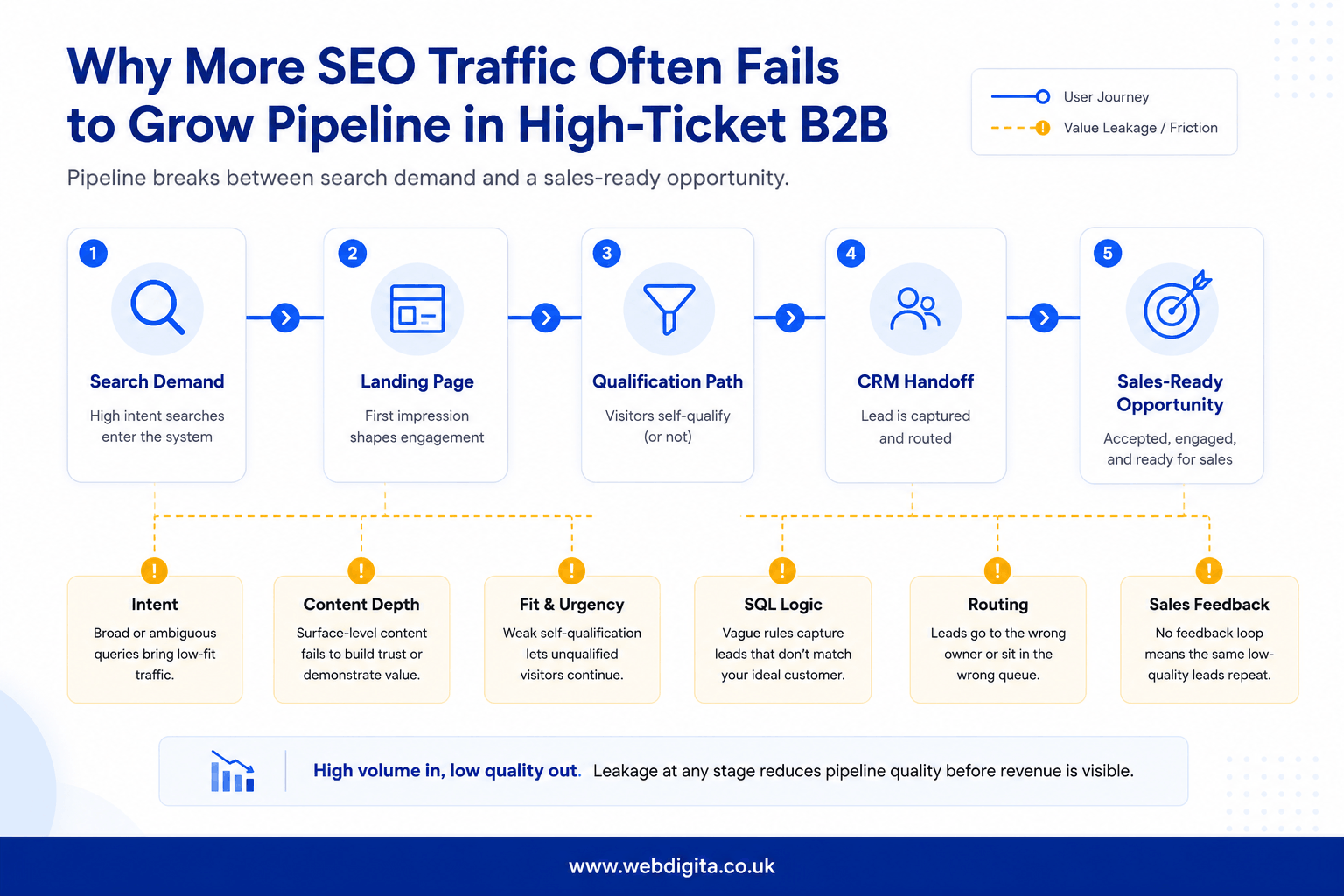
The pattern that repeats across the programmes we review is consistent: the strongest SEO outcomes came from better-fit search demand and a qualification UX that helped serious buyers move forward – not from higher traffic volumes or broader content coverage. Teams that made that shift, even with lower session counts, saw cleaner SQL rates and less noise in the sales handoff. Teams that kept optimising for reach saw pipeline reports stay flat regardless of ranking improvements. That is not an edge case. It is the rule in high-ticket B2B.
In practice, the issue is rarely poor rankings. It is ranking for topics that attract interest without attracting buyers who can move.
Watch the handoff points: if your content answers surface-level questions but not the serious commercial ones, buyers stall. If your forms invite anyone to convert without helping them self-qualify, sales gets noise. If CRM stages and SQL logic are vague, you cannot tell whether SEO is weak or your routing is.
You should check these four areas first:
- Are target keywords tied to real problem awareness and active solution search – not just keyword research volume?
- Do core pages answer the questions a buying committee needs before engaging, not just the questions that generate featured snippets?
- Does the conversion path filter for fit, urgency, and context?
- Can sales and marketing see the same definition of a qualified opportunity?
If you are investing in SEO based B2B lead generation services or similar support, I would push hard on those checks before judging channel performance. Otherwise, you risk blaming SEO for a qualification problem.

Not sure where your SEO pipeline quality is breaking down
We can review intent fit, qualification paths, and handoff gaps to show why traffic is rising while sales-ready opportunities stay weak.
A practical diagnostic, not a generic audit
A simple revenue-vs-traffic model to judge SEO quality
Use this to reset the conversation internally. Rankings and sessions are useful leading signals, but they are not enough on their own.
WEBDIGITA Pipeline Signal Scorecard: use this to compare visible SEO growth against actual commercial quality before you decide whether the strategy is working.
| SEO pattern | Intent quality | SQL rate | Pipeline contribution | Revenue impact |
|---|---|---|---|---|
| High traffic, broad informational reach | Low to mixed | Usually weak | Unclear or inconsistent | Often limited despite strong session growth |
| Moderate traffic, problem-aware search demand | Stronger fit | More stable | Clearer opportunity creation | More likely to influence real pipeline |
| Lower traffic, high-intent commercial topics with strong qualification paths | High | Highest | Direct and measurable | Best chance of revenue relevance |
Use sessions and rankings as leading indicators, then test them against lagging commercial indicators such as SQL rate, opportunity creation, and sales feedback. Do not assume a page is valuable because it attracts visits. Ask whether it attracts the right visits and helps those buyers move forward.
What to check next if you want SEO to support revenue, not just visibility
If traffic looks healthy but commercial impact stays weak, you do not need a bigger dashboard first. You need a tighter review of intent, qualification, and measurement.
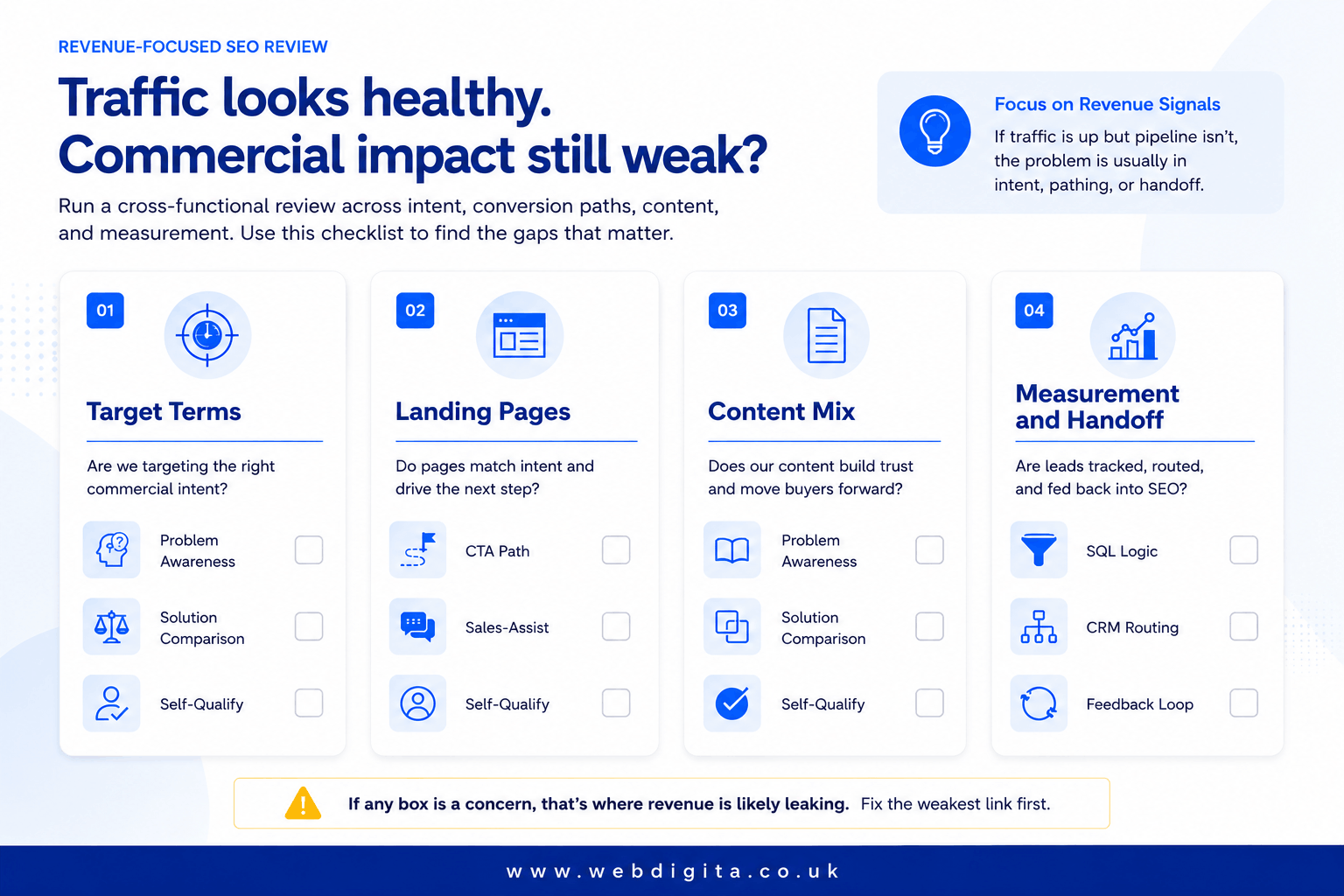
My view, having reviewed where commercial SEO investment typically stalls before reaching SQL stage, is that the first four checks below matter more than any dashboard expansion. These are also the areas where the gap between marketing’s read of performance and sales’ experience of lead quality tends to be widest.
- Check whether your target terms reflect real buyer problems, active evaluation, or solution comparison – not just keyword research volume.
- Check whether key landing pages help visitors self-qualify instead of pushing every click into the same generic CTA.
- Check whether your content mix includes sales-assist material built around the buying committee’s actual questions – not just top-of-funnel education that broadens your content clusters without deepening commercial intent.
- Check whether SQL logic, CRM routing, and sales feedback are part of SEO reporting – not siloed from it.
If you are deciding what to fix first, start where intent and handoff meet. That is usually where the hidden waste sits. If internal teams disagree on what counts as a qualified opportunity, treat that as a warning sign before you scale content production.
When the diagnosis is still unclear, a structured scoping session can save a lot of wasted effort. A project discovery workshop is often the right next step if you need to align search strategy, qualification logic, measurement, and ownership before committing more budget.
The core point is simple: in high-ticket B2B, SEO grows pipeline when it brings the right demand into a clear path, not when it simply brings more people to the site. If you want to avoid another quarter of good-looking traffic and weak commercial movement, that is the shift to make.
Questions buyers ask about revenue-focused SEO
These answers cover the commercial checks teams usually need before they judge SEO performance in a high-ticket B2B setting.
1. What is revenue-focused SEO in a high-ticket B2B business?
Revenue-focused SEO is SEO judged by pipeline relevance, not traffic alone. In a high-ticket B2B model, that means targeting search demand with real commercial intent, building pages that help buyers self-qualify, and measuring whether organic visits turn into qualified opportunities rather than just more sessions.
2. Why can organic traffic grow while pipeline stays flat?
Organic traffic can grow while pipeline stays flat because the traffic is not commercially useful enough. Broad informational terms may bring visitors who are too early, the wrong fit, or not ready to buy. Weak conversion paths and vague SQL definitions can make that problem worse by turning interest into noise instead of opportunity.
3. How do you tell if SEO is attracting the wrong audience?
You can tell SEO is attracting the wrong audience when visits rise but SQL rate, opportunity creation or sales acceptance stay weak. Repeated sales feedback such as wrong company size, no budget, low urgency or no clear problem owner is usually a stronger signal than rankings alone.
4. What should teams check before blaming SEO for weak lead quality?
Teams should check intent, page depth, conversion design and handoff logic before blaming SEO. If target keywords are too broad, pages do not answer serious buying questions, forms invite everyone to convert, or CRM qualification is unclear, the issue may sit in the journey around SEO rather than SEO alone.
5. Are high-intent keywords more valuable than high-volume keywords?
Yes, high-intent keywords are usually more valuable in high-ticket B2B because they are more likely to reflect active evaluation and real buying pain. Lower-volume searches tied to solution comparison or problem awareness often contribute more to pipeline than broader terms that only increase visibility.
6. What metrics matter more than traffic in revenue-focused SEO?
Metrics such as SQL rate, opportunity creation, pipeline contribution and sales feedback matter more than traffic on their own. Rankings and sessions are still useful leading indicators, but they only become meaningful when they connect to fit, qualification quality and measurable commercial movement.
Conclusion
If you are judging SEO in a high-ticket B2B business, the useful question is not whether traffic improved. It is whether the programme is bringing the right demand into a buying journey that sales can actually work with. That changes what you review first and what you stop celebrating too early.
- Look past headline growth: a busy dashboard can hide weak fit, weak urgency and weak deal potential.
- Pressure-test buyer readiness: content should help serious prospects compare, qualify and move, not just learn.
- Bring sales into the diagnosis: if sales feedback and CRM stages are missing, SEO reporting is incomplete.
- Fix the narrowest break first: the best next step is usually where intent, conversion and qualification meet.
Need SEO that supports qualified pipeline, not just more visits
Our SEO service focuses on buyer intent, commercial landing pages, qualification paths, and measurement that connects search performance to real opportunity creation.
Explore Our SEO servicesNot sure what fits yet