Key Takeaways
- Fix the operating model first. Enterprise SEO problems often come from slow ownership, weak decision rights and approval friction, not from a lack of tactical ideas.
- Separate who decides from who delivers. Strategy ownership, implementation ownership and approval ownership need to be named clearly, with an escalation path when teams disagree.
- Govern page types, not isolated pages. Template rules for metadata, linking, schema and indexation create sitewide impact, so they need central standards plus a visible way to handle justified exceptions.
- Judge progress by shipped change. Reporting should show what was implemented, what was blocked and what commercial effect followed, rather than rewarding activity that never reaches production.
Enterprise SEO is not just more pages. It is more people, more dependencies, and more ways to lose alignment. If your search programme feels busy but underpowered, you are almost certainly dealing with an operating model problem before a tactics problem.
The short answer: Managing enterprise SEO effectively requires three things working in parallel – clear ownership of strategy, templates, and approvals across every team that touches search; a governance layer that prevents template errors from compounding at scale; and a reporting loop tied to implementation status, not rankings alone. Without all three, even a well-resourced enterprise SEO programme will stall – not because the strategy is wrong, but because the operating model cannot sustain it.
That gets expensive faster than it looks. A missed template rule can affect thousands of URLs, a delayed sign-off can hold back months of compounding visibility, and unclear ownership across marketing, content, product, engineering and analytics can quietly drain momentum. As an SEO Consultant, I see the same delivery risk across complex service lines – the plan rarely fails on its own; it is the handoffs that break things.
This guide is for enterprise digital leads, marketing owners, content teams, and web or product stakeholders who need clearer search ownership before vendor selection, internal planning, or cross-team implementation.
Why enterprise SEO breaks down before the strategy does
Scale creates fragility. The more teams, systems, and approval layers that sit between a search recommendation and its implementation, the more places it can stall.
If you are managing SEO across several teams, check where decisions actually get made, not where they are supposed to sit on an org chart. Do not assume a good roadmap will survive contact with brand review, legal review, sprint planning, CMS constraints, and reporting pressure.
The honest problem is that shared responsibility often creates slow responsibility. When nobody owns the final call on templates, content standards, crawl rules, or internal links, work keeps moving but impact does not.
- Recommendations sit in the backlog for weeks without a named owner.
- Template changes ship without SEO review.
- Reporting celebrates activity, not implementation or outcome.
- Content teams publish at volume, but page intent and SERP intent drift across content clusters.
- Crawl and index decisions are made locally with no central standard.
If you are seeing two or three of those at once, treat that as a management issue, not a minor process annoyance. That is usually where enterprise SEO services start to earn their keep: not by adding more recommendations, but by making execution governable.
Set ownership before you scale activity
In Chandran’s experience reviewing enterprise SEO engagements across complex delivery environments, the breakdown almost never comes from a weak strategy. It comes from unclear authority. You need three kinds of ownership, and they are not the same thing: strategy ownership, implementation ownership, and approval ownership. If one person or team is expected to carry all three without a clear mandate, progress usually stalls.
In practical terms, SEO may define standards, content may own page creation, engineering may control templates, analytics may validate impact, and brand or legal may approve exceptions. Write that down. Ask who can approve a template-level change, who can reject it, and who breaks the tie when priorities clash.
Decision rights need an escalation path
A common example is a high-value page type that needs a metadata rule change, stronger internal linking, and a different indexation approach. If SEO can recommend it but product owns the template, engineering owns release capacity, and brand owns copy rules, you need an agreed escalation path before the work starts, not after it gets blocked.
The pattern repeats across enterprise engagements: search programmes stall when ownership and template governance are weak, even when the keyword research is thorough and the strategy itself is sound. It is not a strategy failure – it is a delivery structure failure. Treat it as such if your team keeps revisiting the same recommendations without shipping them.
If you are still trying to align multiple stakeholders for you enterprise or eCommerce project, roping in a eCommerce SEO Agency team can help surface assumptions, decision rights, and delivery dependencies before more work gets trapped in review loops.

Not sure where enterprise SEO ownership is really breaking down
We can help you map decision rights, template controls and approval blockers before more recommendations disappear into backlog noise across teams.
Useful if delivery feels busy but impact stays flat
Build template governance that supports scale without blocking exceptions
Templates are where enterprise SEO compounds, for better or worse. A strong rule for metadata logic, schema markup, internal linking, or indexation can improve thousands of pages. A weak one can do the same in reverse.
You should govern page types, not just individual pages. That means setting standards for shared elements such as title logic, heading structure, canonical behaviour, structured data, pagination handling, and internal link modules. But do not assume every page type should follow the same rule, because important sections often need approved exceptions.
We have seen this on large sites where one global template decision looked efficient, but flattened SERP intent across very different page groups and created crawl waste at the same time. To avoid that, separate template standards from exception handling and make both visible.
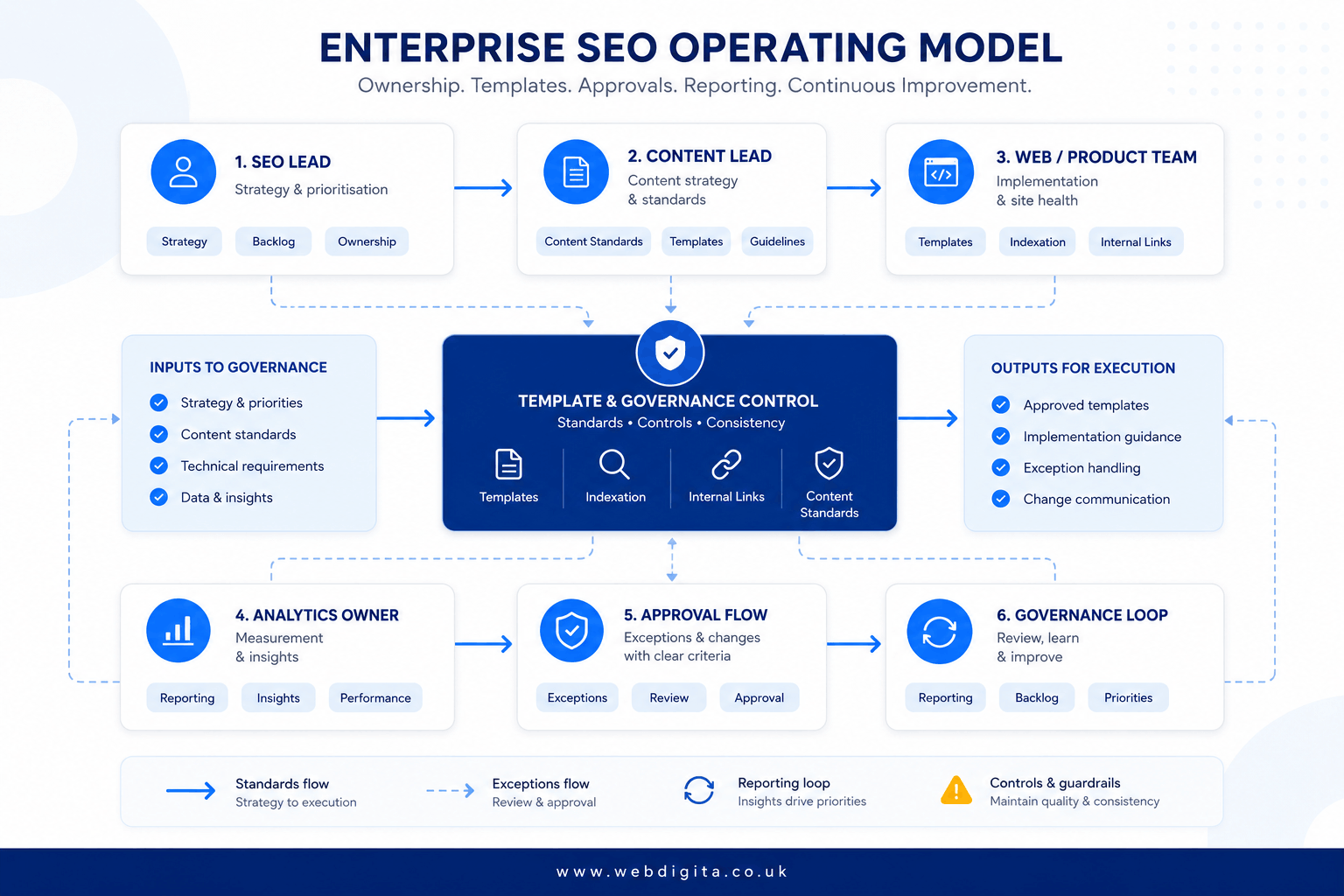
WEBDIGITA Enterprise SEO Ownership Map: use this to check whether your teams, template controls, and reporting loops are clear enough to scale search without losing accountability.
Enterprise SEO operating model
- SEO lead: sets search standards, drives keyword research and topical authority, and flags crawl and index risks.
- Content lead: owns page intent, content clusters, publishing flow, and exception requests.
- Web or product team: owns templates, release planning, and technical feasibility.
- Analytics owner: validates impact and separates shipped work from unshipped recommendations.
- Approval flow: template changes are reviewed centrally, and page-level exceptions are approved by named owners.
- Governance loop: reporting feeds back into priorities, template rules, and backlog decisions.
If your crawl and index strategy is still being handled ad hoc, review that before scaling content production. For a deeper technical view, see these technical SEO checks to review before scaling search.
The red flags that show organisational SEO drag is already costing you
By the time enterprise SEO looks slow, the cost is usually already there. You are paying for activity, but not getting enough implemented change or enough commercial signal back from your reporting.
What makes this difficult to diagnose is that visible metrics – rankings, impressions, Search Console data – can look broadly stable while the underlying execution is fragmenting. Recommendations get blocked, template logic drifts, and content operations produce volume that builds no topical authority because SERP intent is inconsistent across page types.
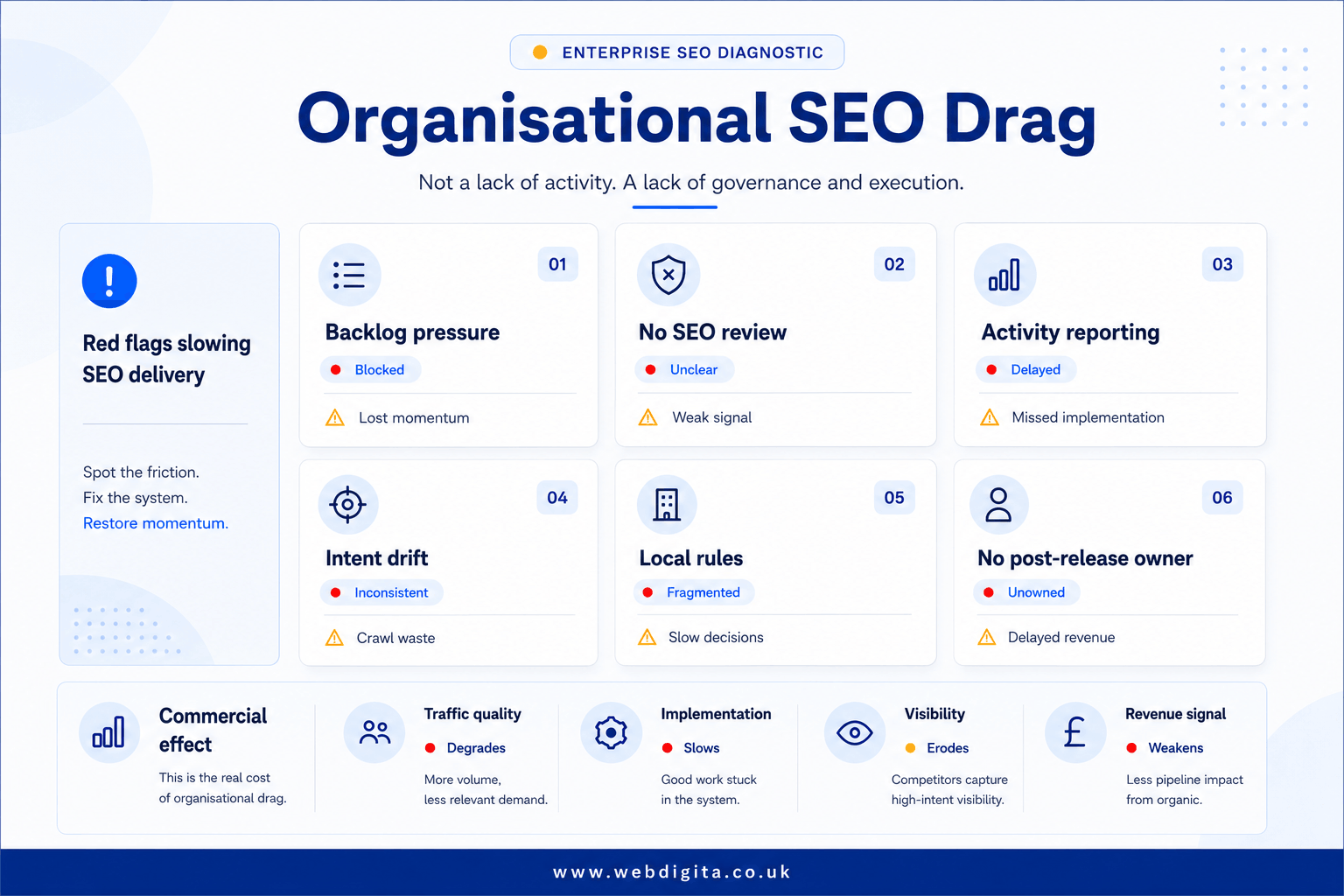
These are the diagnostic questions that reveal whether delivery drag has already taken hold:
- Can you list which recommendations shipped last quarter and which are still in backlog? If not, your reporting is tracking activity, not progress – and the implementation gap is likely larger than it appears.
- When was template logic last reviewed for your highest-traffic page types? Outdated metadata rules, missing schema markup, and broken internal link modules on core templates are among the earliest signs of governance drift.
- Are different teams applying different SEO rules? Inconsistent entity terminology, internal linking standards, and canonical decisions across business units fragment topical authority in ways that keyword research alone will not reveal.
- What happens after a change ships? Without a post-release monitoring process, errors compound quietly until they surface in Search Console – often weeks after the fact and with no clear owner.
- Is your content operation building content clusters, or just publishing pages? Volume without intent alignment produces traffic that does not convert and dilutes authority for the pages that matter most.
Those issues typically lead to weak-fit traffic, low-impact work, and delayed revenue contribution. If you are choosing a partner, ask how they handle governance, not just audits and recommendations. If several of these apply, the right next step is to map ownership, approvals, and post-release expectations properly – including opting in for Website maintenance services.
Common questions about enterprise SEO strategy
These are the questions teams usually ask when search performance is being slowed by internal complexity rather than a lack of ideas.
1. What makes enterprise SEO different from standard SEO?
Enterprise SEO is different because the main challenge is usually coordination, not just optimisation. Large sites involve more templates, more stakeholders, more approval layers and more technical dependencies. That means a good recommendation can still fail if ownership, release planning and governance are weak.
2. Why does enterprise SEO often stall even when the strategy is sound?
Enterprise SEO often stalls because decision-making is fragmented. SEO may recommend a change, but product controls templates, engineering controls capacity, and brand or legal controls approval. Without clear decision rights and escalation paths, work sits in review loops or backlog queues instead of shipping.
3. Who should own enterprise SEO inside a business?
Enterprise SEO should be owned across defined roles, not dumped on one team. SEO should usually own standards and prioritisation, content should own page intent and publishing, web or product should own templates and delivery, and analytics should validate impact. Approval ownership also needs to be named clearly.
4. Why is template governance so important in enterprise SEO?
Template governance matters because one rule can affect thousands of URLs. Metadata logic, internal linking, schema, canonical behaviour and indexation settings often sit at template level, so weak controls can multiply mistakes at scale. Good governance sets shared standards while allowing approved exceptions where page types genuinely differ.
5. What are the warning signs that organisational SEO drag is already costing the business?
The warning signs are usually visible in delivery, not just rankings. Common examples include recommendations stuck in backlog, template changes shipping without SEO review, reporting that ignores implementation status, inconsistent rules across business units, and no clear owner for post-release monitoring. Those issues usually mean effort is being spent without enough impact.
6. What should a business ask an enterprise SEO partner before hiring them?
A business should ask how the partner handles governance, ownership and implementation, not just audits. A strong enterprise SEO partner should be able to explain how recommendations move through teams, how template decisions are managed, how blocked work is escalated, and how reporting connects shipped changes to business outcomes.
Conclusion
Enterprise SEO gets harder as more teams, templates and review layers touch the same site. That is why a sensible strategy can still underperform if the business has not made search execution governable.
- Check ownership: know who sets standards, who ships changes and who signs them off.
- Check template control: make sure shared rules improve scale without flattening important page differences.
- Check reporting: tie dashboards to implementation status and post-release impact, not just rankings or traffic movement.
- Check maintenance: decide who monitors live changes and keeps standards from drifting.
If those basics are unclear, adding more SEO activity usually adds more noise. The better next step is to sort the decision model first, then scale work through a structure that can actually hold.
Need enterprise SEO support that can handle governance and implementation
Our enterprise SEO service helps align teams, fix template-level issues, improve crawl and index control, and turn stalled recommendations into accountable delivery.
See Our enterprise SEO ServicesStill weighing internal blockers first