Key Takeaways
- Judge links like a buyer would: if a placement looks off-brand, irrelevant or awkward in context, it is more likely to erode trust than strengthen authority.
- Relevance beats raw volume: credible niche sites, specialist publishers and genuine editorial coverage usually do more for B2B authority than a long list of easy wins.
- Destination matters as much as source: sending every link to the homepage wastes context; stronger results come when the linked page matches the topic, intent and content cluster being reinforced.
- Weak filtering is expensive: outreach can look productive in reports while quietly creating brand mismatch, poor audience fit and links no serious prospect would ever value.
- Safer long-term strategies connect the dots: link acquisition works best when it supports strong content, internal linking and a site that is genuinely worth endorsing.
Most B2B marketing leads reviewing a link campaign ask the wrong question. They check whether links were built. The question that actually matters is whether those links would hold up in front of a serious buyer – or whether they quietly make the brand look generic, misplaced, or credible on paper but irrelevant in context.
The short answer: B2B link building builds genuine authority when placements reinforce topical authority in your specific subject area, align anchor text to the right content cluster, and would survive scrutiny from a buyer or brand lead. Volume-first approaches – listicle spam, loosely relevant placements, generic outreach scripts – generate activity without credibility and tend to damage trust signals and entity SEO over time.
If you are reviewing a provider shortlist or approving strategy spend, this is the filter you need before committing further budget. And if assumptions need surfacing before more investment moves, a project discovery workshop is often where that happens.
This guide is for in-house marketing leads, founders, and demand generation teams who want a sharper way to assess link opportunities, evaluate provider recommendations, or pressure-test a strategy before approving the next phase. And for businesses searching for the best SEO Agency in London to implement their SEO marketing campaigns.
What B2B authority-building should actually look like
In B2B, topical authority is built through consistent, credible presence in the right conversations – not link counts. A strong link should do more than pass SEO value. It should reinforce the story that you understand this subject, belong in this market, and deserve serious consideration.
Low-trust links usually come from weak sites, thin listicles, vague round-ups, or pages that could include almost any company. Credible niche links come from relevant industry sites, associations, specialist publishers, or partner ecosystems where your presence makes sense. Editorial placements carry the strongest authority signal because they embed your expertise inside a real topic, for a real audience, with genuine editorial judgement behind the inclusion.
Digital PR – when it is commercially framed and placed in the right publications – often delivers the highest-quality editorial links, but only when the story is tied to genuine topical authority rather than brand visibility for its own sake. Coverage that does not map back to a specific content cluster or buyer intent adds noise to your entity signals, not signal strength.
A common pattern is a B2B team reviewing a vendor report packed with placements that look active on paper but would mean nothing to sales, leadership, or buyers. If you are seeing that, do not assume the campaign is working just because links were built. Ask whether the anchor text, destination page, and surrounding topic match the problem you are trying to own.
If a placement would embarrass your brand team or make a buyer question why you are there, it is not authority. It is risk.
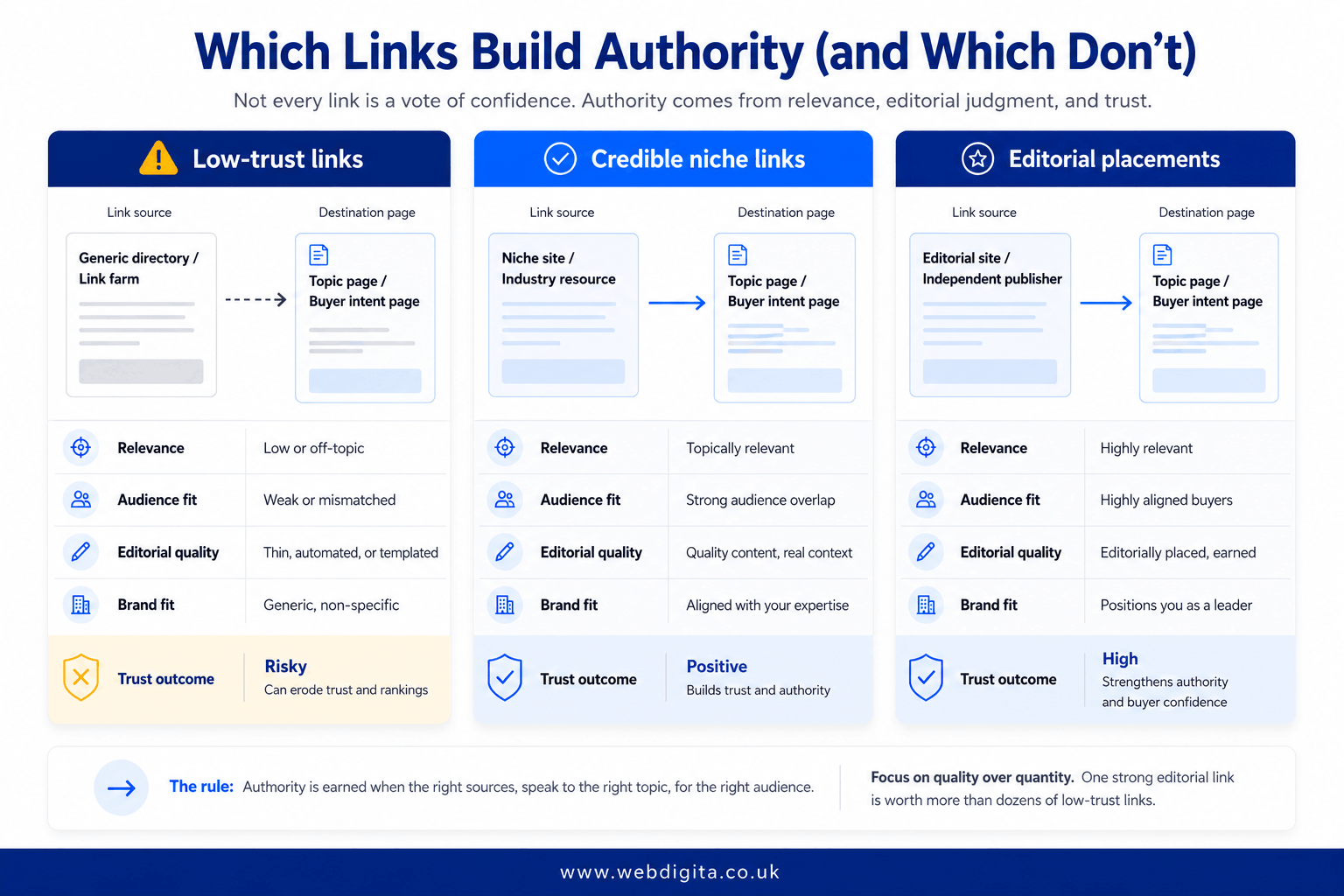
You also need to check where the link points. Sending every link to the homepage is a missed opportunity. In a sound B2B link-building strategy, the destination should support the specific long-tail topic, match the buyer’s SERP intent, and strengthen the content cluster you are building around that subject.
How to judge a link opportunity before it damages trust
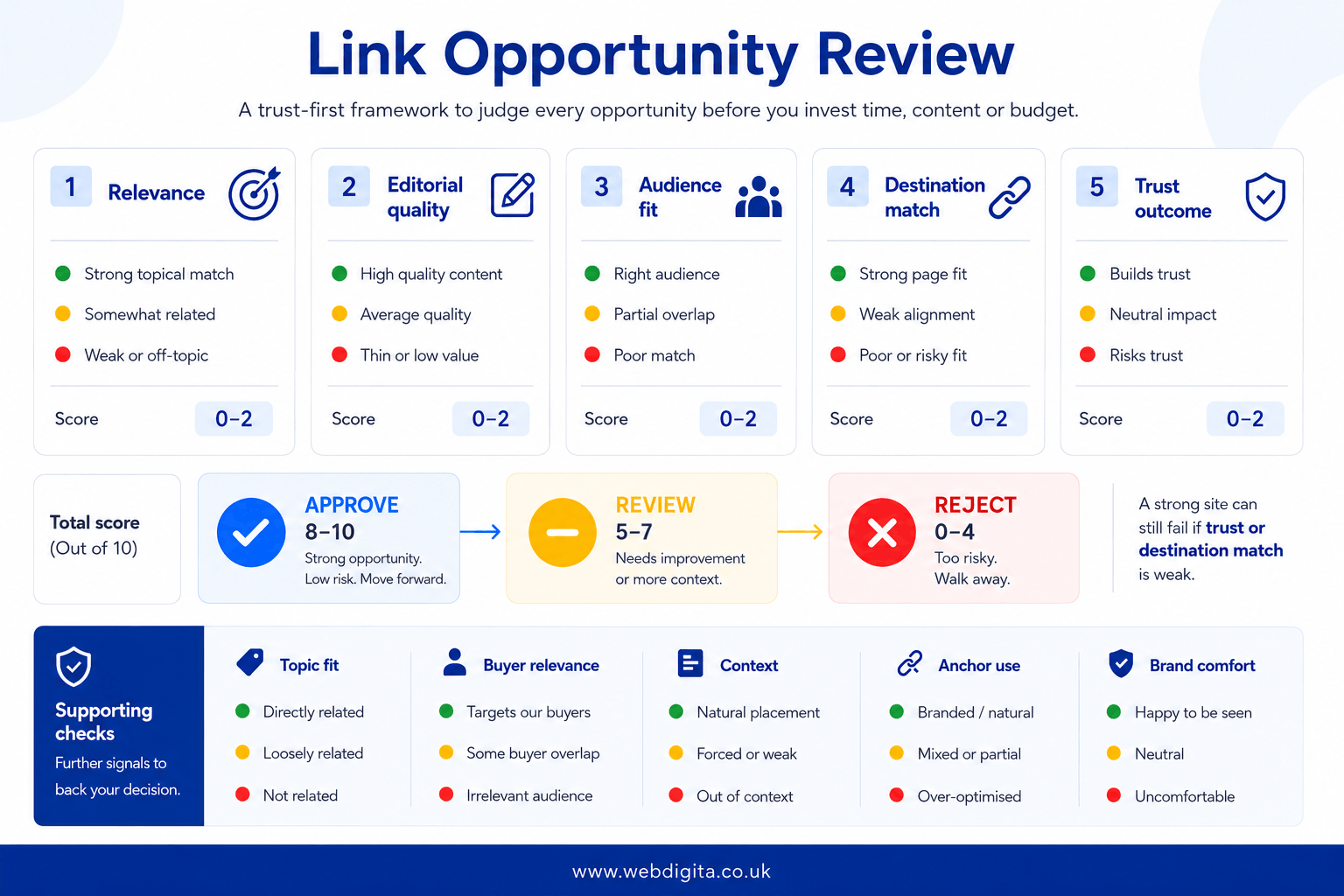
The safest way to assess a link is to stop asking, “Can we get it?” and start asking, “Should we want it?” Apply a consistent filter that covers relevance, editorial quality, audience fit, and trust outcome before outreach starts.
WEBDIGITA Link Trust Evaluation Grid: use this to compare link types before approving outreach, content spend, or campaign sign-off. A poor score on relevance and trust outcome is a warning sign even when the site looks strong on standard domain metrics.
A simple authority-building model for B2B link decisions
| Link type | Typical fit | Authority value | Trust outcome |
|---|---|---|---|
| Low-trust links | Loose relevance, weak editorial standards, generic pages | Usually short-lived or overstated | Can dilute credibility and create brand mismatch |
| Credible niche links | Strong topic fit, specialist audience, sensible context | Good support for topical authority | Reinforces expertise and market relevance |
| Editorial placements | Trusted publication or respected industry source with real review standards | High authority when topic and destination align | Builds confidence with buyers as well as search engines |

Not sure which links help authority and which create risk
We can review your current outreach, placements, and destination choices to spot where relevance, editorial quality, or brand fit may be working against trust.
A useful first step before approving more spend.
If you are approving outreach, check these points first:
- Does the site reach an audience you would actually want to influence?
- Does the page topic and SERP intent make your inclusion feel natural rather than inserted?
- Is the destination page the right match for the content cluster and buyer intent – not just the easiest URL to push?
- Would your sales or brand team be comfortable showing the placement to a prospect?
Trust-safe outreach is less about scripts and more about judgement. Ask for real topic fit, sensible destination choices, and editorial context that reads naturally to a human. The pattern we see most often is teams chasing placements at scale and ending up with links that technically exist but sit on pages no serious buyer would ever read.
And if your wider site is neglected, even strong links can underperform. That is why the foundations matter alongside acquisition – from content quality and internal linking structure to, where relevant, so authority signals are not arriving on weak or outdated pages.
What to reject and how to build long-term authority without brand damage
The reject list is straightforward: listicle spam, generic outreach, irrelevant placements, rented authority on sites with no genuine audience fit, and any tactic where the source makes your brand look smaller or less credible than it is.
My view, having reviewed the pattern across a significant number of B2B authority campaigns, is that the strongest gains consistently came from relevant, credible placements that reinforced brand trust and topic ownership – not from sheer link volume. That finding holds whether you are in a competitive niche or a specialist vertical with a small addressable audience. If a provider is selling quantity as the main story, push back hard on that.
The trade-off is real. Volume-first tactics move quickly but flatten positioning. They often create entity SEO problems: inconsistent topic signals, anchor patterns that do not reinforce content clusters, and destination pages that do not support the subject you are trying to own. Credibility-preserving tactics move more carefully, but they compound. The authority you build this quarter becomes the baseline for the next.
A safer long-term strategy is built on three connected foundations:
- Topical authority: Content clusters with genuine depth, supported by internal links and schema markup where relevant, so search engines have a clear picture of your subject expertise and featured snippet eligibility.
- E-E-A-T signals: Editorial placements, contributor profiles, and external references that confirm expertise and experience to both users and algorithms.
- Entity SEO alignment: Consistent use of the right terminology, clear entity relationships across your site, and destination pages that match the SERP intent you are targeting.
If you are choosing a partner, ask how link acquisition connects to these three foundations – not just outreach volume or domain rating targets.
For teams where authority building sits inside a broader commercial growth or platform project, make sure the delivery side can support the visibility you are building. If you are in the eCommerce business then working with a strong eCommerce SEO Agency can help you with this with a faster turn-around.
If your team cannot clearly defend why a specific link helps both search visibility and buyer confidence, that is the moment to pause. Review the strategy, tighten the filters, and only then invest further.
Common questions about B2B link building strategy
These are the questions teams usually ask when they need links to support authority, not just reporting volume.
1. What makes a good B2B link building strategy?
A good B2B link building strategy prioritises trust, relevance and topic fit over volume. The best links come from places where your brand genuinely belongs, reach an audience that matters, and point to pages that support the topic being discussed. If the placement would not make sense to a serious buyer, it is probably not helping authority.
2. Are high-volume link campaigns risky for B2B brands?
Yes, high-volume link campaigns can be risky for B2B brands when quality control is weak. A large number of irrelevant or low-trust placements may inflate reporting activity while making the brand look generic or out of place. The risk is not just SEO underperformance, but a quieter loss of credibility with buyers and internal stakeholders.
3. Should B2B links always point to the homepage?
No, B2B links should not always point to the homepage. In many cases, a deeper page is the better destination because it matches the topic, buyer intent and content cluster more closely. Sending every link to the homepage is usually a sign of lazy planning rather than a strategy built around authority and relevance.
4. How can you tell if a link opportunity will damage trust?
You can usually tell by checking relevance, editorial quality, audience fit and brand comfort. If the page topic is loose, the site feels thin, or your inclusion looks inserted rather than earned, the placement is a warning sign. A simple test is whether your sales or brand team would be comfortable showing that link to a prospect.
5. What types of links tend to work best for B2B authority?
The links that tend to work best are credible niche links and genuine editorial placements. These usually come from specialist publishers, industry sites, associations or respected sources with real standards. They do more than pass SEO value because they also reinforce the idea that your company knows the subject and belongs in the market.
6. What should you ask a link building provider before approving spend?
You should ask how the provider judges relevance, where links will point, and how placements support trust as well as rankings. A serious provider should be able to explain why a link fits the topic, the audience and the destination page. If the main story is quantity, outreach volume or easy wins, that is usually a poor sign.
Conclusion
The useful question is not whether a provider can build links at scale. It is whether the links make your company look more credible in the exact market you want to win. In B2B, authority is not borrowed from random placements. It is earned through consistent topic fit, sensible destinations and editorial context that a real prospect would recognise as legitimate.
If you are reviewing a campaign or choosing a partner, look past activity metrics and ask what the work is actually compounding. When links support expertise, content depth and a stronger buyer journey, they can add real strategic value. When they are just there to fill a report, the safer decision is usually to pause, tighten the filter and spend only where trust and visibility rise together.
Need a safer SEO strategy that builds authority without weak links
If link quality, topical relevance, and trust signals all need tightening, our SEO service helps connect authority building to content, structure, and commercial intent.
Explore our SEO workPrefer to talk it through first