Key Takeaways
Early SEO movement and real commercial impact are not the same thing. Most stores see indexation fixes and category ranking gains before meaningful revenue lift.
- First movement: cleaner indexation, better crawl access, and ranking gains on priority category pages usually show within the first few months, often before product pages or conversion paths are ready to turn visibility into sales.
- Revenue impact: traffic, conversion, and revenue take longer because technical fixes alone do not create commercial outcomes—you need rankings on the right pages, for the right intent, with pages that can actually convert.
- Timeline drivers: starting condition, technical debt, crawl control, catalogue shape, implementation speed, and ownership clarity shape the pace far more than the strategy deck.
- Reporting discipline: monthly updates should show shipped fixes, blocked work, indexation movement, category visibility, and commercial outcomes where they are mature enough to judge—not just activity.
I have sat across the table from buyers who just got handed a twelve-week SEO plan by an agency that had spent forty minutes looking at their store. Clean slide. Confident numbers. Complete fiction.
Here is the reality: eCommerce SEO timelines are shaped by starting conditions and execution quality – not by what gets written on a proposal slide. If you are comparing agencies, weighing an in-house hire, or trying to hold a provider accountable, you need a sequence, not a promise.
The short answer: Most stores see early technical and indexation signals within the first two months. Meaningful traffic and revenue impact typically takes longer – three to six months at minimum, often more – and the pace is determined by how much technical debt is sitting in the store, how fast fixes actually go live, and whether your category pages and product schema are in a state that can convert visibility into sales.
If you want to know what a realistic timeline looks like and why most projects slip, read on.
What results usually show up first
The first wins are never the ones on a board slide. Before any meaningful traffic moves, you need canonical tags cleaned up, crawl budget protected, XML sitemap health confirmed, and your priority category pages actually being found and trusted by search engines.
What that means in practice: category pages tend to move before product pages. Indexation improves before revenue does. A category can start climbing while the rest of the store – conversion paths, internal links, product schema – is still in the backlog.
I ask every provider the same test question: what do you expect to move first, and why? If the answer jumps straight to traffic without mentioning canonical tags, faceted navigation, XML sitemap health, or whether key category pages are even being crawled properly – the timeline is padded.
Before and after: before, the team is tracking rankings while duplicate category URLs are live and crawl budget is being wasted on pages that should never be indexed. After indexation is tightened and category priorities are locked in, the priority pages move. If the backlog stays untouched, the charts stay flat regardless of how polished the strategy deck looks.
What usually takes longer to show real business impact
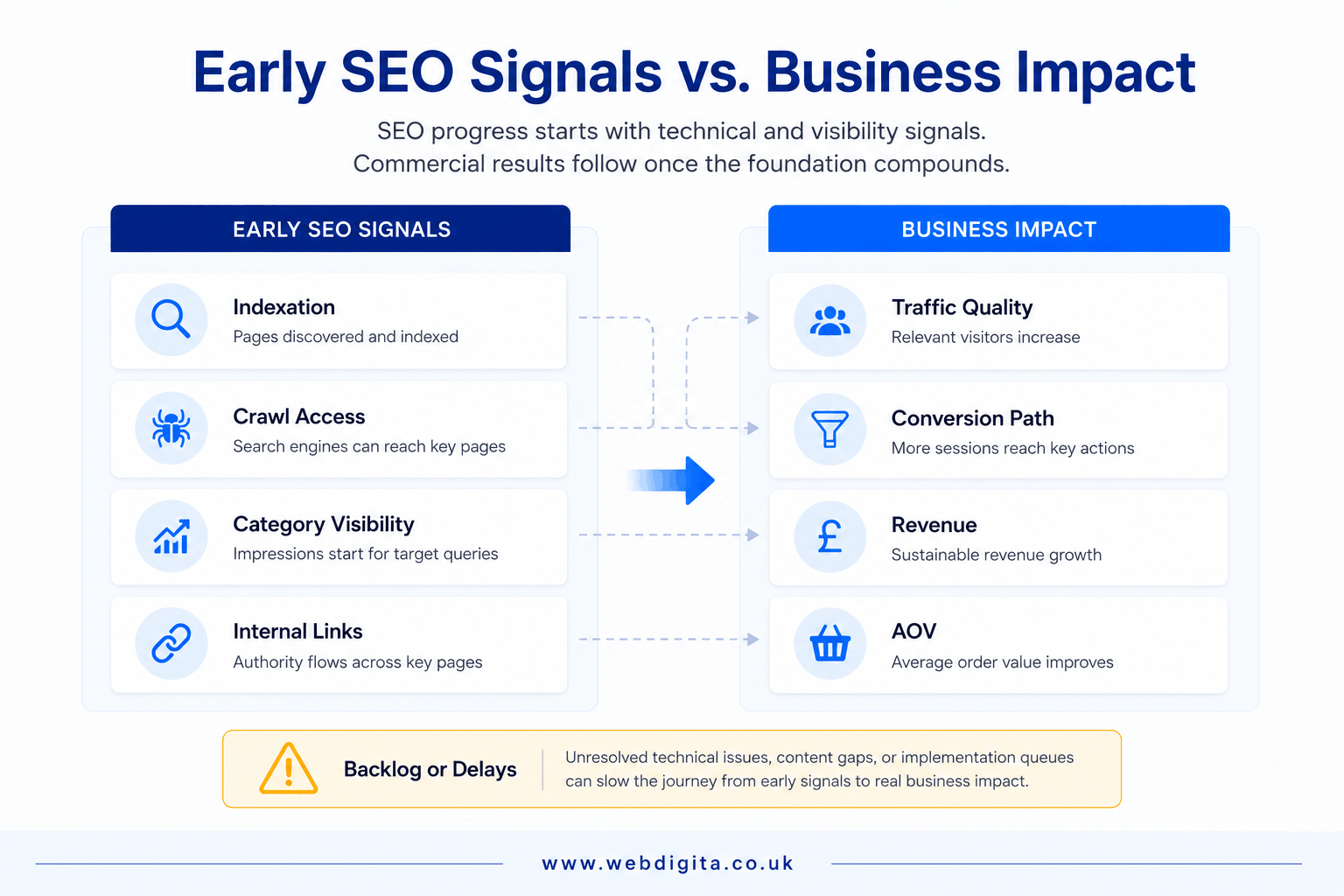
Traffic, conversion, and revenue take longer. Technical fixes alone do not create commercial impact. You need rankings on the right pages, for the right intent, with category pages and product schema capable of converting that visibility into orders.
If your catalogue is large, thin, or badly structured – thousands of SKUs with weak content, duplicate URL paths, or broken internal links – gains compound slowly even when the SEO direction is sound.
Commercial reality: a ranking lift on a category page is not profitable growth. Reporting should separate leading indicators from business outcomes. If it does not, you end up paying for activity while still guessing at impact.
Newer stores need longer. They still have to build trust, topical coverage, and internal link depth before the compounding effects kick in. An established store with mainly technical problems – blocked crawl budget, poor indexation on valuable categories – can sometimes move faster if the implementation pipeline is clean.
Seasonality distorts this further. A peak trading month can make weak SEO look stronger than it is. A quiet period makes solid work look flat. Monthly reporting should show shipped fixes, blocked work, indexation movement, category visibility, and commercial outcomes – not just rankings and traffic.
A busy store can look like it is improving because more charts are moving. The honest question is whether the right category pages are gaining qualified visibility and whether the site can actually turn that into revenue.
The main factors that change the timeline up or down
This is where weak proposals hide the risk. The timeline is shaped less by the strategy and more by the starting condition of the store, the depth of technical debt, and how fast the team can actually ship changes.
Use this as a credibility check when you evaluate a provider. You need to test SEO difficulty and delivery throughput separately – because one without the other tells you nothing.
- Starting condition: are key category pages indexed, crawlable, and free from canonical or duplicate path issues?
- Technical debt: template problems, JavaScript rendering issues, or crawl budget waste can delay progress before any growth work starts.
- Faceted navigation control: poor faceted navigation creates endless duplicate URLs, kills crawl budget, and slows category visibility significantly.
- Catalogue shape and content: the more categories, subcategories, and SKUs that need work, the longer it takes to build coverage.
- Schema markup: missing or broken product schema, breadcrumb schema, and review schema delays rich result eligibility and reduces click-through on pages that do rank.
- XML sitemap and crawl frequency: if search engines visit key pages slowly or the XML sitemap is inconsistent, fixes take longer to register.
- Ownership and approvals: if implementation, QA, and sign-off sit across different teams with slow cycles, the timeline stretches quickly regardless of the strategy quality.
- Market pressure: a significant authority gap against established competitors usually means a longer climb on high-volume category terms.
A common pattern: a store with decent products but poor faceted navigation control and duplicate category paths. On paper the SEO plan looks simple. In reality, the delay is in development queue time and template fixes – not keyword research or content strategy.
If you are dealing with heavy technical debt, start with a proper technical SEO audit to surface what slows results before you scale. And if a proposal skips ownership assumptions or implementation constraints entirely, push for eCommerce project discovery support before you accept any timeline.

Not sure where your store sits on the SEO timeline?
We can run a quick diagnostic on your indexation, category structure, crawl health, and technical debt to show you what is likely to move first and what might be blocking progress.
No sales pitch, just a clear view of where you are.
A realistic month-by-month view of eCommerce SEO progress
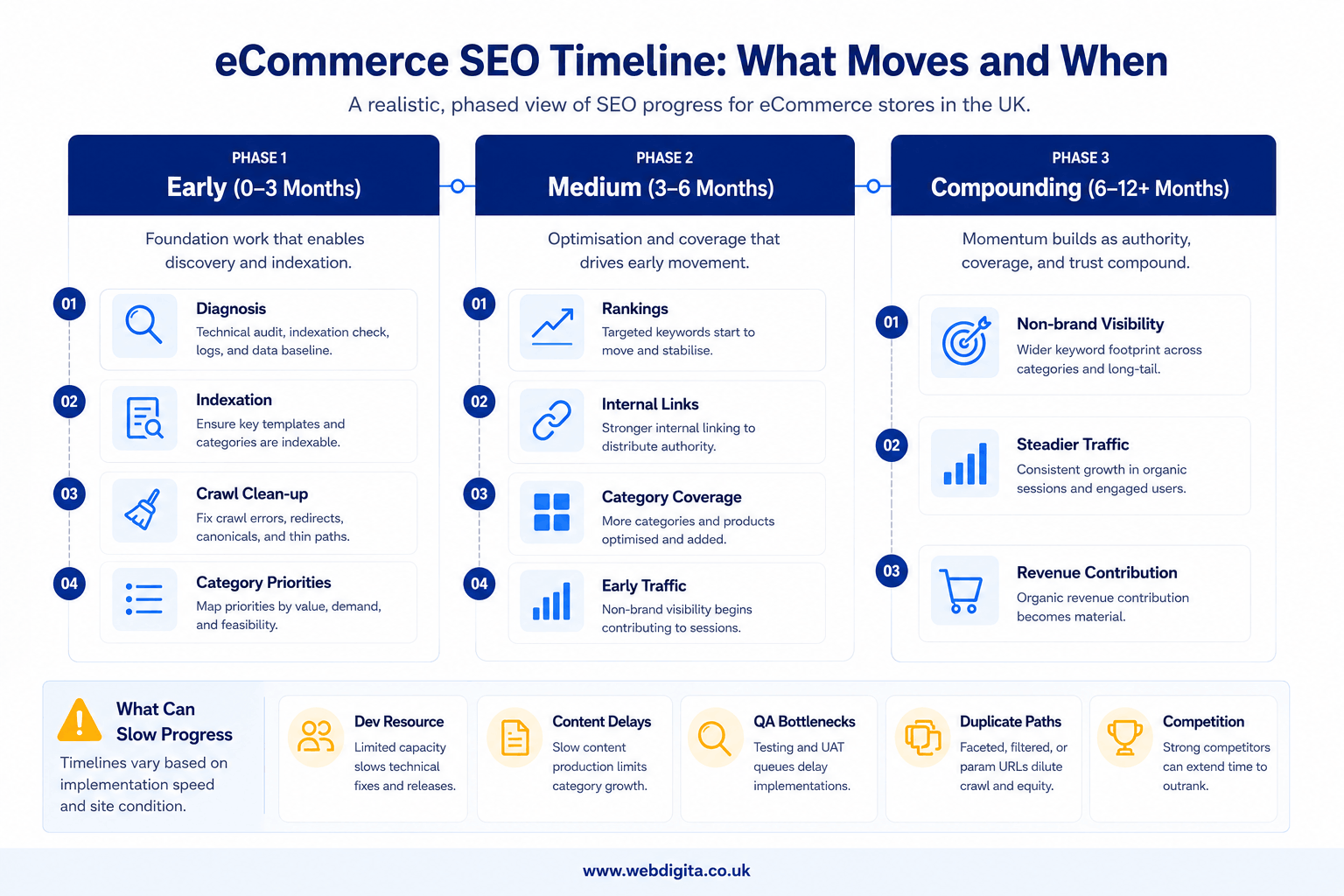
Think in phases, not promises. Early, medium, and compounding. The pace shifts with site condition, scope, competition, and implementation speed – but the sequence is usually consistent.
Early, medium, and compounding SEO outcomes by month
| Phase | Likely months | What tends to move | What slows it down |
|---|---|---|---|
| Early | Months 1 to 2 | Diagnosis, baseline reporting, indexation fixes, crawl clean-up, category prioritisation, XML sitemap review, schema markup audit, implementation planning | Slow dev access, unclear ownership, poor crawl budget control, weak or missing reporting |
| Medium | Months 3 to 5 | Ranking movement on priority category pages, internal linking gains, broader category coverage, early traffic improvement where work has shipped cleanly | Template bottlenecks, content delays, unresolved duplicate paths, slow QA, blocked schema markup rollout |
| Compounding | Months 6 and beyond | Wider non-brand visibility, steadier traffic growth, stronger revenue contribution where category pages and product schema are already in decent shape | Thin product content, weak conversion journeys, slow rollout, strong category competition |
If you are also weighing platform capability or development support, that matters more than most buyers realise. A weak implementation setup drags out SEO gains regardless of how good the strategy is – which is why agency fit often overlaps with the eCommerce development agency you work with – when technical debt is part of the bottleneck.
Why implementation backlog kills SEO timelines – not strategy
In my experience reviewing stores across multiple sectors, the projects that moved fastest shared one thing: indexation issues and category priorities were fixed early, and the implementation pipeline was clear from week one.
The projects that stalled? Almost always the same cause. The strategy was fine. The backlog was not. Recommendations sat unshipped for weeks while development resource was tied up elsewhere, QA was unclear, and approvals required three sign-offs nobody had agreed to upfront.
My proof point from working across eCommerce stores of different sizes and platforms: faster results came directly from fixing indexation and category priorities in the first month. Slower results were delayed by implementation backlog – not by a bad strategy, not by a weak keyword list, not by a difficult market. The bottleneck was always execution.
This is what I look for when I review an eCommerce SEO services proposal: does it say anything real about implementation? Who owns development changes, content updates, schema markup rollouts, and QA? If those responsibilities are vague or sit across teams with slow approval cycles, the timeline in the deck is not the timeline you will actually get.
Watch the reporting: if monthly reports show tasks completed but never show blocked work, unshipped fixes, or unresolved dependencies, you are not seeing the real timeline risk. On larger stores, internal dependencies and template complexity can extend SEO timelines far beyond the original forecast.
What buyers should ask before accepting an SEO timeline
This is where you separate a realistic provider from a polished pitch. The questions below are not traps – they are the baseline for a conversation that should happen before you sign anything.
If the answers stay vague or optimistic without explanation, treat that as buying risk. A weak proposal often sounds confident precisely because it skips the messy parts: backlog assumptions, crawl budget control, ownership gaps, and what happens when priorities shift after kickoff.
- What do you expect to move first, and why? – If the answer is traffic before indexation, push back.
- Which dependencies sit with your team and which sit with ours? – Schema markup, dev changes, content – who owns what?
- How will you handle technical debt, faceted navigation, canonical tags, and XML sitemap health? – Specific to our store, not generic.
- What will monthly reporting show beyond rankings and traffic? – Shipped fixes, blocked work, crawl budget movement, commercial outcomes where they are mature enough to judge.
- What could delay progress after kickoff, even if the strategy is right? – A good provider answers this without prompting.
If you already know releases, fixes, and ongoing store support will shape the implementation pace, factor in eCommerce maintenance support, so the work does not stall once the SEO plan is agreed.
You do not need a provider who promises a fixed month for results. You need one who can map the likely sequence, name the real blockers, and tell you the next best move – without papering over the risk with a clean timeline slide.
Questions buyers ask before committing to an eCommerce SEO timeline
Honest answers about what moves first, what takes longer, and where timelines usually slip in practice.
1. How long does it take to see any SEO results on an eCommerce store?
Most stores see early indexation improvements and ranking movement on priority category pages within the first few months. Meaningful traffic and revenue impact usually takes longer, typically from month three onwards, and depends on starting condition, technical debt, implementation speed, and how strong the category and product experience already is. If key pages are not indexed properly or crawl control is weak, early movement can be delayed.
2. What SEO results usually show up first on an eCommerce site?
The first things that move are cleaner indexation, better crawl access, and ranking gains on priority category pages. You are more likely to see search engines finding and trusting the right pages before you see serious revenue lift. Product pages, conversion paths, and average order value often lag behind. A category can climb before the rest of the store is ready to turn that visibility into sales.
3. Why does eCommerce SEO take longer to show revenue impact?
Revenue takes longer because technical fixes alone do not create commercial impact. You need rankings on the right pages, for the right intent, with pages that can actually convert. If your catalogue is large, thin, or badly structured, gains compound more slowly. Thousands of SKUs with weak product content, duplicate URL paths, or poor internal linking can blunt progress even when the SEO direction is sound.
4. What factors slow down eCommerce SEO timelines the most?
The main factors are technical debt, poor crawl control, weak faceted navigation, slow implementation speed, and unclear ownership. If development changes, content updates, and QA sit across different teams with slow approvals, the timeline stretches quickly. Template bottlenecks, duplicate category paths, and thin product content also delay progress even when the strategy is right.
5. How can I tell if an eCommerce SEO timeline is realistic?
Ask what the provider expects to move first and why. If they jump straight to traffic growth without mentioning indexation, crawl control, faceted navigation, or category priorities, the timeline is probably padded. A realistic timeline should separate early indexation gains, medium-term ranking movement, and compounding revenue impact. It should also explain dependencies, ownership, and what could delay progress after kickoff.
6. Do newer eCommerce stores take longer to see SEO results?
Yes, newer stores often need longer because they still have to build trust, coverage, and internal link depth. An established store can sometimes move sooner if the main problem is technical, such as blocked crawling or poor indexation on valuable categories. However, if a new store has clean technical foundations and strong product content, it can gain traction faster than an older store with heavy technical debt.
7. Why do some eCommerce SEO projects stall even with a good plan?
The honest problem is usually not the plan—it is the backlog. SEO recommendations do not create results until somebody ships them, tests them, and keeps moving. If implementation, approvals, and QA sit across different teams with slow processes, the timeline will stretch whether the agency is good or not. Reporting should show shipped changes and blocked work, not just tasks completed.
8. What should monthly eCommerce SEO reporting show beyond rankings and traffic?
Monthly reporting should show shipped fixes, blocked work, indexation movement, category visibility, crawl health, internal linking gains, and commercial outcomes where they are mature enough to judge. It should separate leading indicators from business outcomes. A ranking lift on a category page is not the same as profitable growth, and reporting should make that distinction clear.
Conclusion
The honest timeline is shaped less by the promise and more by what is broken, how fast fixes go live, and whether your team can ship changes without getting stuck in approvals or backlog drift.
- Ask what moves first: if a provider jumps straight to traffic growth without mentioning indexation, crawl control, or category priorities, the timeline is probably padded.
- Check ownership early: if implementation, content, and QA sit across different teams with slow approvals, the timeline will stretch whether the agency is good or not.
- Separate leading indicators from business outcomes: a ranking lift on a category page is not the same as profitable growth—reporting should make that distinction clear.
- Watch for blocked work: if reports show tasks completed but not unresolved dependencies or shipped changes, you are not seeing the real timeline risk.
If your store needs clearer SEO direction and faster implementation, we can help
We work with eCommerce stores that need realistic SEO timelines, cleaner technical foundations, and delivery support that keeps the work moving. Our approach focuses on indexation, category priorities, and shipping fixes that actually improve visibility and revenue.
See how we support eCommerce SEOOr if you prefer,