Key Takeaways
When buyers are evaluating equipment purchases above £10,000, they need proof that reduces financial, compliance, operational and approval risk. Generic trust signals help first impressions but do not carry enough weight under scrutiny.
| Risk area | What buyers verify |
|---|---|
| Compliance and technical | Certifications, standards, test data, specifications, operating tolerances |
| Financial and supplier | Warranty terms, payment logic, company details, service coverage, escalation paths |
| Operational | Delivery windows, installation method, commissioning process, training, response times |
| Approval and fit | Case studies, referenceable use cases, sector fit, proof the equipment works in similar conditions |
The bigger the risk, the less buyers care about generic trust badges – and the more they care about proof that survives scrutiny. A high-value equipment site can look credible at first glance and still fail the real test. If a buyer is weighing up a 10,000 pounds plus purchase, they are not looking for surface reassurance. They are trying to reduce financial risk, operational risk and supplier risk before they put their name behind an enquiry.
The short answer: At 10,000 pounds plus, the trust signals that carry real weight are the ones buyers can verify and defend internally – compliance and technical proof, clear warranty and support terms, realistic delivery and installation detail, and case studies that show the product working in a comparable operating environment. Generic badges, vague testimonials and polished visuals do not survive procurement scrutiny at this level.
This guide is for operators, commercial teams and technical marketers reviewing trust gaps before supplier comparison, internal sign-off or high-value enquiry optimisation.
Which trust signals actually carry weight at 10,000 pounds plus
At this level, trust has to match consequence. If the buyer is risking downtime, compliance issues, budget scrutiny or a poor rollout, you need to show proof that answers those risks directly. Start by asking which parts of the purchase would be hardest for the buyer to justify if something went wrong.
That is why support boundaries, response expectations and after-sales clarity matter early, not as an afterthought. Serious buyers want to know what happens after delivery and after the invoice is paid. Working with high-ticket B2B clients across industrial and technical sectors, we tend to see the same pattern – the sites generating the strongest enquiry quality from their lead generation programmes are the ones that treat post-sale proof as a conversion asset, not an afterthought. Do not assume buyers will ask later. If support terms affect risk, put them where buyers can see them before they enquire.
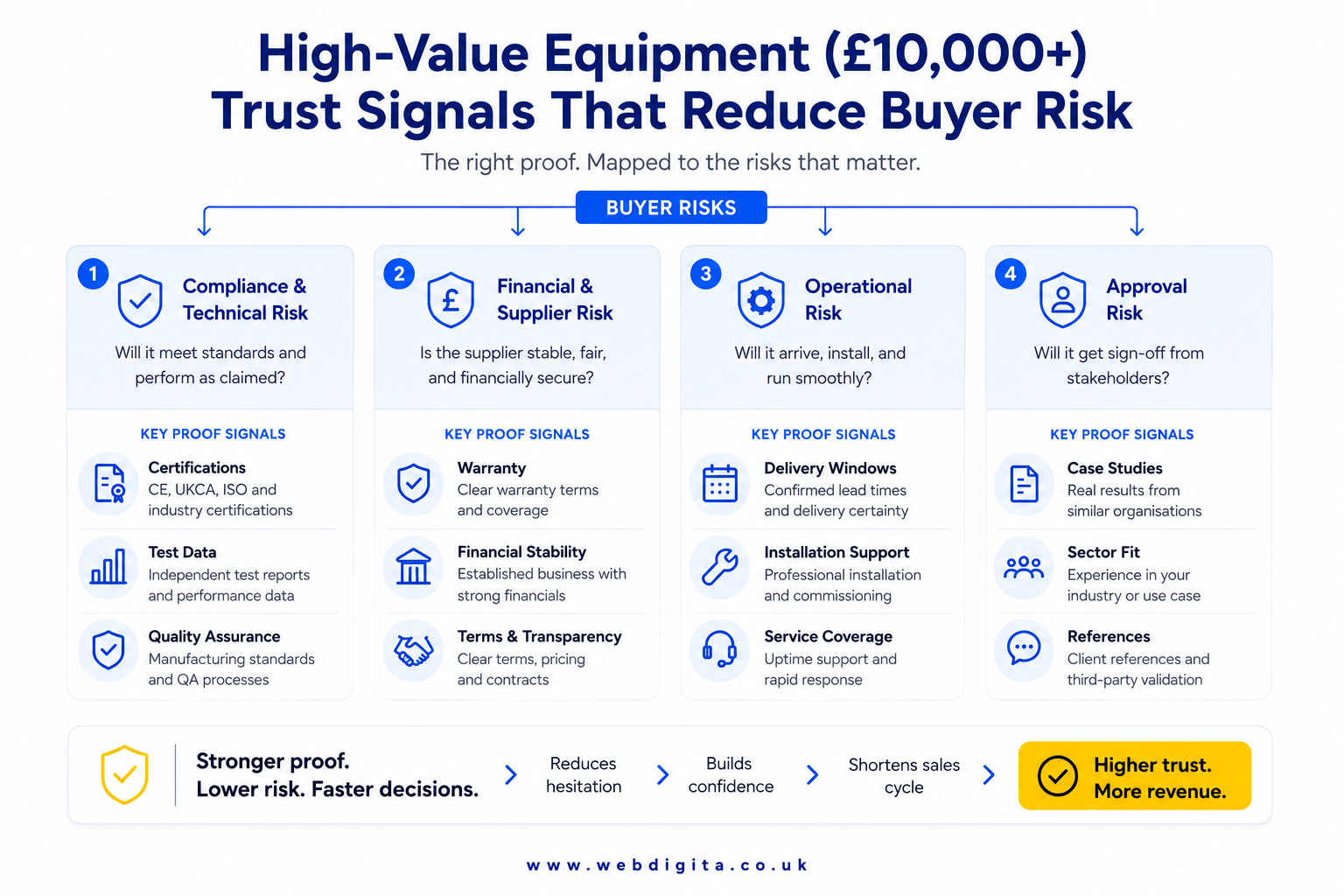
- Compliance and technical risk: certifications, standards, test data, spec sheets, operating tolerances, safety documentation.
- Financial and supplier risk: warranty terms, payment logic, company details, service coverage, escalation paths.
- Operational risk: delivery windows, installation method, commissioning process, training, service response times.
- Approval risk: case studies, referenceable use cases, sector fit, proof the equipment works in conditions like theirs.
If you are choosing what to improve first, prioritise the proof closest to the buyer’s biggest exposure. A polished homepage helps less than a product page with clear compliance evidence, installation detail and support terms.
Why generic trust elements fail in high-ticket equipment sales
We see this consistently across the high-ticket equipment sites we audit: teams add more reassurance because enquiries feel soft, but the issue is rarely a lack of badges. It is a lack of proof that holds up under scrutiny.
There is a useful distinction we come back to with clients. Decoration implies credibility. Proof reduces risk. Generic trust elements – a review badge, a few logos in the footer, a broad quality claim – are built for low-friction buying. They create a decent first impression, but they do not answer the question a serious buyer is actually asking: can we rely on this supplier when the stakes are real?
What changes this is what we call the Risk-Reducing Proof Standard: every trust signal on a high-ticket product page should be verifiable by procurement, defensible in a technical review, and specific enough to survive a pushback from operations. If it cannot pass that test, it is too weak for a 10,000 pounds plus sale.
The trade-off is worth understanding: broad reassurance can help early attention, but expensive technical purchases need stronger evidence to convert. Keep the basic credibility cues – they still matter for first impressions – but do not mistake them for decision-stage proof. Watch for pages that look trustworthy yet leave obvious buyer questions unanswered.
When that gap stays open, we see a predictable outcome: sales cycles slow, enquiries become more tentative and more wrong-fit leads get through. And if you want a wider view of what buyers need before they will even enquire, it helps to look at trust as a risk system, not a design layer.

Not sure which trust signals are holding back your high-value enquiries?
We can review your current site against the proof buyers actually check before they commit to 10,000 pounds plus purchases. You will get a clear view of which gaps matter most and where to strengthen reassurance without adding generic filler.
Takes 20 minutes. No pitch, just practical next steps.
Where those signals need to appear in the buying journey
Good trust signals fail all the time because they are buried in the wrong place. Buyers should not have to dig through PDFs, chase sales for basic warranty detail or wait for a call to understand installation logic. If the information changes the buying decision, place it where the decision is happening.
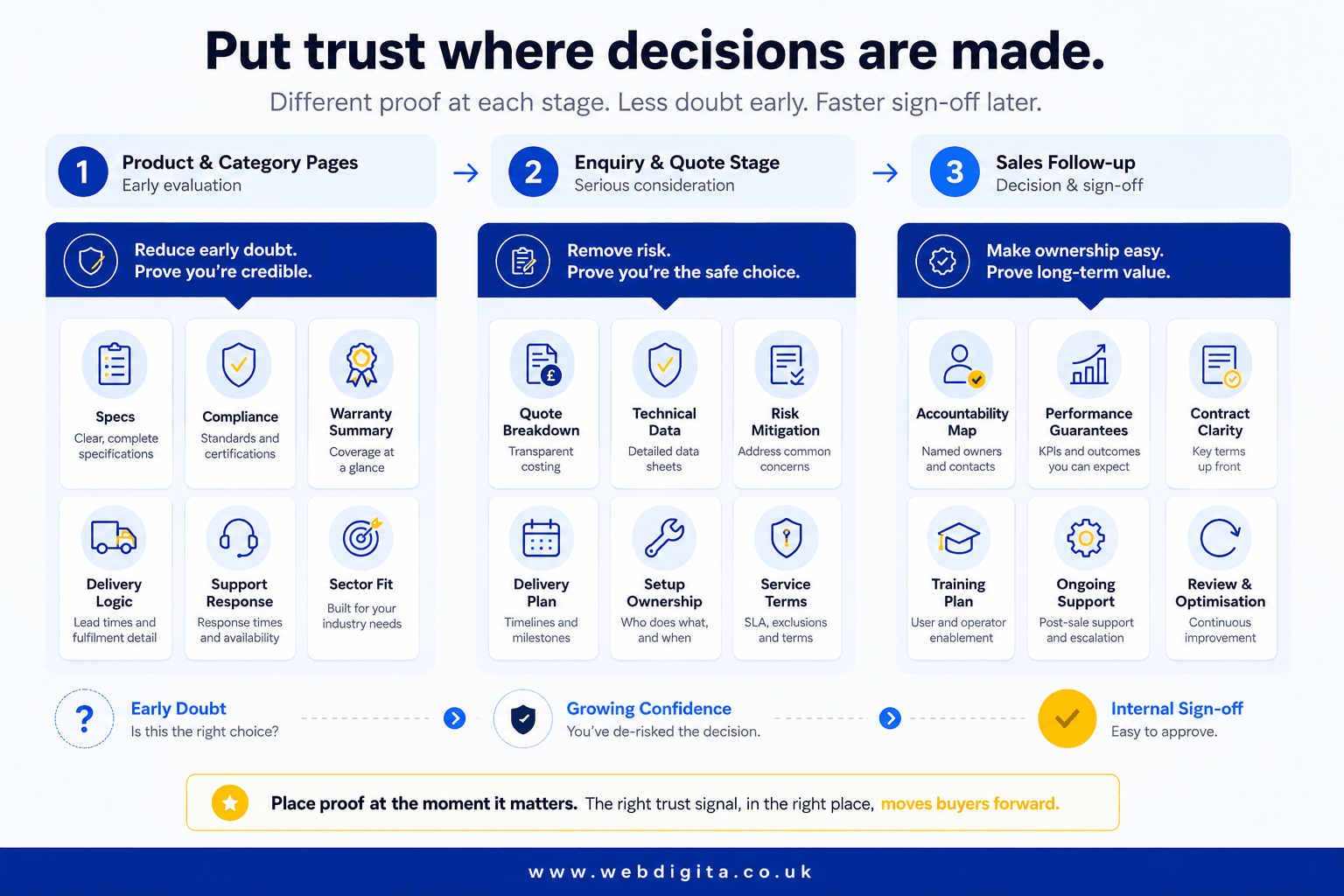
A practical way to think about this is by stage. Product and category pages should reduce initial doubt, while quote forms and enquiry paths should reduce hesitation at the point of action. Sales follow-up should deepen proof for internal review. If you are still unclear on what belongs where, a project discovery workshop is the sort of exercise that helps expose missing assumptions before they damage conversion.
A common example we encounter: a buyer is comparing two suppliers for a specialist machine. One site looks modern but keeps service response, commissioning steps and warranty exclusions vague. The other shows lead times, installation responsibilities, support coverage and a case study from a similar operating environment. You already know which one is easier to shortlist and defend internally.
- On product pages: specs, compliance, operating conditions, warranty summary, installation overview.
- Near enquiry points: delivery logic, support response, who handles setup, what happens next.
- In downloadable or sales assets: full technical data, service terms, implementation detail, sector-fit proof.
Check whether your strongest proof appears before enquiry, not only after a sales conversation starts. And do not bury operational detail on a support page if it is one of the main reasons buyers hesitate.
If you are also trying to improve lead quality, engineering high-intent enquiries in industrial buying journeys usually starts with making the right proof easier to find, not with driving more traffic.
Trust-to-Risk Ratio: a simple way to audit your current proof
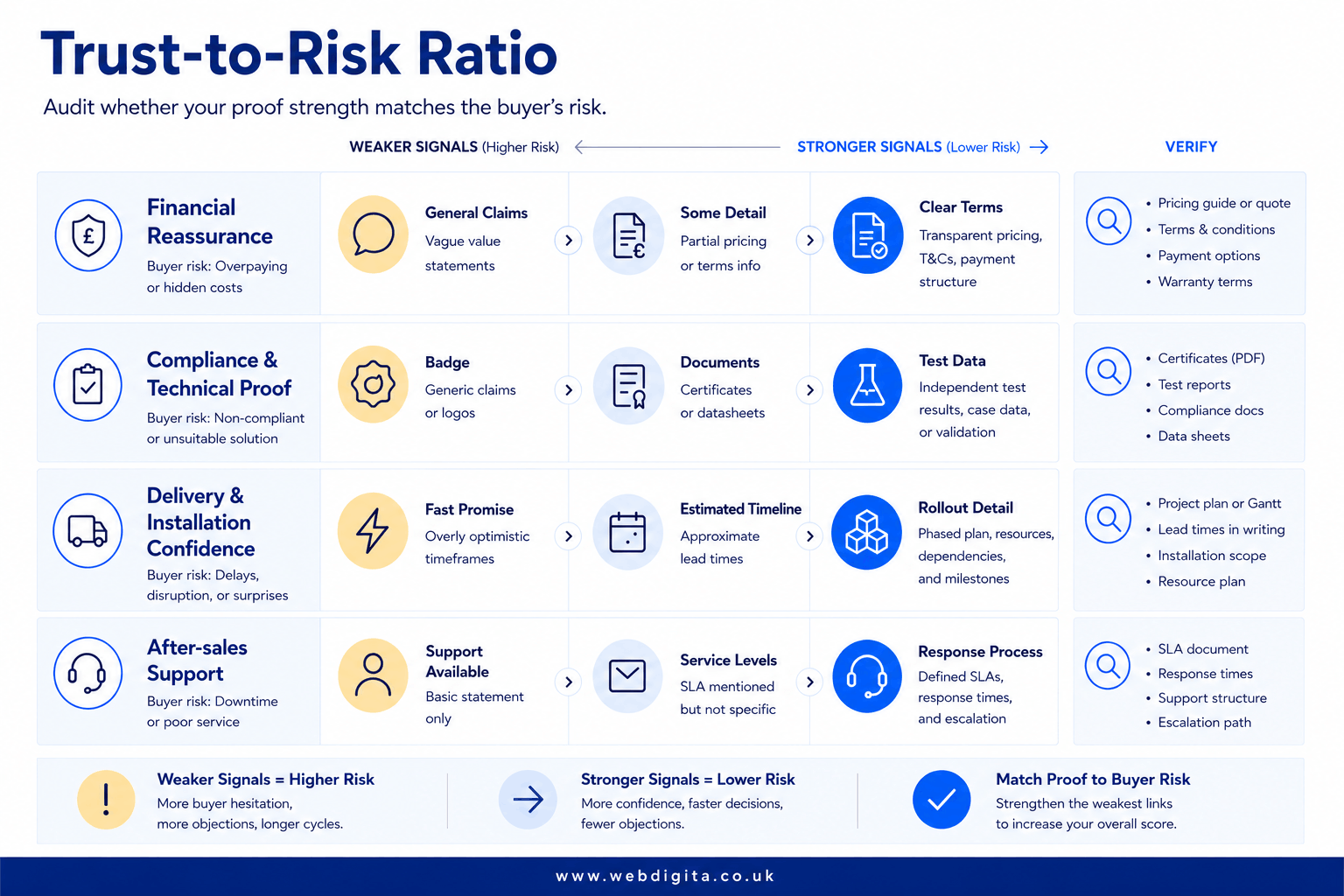
If you want a fast diagnostic, compare the buyer’s risk with the strength of the proof you give them. Check whether your current signals are proportionate to the spend, complexity and operational consequence of the sale.
WEBDIGITA Trust-to-Risk Diagnostic: use this to spot where your current reassurance is too weak for the level of buyer scrutiny.
| Buyer risk area | Weak signal | Strong signal | What the buyer can verify |
|---|---|---|---|
| Financial reassurance | General claims about quality | Clear warranty terms, ownership details, support coverage | What is covered, for how long, and who is accountable |
| Compliance and technical proof | Badge without context | Standards, certifications, test data, detailed specifications | Whether the equipment meets required technical or regulatory needs |
| Delivery and installation confidence | Vague promise of fast delivery | Lead times, commissioning steps, site requirements, training detail | How rollout will work in practice |
| After-sales support | “Ongoing support available” | Response terms, service process, escalation route, maintenance boundaries | What happens when something needs fixing |
If your ratio is weak, fix the proof nearest to the risk first. We would not start by adding more generic reassurance when buyers still cannot verify the basics that matter to procurement, operations or technical sign-off.
And if the issue is not just content but how the buying journey is built, scoped or presented, that is usually where stronger structure can help. The next sensible step is not a bigger list of badges. It is a clearer proof system that helps serious buyers say yes with less hesitation.
Questions buyers ask before committing to high-value equipment purchases
These questions reflect the compliance, financial, operational and approval concerns that matter most when the purchase is over £10,000.
1. What trust signals matter most for equipment purchases over £10,000?
Compliance and technical proof, clear warranty and support terms, realistic delivery and installation detail, and case studies showing the equipment works in a real operating setting. Generic badges and testimonials help first impressions but do not reduce financial, operational or supplier risk under scrutiny. Buyers need proof they can verify and defend internally.
2. Why do generic trust elements fail in high-ticket equipment sales?
Generic trust elements are built for low-friction buying, not high-scrutiny buying. A review badge or a few logos do not answer whether a buyer can rely on the supplier when the stakes are real. Serious buyers trust proof that reduces risk, not decoration that implies credibility. If the signal cannot survive a procurement check or technical review, it is too weak.
3. Where should trust signals appear in the buying journey?
Product and category pages should reduce initial doubt with specs, compliance, operating conditions, warranty summary and installation overview. Near enquiry points, show delivery logic, support response, who handles setup and what happens next. In downloadable or sales assets, include full technical data, service terms, implementation detail and sector-fit proof. Buyers should not have to dig for information that changes the decision.
4. What is the Trust-to-Risk Ratio and how do I use it?
The Trust-to-Risk Ratio compares the buyer's risk with the strength of the proof you give them. Check whether your current signals are proportionate to the spend, complexity and operational consequence of the sale. If your ratio is weak, fix the proof nearest to the risk first rather than adding more generic reassurance.
5. What should I prioritise if I am improving trust signals for the first time?
Prioritise the proof closest to the buyer's biggest exposure. A polished homepage helps less than a product page with clear compliance evidence, installation detail and support terms. Place the strongest proof where the decision is happening, not buried in PDFs or sales follow-up. Fix operational detail before adding more generic badges.
6. How do I know if my trust signals are strong enough for high-value sales?
Ask whether your current reassurance can survive a procurement check, technical review or operations challenge. If buyers still cannot verify warranty terms, compliance standards, delivery windows or support response, your signals are too weak. Strong signals answer the questions procurement, operations or technical sign-off will actually ask.
Conclusion
The trust signals that carry weight in high-value equipment sales are the ones buyers can verify and defend internally. If your current reassurance cannot survive a procurement check, technical review or operations challenge, it is too weak for the level of scrutiny these purchases attract.
Serious buyers trust proof that reduces risk, not decoration that implies credibility.
- Place compliance, warranty and installation detail where buyers can see it before they enquire, not buried in PDFs or sales follow-up
- Audit your Trust-to-Risk Ratio by comparing the strength of your proof with the buyer's financial, operational and approval exposure
- Fix the proof nearest to the risk first rather than adding more generic reassurance that does not answer the questions procurement, operations or technical sign-off will actually ask
If your site sells high-value equipment but enquiries feel soft or slow, the issue is usually proof strength, not traffic volume.
We help technical and industrial businesses build trust systems that reduce buyer hesitation at every stage. From compliance detail and warranty clarity to delivery logic and support terms, we make sure serious buyers can verify what they need before they enquire.
See how we build trust into eCommerceOr if you want to start with a diagnostic,