Key Takeaways
Marketplace budgets break when workflow complexity, payment logic, and integration dependencies are underestimated or left out of the brief entirely.
- Scope: A lean MVP may start around a lower five-figure budget, but operational multi-vendor builds with serious admin controls, payment splits, and vendor workflows usually cost significantly more.
- Platform choice: Shopify, WooCommerce, and Magento create different cost profiles—cheaper early does not always mean cheaper overall once plugin debt or custom logic accumulates.
- Hidden drivers: ERP integration, B2B pricing rules, headless architecture, and seller approval workflows move the quote far more than storefront design ever will.
- Discovery and migration: Proper workflow mapping, data migration, and post-launch support are part of the real budget, not optional extras you add later.
eCommerce Marketplace development budgets are usually planned wrong. The brief prices a storefront, but the real cost sits in seller onboarding, commission logic, payment splits, approval workflows, admin controls, and the back-office dependencies nobody wanted to discuss in the first meeting.
In the UK, ecommerce marketplace development cost usually starts around a lower five-figure budget for a lean MVP and moves into a much larger investment once you add serious vendor workflows, ERP integration, B2B rules, migration, or headless architecture. The biggest price changes come from platform choice, custom logic, payment handling, admin complexity, and how many operational edge cases the build has to survive. If you are comparing quotes, check whether those moving parts were actually scoped or quietly left out.
This guide is for founders, commercial leads, and ops teams who need budget clarity before shortlisting suppliers, comparing MVP vs replatforming options, or pressure-testing a marketplace quote.
What a UK based eCommerce marketplace build usually costs by scope and platform
A marketplace is not a normal ecommerce build with a few extra plugins bolted on. You are paying for two-sided logic, more permissions, more failure modes, and far more testing. If you are speaking to an eCommerce development team, ask them to separate storefront cost from marketplace operations cost. If they cannot, the quote is probably hiding risk.
A lean MVP might sit around the lower end of the five-figure range if the seller model is simple, commission rules are basic, and integrations are light. A mid-range operational marketplace usually lands higher because admin controls, payment flows, reporting, and workflow exceptions start to multiply. Complex multi-vendor platforms with ERP, PIM, B2B pricing, or headless front ends can move well beyond that.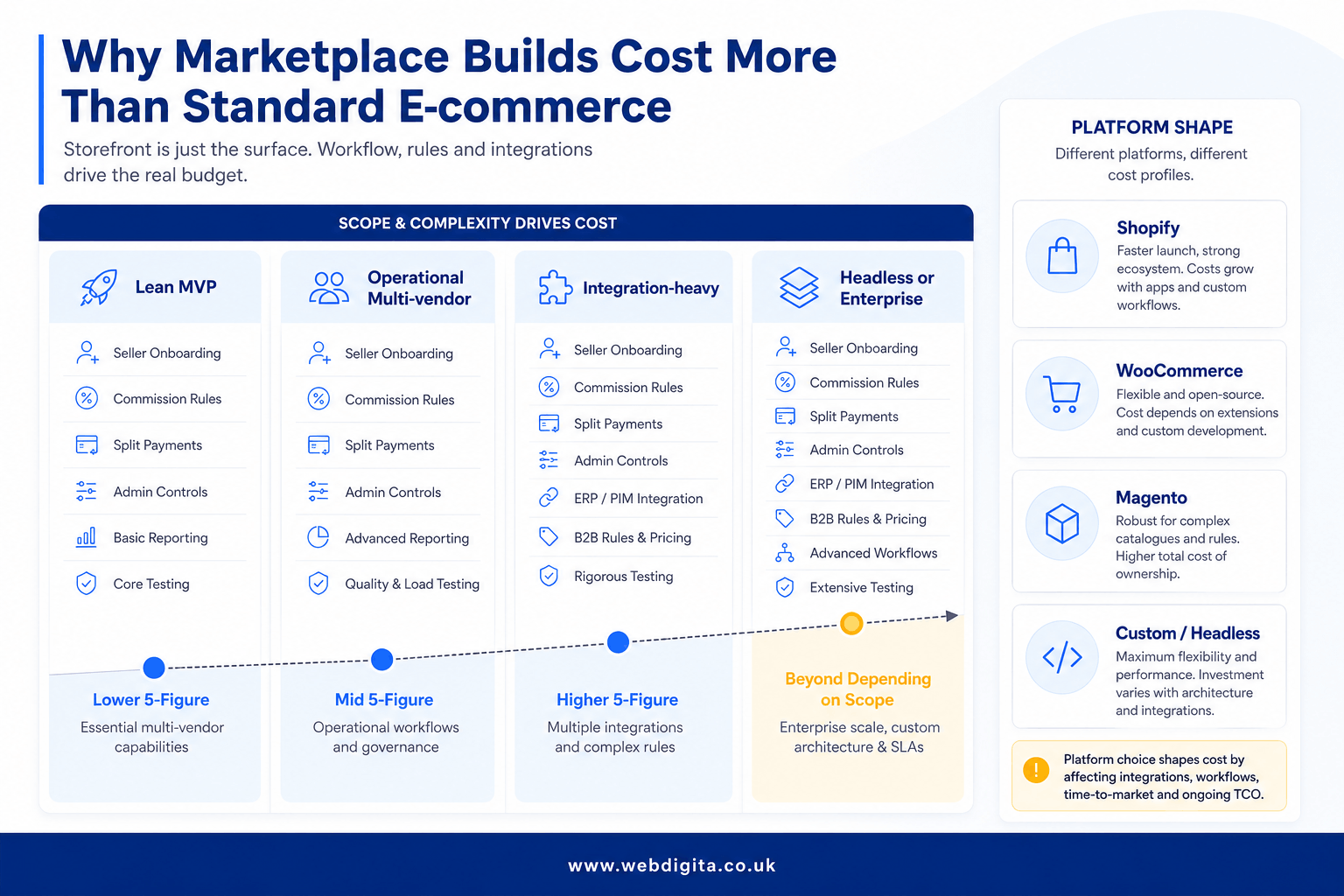
A common example is two projects with near-identical storefronts pricing very differently because one also needs seller approval rules, split payments, returns ownership, and vendor-level stock handling. The storefront is the visible part. The workflow debt is where the budget moves.
Cost driver matrix: project type vs complexity vs typical UK price range
| Project type | Complexity | Typical UK price range |
|---|---|---|
| Lean marketplace MVP | Low to moderate | Often a lower five-figure budget |
| Operational multi-vendor build | Moderate | Usually a mid five-figure budget |
| Integration-heavy marketplace | High | Often a higher five-figure budget |
| Headless or enterprise-style marketplace | High to very high | Can move beyond that, depending on scope |
Platform Shape Matters: Shopify, WooCommerce, Magento, and more custom routes do not simply cost more or less. They create different cost profiles. Shopify can reduce some build overhead but may push cost into app constraints or custom workarounds. WooCommerce can look cheaper early, then become expensive if plugin debt and custom logic pile up. Magento and Adobe Commerce usually make more sense when catalogue, B2B, or operational complexity is already high. If you want a deeper view of how platform selection changes the overall build budget, that is worth reading before you compare proposals.
The cost drivers that change the quote most
The honest problem is that buyers often ask for a price before the expensive decisions have been made. If you want a useful quote, you need to know which choices move the number first. I would push on these before treating any estimate as credible.
Biggest Budget Movers:
- Vendor workflow complexity: onboarding, approvals, permissions, returns, disputes
- Payment handling: split payments, commission rules, refunds, tax logic, checkout optimisation
- Integrations: ERP, PIM, stock sync, order flow, finance systems
- B2B eCommerce rules: customer groups, contract pricing, account hierarchies, credit terms
- Architecture choice: traditional platform build vs headless commerce
The storefront rarely blows the budget first. Hidden workflow logic and system dependencies usually do that.
ERP and Back-Office Integration: This is where quotes often become fiction. You are not only connecting systems. You are defining field mapping, stock ownership, order status logic, retry handling, and what happens when data fails halfway through a process. Ask who owns those rules and how failures will be handled, because integration risk creates both build cost and operational overhead.
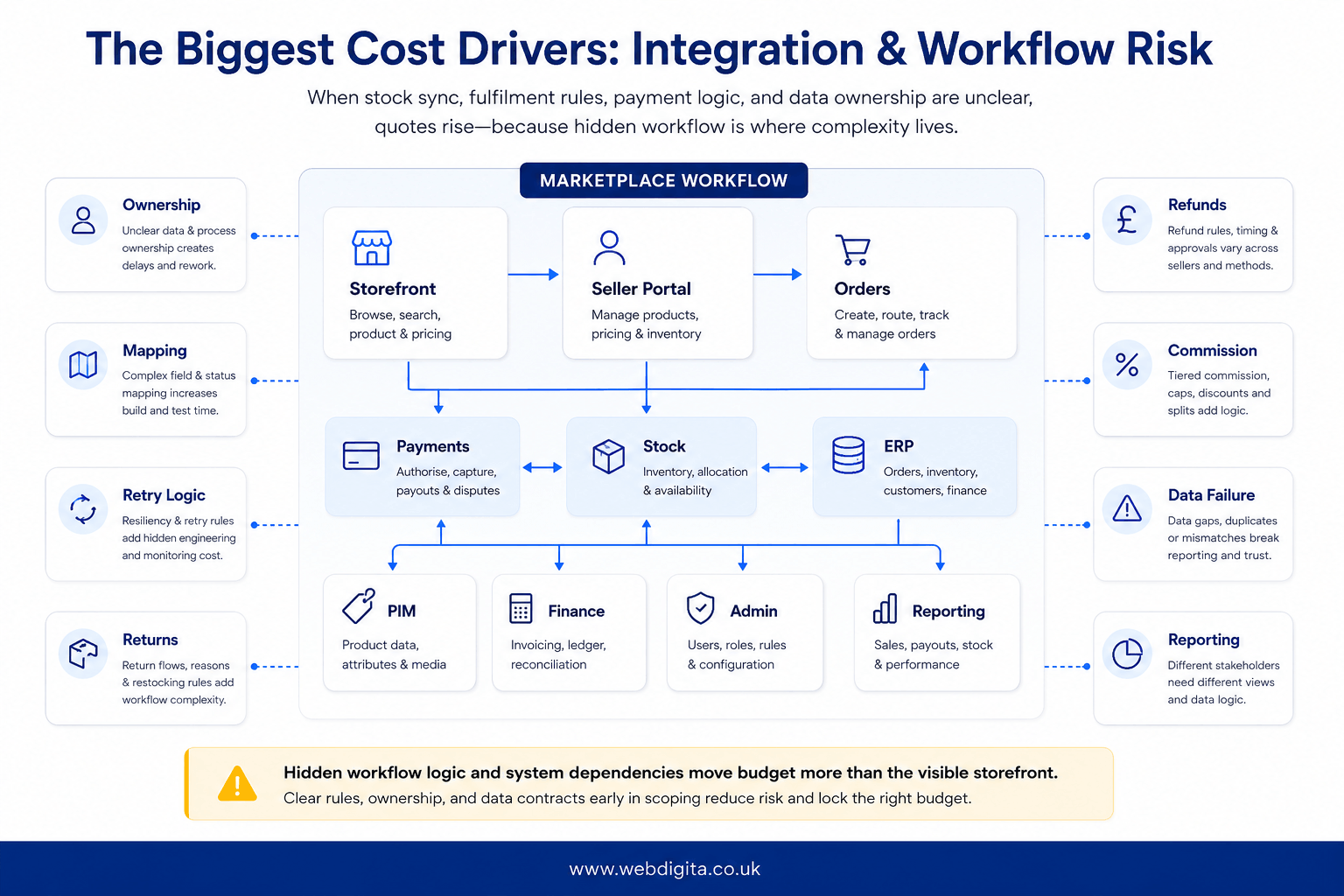
I have seen this on marketplace projects where the visible brief looked tidy, but the real issue sat in stock sync, seller fulfilment rules, and order data moving between systems with no agreed ownership. That is why a project discovery workshop often saves money rather than adding cost.
Headless vs Traditional: headless can give you more front-end control, but it also adds coordination, testing, and maintenance layers. Do not assume headless is the premium answer by default. If your marketplace model is still operationally immature, I would treat headless as a cost multiplier unless there is a clear commercial reason for it. If that is on your shortlist, read the extra cost considerations that come with headless ecommerce before you sign off the architecture.

Not sure whether your marketplace brief is scoped properly?
Most marketplace quotes miss the same things: vendor workflow detail, payment split logic, integration ownership, and operational edge cases. We run scoping workshops that surface those dependencies before you commit to a build price.
Quick scoping call, no obligation, clearer budget before you shortlist suppliers.
The costs clients miss before they ask for a quote
In my experience running marketplace builds across Shopify, Magento and WooCommerce, the same three costs get missed on almost every quote: discovery, migration detail, and post-launch support. None of these are optional extras. They are part of the real budget, whether they appear in the proposal or not – and a supplier who leaves them out is not being efficient, they are deferring the cost until after you have signed.
Discovery Cost: a proper discovery phase covers workflow mapping, architecture choices, dependency checks, and acceptance criteria. That work may cost a few thousand pounds depending on scope, but it is usually cheaper than building against assumptions and paying for rework later. If a supplier wants to jump straight to a fixed build price on a complex marketplace without this stage, I would treat that as a warning sign, not a saving.
Migration and Support: if you are replatforming, you need to account for catalogue data, customer records, order history, redirects, and operational process changes. Then there is support after launch: updates, bug handling, integration monitoring, and platform maintenance. Ask where warranty ends and where regular eCommerce maintenance retainer begins, because that boundary gets blurred very quickly on marketplace builds.
What a quote that is hiding cost looks like: these are the gaps I check for before I trust a number.
- The seller journey is missing entirely, and only the buyer journey has been scoped.
- Payment rules, commission rules, and refund edge cases are described as “standard” with no detail.
- Integrations are listed by name only, with no owner named for the source data on either side.
- The quote does not say whether the build is net-new, replatforming, or migration-heavy, even though that single decision changes almost every other cost.
- Everything is priced as fixed scope, with no staged option offered for the parts that are genuinely uncertain.
For complex marketplace work, staged delivery or time and materials is often more honest than a forced fixed-scope quote. You need enough structure to control budget, but enough flexibility to deal with edge cases once real workflow detail appears. If you want to compare marketplace cost against broader build expectations, our guide to eCommerce development cost in the UK is a useful next read.
Questions buyers ask before budgeting a UK marketplace build
Common cost and scoping questions that come up when planning a multi-vendor ecommerce platform.
1. What is the typical starting cost for a marketplace MVP in the UK?
A lean marketplace MVP in the UK often starts around a lower five-figure budget if the seller model is simple, commission rules are basic, and integrations are light. The price moves quickly once you add vendor approval workflows, split payment logic, admin controls, or back-office system integration. The storefront is usually the cheaper part—operational workflow and payment handling are where the real cost sits.
2. Why do marketplace builds cost more than standard ecommerce sites?
Marketplace builds cost more because you are paying for two-sided logic, vendor workflows, payment splits, commission rules, approval processes, and far more testing. A normal ecommerce site serves one seller. A marketplace has to handle multiple vendors, each with their own stock, pricing, fulfilment rules, and admin permissions. That complexity multiplies the build, testing, and maintenance cost.
3. Does platform choice affect marketplace development cost?
Yes, significantly. Shopify can reduce some build overhead but may push cost into app constraints or custom workarounds. WooCommerce can look cheaper early, then become expensive if plugin debt and custom logic pile up. Magento and Adobe Commerce usually make more sense when catalogue, B2B, or operational complexity is already high. The platform shapes the cost profile, not just the upfront price.
4. What are the biggest cost drivers in a UK marketplace build?
The biggest cost drivers are vendor workflow complexity, payment handling including split payments and commission logic, ERP and PIM integrations, B2B pricing rules, and architecture choice such as headless commerce. Storefront design rarely blows the budget first. Hidden workflow logic, system dependencies, and operational edge cases usually do that.
5. Should I budget for discovery before getting a fixed marketplace quote?
Yes. A proper discovery phase covers workflow mapping, architecture choices, dependency checks, and acceptance criteria. That work may cost a few thousand pounds depending on scope, but it is usually cheaper than building against assumptions and paying for rework later. If a supplier wants to jump straight to a fixed build price on a complex marketplace, treat that as a warning sign.
6. What costs do buyers usually miss when budgeting a marketplace?
Buyers usually miss discovery cost, migration detail including data mapping and redirects, and post-launch support such as updates, bug handling, and integration monitoring. Those are not optional extras. They are part of the real budget, whether they appear in the proposal or not. Ask where warranty ends and where ongoing maintenance begins, because that boundary gets blurred very quickly.
7. Is headless architecture worth the extra cost for a marketplace?
Headless can give you more front-end control, but it also adds coordination, testing, and maintenance layers. Do not assume headless is the premium answer by default. If your marketplace model is still operationally immature, treat headless as a cost multiplier unless there is a clear commercial reason for it. The extra cost is only justified if the business case supports it.
8. How much does ERP integration add to a marketplace build?
ERP integration can add significantly to the budget because you are not only connecting systems—you are defining field mapping, stock ownership, order status logic, retry handling, and what happens when data fails halfway through a process. Integration risk creates both build cost and operational overhead. Ask who owns those rules and how failures will be handled before you sign off the scope.
Conclusion
The storefront is the visible part. The workflow debt, payment logic, and integration dependencies are where the budget actually moves.
- If your brief prices a storefront but leaves vendor workflows, commission rules, and back-office dependencies vague, the quote is probably hiding risk rather than controlling it.
- Staged delivery or time and materials is often more honest than a forced fixed-scope quote when operational edge cases have not been fully mapped yet.
- Budget for discovery, migration detail, and ongoing support from the start—those costs do not disappear just because they are missing from the proposal.
- Before you shortlist suppliers or sign off a marketplace build, make sure the quote reflects the two-sided logic, payment splits, and admin complexity your model actually needs.
Ready to scope a marketplace build that survives real operational complexity?
We build multi-vendor platforms for UK businesses who need seller workflows, payment logic, and back-office integration handled properly from the start. Our team works with Shopify, WooCommerce, Magento, and custom builds.
See Our eCommerce Marketplace Development ApproachOr start with