Key Takeaways
Most eCommerce SEO budget mistakes happen because buyers compare monthly fees without comparing what those fees actually cover. One quote may include strategy only, another assumes developer support, and a third leaves content and technical fixes outside scope entirely.
- Catalogue size and technical debt drive cost more than agency branding. A 300-product store and a 30,000-product store need very different levels of governance, template work, and crawl management.
- Smaller UK retainers often start around £1,500 to £3,000 per month. Broader ongoing programmes with technical oversight, content direction, and implementation support more often sit in the £3,000 to £8,000+ range.
- Implementation ownership is the most common gap. Many retainers include audits and recommendations but leave developer fixes, content production, and Core Web Vitals work outside scope.
- International scope adds market targeting, localisation, and duplicate-content control. That pushes monthly costs higher and extends the timeline before organic revenue compounds.
Compare scope and ownership before price. The cheapest retainer often becomes the most expensive route once the real workload appears.
I have analysed and reviewed enough failed eCommerce SEO Projects to know this pattern. One quote covered strategy only. A second assumed developer support sat inside scope. A third left content, Core Web Vitals fixes, and implementation as extras nobody flagged until the first invoice arrived. The buyer approved the cheapest number. Twelve months later, the site is technically cleaner but commercially untouched.
eCommerce SEO services in the UK typically costs between £1,500 and £3,000 per month for smaller or lower-complexity stores, and between £3,000 and £8,000+ per month for mid-size to large catalogues with real technical or content demands. The main swing factors are catalogue size, technical debt, content scope, competition level, and platform constraints. Before comparing prices, compare what is actually inside the brief – because those are rarely the same thing.
If you are trying to budget this properly, comparing scope and ownership before price is the only approach that does not blow up later.
What a typical UK eCommerce SEO retainer is really paying for
A retainer is not a package. It covers ongoing eCommerce SEO thinking, prioritisation, technical oversight, content direction, reporting, and delivery pressure over time. Understanding what a properly structured eCommerce SEO programme should cover changes how you read any quote.
Two quotes at similar monthly fees can still buy very different levels of work. One may cover strategy, audits, and reporting only. Another may include hands-on technical input, category and product page optimisation, internal linking, and closer support with developers – especially if your store also needs eCommerce development work to fix templates or platform limits.
Separate the cost types: A monthly retainer covers ongoing work, while a one-off technical audit is often priced separately. For a large or technically messy store, a full audit can run from a few thousand pounds into a lower five-figure budget, depending on site size and depth. Implementation support may then sit outside both.
Compare scope before price. In eCommerce SEO, the cheapest retainer often becomes the most expensive route once extra work starts appearing outside the brief.
The eCommerce SEO cost drivers that change the price most
The biggest pricing shifts usually come from workload, not agency branding. Two stores can sell similar products, but if one has 300 URLs and the other has 30,000, the SEO workload is nowhere near the same.
In my experience, the price moves fastest when catalogue size, technical debt, and content demand stack up together. A store may look simple on the surface, then you find faceted navigation creating crawl budget waste, weak canonical tags, and templates that make clean fixes slow. That combination is where retainers either hold their scope or quietly balloon.
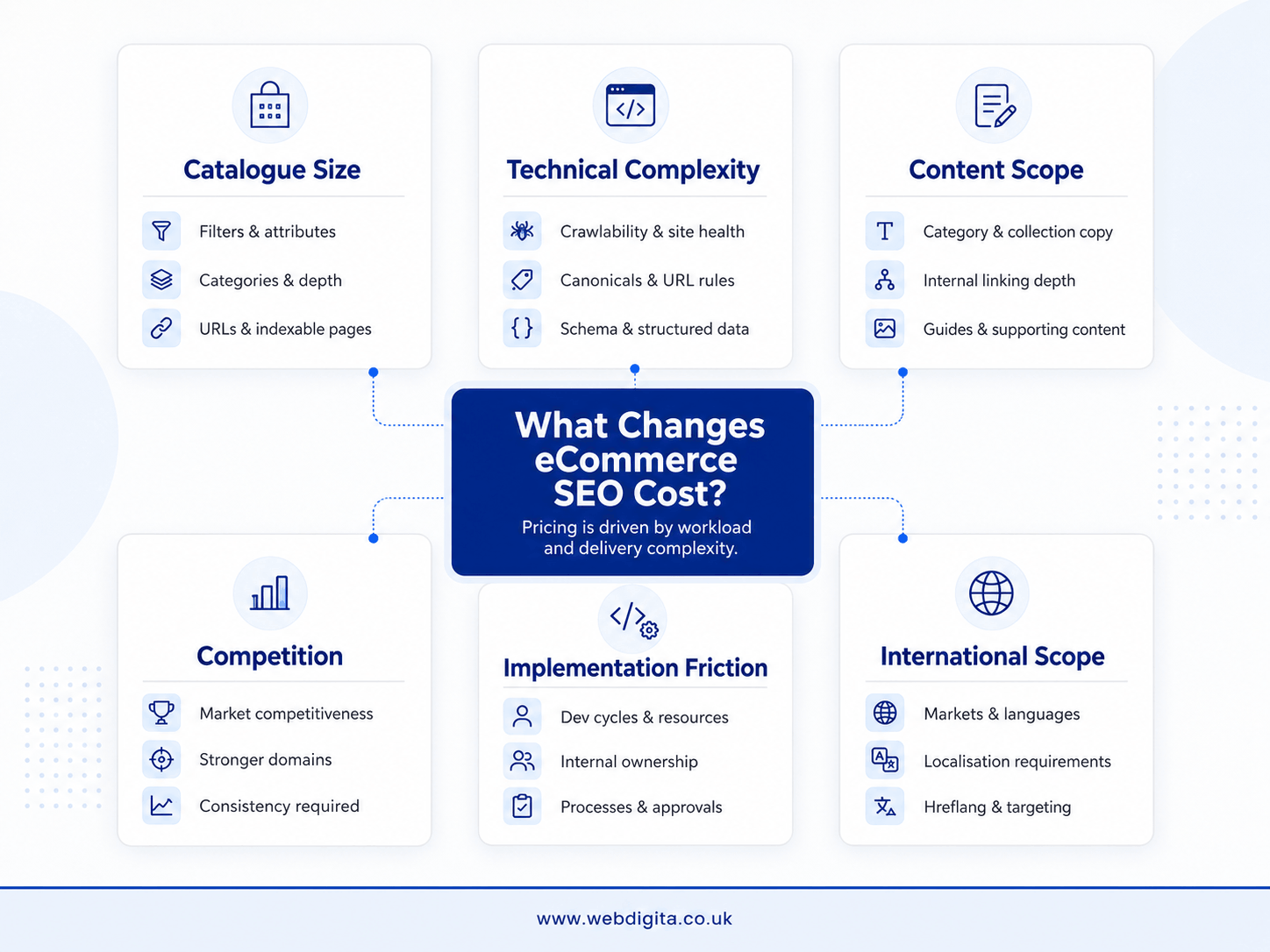
- Catalogue size and structure: More products, filters, and category paths usually mean more governance and more template work.
- Technical complexity: Faceted navigation, duplicate URLs, indexation issues, JavaScript-heavy pages, and product schema problems push cost up quickly.
- Content scope: Category copy, product page optimisation, internal linking, and supporting content all take time.
- Competition level: Tougher markets need more consistency, better prioritisation, and often a stronger content pace.
- Implementation friction: If fixes depend on slow dev cycles or unclear ownership, delivery cost rises even when the SEO plan is sound.
- International scope: Extra markets add technical and content overhead – not just translation work.
If you are seeing a very low quote on a technically messy site, this is where things tend to go wrong.
eCommerce SEO – Cost driver matrix: Project type, complexity and typical UK price range
Use this as a sense-check, not a fixed rate card. It helps you compare project shape against broad UK pricing bands before you approve budget.
| Project type | Typical complexity | Typical UK price range | What usually drives the range |
|---|---|---|---|
| Smaller catalogue store | Low to moderate | About £1,500 to £3,000 per month | Core technical checks, category optimisation, light content planning |
| Mid-size catalogue with mixed technical needs | Moderate | About £3,000 to £5,000 per month | Broader category work, internal linking, recurring technical fixes, stronger reporting |
| Large catalogue with technical debt | High | About £5,000 to £8,000+ per month | Faceted navigation, crawl budget issues, template constraints, developer dependency |
| International eCommerce scope | High to very high | Often £6,000+ per month, with extra technical or localisation costs | Market targeting, duplicate-content control, hreflang oversight, added content governance |
If a proposal sits well below the likely band for your project type, ask what has been excluded before you sign anything.

Not sure which scope fits your store?
Most eCommerce SEO budget mistakes happen when catalogue size, technical debt, and content demand are guessed rather than mapped. We can walk through your site structure, platform constraints, and delivery ownership in a short scoping call.
No pitch. Just a clearer view of what the work actually involves.
What is usually included, what is often extra, and where quotes go wrong
Most retainers include strategy, audits, prioritisation, reporting, and a defined amount of ongoing optimisation. What they often do not include is the full implementation load, large-scale content production, or specialist performance engineering.
Technical versus content split: some stores need more technical eCommerce SEO budget because crawl budget issues, canonical tags, product schema, and template constraints are blocking visibility. Others need more content-side work across category pages, product page optimisation, and internal linking because the site is indexable but commercially thin. That split changes by site type – do not assume every retainer spreads time evenly.
Core Web Vitals are a common fault line. Diagnosis is often included, and ticket writing and developer coordination may be too. The actual code changes are often separate, which is why buyers get confused about whether Core Web Vitals work sits inside SEO scope or needs separate performance support.
A common bad-fit quote looks thorough because it includes audits and monthly reporting, but all developer fixes and category content sit outside scope. On paper it looks cheaper. In practice, the work that moves organic revenue never really starts.
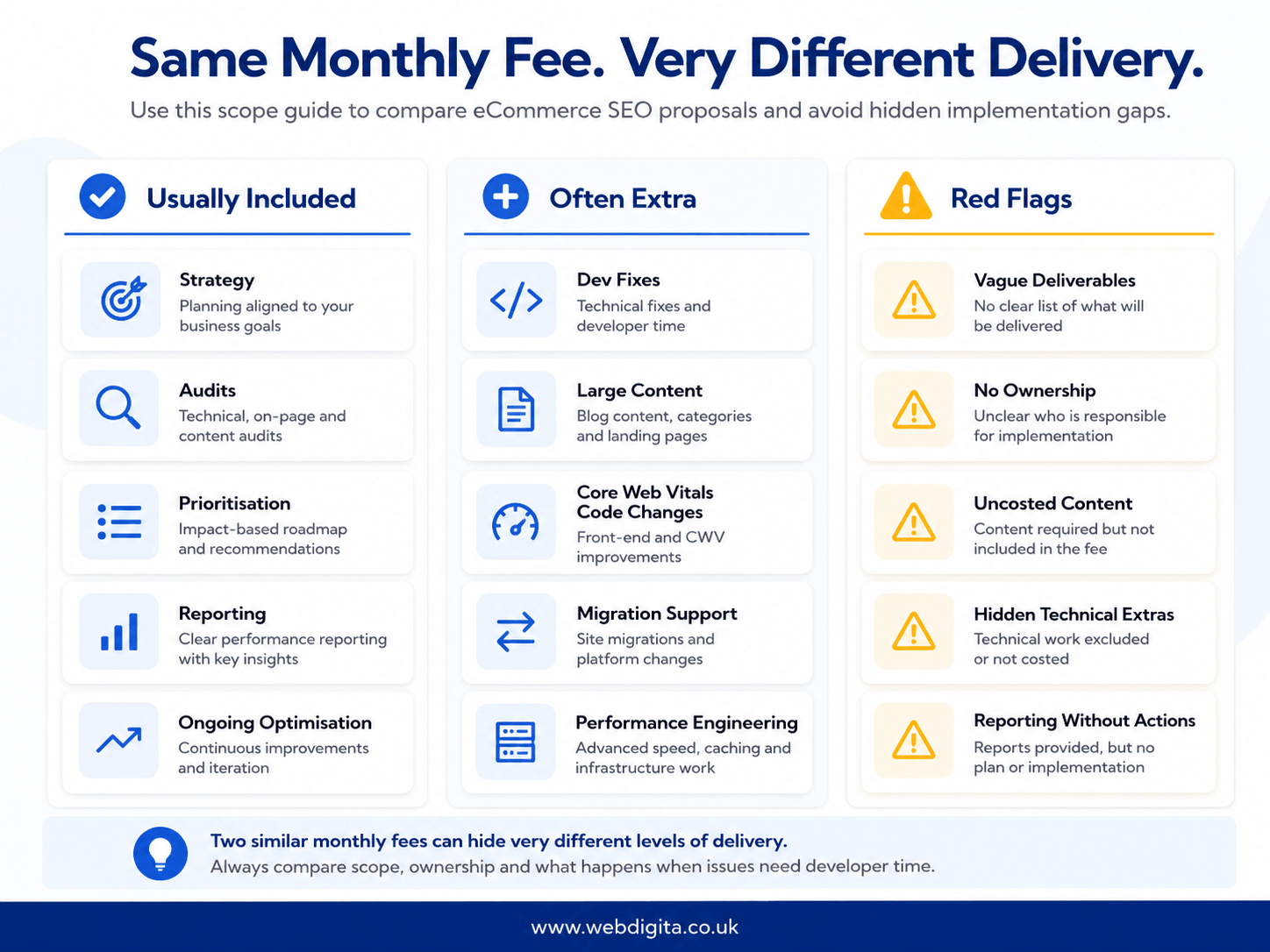
- Red flag 1: Deliverables are vague, with no monthly output or ownership detail.
- Red flag 2: Technical fixes are recommended, but nobody owns implementation.
- Red flag 3: Large content needs are implied, but not costed.
- Red flag 4: Migration, template changes, or product schema work are treated like minor extras.
- Red flag 5: Reporting is promised, but there is no clear link to visibility, revenue, or next actions.
When international scope and revenue timing change the budget
International eCommerce SEO costs more because you are not repeating the same work in a different language. You are adding market-specific targeting, hreflang implementation, duplicate-content control across country subfolders or subdomains, and technical oversight of templates, category structures, and product data that often behaves differently per market.
Most stores underestimate this before they start. I have seen sites with clean canonical tags and solid crawl budget management domestically fall apart the moment a /de/ or /fr/ subfolder goes live without the right technical groundwork. International eCommerce SEO is not a scope extension – it is a different programme running in parallel with the domestic one. The cost difference is not cosmetic.
The second problem is timeline expectations. Organic revenue rarely moves significantly in month one because early work goes into crawl fixes, indexation, site architecture, and content gaps before the commercial effect compounds. If you need a clearer view of how long eCommerce SEO typically takes to show measurable results, that question needs to sit alongside your budget conversation, not after it.
The useful question is not “what is the cheapest monthly retainer?” It is: who owns implementation, what gets prioritised in the first ninety days, and what happens when a fix depends on a developer queue that is already two sprints deep? If you are reviewing proposals now, check how the SEO programme connects with your development workflow, merchandising calendar, and a regular eCommerce maintenance setup. That alignment is often what separates a retainer that builds organic revenue from one that produces monthly reports nobody acts on.
Questions buyers ask before budgeting eCommerce SEO
Common questions about scope, pricing, and what UK eCommerce SEO retainers actually cover.
1. What does a typical UK eCommerce SEO retainer cost per month?
Smaller-scope eCommerce SEO retainers in the UK often start from around £1,500 to £3,000 per month, while broader ongoing programmes with technical oversight, content direction, and implementation support more often sit in the £3,000 to £8,000+ range. The real swing factors are catalogue size, technical complexity, content demand, competition, platform constraints, and any international layer. Compare scope and ownership before price.
2. What is usually included in an eCommerce SEO retainer?
Most retainers include strategy, audits, prioritisation, reporting, and a defined amount of ongoing optimisation. What they often do not include is the full implementation load, large-scale content production, or specialist performance engineering. Technical fixes may be recommended, but the actual code changes often sit outside scope. That is why buyers get confused about whether Core Web Vitals work, developer fixes, or category content are included or priced separately.
3. Why do two eCommerce SEO quotes with similar monthly fees look so different?
Two quotes with similar monthly fees can buy very different levels of work. One may cover strategy, audits, and reporting only. Another may include hands-on technical input, category and product page optimisation, internal linking, and closer support with developers. The difference is usually in scope, ownership, and what sits outside the retainer. Compare deliverables and implementation support before comparing price.
4. What drives eCommerce SEO cost up most?
The biggest pricing shifts usually come from workload, not agency branding. Catalogue size, technical debt, and content demand stack up quickly. A store may look simple on the surface, then you find filter URLs creating crawl waste, weak canonicals, and templates that make clean fixes slow. Competition level, implementation friction, and international scope also push cost up fast.
5. Are Core Web Vitals fixes included in eCommerce SEO retainers?
Diagnosis is often included, and ticket writing and developer coordination may be too. The actual code changes are often separate. That is why buyers get confused about whether Core Web Vitals work sits inside SEO scope or needs separate performance support. Check who owns implementation before you approve the budget.
6. How much does a full eCommerce SEO audit cost in the UK?
A one-off technical audit is often priced separately from the monthly retainer. For a large or technically messy store, a full audit can run from a few thousand pounds into a lower five-figure budget, depending on site size and depth. Implementation support may then sit outside both the audit and the retainer.
7. Does international eCommerce SEO cost more?
Yes. International SEO costs more because you are adding market targeting, localisation choices, duplicate-content control, and more technical oversight across templates, categories, and product data. You are not just repeating the same work in another market. That pushes monthly costs higher and extends the timeline before organic revenue compounds.
8. What are the red flags in an eCommerce SEO proposal?
Red flags include vague deliverables with no monthly output or ownership detail, technical fixes recommended but nobody owns implementation, large content needs implied but not costed, migration or schema work treated like minor extras, and reporting promised but no clear link to visibility, revenue, or next actions. If a proposal sits well below the likely band for your project type, ask what has been excluded.
Conclusion
The real cost question is not what the monthly retainer is. It is who owns what, what gets done first, and what support sits behind the plan when technical fixes need developer time or category content needs writing at scale.
In eCommerce SEO, the cheapest retainer often becomes the most expensive route once extra work starts appearing outside the brief.
If you are reviewing proposals now, check how SEO work will connect with developers, merchandisers, and your maintenance setup. That connection is often what decides whether the budget turns into revenue or turns into rework. Compare deliverables, ownership, and implementation support before you compare price.
Ready to scope eCommerce SEO properly before you commit budget?
We help UK eCommerce brands map technical debt, content gaps, and delivery ownership before any retainer starts. That means you compare scope and workload first, not just monthly fees. Our eCommerce SEO service covers strategy, technical oversight, category optimisation, and developer coordination across Shopify, WooCommerce, and custom platforms.
See our eCommerce SEO serviceOr if you prefer,