Key Takeaways
- Visibility alone is not enough: manufacturers need to be recommendable, not just indexed, which means AI tools must be able to verify your company, products, certifications, and sector fit clearly.
- Recommendation trust comes from structured signals: entity clarity, technical credibility, citable content, comparison readiness, and trust consistency across your site and wider web all matter.
- Common blockers include thin product pages, missing compliance detail, and disconnected company and product evidence: if your technical knowledge lives in unlabelled PDFs or vague copy, answer engines cannot safely cite you.
- Start with the foundation layers first: clarify your entity, strengthen key product pages with application context, add visible proof, improve comparison content, and assign clear ownership for ongoing updates.
If your business is not being surfaced when buyers ask AI tools for suppliers, you are invisible at the moment of intent. In manufacturing, the problem is rarely a lack of products. It is that answer engines cannot confidently connect your company, product range, technical proof, and fit for a buyer’s specific use case.
The right answer: B2B manufacturers improve their chances of being recommended in AI-driven search by making their digital footprint easier to verify, compare, and cite. That means clearer entity signals, stronger product and application pages, visible certifications and compliance evidence, and content that helps AI tools understand when your business is a good supplier fit. If those signals are thin or inconsistent, you may still rank somewhere, but you are less likely to be named, summarised, or shortlisted.
This guide is for manufacturers, industrial suppliers, technical sales teams, and marketing leaders who need clearer recommendation-readiness before improving product content, technical proof, or evaluation-stage discovery.
What AEO means when a buyer asks AI for suppliers
For manufacturers, AEO is not just about being found. It is about being selected into the answer when an engineer, procurement lead, or specifier asks for suppliers by product type, application, certification, or sector fit.
If you are treating this like a rankings exercise alone, you are likely missing the real commercial shift. A buyer might ask an AI tool for stainless steel enclosure suppliers with IP-rated options for food production – and the tool will not simply list whoever exists. It will lean towards suppliers it can understand, compare, and trust. That is a very different kind of lead pipeline than organic traffic.
That is the difference between visibility and recommendability. A site can be indexed and still fail this test. You need to check whether your pages clearly show what you make, who it is for, what standards you meet, and why your offer is distinct. Even businesses that have invested significantly in digital infrastructure can miss this if the build looks polished but the supplier evidence is still scattered.
Before, a manufacturer could get away with fragmented product pages, buried PDFs, and broad claims. Now, the businesses that earn inclusion are the ones with clear, citable supplier information at page level – content that an AI system can use to build a confident recommendation, not just a link. If you want better-fit enquiries from buyers who already know what they need, this is the layer you optimise for. Our B2B lead generation work in London consistently shows that recommendation trust, not just rankings, is where qualified pipeline is now being won or lost.
What makes a manufacturer recommendable to answer engines
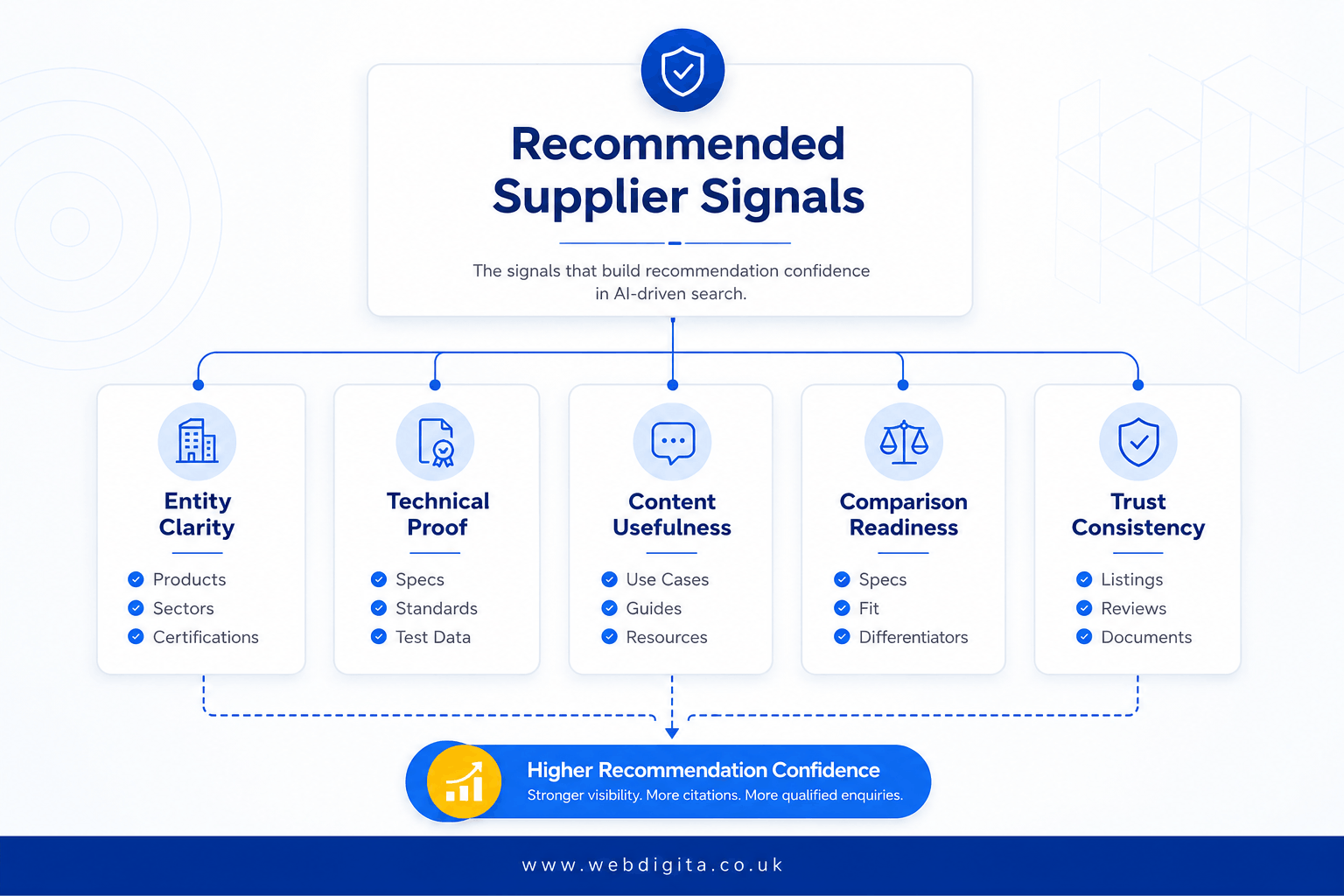
Recommendation trust comes from a cluster of signals, not one tactic. You need to make it easy for an answer engine to understand your company as a real supplier entity, connect that entity to specific products and sectors, and see evidence that supports the claim.
The pattern we see again and again: manufacturers become recommendable when their digital footprint is useful, structured, and technically credible. That is not a vague aspiration – it is a practical diagnostic. We have worked with manufacturers who had strong offline credibility and weak page-level evidence. The technical knowledge was real. The ICP was well-defined internally. But answer engines had almost nothing usable because the detail lived in unlabelled PDFs, inconsistent product tables, and sales decks that were never designed to be crawled. The fix is not more content – it is better-structured proof.
That often means cleaning up years of mixed messaging, thin templates, and missing evidence before any new content programme makes sense.
You should look for the core signals below and ask whether each one is visible on-page, not just hidden in brochures or sales decks.
- Entity clarity: company name, locations, sectors served, product families, and distributor relationships are consistent across the site and the wider web.
- Technical credibility: specifications, tolerances, certifications, compliance detail, and documentation are easy to access and tied to the right products.
- Citable usefulness: pages answer real buyer questions in plain language, so they can be quoted or summarised without needing additional context.
- Comparison readiness: your content makes it clear where your offer fits, where it does not, and how it differs by application or capability – including for buyers with specific ICP-level requirements.
- Trust consistency: the same story appears across product pages, company pages, directories, distributor mentions, and downloadable assets.
Where manufacturers usually fall short
The honest problem is that many manufacturing sites still speak like brochures while buyers search like evaluators. If your pages are vague, answer engines cannot safely recommend you – even if your business is well known in the market.
The gaps that break trust between your company, your offer, and the buyer’s question are usually the same ones. Thin product pages, missing application context, unclear certification detail, and weak links between company expertise and product capability. Generic copy about quality and service does not help a technical buyer build a shortlist. It does not help AI systems either.
If you are unsure where the weakness sits, use this quick diagnostic.
WEBDIGITA Supplier Recommendation Diagnostic: use this to spot the gaps most likely to stop your business being cited or shortlisted in AI search.
- Your key product pages rely on downloadable PDFs instead of clear HTML page content.
- Certifications or compliance claims are mentioned, but not tied to specific products or use cases.
- Industry fit is implied, not stated – so engineers and procurement teams have to guess relevance.
- Company pages and product pages feel disconnected, with little proof that you actually supply the stated solution.
- Distributor listings, directories, and your own site describe the business differently.
It is worth reviewing the technical checks worth reviewing before scaling search visibility, because recommendation quality still depends on whether your evidence can be discovered and interpreted properly.
When the problem is spread across teams – and it usually is, because marketing, product, and sales all hold different parts of the truth – a short audit before more content gets commissioned will save a lot of wasted effort.

Not sure where your supplier signals are breaking down?
We can review your product pages, technical proof, and entity clarity to show you which gaps are most likely stopping AI tools from recommending your business when buyers search for suppliers.
Practical next steps based on your current digital footprint.
How to read your recommendation-readiness stack
The diagram below shows five connected layers, each one supporting the next. We use this framing when we are helping manufacturers decide where to focus – because the question is never “do we have content?” It is “which layer is breaking the chain?”
Start at the bottom. If the lower layers are weak, the upper ones will not hold.
1. Entity clarity: who you are, what you supply, where you operate, and which markets you serve – stated explicitly, not implied.
2. Technical proof: specifications, certifications, compliance evidence, and documentation quality tied to specific products and use cases.
3. Content usefulness: pages that answer buyer questions clearly enough to be cited – no filler, no vague claims, nothing that requires follow-up to make sense.
4. Comparison readiness: content that shows fit by application, capability, and constraints. Buyers with tightly defined requirements – and the AI tools they use – need to see where you fit and where you do not.
5. Trust consistency: the same signals repeated across site pages, documents, listings, and third-party mentions. CRM hygiene and sales pipeline data often reveal where the story drifts between teams.
We see manufacturers invest in layer three – more articles, more thought leadership – before layers one and two are solid. That is the most common reason a content programme produces traffic but not shortlisting. Strengthen the stack in order. Recommendation confidence builds from the bottom up, not the other way around.
What to fix first if you want better recommendation chances
You do not need a large content programme to start improving this. You need the right fixes in the right order, with clear ownership across marketing, product, technical, and sales teams.
If you jump straight to thought leadership or broad AI content, you will probably add noise before fixing the real issue. We would always start with the pages and signals most likely to influence shortlist decisions – because that is where the pipeline is actually being won or lost.
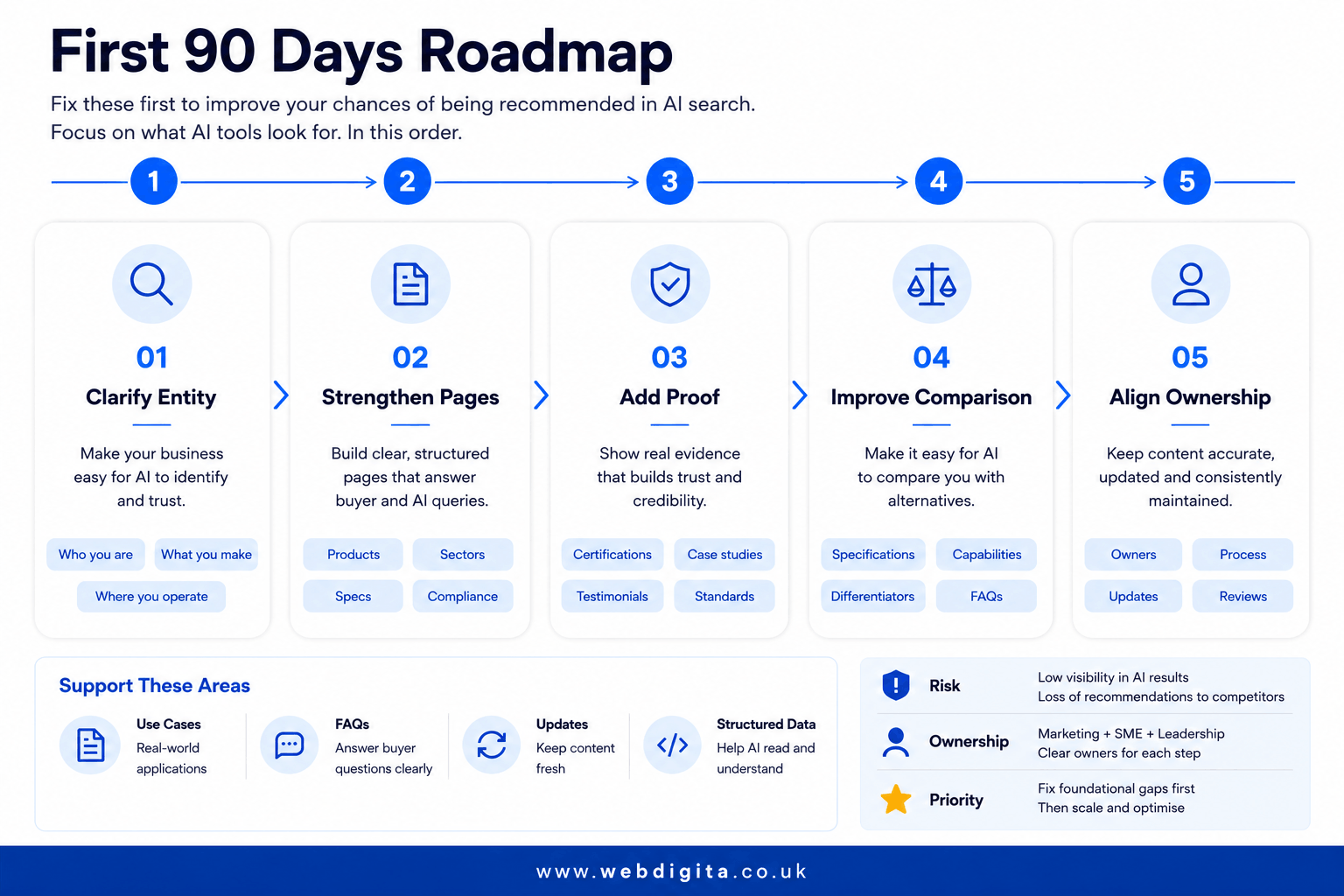
First 90 days
- Clarify the entity: make sure your company, product families, sectors served, and locations are described consistently across core pages and external directories.
- Strengthen key product and category pages: add plain-English application context, technical detail, and buyer-fit language that answers the questions a procurement lead or engineer would actually ask.
- Add visible proof: bring certifications, standards, tolerances, and compliance evidence onto the page where buyers need it – not just in PDFs.
- Improve comparison content: help buyers understand when your solution is right for their use case, and when another route may fit better. Being honest about fit builds more trust than generic positioning.
- Align ownership: agree who owns product truth, documentation updates, and ongoing evidence hygiene. Without this, the site drifts back within six months.
We see this a lot: the first round of fixes works, then the site drifts because nobody owns updates after launch. If you want recommendation gains to hold, you need a maintenance rhythm for product data, documentation, and trust signals – much like keeping any high-stakes digital platform reliable after go-live.
This is a shared process, not a one-off SEO task, and it works best when marketing, product, and sales are aligned on what the evidence should say and who keeps it current. If you want a clearer view of the highest-impact gaps, the next sensible step is a personalised roadmap showing what to fix first, what can wait, and where recommendation trust is currently breaking down.
Questions manufacturers ask about AEO and AI-driven supplier search
Practical answers for technical sales teams, marketing leads, and procurement-facing businesses preparing for answer engine visibility.
1. What is AEO for B2B manufacturers?
AEO for B2B manufacturers means optimising your digital footprint so AI tools and answer engines can confidently recommend your business when buyers ask for suppliers by product type, application, certification, or sector fit. It is not just about being indexed or ranking somewhere. It is about being selected into the answer because your entity signals, technical proof, and product evidence are clear, citable, and comparison-ready. Manufacturers improve their chances by making it easy for AI systems to verify what you make, who it is for, what standards you meet, and why your offer is distinct.
2. Why are manufacturers not being recommended even when they rank in search?
Manufacturers often rank but are not recommended because their digital footprint lacks the structured signals AI tools need to verify supplier fit. Common issues include thin product pages, missing certifications or compliance detail, vague application context, and inconsistent entity information across the site and wider web. Answer engines lean towards suppliers they can understand, compare, and trust. If your technical knowledge lives in unlabelled PDFs or your product pages rely on broad claims without proof, AI systems cannot safely cite or shortlist you, even if your business is well known offline.
3. What are the most important signals for manufacturer recommendation readiness?
The most important signals are entity clarity, technical credibility, citable usefulness, comparison readiness, and trust consistency. Entity clarity means your company name, locations, sectors served, and product families are consistent across your site and the wider web. Technical credibility includes visible specifications, certifications, compliance evidence, and documentation tied to the right products. Citable usefulness means your pages answer real buyer questions in plain language. Comparison readiness shows where your offer fits by application and capability. Trust consistency means the same story appears across product pages, company pages, directories, and distributor mentions.
4. How do I know if my product pages are strong enough for AEO?
Your product pages are strong enough for AEO if they clearly show what you make, who it is for, what standards you meet, and why your offer is distinct, all in plain HTML rather than buried in PDFs. Check whether certifications and compliance claims are tied to specific products or use cases, whether industry fit is stated rather than implied, and whether your company pages and product pages feel connected with visible proof. If engineers or procurement teams have to guess relevance, or if your site describes the business differently from distributor listings and directories, your pages are not yet recommendation-ready.
5. What should manufacturers fix first to improve AEO?
Manufacturers should start by clarifying the entity, strengthening key product and category pages with application context and technical detail, adding visible proof such as certifications and compliance evidence, improving comparison content, and assigning clear ownership for ongoing updates. Do not jump straight to thought leadership or broad AI content before fixing the foundational signals. Focus on the pages and evidence most likely to influence shortlist decisions, and treat this as a shared process across marketing, product, technical, and sales teams rather than a one-off SEO task.
6. Can AEO help manufacturers get better-fit enquiries?
Yes, AEO can help manufacturers get better-fit enquiries by making it easier for AI tools to understand when your business is a good supplier match for specific applications, certifications, or sector requirements. When your digital footprint clearly shows product capabilities, technical proof, and buyer fit, answer engines can confidently recommend you to the right buyers rather than surfacing your business for vague or irrelevant queries. This improves enquiry quality because the buyers who contact you have already been matched to your actual offer based on structured, citable evidence.
7. How long does it take to see results from AEO improvements for manufacturers?
Most manufacturers see early signals within the first 90 days if they focus on clarifying entity signals, strengthening key product pages, and adding visible technical proof. However, sustained recommendation gains depend on ongoing evidence hygiene and trust consistency across the site and wider web. If you fix the foundational layers but do not assign ownership for product data updates, documentation maintenance, and signal alignment, the gains will drift. Treat AEO as a continuous process rather than a one-off project, and expect recommendation confidence to build as your structured signals strengthen over time.
Conclusion
- Clarify your entity and product families across core pages: make sure your company name, locations, sectors served, and product range are described consistently so AI tools can connect your business to the right buyer questions.
- Strengthen product and category pages with plain-English application context and technical proof: bring certifications, standards, tolerances, and compliance evidence onto the page where buyers and answer engines need it, not buried in PDFs.
- Build comparison readiness into your content: help buyers understand when your solution is the right fit and when another route may work better, so AI tools can confidently shortlist you for the right use cases.
- Assign ownership for ongoing evidence hygiene: recommendation gains will drift if nobody owns product truth, documentation updates, and trust signal consistency after the first round of fixes.
If you need clearer recommendation readiness before your next product launch or site update
We help B2B manufacturers strengthen the supplier signals that matter most in AI-driven search. That means clearer entity structure, better product and application pages, visible technical proof, and content that helps answer engines understand when your business is the right fit.
See our B2B lead generation servicePrefer to talk first?