Key Takeaways
A credible B2B SEO agency should make the delivery model easy to inspect before you sign. The strongest proposals show how search strategy, technical work, content quality, reporting, and team ownership connect to qualified demand rather than just traffic movement.
| What to check | What it tells you |
|---|---|
| Keyword and page priorities | Whether the agency understands buyer intent and conversion paths, not just search volume. |
| Technical issue ownership | Whether audits will turn into implemented fixes instead of sitting in reports. |
| Content production process | Whether specialist B2B content will be reviewed properly or pushed out at volume. |
| Reporting logic | Whether the agency can explain business progress when rankings and lead quality move in different directions. |
Most SEO agencies sell visibility. That is easy to package and easy to pitch. A polished proposal, a rising rankings graph, and a tidy dashboard can make a weak retainer feel safe – until six months later you are still asking why lead quality has not improved, why sales is ignoring the traffic, and why technical issues are somehow still “in progress”.
The short answer: A serious B2B buyer should evaluate an SEO agency on pipeline relevance, not rankings. That means assessing whether they understand buyer-journey complexity, can map keyword research and content clusters to actual buying stages, demonstrate technical audit depth with clear implementation ownership, apply SME-led content quality controls, structure content for featured snippets and entity-led discovery, and report on business outcomes – not just sessions and positions.
The real issue in B2B buying cycles is not visibility alone. It is whether the agency understands your buyer journey, makes sensible commercial trade-offs, works with your team effectively, and turns search demand into conversations that actually matter.
This selection guide is for founders, CMOs, and heads of growth comparing SEO partners, reviewing proposals, or preparing shortlist meetings for a serious B2B growth mandate.
Why rankings and dashboards are a weak buying filter
Rankings are not useless, but they are a poor primary buying filter for a serious B2B SEO agency. In long sales cycles, low search volume and niche SERP intent often matter more than raw traffic. The question is not whether the agency can improve visibility – it is whether they can improve qualified demand.
The pattern we see most often in failed B2B SEO engagements is consistent: agencies over-index on ranking reports and under-deliver on lead quality, content depth, and technical follow-through. That gap between what is reported and what actually reaches sales is where most retainers lose commercial credibility – and where buyers who relied on dashboard metrics get surprised.
A realistic example: a CMO is comparing two agencies. One promises traffic growth and a bigger keyword footprint. The other maps keyword research, content clusters, internal links, and landing-page intent to actual buying stages – connecting SERP intent to pipeline, not just sessions. If you are choosing between those two, do not assume the better-looking dashboard is the safer choice.
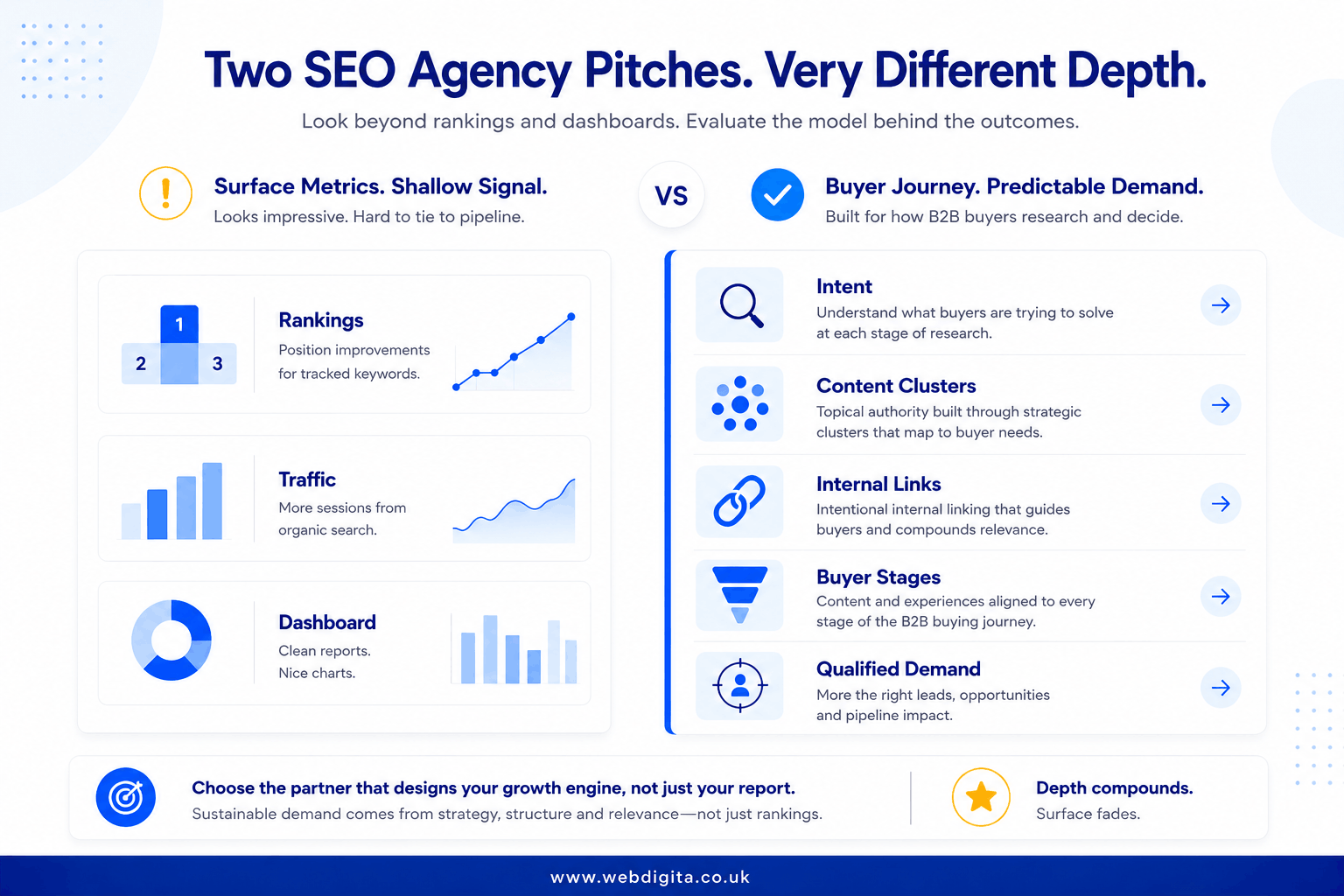
That gap gets wider in London markets such as SaaS, property, and professional services, where SERPs are crowded and credibility standards are higher. Shallow content, weak E-E-A-T signals, and generic authority tactics get exposed quickly. Ask how the agency plans to compete where topical authority and subject depth matter more than volume.
- They talk about rankings far more than lead quality or pipeline relevance.
- They show dashboards, but not how decisions are made or prioritised.
- They cannot explain who owns technical fixes after the audit.
- They promise content output without showing SME review or QA controls.
- They avoid discussing assumptions, dependencies, or commercial trade-offs.
What serious buyers should inspect before they sign
Inspect the operating model, not just the pitch. A strong agency should be able to show how strategy, technical SEO, content production, authority building, and reporting work together as one system.
Strategy depth: ask how they handle buyer-journey complexity. In B2B, keyword research should not stop at search volume. You need to check whether they can separate research intent from buying intent, build content clusters around real commercial questions, and support the conversion path with sensible internal links and page priorities. Agencies that treat topical authority as a content output target – rather than an entity-led structure tied to SERP intent – rarely close the gap between traffic and pipeline.
Technical depth: ask what a proper audit would reveal in month one. A credible team should explain crawl and indexation issues, schema markup, site architecture, rendering, and implementation ownership in plain English. My view, having reviewed agency proposals and technical scopes across B2B SaaS and professional services engagements, is that the clearest signal of delivery maturity is whether the response is a prioritised action list with sequenced ownership – not a long findings document. If you are hearing vague phrases instead, push on that before anything is signed. For teams needing clearer scope before work starts, a project discovery workshop can help surface assumptions early.
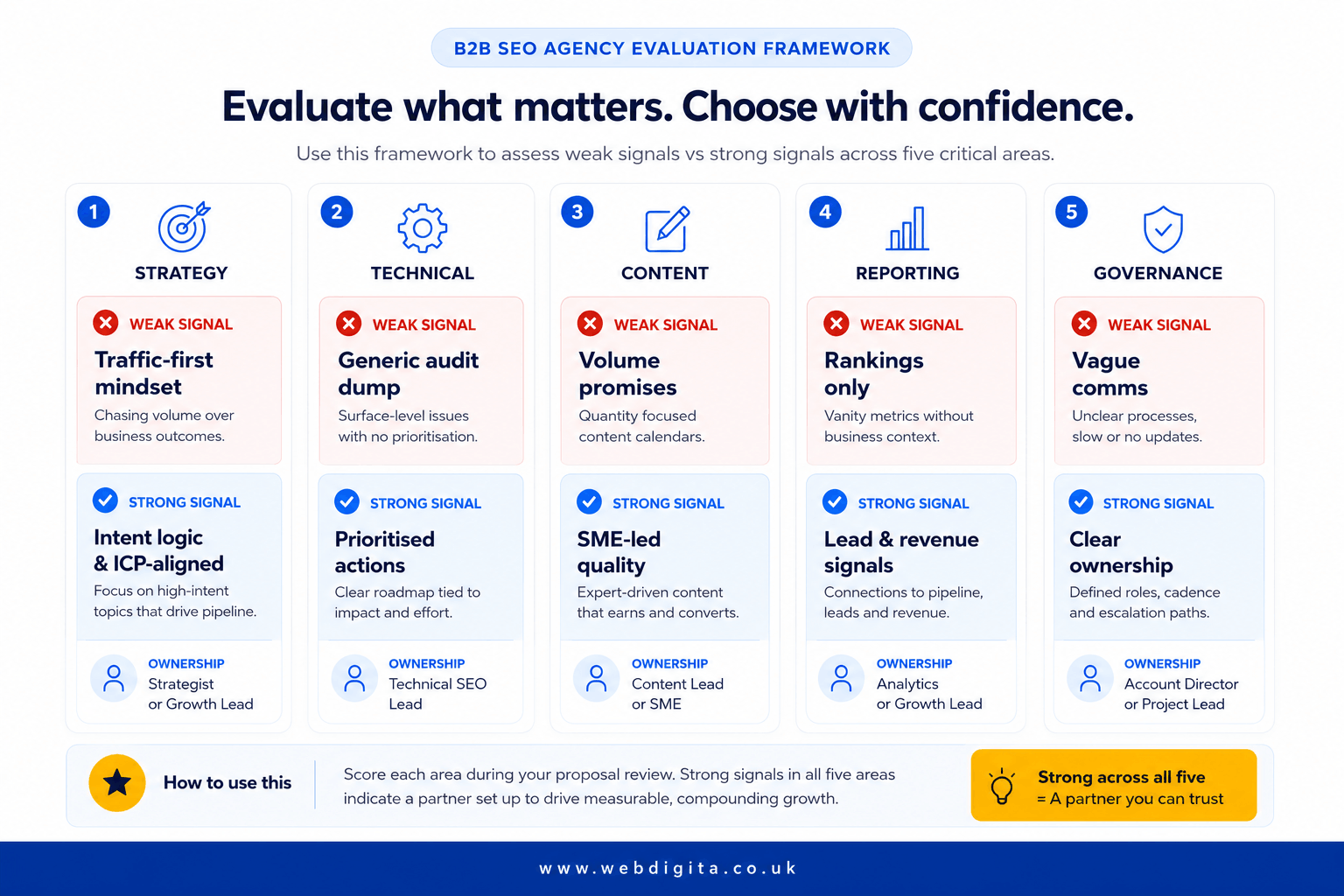
| Area | Weak signal | Strong signal |
|---|---|---|
| Strategy | Traffic-first plan | SERP intent, pipeline, and conversion-path logic |
| Technical | Generic audit summary | Prioritised issues with ownership and sequencing |
| Content | Volume promises | SME input, editorial QA, and topical authority depth |
| Reporting | Rankings and sessions only | Assumptions, lead signals, and business review points |
| Governance | Loose comms and vague deliverables | Clear roles, approvals, access, and follow-through |

Not sure how strong an SEO proposal really is
We can review the strategy, technical depth, reporting logic, and delivery model with you before you commit, so weak retainers are easier to spot early.
Useful if you are comparing agencies right now
Questions that expose delivery depth quickly
You do not need a long checklist. You need questions where the answer – or the evasion – tells you something real about how the agency actually operates. For each question below, what matters is not the question itself but what the response reveals.
- How will you decide which keywords and pages matter for qualified demand, not just traffic?
A strong answer ties keyword research to SERP intent by buying stage, distinguishes informational from commercial queries, and identifies the specific page types that support conversion. A weak answer leads with search volume and domain authority. - What happens after you find technical issues, and who owns implementation?
A strong answer names a workflow – what gets escalated, who fixes it, and in what sequence. A weak answer says “we flag it to your dev team” without a prioritisation or ownership process. - How do you stop specialist B2B content from becoming thin or generic?
A strong answer describes SME involvement, editorial review, and how entity SEO and content clusters are maintained over time. A weak answer talks about word count targets or topic coverage breadth. - What will you report on if rankings improve but lead quality does not?
A strong answer shows reporting tied to business signals – not just positions – and a process for diagnosing conversion or intent mismatches. A weak answer restates that more rankings means more traffic means more leads.
A common failure mode is an agency recommending high content output when the real issue sits in indexation, weak page templates, or poor conversion paths. This shows up when reporting looks busy but the underlying site and content model were never strong enough to support revenue intent.
If you are also comparing agencies on broader digital delivery, the same discipline applies to B2B SEO agencies in London: the proposal should make ownership, scope, and execution logic obvious before signature.
A meeting-grade scorecard for shortlisting the right SEO partner
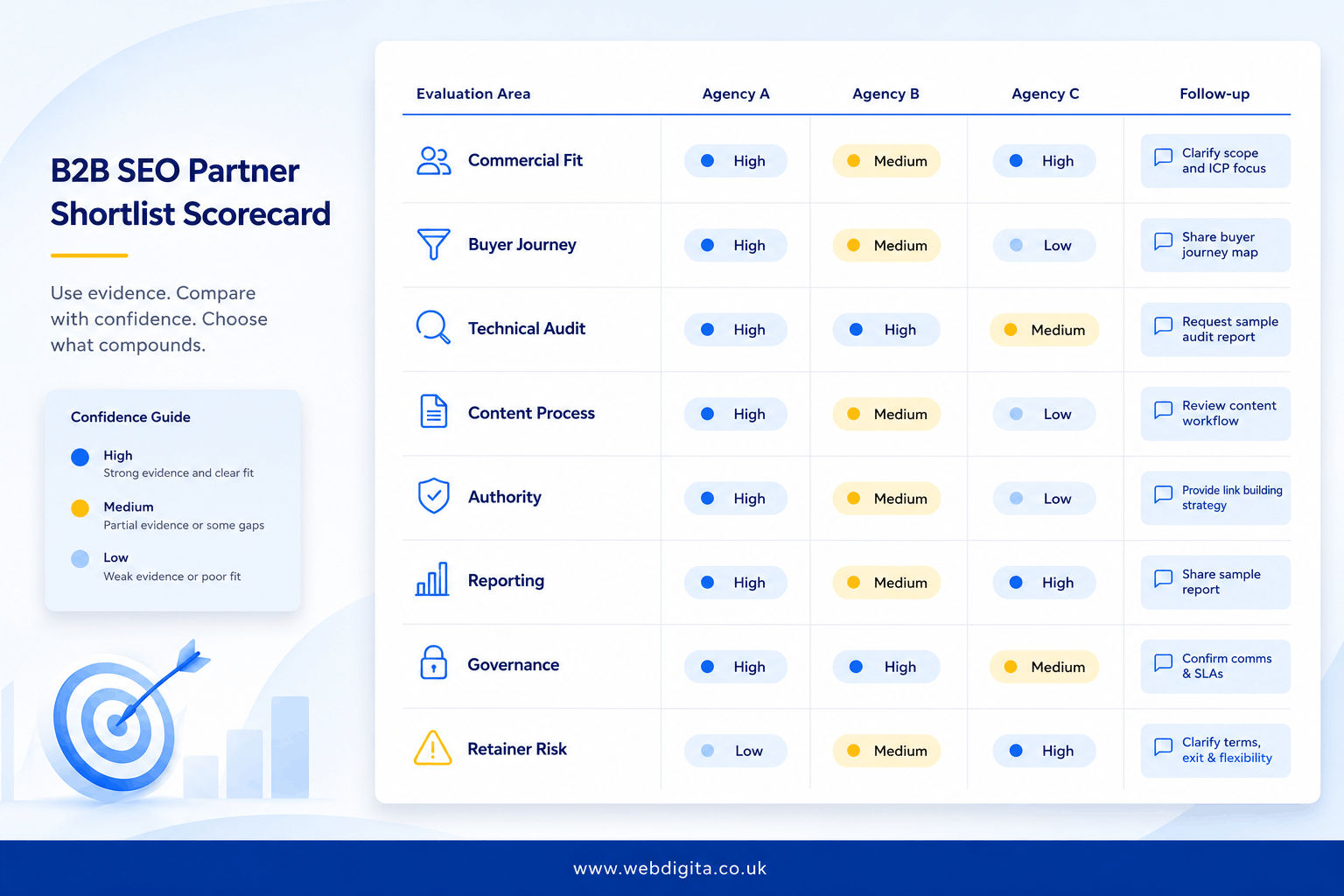
If you want to make shortlist meetings more objective, use the scorecard below. Mark what each agency actually showed, note what still feels unclear, and keep the conversation grounded in evidence rather than presentation polish.
WEBDIGITA SEO Partner Evaluation Scorecard: use this to compare agencies on the things that usually decide delivery quality after the contract is signed.
| Criteria | Evidence seen | Confidence level | Follow-up question |
|---|---|---|---|
| Commercial fit | Did they connect SEO to pipeline, SQLs, or sales quality? | High / Medium / Low | How will success be judged beyond traffic? |
| Buyer-journey understanding | Did they map SERP intent by stage and stakeholder? | High / Medium / Low | Which pages support each stage? |
| Technical audit depth | Did they show prioritised issues and ownership? | High / Medium / Low | Who implements and in what order? |
| Content and SME process | Did they explain QA, expertise input, and review flow? | High / Medium / Low | How do they prevent thin specialist content? |
| Authority strategy | Did they explain how topical authority will be built? | High / Medium / Low | What is the plan beyond generic links? |
| Reporting maturity | Did they include assumptions, lead signals, and review logic? | High / Medium / Low | What happens if rankings rise but leads do not? |
| Communication and governance | Were roles, access, approvals, and cadence clear? | High / Medium / Low | Who owns follow-through on both sides? |
| Retainer risk | Are deliverables vague, generic, or guarantee-led? | High / Medium / Low | What exactly is included each month? |
Do not choose the agency with the best presentation. Choose the one with the clearest operating model, the strongest judgement on commercial trade-offs, and the fewest hidden assumptions.
Watch for red flags in retainers: vague monthly outputs, ranking guarantees, generic reporting, unclear role-based access, and no explanation of technical follow-through. If you are hearing “we will optimise continuously” without specifics, treat that as a commercial risk, not a comfort.
And if your business model and shortlist involves B2B eCommerce SEO Services, the ongoing SEO support only works when responsibilities, response expectations, and boundaries are clear before work begins.
If an agency cannot explain how it will improve qualified demand, work with your team, and report on business progress before signature, it is not ready for shortlist approval.
Questions buyers ask about choosing a B2B SEO agency
These are the points that usually matter once proposals, shortlist meetings, and retainer risk come under proper scrutiny.
1. Why are rankings a weak way to choose a B2B SEO agency?
Rankings are a weak primary filter because they do not show whether SEO is improving qualified demand. In B2B markets, low-volume high-intent searches, long buying cycles, and complex conversion paths matter more than headline visibility. A better test is whether the agency can connect keyword choices, content priorities, and technical work to sales-relevant outcomes.
2. What should a serious buyer inspect before signing an SEO retainer?
A serious buyer should inspect the agency's operating model before signing. That means looking at strategy depth, technical audit quality, content QA, reporting logic, and governance. You want to see how decisions are prioritised, who owns implementation, and how progress will be judged if traffic rises but lead quality does not.
3. What are the clearest red flags in an SEO proposal?
The clearest red flags are vague deliverables, ranking guarantees, generic reporting, and unclear technical ownership. Another warning sign is heavy emphasis on dashboards without explaining how decisions are made. If an agency cannot show assumptions, dependencies, and commercial trade-offs, the retainer may look safer than it really is.
4. How can you tell if an agency understands the B2B buyer journey?
You can tell by how the agency talks about intent, page roles, and conversion paths. A strong B2B SEO agency will separate research intent from buying intent, map content to stages of the journey, and explain which pages support evaluation and enquiry. If the discussion stays at keyword volume level, depth is probably missing.
5. What should an SEO agency report on besides rankings and traffic?
An SEO agency should report on lead signals, assumptions, business review points, and what actions follow from the data. Rankings and sessions still matter, but they are not enough on their own. Good reporting helps you understand whether SEO is attracting the right audience and where the conversion path is helping or leaking demand.
6. Why does technical ownership matter so much in B2B SEO?
Technical ownership matters because many SEO problems are not solved by finding them. If nobody is clearly responsible for implementation, audits turn into backlog documents and progress stalls. A credible agency should explain what it expects to find, how issues will be prioritised, and who will fix what on both the agency and client side.
Conclusion
If you are shortlisting agencies, the safest choice is usually the one that makes its thinking easiest to test. A polished deck can hide weak delivery, but a clear operating model is much harder to fake.
- Start with commercial fit: check whether the agency can connect SEO work to qualified demand, sales conversations, and the pages that support buying decisions.
- Test execution realism: ask who owns implementation, approvals, SME input, and follow-through once the contract starts.
- Pressure-test reporting: make sure they can explain what they will do if visibility improves but lead quality does not.
- Choose on clarity: when an agency can show priorities, trade-offs, and responsibilities in plain English, you are usually looking at a lower-risk partner.
Need an SEO partner built around qualified demand, not vanity metrics
Our SEO service is designed for businesses that need technical clarity, stronger content judgement, and reporting tied to commercial outcomes rather than rankings alone.
Explore our SEO serviceStill weighing up your options