Key Takeaways
If a redesign matters commercially, the strategy underneath has to be settled first.
- Visual improvement is not enough. If positioning, service priority and proof are still unclear, a new interface will only package the same confusion more neatly.
- London raises the bar quickly. Buyers judge trust, relevance and capability fast, so the site needs a clear hierarchy and stronger qualification from the first visit.
- Alignment comes before design. Leadership, sales and marketing need agreement on target clients, priority services, proof and success criteria before UI work starts.
- Lead quality depends on structure. Better forms, clearer CTAs and stronger routing help the site qualify interest instead of inviting broad, low-fit enquiries.
- A strategy-led provider asks harder questions early. That friction usually protects the investment rather than slowing it down.
Competing in London? Your B2B website is not compared to local peers. It is compared to the best digital experiences your buyers already trust – the consulting firm they shortlisted last week, the SaaS product that onboarded them in minutes, the professional services brand that made fit immediately clear.
Before a high-stakes redesign, a London B2B service firm should align on market positioning, service hierarchy, differentiation, proof strategy, lead qualification paths, CRM handoff, and stakeholder agreement on success criteria. Without that foundation, you are changing the visual hierarchy but not the commercial signal – and serious buyers will still leave without enough confidence to continue.
A high-stakes redesign usually gets approved when leadership no longer trusts how the firm looks online. But the bigger risk is rarely visual age on its own. It is that the site no longer signals clearly enough who you are best for, what you want to be known for, or why a serious buyer should keep going.
That gap shows faster in London. Buyers are not just comparing you with nearby firms. They are comparing your presentation with the clearest digital experiences they already trust. If positioning, service priority, proof and qualification are still unsettled, a redesign will only give the same confusion a cleaner surface. If that sounds familiar, I would start with a project discovery workshop in London before any serious UI direction is approved.
Why London raises the redesign standard before design even starts
A London B2B service firm can look credible on paper and still feel uncertain online. That usually happens when the first impression says one thing, the service pages say another, and the proof does not hold the story together. That is a strategy problem before it becomes a UX or design problem.
Picture a senior buyer landing on your site after a referral. They are short on time, the market already feels crowded, and they are trying to judge fit quickly. If the service hierarchy is blurred, partner expertise is buried, and every call to action sends them to the same generic enquiry form, they may not think your firm looks poor. They simply leave without enough confidence to continue.
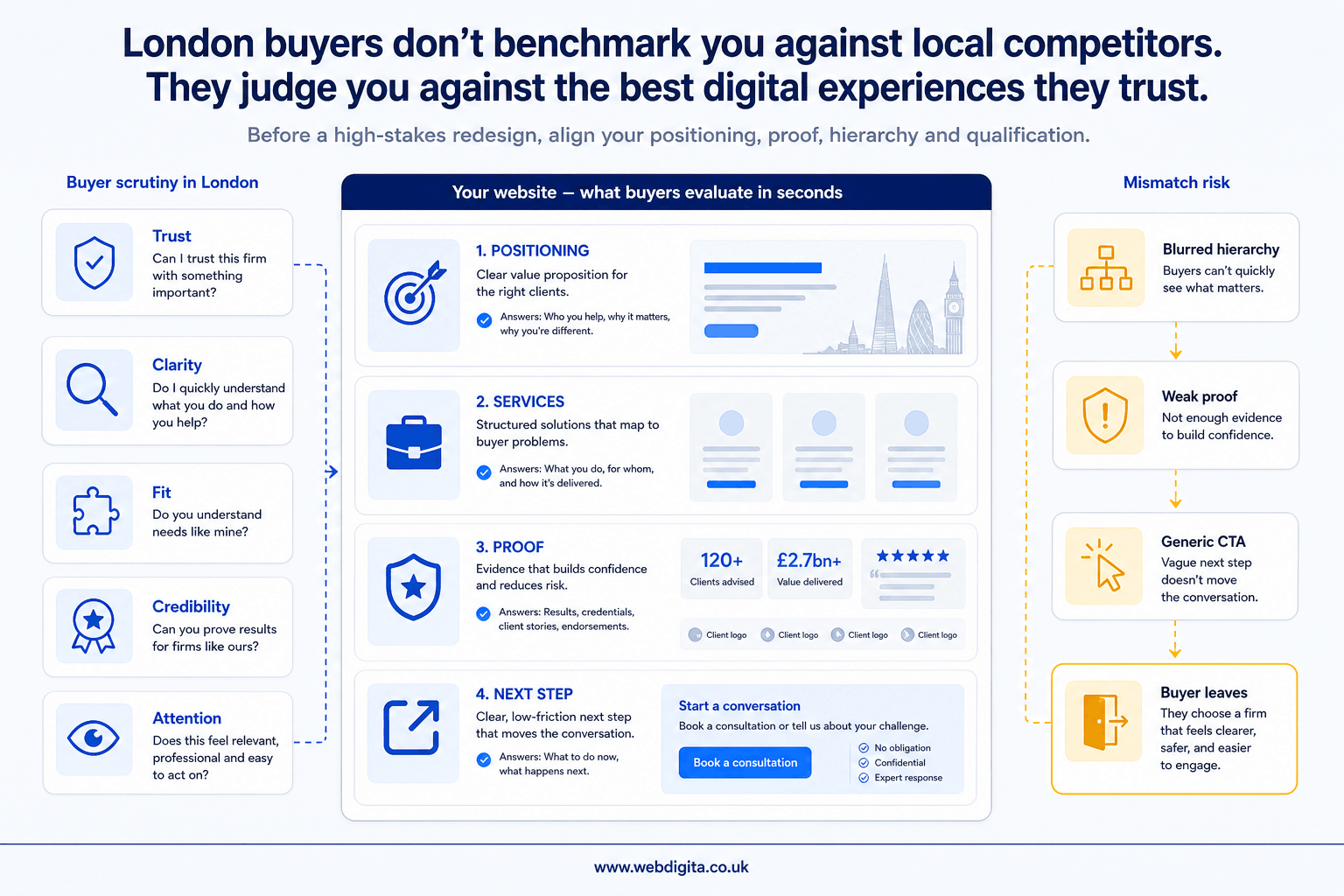
The pressure in London: attention is expensive, expectations are high, and trust is judged quickly. The site has to signal the right level of capability in the first minute – not just contain more information. That matters even more if you want to win higher-value work, charge stronger fees, or move into a more selective part of the market.
A design-first redesign often improves the surface but keeps the same uncertainty underneath. A positioning-led redesign changes the hierarchy, proof and conversion design so the site feels more assured because the business case behind it is more assured.
If the website cannot express your commercial position clearly, redesigning the interface alone will not fix the hesitation buyers feel.
What must be aligned before a high-stakes redesign
This is the part many firms rush. They brief a B2B web design agency on pages, visuals and references before agreeing the commercial logic underneath. If you want the redesign to improve lead quality rather than just appearance, you need alignment on what the business is trying to signal and how the site should help qualify interest.
- Positioning: define who you want to win, what you want to be known for, and what you should stop sounding like.
- Service hierarchy: decide which services lead, which support, and how navigation reflects commercial priority rather than internal org structure.
- Differentiation: identify what a buyer should understand quickly that similar firms do not explain well.
- Proof strategy: agree which trust signals matter most – from case evidence and sector credibility to partner expertise and founder visibility where relevant.
- Lead paths and qualification: decide what each key page and its landing pages should ask the buyer to do, what counts as a qualified enquiry, and what sales needs to judge fit.
- Content depth and ownership: decide where sharper explanation is needed and who signs off message, proof and success criteria.
Do not assume more pages means more clarity. Often the issue is weak composition, not lack of volume. A service page that explains the problem, fit, proof and next step properly will usually outperform a sprawling site full of partial answers.
This is where things often go wrong for referral-led firms. Sales knows which enquiries are worth taking, but the website still invites broad, low-fit contact. Forms should capture the basics sales actually needs – service line, budget range, sector fit, urgency or location. Routing should then send the enquiry to the right person quickly, not leave everyone sorting it out by email afterwards.
Stakeholder alignment matters just as much. If leadership, sales and marketing do not agree on message, priority services and success criteria before design starts, the project typically turns into rounds of visual opinion rather than clear commercial decisions.

Not sure your redesign brief is solving the right problem
If positioning, proof, service priority or lead qualification still feel unclear, a discovery workshop can surface the gaps before design decisions start locking them in.
A practical first step before visual direction is approved
How to tell whether a provider is strategy-led or just design-led
The difference shows up early. A design-led provider moves fast into references, layouts and visual direction. A strategy-led provider slows the conversation first – asking what the site must signal, where trust is weak, which services deserve prominence, how proof should be structured, and how sales wants qualification to work. That friction is useful because it protects the investment.
My view, having assessed repeated project outcomes across positioning-led and design-first builds, is that the distinction is not theoretical. Positioning-led projects consistently produced stronger commercial results – not because the UX or visual hierarchy was better in isolation, but because differentiation and qualification were resolved before any interface direction was set. Conversion design decisions made on top of unclear positioning tend to get revisited within six to twelve months. The redesign then costs more than it needed to.
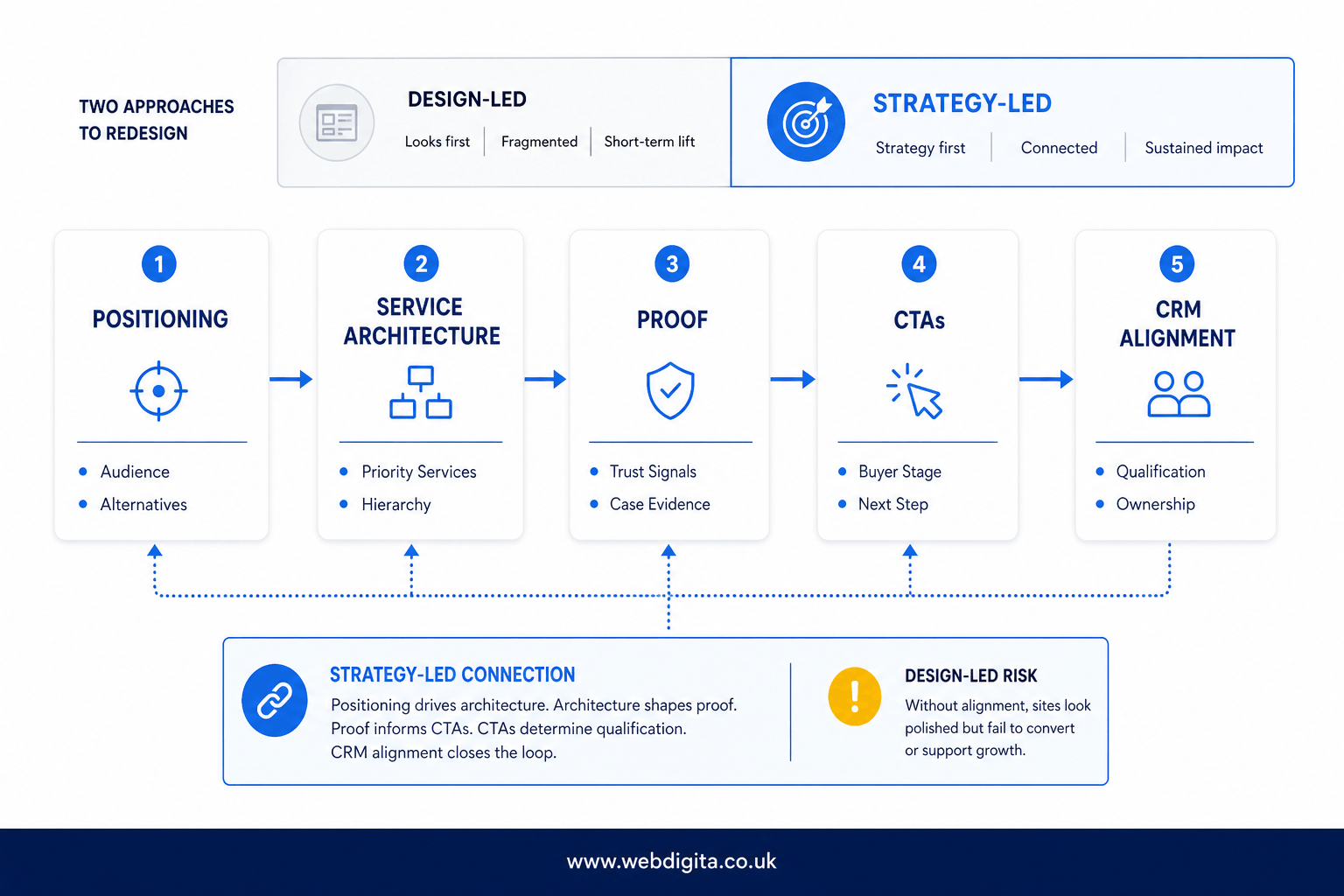
Service-firm redesign strategy canvas
Before design systems, responsive layouts or page speed are discussed, a strategy-led provider should be able to work through these five areas with you:
- Positioning: Who do you want to win, for what, and against which alternatives? If that answer is vague, every homepage headline will be vague too.
- Service architecture: Which services lead the story and which support it? This shapes visual hierarchy, navigation and page priority – not the other way around.
- Proof: What evidence reduces doubt fastest – sector experience, client outcomes, methodology, team credibility, or founder authority? Use the proof that matches the buyer’s real concern, not what is easiest to publish.
- Conversion design: What should a cold visitor, a warm evaluator and a ready buyer each do next? One generic contact prompt rarely fits all three stages.
- CRM alignment: What must be captured, routed and scored so sales can judge fit quickly? If the handoff is weak, the site generates leads but still creates friction downstream.
If you are evaluating providers, ask direct questions. Ask what they need to know before recommending page structure. Ask how they handle stakeholder disagreement on service priority. Ask how they define a qualified enquiry, what fields they would capture, and how that changes CTA design. Ask what happens after launch if the site needs refinement, integration planning or broader delivery support such as website maintenance services or WordPress Website development in London.
The honest answer is simple: if these areas are still unsettled, you are not ready for design production. You are ready for discovery. For a London service firm making a visible, high-value change, that is usually the safer move – and the one most likely to produce a redesign that feels clear, credible and commercially aligned.
Questions buyers ask about B2B website strategy in London
These are the practical questions that usually come up before a service firm commits to a visible redesign.
1. Why is strategy more important than design at the start of a redesign?
Strategy is more important first because design cannot fix unclear positioning. If your firm has not agreed who it wants to win, which services matter most, and what proof builds trust, the new site may look better but still leave buyers unsure whether to continue.
2. What should a London service firm align before approving a redesign?
A London service firm should align positioning, service hierarchy, differentiation, proof strategy, lead qualification and content ownership before approving a redesign. Those decisions shape navigation, page priority, calls to action and enquiry handling. Without them, projects often drift into subjective design debate instead of clear commercial choices.
3. How can you tell if a web partner is strategy-led or just design-led?
You can usually tell in the first conversations. A strategy-led partner asks what the site must signal, which services should lead, where trust is weak and how sales defines a qualified enquiry. A design-led partner tends to move straight into visual references, layouts and style direction.
4. Will adding more pages improve lead quality?
No, more pages do not automatically improve lead quality. If the structure is weak, extra pages often add more noise rather than more clarity. A smaller set of well-composed pages that explain fit, proof, service value and next steps clearly will usually perform better than a sprawling site full of partial answers.
5. What makes London a tougher environment for B2B website redesigns?
London is tougher because buyer expectations are higher and attention is harder to win. Prospects are not only comparing you with direct competitors. They are comparing your site with the clearest digital experiences they already trust, so weak hierarchy, vague messaging and generic calls to action get exposed faster.
6. What should website forms capture if lead quality matters?
Website forms should capture the information sales actually needs to judge fit quickly. That often includes service line, budget range, sector fit, urgency or location. The goal is not to make forms longer for the sake of it, but to collect enough context to route enquiries properly and reduce low-fit conversations.
Conclusion
A high-stakes redesign is usually less about making the firm look newer and more about making the business easier to understand, trust and buy from. If the commercial story is still unsettled, design production starts too early.
The sensible next step is to pressure-test the basics before anyone commits to layouts or visual direction: who the site is for, which services lead, what proof reduces doubt fastest, and how qualified enquiries should be captured and routed. When those decisions are clear, the redesign has a far better chance of improving lead quality rather than just appearance.
Start with strategy before you commit budget to redesign production
Our London discovery workshop helps B2B service firms align positioning, service hierarchy, proof, CTA paths and qualification needs before design and build begin.
View discovery workshopStill weighing up the fit