Key Takeaways
A competitive quote means very little if the scope is vague. Before sign-off, make sure the commercial detail is written down in a way that can actually be tested and accepted.
- Separate included, assumed, and excluded work. If those blur together, the price is not reliable.
- Push past broad labels like payment gateway integration or product import. You need triggers, failure handling, ownership, retries, and sign-off criteria.
- Get clear responsibility for content, migration, QA, UAT, and launch-day tasks. Unclear ownership is where delays and budget creep usually start.
- Check the quote covers non-functional requirements too, including performance, browser support, security, reliability, and environment setup.
- Treat missing exclusions, rollback planning, defect rules, and change control as warning signs, not minor admin gaps.
Most over-budget eCommerce builds start with under-defined scope – not bad agency work. Integrations get waved through with vague wording, migration becomes a line item, QA gets mentioned as if that proves anything, and UAT quietly becomes your problem. Then the build starts, edge cases appear, inventory sync fails, launch tasks get disputed, and the budget moves.
The short answer: Before approving any eCommerce development quote, you need written scope covering functional requirements, non-functional requirements, named integrations with failure handling, content migration assumptions, QA coverage, UAT ownership, launch tasks, warranty terms, exclusions, and change request rules. If any of those are implied rather than written, the quote is not ready for sign-off.
This is a sign-off checklist for buyers comparing agency proposals and trying to close scope gaps before contract signature – whether you are reviewing a quote from a Shopify agency in London or any other ecommerce website development agency.
If the eCommerce development quote is built on assumptions, the price is not real
Two quotes can sit close on price and still describe very different jobs. One may include migration mapping, integration testing, and launch support; the other assumes your team handles half of that, and only surfaces the gap once delivery is under way.
Written scope beats implied intent. If a line item cannot be tested, reviewed, or signed off, it is not scoped well enough. Pretty demos do not prove operational stability. Edge cases do.
Keep three things separate: what is included, what is assumed, and what is excluded. If those blur together, pause approval. Terms like “payment gateway integration” or “product import” do not mean much on their own. You need to know what happens when data conflicts, inventory sync fails, or an order only partially captures payment.
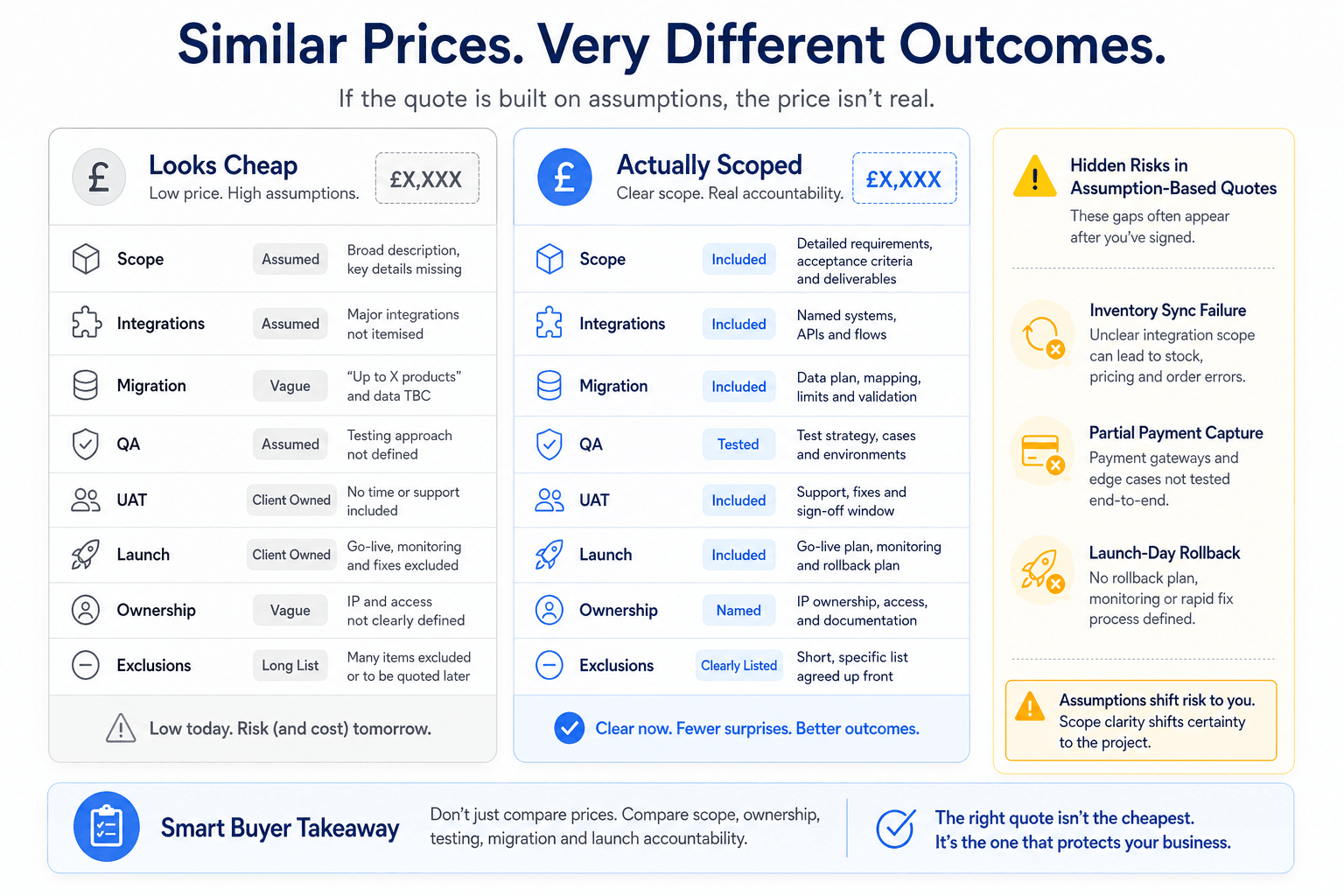
The scope sections that must be written down before sign-off
You need the quote to define both what the customer sees and what the system has to survive. If either side is vague, the build is under-scoped.
Functional Requirements: Name the storefront features, checkout UX, account flows, promotions, search, filters, CMS integration needs, and any platform-specific requirements for Shopify, WooCommerce, Magento, or headless commerce. The quote should also say what is standard configuration, what needs custom development, and what is out of scope.
Non-Functional Requirements: Write down performance expectations, browser and device support, security, reliability, and any real scalability limits. “Optimised” is not a requirement. It is filler.
Integrations and Environments: Each integration should define triggers, data direction, failure handling, retries, conflict rules, and ownership. That applies to payment gateways, ERP, inventory sync, shipping, tax, CRM, and CMS integration. If you are reviewing a quote from a WooCommerce agency in London, push on staging, production, deployment method, access, and what your team must provide – and by when.
A vague line like “payment gateway integration” should become something you can test: supported payment methods, refund behaviour, partial capture handling, failure states, test coverage, and sign-off criteria. That is the difference between a quote and a controlled scope.

Not sure your quote covers the risky parts properly
We can review the scope for gaps in integrations, migration, QA, UAT, launch ownership, and exclusions before you sign anything.
Useful before approval or final supplier selection.
Who owns content, data, testing, and sign-off
Across eCommerce builds, the most consistent driver of budget creep is not technical complexity – it is the point at which everyone discovers their assumptions about integration testing, data migration, and UAT ownership were pointing in different directions. By then, defects are live, sprints are closed, and the budget for resolving it cleanly is already gone. That pattern repeats regardless of platform, agency size, or project value.
Content and Data: The quote should state what is being migrated, cleaned, mapped, imported, and checked. Ask who supplies source exports, who validates mapped fields, and who signs off redirects, customer accounts, order history, blog content, media, and product attributes. If data quality work is not named, do not assume it is covered.
QA and UAT: The scope should say what the agency tests, what you test, who owns test scripts, who provides test data, who logs defects, and what formally counts as acceptance. These are not process details – they are the boundary between what the agency delivers and what becomes your cost.
If UAT ownership is vague, sign-off will be vague as well. And vague sign-off is how defects turn into arguments.
You should also check whether edge cases sit inside test coverage: partial captures, refunds, failed inventory sync retries, coupon conflicts, stock mismatches, and similar failure modes. If they matter to the business, push on them before approval – not after sprint one.
Annotated scope checklist: mandatory, optional, and risky omissions
Use this as a quick approval filter. If several mandatory items are missing, pause the quote. If a risky omission appears, ask for written clarification before you sign.
- Mandatory – approve only if written: functional requirements, non-functional requirements, named integrations, migration assumptions, staging and production environments, QA coverage, UAT ownership, launch tasks, handover, warranty period, exclusions, and change request rules.
- Optional – clarify if relevant: post-launch optimisation, CRO testing, advanced reporting, extra training sessions, extended support hours, and phased releases after go-live.
- Risky omissions – pause if missing: failure handling for integrations, data clean-up responsibility, browser and device coverage, rollback plan, defect severity rules, sign-off criteria, access dependencies, and who is on point during launch.
Missing exclusions are not a nice surprise. They are a warning sign. If a major area is named without behaviour, ownership, or acceptance criteria, the quote is not ready for approval.
What to lock down on launch, support, exclusions, and change requests
Launch week is where weak scope becomes expensive. By then, nobody wants an argument about what was or was not included.
I leads solution scoping at Webdigita and audits agency proposals before clients sign and make this point consistently: the warranty clause is where most defect disputes start. If the bug-fix window is not defined by duration, coverage, and response expectation in the quote itself, it will be interpreted differently by every party once go-live pressure arrives.
Before sign-off, get written answers on each of the following:
- Launch and handover: deployment steps, rollback ownership, smoke testing scope, launch-day contacts, monitoring setup, documentation, training, and who is reachable after go-live. If you are comparing agencies for eCommerce website development in London, this is one of the fastest ways to separate delivery teams from quote writers.
- Warranty and support: how long the bug-fix window lasts, what counts as a defect versus a change request, what response time applies, and what falls outside support. Bugs in agreed scope should not be rebadged as new work because the boundary was never written down.
- Exclusions and change control: what is not covered, how new work is identified and priced, and who approves it. Keep defects separate from change requests. If that line stays fuzzy in the quote, it will be a problem mid-build – not something to resolve later.
If you want a second opinion before contract signature, get the scope reviewed while it can still be fixed cheaply. That is almost always far less painful than paying for assumptions that surface once delivery is under way.
Questions buyers ask about eCommerce development scope
These are the points worth clarifying before a quote turns into a contract and assumptions become cost.
1. What should an eCommerce development quote include before I sign it?
An eCommerce development quote should include written scope for functional requirements, non-functional requirements, integrations, migration, environments, QA, UAT, launch tasks, support, exclusions, and change control. The key test is whether each item can be reviewed and signed off. If a line item is too vague to test, it is not properly scoped.
2. Why are vague assumptions in an eCommerce quote such a risk?
Vague assumptions are risky because they hide delivery gaps until the project is under way. A quote can look competitive while quietly excluding migration work, integration handling, launch support, or testing ownership. Once those gaps surface, the budget usually moves and the discussion becomes harder because nobody agreed the boundary in writing.
3. How detailed should integration scope be in an eCommerce project?
Integration scope should be detailed enough to define how the system behaves when things go right and when they go wrong. That means triggers, data direction, retries, conflict rules, failure handling, ownership, test coverage, and acceptance criteria. A phrase like payment gateway integration is not enough on its own because it says nothing about real operational behaviour.
4. Who should own QA and UAT in an eCommerce build?
QA and UAT ownership should be split clearly and written into the scope. The agency should state what it tests, while the client side should know what it must validate, who provides test data, who logs defects, and what counts as acceptance. If UAT ownership is vague, sign-off usually becomes vague as well.
5. What are the biggest warning signs in an eCommerce development scope?
The biggest warning signs are missing exclusions, unclear migration responsibility, vague integration wording, no rollback plan, weak defect rules, and no defined sign-off criteria. Another common problem is naming a major area without describing behaviour or ownership. If the quote relies on shorthand, the commercial risk is usually still sitting in assumptions.
6. Should launch support and warranty terms be part of the original quote?
Yes, launch support and warranty terms should be part of the original quote. The scope should say who owns deployment, smoke testing, rollback, monitoring, post-launch availability, bug-fix windows, and what counts as a defect. If those points are left until later, launch week is where confusion usually turns into extra cost.
Conclusion
The safest quote is not the one that looks cheapest at first glance. It is the one that makes delivery boundaries, responsibilities, and acceptance criteria hard to argue with later.
Before you sign, read the scope as if the project has already hit a problem. Check who owns the data, who tests edge cases, what happens when integrations fail, and how launch support actually works. If any major area is still described in shorthand, pause and get it written properly. That is usually the point where expensive assumptions can still be fixed cheaply.
Need an agency that scopes eCommerce builds properly from the start
See how we handle requirements, integrations, migration, QA, launch planning, and support so your quote reflects the real delivery work, not assumptions.
View eCommerce developmentNot ready to browse yet