Key Takeaways
Stock status alone should not drive SEO decisions. Separate temporary gaps from permanent discontinuation, then assess search demand, backlinks, internal equity, substitute fit, and seasonal return likelihood before acting.
- Keep temporarily out-of-stock pages live if the product is expected back, preserving rankings and link value while routing users to close alternatives or parent categories.
- Redirect discontinued products only when a close replacement satisfies the same intent; poor redirect fit creates relevance loss and weak user signals.
- Consolidate obsolete pages with overlapping intent into one stronger destination rather than keeping multiple weak URLs or forcing unnatural redirects.
- Retire cleanly when no honest substitute exists and the page no longer serves search demand, backlinks, or internal link value.
I have watched ecommerce teams delete high-ranking product pages the moment a SKU went to zero. Wiped rankings they spent two years building. Then I have watched a different kind of mistake: every dead product URL left alive forever, with no messaging, no substitute, no schema update, nothing. Both are self-inflicted. Both are avoidable with a decision rule that takes about ten minutes to implement.
Short Answer: If a product is temporarily out of stock, keep the URL live, update the messaging, and route users to close alternatives or the parent category page. If the product is permanently gone, the right action depends on search demand, backlinks, internal link value, substitute fit, and seasonal return likelihood – not on what is easiest in the CMS. Never let an inventory flag make the SEO decision for you.
This guide is for ecommerce managers, SEO leads, and trading teams who need a repeatable review before changing product-page rules, redirect logic, or stock-state handling across the catalogue.
Start with the real question: is this product coming back or not?
Stock status on its own is not an SEO action plan. You need to separate a short supply gap from a true end-of-life product before anyone touches redirects, removals, or internal links. If you treat both states the same, you create avoidable rework – and avoidable ranking drops.
A product page with search demand, backlinks, and internal link equity can lose ground simply because someone marked it unavailable for two weeks. Bad stock-handling logic is usually baked into site rules and CMS templates, not into your ecommerce SEO strategy – which is exactly why it keeps happening.
Use this split first: temporary out of stock means the product is expected back. Discontinued means it is not returning in any meaningful way. Then check five signals before acting:
- Search demand – is the URL still pulling organic visits or long-tail queries?
- Backlinks – does the page carry external link value worth protecting?
- Internal links – are other pages pointing here in a way that matters?
- Substitute relevance – is there a close replacement that satisfies the same intent?
- Seasonal return likelihood – could this SKU come back in three or six months?
Kill a useful URL too early and you lose rankings, link equity, and your route back when stock returns. Keep the right page alive during a genuine stock gap and you preserve visibility while still giving shoppers somewhere useful to go.
What to do with a temporarily out-of-stock product page
Category pages and internal links are the first things teams break when stock runs out. Most temporary stock gaps do not need deletion, noindexing, or a 301. Keep the page live. Keep the internal links pointing at it. Keep it useful enough that both users and search engines can still understand what it is.
Message the page properly: say the item is out of stock, avoid fake urgency, and give a realistic next step. That might be an expected return window, an email alert, a close substitute, or a clear route to the parent category page. If you leave only a dead notice and a disabled add-to-basket button, you are keeping the URL but wasting every visit it still earns.
Keep the signals aligned: your product schema should reflect the real availability state. Your internal links should not quietly disappear just because stock is low. And keep useful copy on the page – a product page that ranks for a specific long-tail model query often does so because it contains the exact specs, compatibility details, and buying context that the searcher needed. Strip that and you strip the ranking reason.
- Keep the URL live if the product is expected back soon.
- Preserve internal links if the page still attracts search demand.
- Add close substitutes – not random bestsellers with no intent match.
- Link clearly to the parent category page if the shopper needs another route.
- Update product schema to reflect real availability – do not leave it as “InStock”.
- Keep the page in the XML sitemap while organic demand still exists.
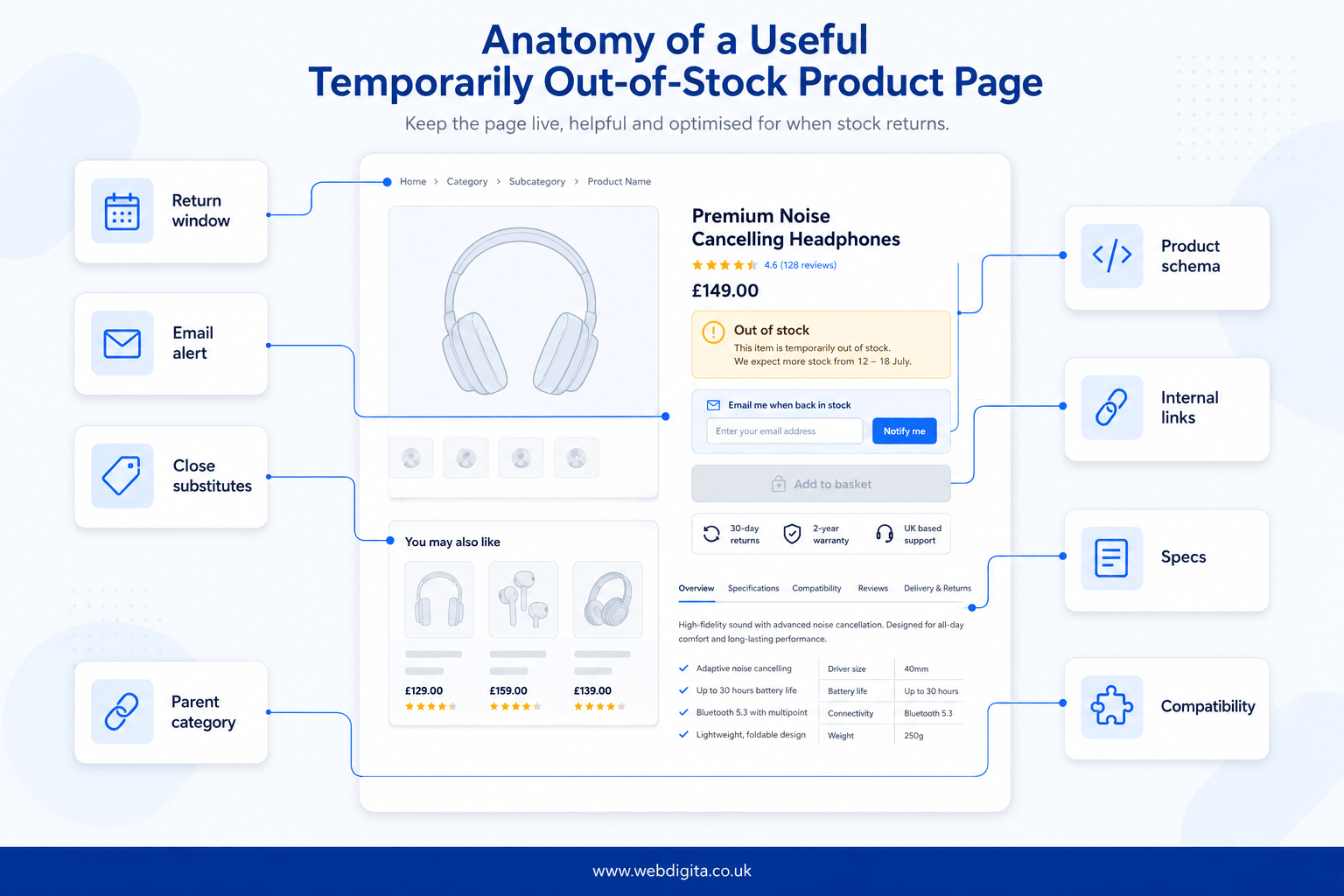
One common mistake: teams remove the page from navigation, XML sitemaps, and internal search all at once the moment a SKU goes to zero. Keep the page discoverable where demand still exists, then review it again when the return window becomes clearer.
When a discontinued product should be redirected, consolidated, or retired
Permanent discontinuation is where lazy rules do the most damage. Redirecting everything to the homepage is not a strategy – it is a signal to Google that you do not understand what those URLs were for. Forcing every dead product into the nearest vaguely similar SKU because a redirect feels tidy is almost as bad.
Good redirect fit versus bad redirect fit
A 301 redirect makes sense when there is a close replacement that satisfies the same intent: same product family, same use case, similar specs, and a realistic chance that the user will accept the substitute. If you are not confident on that fit, redirecting creates soft relevance loss and poor user signals – neither of which shows up immediately, but both of which erode performance over weeks.
Bad redirect fit is easy to spot. A discontinued blue size-8 trail shoe should not jump to a generic footwear category page if a near-identical replacement exists. Equally, it should not jump to an unrelated product just because that page converts well. My view: that is a warning sign the business is protecting merchandising convenience, not search equity. Those are different things and they should be treated differently.
Sometimes the better move is consolidation. If you have several obsolete or weak product pages with overlapping intent, support one stronger destination rather than keeping all of them limping along. If there is no true substitute, retiring the page cleanly may be better than forcing a poor redirect. In large catalogues, old products often still carry backlinks and internal links – but no honest replacement exists. Consolidation to a relevant category page is usually the right answer there. When you consolidate, set canonical tags on any surviving variant or archive pages pointing to the consolidation destination, and keep the 301 clean.
If your team keeps arguing over edge cases, you need clearer decision ownership. That is exactly the kind of ambiguity a project discovery workshop can flush out before bad rules get hard-coded into catalogue management.

Not sure which product pages to keep live or redirect?
We can review your current stock-state handling, check which URLs still carry search demand or link value, and help you build clearer rules before rankings drop unnecessarily.
Quick diagnostic call to spot avoidable equity loss
A simple decision tree: keep live, redirect, consolidate, or retire
You do not need a policy deck for this. You need a repeatable decision filter that stops blanket actions before they wipe equity you spent months building.
WEBDIGITA Product URL Decision Map – use this before you remove, redirect, or deindex any stock-state page:
| Question | If yes | If no |
|---|---|---|
| Is the product temporarily out of stock? | Keep live | Go to next question |
| Is it likely to return seasonally or after a supply gap? | Keep live and review later | Go to next question |
| Is there still search demand, backlinks, or strong internal link value? | Preserve value and assess best destination | Retire if no useful role remains |
| Is there a close replacement matching the same search intent? | Redirect to the replacement | Go to next question |
| Can several obsolete pages support one stronger destination? | Consolidate to that page | Retire cleanly |
Use this as a review filter, not a robot rule. High traffic is not the only signal worth protecting – some low-volume product URLs still carry valuable long-tail intent and internal link equity that matters for cluster depth and crawl budget efficiency.
The six signals that protect organic equity through stock changes
My experience reviewing stock-state decisions across catalogues of every size is that the right page decision accounts for about 20 percent of the outcome. The other 80 percent is execution – whether the supporting signals are actually maintained after the decision is made.
In the cases where preserving product URLs during stock gaps protected long-tail traffic and internal link equity, the difference was never the redirect decision alone. It was whether the team kept six things intact while stock was out. Here they are, in the order they tend to break:
- Product schema and schema markup: update availability to reflect the real state – “OutOfStock” rather than “InStock”. Leaving inaccurate schema markup live erodes E-E-A-T signals and risks rich result eligibility.
- Internal links: do not silently remove category page links, navigation links, or cross-sell links just because the product is unavailable. The page still needs to be findable.
- XML sitemap inclusion: keep pages with active demand in the sitemap. Remove only pages with no remaining organic value and a clean retirement destination.
- On-page copy: keep the specs, compatibility details, and buying context that drove the original ranking. A stripped-down “this product is unavailable” page loses the query match that earned the visit.
- Substitute recommendations: map substitutes by intent match, not by what is easy to surface. A poorly matched substitute drives bounces and trains negative user signals.
- Seasonal review cycle: if products disappear and return each year, build a calendar-triggered review rather than retiring them on autopilot. Consistent eCommerce maintenance is what keeps these rules applied consistently across templates, feeds, schema, and internal linking at scale.
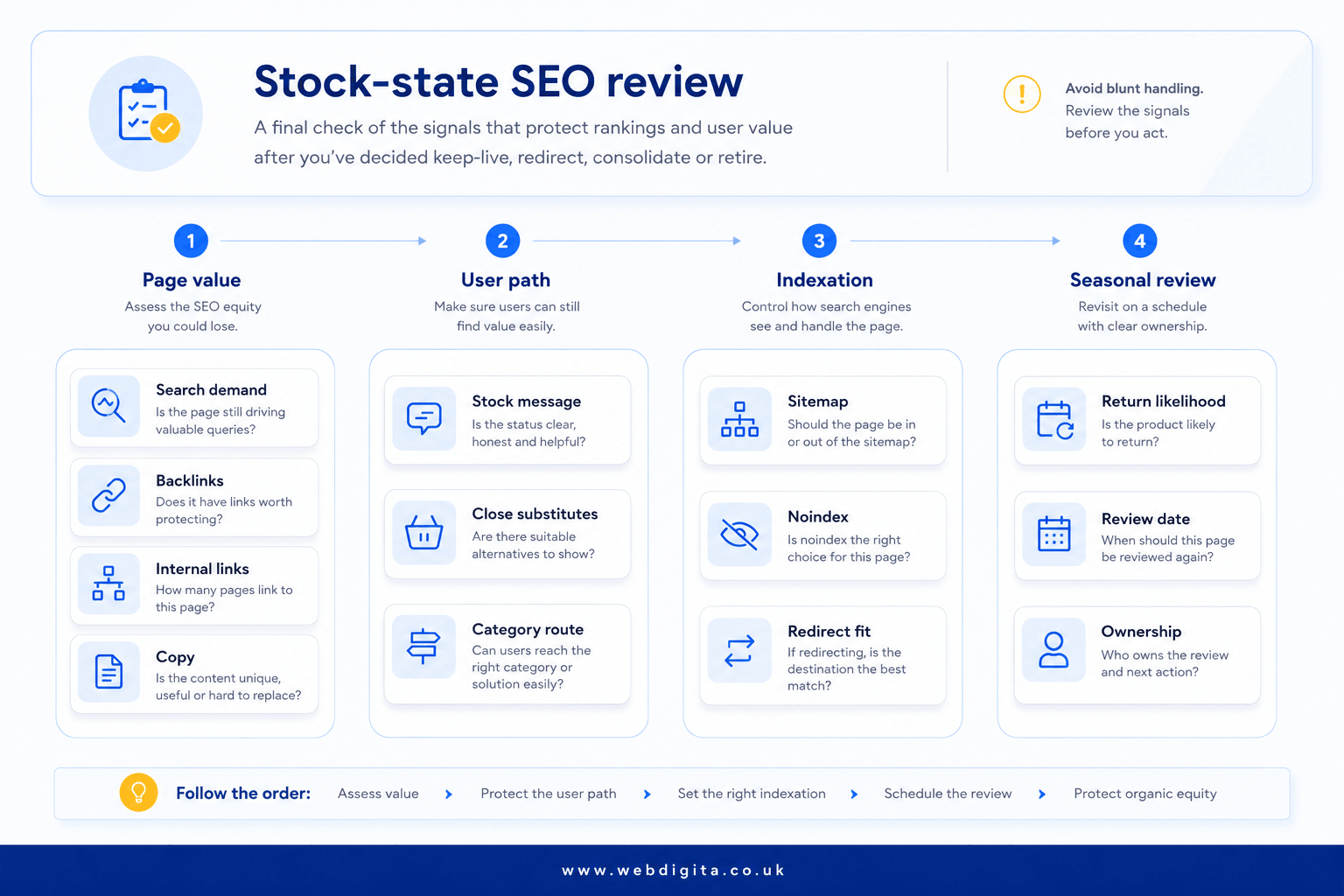
The practical next step: audit your current stock-state rules page by page. Check which URLs still have demand, which ones have honest substitutes, and which ones are only live because nobody owns the decision. That review usually reveals exactly where rankings are being lost unnecessarily – and it is always a shorter list than people expect.
If you want expert eyes on your catalogue’s stock-state SEO, speak with our ecommerce SEO team about where the quick wins are.
Questions buyers ask about out-of-stock product SEO
Practical answers on handling product pages when stock changes, without losing rankings or creating dead ends.
1. Should I delete a product page when stock runs out?
No, not immediately. If the product is temporarily out of stock and expected back, keep the page live with clear messaging, close substitutes, and a route to the parent category. Deleting wastes rankings and link value. Only remove or redirect if the product is permanently discontinued and you have assessed demand, backlinks, and substitute fit first.
2. What is the difference between temporarily out of stock and discontinued?
Temporarily out of stock means the product is expected to return after a supply gap or seasonal break. Discontinued means the product is not coming back in any meaningful way. This distinction drives the SEO action: temporary gaps usually keep the page live, while permanent discontinuation requires assessing redirect fit, consolidation, or clean retirement.
3. When should I redirect a discontinued product page?
Redirect when there is a close replacement that satisfies the same search intent: same product family, similar specs, and a realistic chance the user will accept the substitute. Poor redirect fit, such as jumping to a generic category or unrelated product, creates relevance loss and weak user signals. If no honest substitute exists, consolidation or clean retirement may be better.
4. Should I noindex out-of-stock product pages?
Not automatically. If the product is temporarily unavailable but still has search demand, backlinks, or internal link value, keep it indexed and discoverable. Noindexing makes sense only if the page is genuinely retired, has no useful destination, and no longer serves a search or navigation purpose. Rushed noindexing often causes avoidable ranking drops.
5. How do I handle seasonal products that return each year?
Build a review cycle instead of retiring them on autopilot. Keep the page live during off-season periods with clear messaging about expected return dates, and preserve internal links where demand still exists. Seasonal products with consistent search patterns should not be treated as permanently discontinued just because stock is temporarily unavailable.
6. What should I include on a temporarily out-of-stock product page?
Keep the core product copy, specs, and buying context so the page still answers the query. Add a clear stock status message, realistic return window if known, email alert option, close substitutes that match intent, and a route to the parent category. Avoid leaving only a dead notice and disabled basket button, as this wastes the visit.
7. Can I redirect multiple discontinued products to one stronger page?
Yes, if the obsolete pages have overlapping intent and the stronger destination genuinely satisfies the same search need. This is consolidation, and it works better than keeping multiple weak URLs live or forcing poor individual redirects. Assess whether the target page can absorb the intent and link value before consolidating.
8. What signals protect organic equity during stock changes?
Preserve user value by keeping useful product copy and clear stock messaging. Preserve link value by maintaining internal links where the page still deserves discovery. Keep availability schema aligned with real stock state. Avoid removing pages from sitemaps or navigation too quickly if demand still exists, and use category pages as support paths rather than dead ends.
Conclusion
The right action for an out-of-stock product depends on whether it is coming back, whether it still serves search demand, and whether a genuine substitute exists. Blanket rules waste organic equity and create avoidable rework.
- Temporary gaps: Keep the page live, message stock status clearly, and preserve internal links where demand still exists.
- Permanent discontinuation: Redirect only to close replacements that match intent, consolidate overlapping pages, or retire cleanly if no useful destination fits.
- Ongoing review: Audit current stock-state rules page by page to identify where rankings are being lost unnecessarily and where seasonal logic should replace autopilot removal.
- Decision ownership: Clarify who decides redirect fit, consolidation targets, and retirement criteria before bad rules get hard-coded into catalogue templates.
Need help protecting organic equity while your catalogue changes?
We work with ecommerce teams to audit stock-state handling, fix redirect logic, preserve internal link value, and build repeatable rules that stop rankings being lost through blunt operational decisions.
See eCommerce SEO servicesOr start with