Key Takeaways
If you want better agency proposals, tighten your eCommerce project requirement documentation before you ask for a proposal or quote.
- Start with the commercial case: define what is changing, why now, and what success looks like before discussing features.
- Make constraints visible early: platform position, integrations, data quality, content structure, and compliance needs can change scope fast.
- Separate priorities from wish lists: if everything is fixed at once, budget, timeline, and feature depth will clash.
- Name owners, not just systems: unclear responsibility for data, content, approvals, or integration access is a common cause of delay.
- A one-page brief is enough: the goal is not perfection, but enough truth for agencies to assess fit, risk, and pricing on comparable terms.
Most eCommerce projects go wrong before agency selection, not during build. The agency can usually build it. What goes wrong first is what you hand them.
The short answer: Before approaching eCommerce development agencies, define your commercial trigger and measurable success criteria, the customer journey moments that change build scope, your platform position and non-negotiables, every integration dependency with a named owner, your content and data readiness, budget range, timeline pressure, and who internally signs off each decision. You do not need a 40-page specification – you need enough clarity for an agency to assess fit and price without inventing assumptions.
If you are speaking to eCommerce agencies about eCommerce development in London or in your city, your job is not to write a perfect project specification document. It is to define commercial goals, technical constraints, dependencies, and decision owners clearly enough that an agency can judge fit properly and price with fewer blind spots.
Why weak eCommerce project requirement documents create bad agency discussions
A weak brief forces the agency to fill in the blanks. One assumes a light rebuild, another assumes a full eCommerce re-platforming, and a third quietly prices around risks it suspects you have not mentioned. That is not healthy competition. It is a broken starting point.
This is pre-agency preparation, not a signed scope document. You need enough clarity to compare agencies on real fit, delivery risk, and thinking quality – not on who wrote the nicest proposal around missing information.
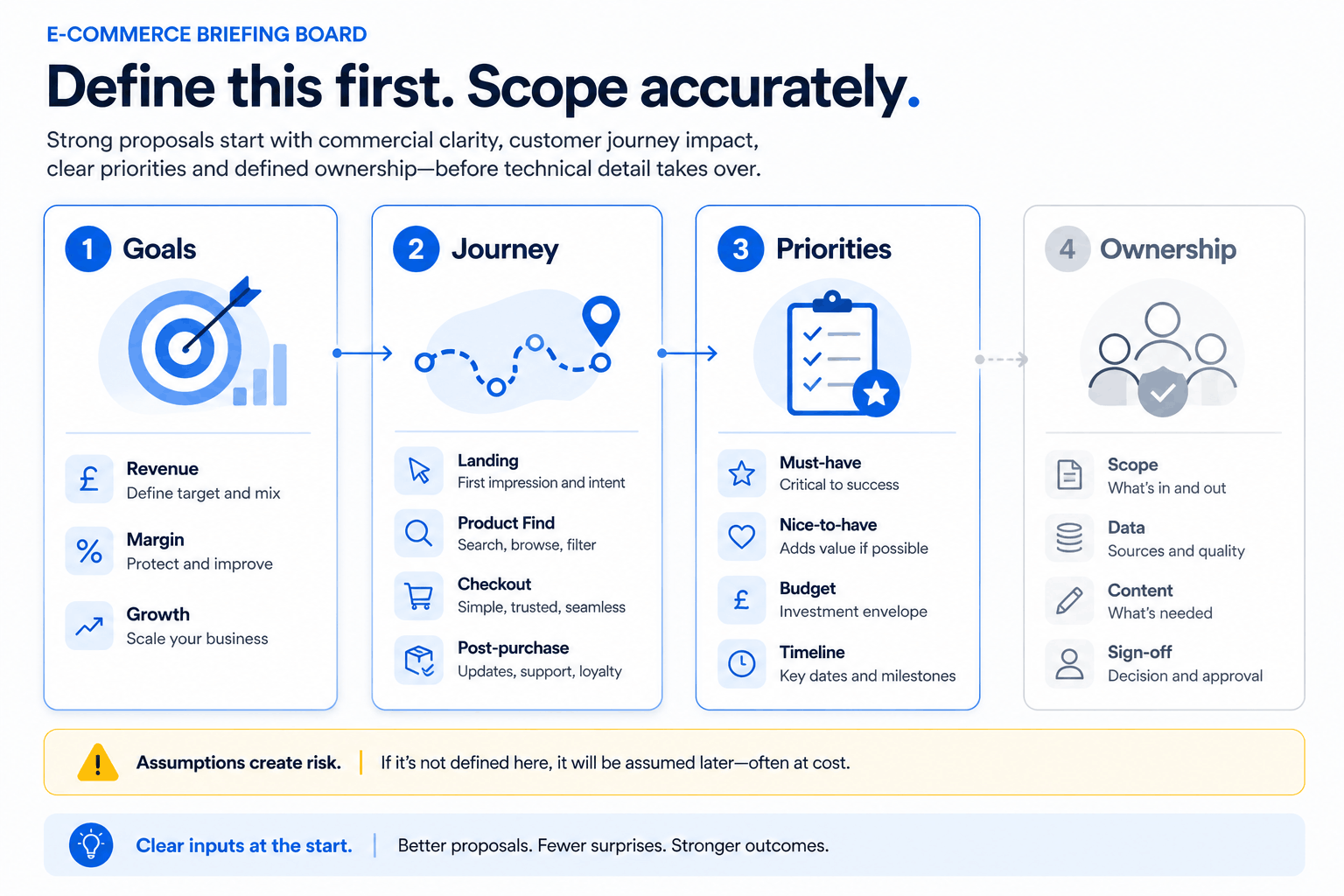
Start with three answers: what is changing, why now, and what success looks like in measurable terms. If your team cannot answer those cleanly, you are not ready to compare quotes.
Define the commercial document before the technical brief
Most teams jump straight to features, and that is usually where the waste starts. Scope only makes sense when the commercial pressure is clear.
Business Trigger: Be plain about what is driving this. Margin pressure, poor conversion, operational drag, international growth, or a platform that has become expensive to maintain all lead to different decisions. If you cannot name the trigger, agencies will scope around guesswork.
Customer Journey Impact: Map the moments that change build scope – where customers land, how they find products, where checkout friction sits, what account actions matter, and what happens after purchase. These are not UX nice-to-haves. They set the architecture.
Feature Priority: Separate must-haves from nice-to-haves. A long wish list is not a brief. It is how teams end up fixed on budget, fixed on launch date, and fixed on feature depth simultaneously – a combination that rarely holds.
Be honest about budget range and timeline pressure as well. Hiding them until late does not create leverage. It creates bad scoping.
Surface the technical constraints that change scope fast
Pretty demos hide ugly dependencies. Architecture, data quality, and integration risk change effort far faster than homepage mock-ups do.
Platform position: State whether you are staying put, re-platforming, or still undecided. If Shopify, WooCommerce, Magento, or a custom architecture is already non-negotiable, say so. If it is still open, say that too – the agency will frame options differently. If you need help reaching that decision, structured project discovery services can surface the gaps before they become revision loops.
Integration dependencies: List every system that matters to trading and operations – ERP, PIM, CRM, payments, shipping, tax, subscriptions, search, or custom middleware. Name the owner and current state of each. This is where things most often go wrong. A store can look straightforward until ERP stock rules, shipping logic, and discount apps all need to agree at checkout. The “simple build” suddenly carries real integration risk and operational overhead.
Data and content readiness: Check product data quality, asset ownership, and whether the content structure already exists. If catalogue logic, attributes, or content models are still undefined, accurate pricing is unlikely.

Not sure what your eCommerce proposal is still missing
We can review your goals, integrations, ownership gaps and scope assumptions before agency talks start, so you can brief with fewer blind spots and compare proposals more fairly.
Useful if scope still feels unclear internally
The 1-page WEBDIGITA eCommerce requirement framework
You do not need a 40-page document. You need one page that makes the important things visible and shows clearly what is still unresolved.
| Input group | What to define | What usually goes missing | What to confirm |
|---|---|---|---|
| Business | Goals, rebuild trigger, revenue model, key journeys, must-have features, budget range, timeline pressure | Vague success measures and too many equal priorities | Agree what success means and what can wait |
| Technical | Current platform, constraints, integrations, data quality, content structure, security or compliance needs | Unknown dependency owners and hidden architecture risk | Name each dependency, its owner, and current state |
| Operational | Fulfilment workflow, support impact, merchandising process, launch pressure, continuity needs | Processes that must keep running during delivery | Check what cannot break while the project is live |
| Stakeholder | Decision makers, approvers, product owner, content owner, data owner, integration contacts | Unclear sign-off rights and slow decisions | Confirm who signs off what and when |
If you cannot complete this without internal debate, that is useful information. A weak brief produces three non-comparable proposals. A stronger one produces faster scoping and a fairer shortlist.
Questions your internal team must answer before asking for an eCommerce development quote
This is where proposals most often break down. The problem is rarely ambition. It is unclear ownership and unspoken trade-offs that nobody wants to surface before the agency conversation starts.
You need to know who signs off scope, who owns product data, who owns content, and who can unblock integration access. When those answers are vague, the project drags – regardless of how capable the agency is.
You also need to decide what cannot change and what is still open. Are you fixed on platform, fixed on launch date, or fixed on feature depth? Most teams do not get all three without compromise, and the sooner that trade-off is named, the better the brief.
If your team cannot explain the non-negotiables, the agency will invent them for you.
Finally, check what must keep running during the project and how much internal resource is genuinely available. Teams often commit to fast feedback cycles, then find the people holding the real answers are already at capacity.
What eCommerce agencies need from you before they can price properly
Agencies do not need a perfect brief. They need enough truth to see the actual shape of the work: a clear commercial trigger, defined scope boundaries, platform context, named integration dependencies, data and content status, a stakeholder map, an honest budget range, and a realistic timeline.
Those inputs – not a polished document – are what allow an agency to price around real complexity rather than optimistic assumptions.
In my experience reviewing briefs across scoping engagements, the projects that ran into revision loops had one thing in common: hidden dependencies that neither side named before the agency started filling in the blanks. The briefs that cut discovery time and reduced rework were not longer or more formal. They were more honest about what was still unresolved. That is a meaningfully different standard from a generic eCommerce web development checklist.
It means naming your unknowns as clearly as your requirements.
If search visibility is part of the brief, bring SEO ownership into the conversation early. A rebuild can damage organic performance if nobody owns it – you may need eCommerce SEO agency input before launch planning hardens.
A sensible next step is to use your brief to test agency fit first. Then, if the conversation looks right, ask for a free personalised roadmap or a free scoping review.
Questions buyers ask about writing an eCommerce website development brief
These are the points that usually affect quote quality, delivery risk, and how easy agencies are to compare.
1. How detailed does an eCommerce website development brief need to be?
It does not need to be exhaustive. An eCommerce website development brief should clearly define goals, scope boundaries, platform context, key integrations, stakeholder ownership, budget range, and timeline pressure. Agencies do not need a perfect specification at this stage. They need enough clarity to assess fit, spot risk, and avoid pricing around guesswork.
2. Why do agency quotes vary so much when the project sounds similar?
Agency quotes vary because each agency fills in missing information differently. One may assume a light rebuild, another a replatform, and another may price in hidden integration risk. When the brief is vague, proposals stop being directly comparable. The variation often reflects different assumptions, not just different day rates or delivery quality.
3. What should be included before asking an agency for a quote?
You should include the commercial trigger, success measures, customer journey priorities, must-have features, platform position, integration dependencies, data and content status, stakeholder map, budget range, and timeline reality. That gives an agency enough context to understand the shape of the work. It also makes it easier to challenge weak thinking before the project starts.
4. Should budget and timeline be shared early with an agency?
Yes, budget range and timeline pressure should be shared early. Hiding them rarely improves your negotiating position. It usually leads to bad scoping, unrealistic proposals, or late-stage resets when the real constraints emerge. A sensible range helps agencies shape options properly and tell you where trade-offs are likely to appear.
5. What are the biggest risks to surface in an eCommerce brief?
The biggest risks are usually technical dependencies, poor data quality, unclear content ownership, and weak internal decision-making. Integrations with ERP, PIM, CRM, payments, shipping, tax, or custom middleware can change scope quickly. If nobody owns those dependencies or can unblock access, the project can stall even when the build itself is straightforward.
6. Do we need to choose the platform before speaking to agencies?
No, you do not always need to choose the platform first. You do need to be clear whether the platform is fixed, likely, or still open. That distinction changes how an agency frames the project and what it can price with confidence. If the platform decision is unresolved, say so rather than letting agencies assume different starting points.
7. Who should own the brief internally?
One accountable owner should coordinate the brief, but several owners usually need to contribute. Product, content, data, integrations, and sign-off responsibilities should all be explicit. If ownership is vague, agencies will struggle to get clear answers and the project will slow down. The brief works best when decision rights are visible from the start.
Conclusion
A good eCommerce development requirement document does not need to answer everything. It needs to make the important things clear enough that an agency can judge fit honestly, flag delivery risk early, and scope the work without filling gaps with assumptions.
Before you ask for proposals, get your internal team aligned on goals, non-negotiables, dependency owners, and what can flex if pressure appears. That alone will improve the quality of agency conversations. You are not trying to look prepared on paper. You are trying to avoid buying a plan built on guesswork.
Need a clearer route from brief to scoped eCommerce delivery
Our project discovery service helps define requirements, expose integration risk, align stakeholders and turn early assumptions into a clearer delivery plan before build decisions harden.
Explore eCommerce discovery servicesStill weighing up the right next step