Key Takeaways
Headless CMS works best for enterprise teams managing multiple regions, brands, or channels from one content foundation. It brings clearer separation between content, presentation, and integrations, but only when workflow, governance, and team capability support the added complexity.
- Multi-channel fit: Headless earns its place when you need one content source feeding several experiences with shared rules and local variation.
- Workflow reality: If routine updates need developer help, the architecture may be cleaner but the operating model is not.
- Governance first: Weak content models, approval paths, or localisation rules will be exposed by a more complex stack, not fixed by it.
- Team capability matters: Long-tail cost builds through extra support, slower fixes, and more release coordination if internal or partner capability is not strong.
Headless is powerful, but it is not a badge of maturity. In the wrong organisation, it just makes publishing harder – and the gap between what was promised and what gets delivered shows up fast.
The real question is not whether headless is the better architecture in principle. It is whether your organisation has the publishing reality, governance maturity, and team capability to make it work. This guide is for enterprise digital leads, marketing owners, product teams, and platform stakeholders weighing a replatform, redesign, or enterprise web design partner decision.
The short answer: headless CMS for enterprise helps when publishing scale, integration complexity, and multi-channel needs genuinely justify the additional moving parts. When those conditions are weak, it adds friction without proportionate gain.
When headless CMS helps an enterprise website
Headless earns its place when one website is really several experiences held together by shared governance. If you are managing multiple regions, brands, or channels from one content foundation, decoupling brings more clarity, better flow, and stronger control – particularly when your enterprise IA, design systems, and component libraries are already mature enough to hold the structure together.
The value here is not front-end freedom for its own sake. It is a cleaner separation between content, presentation, and integrations – which reduces the friction that comes when regional teams are fighting rigid templates, duplicating content, or waiting on central engineering for every localised update. A shared content model with governed components can support local variation without breaking consistency across markets.
In my experience reviewing enterprise platform decisions, the strongest fit tends to be an organisation running regional sites with one central content model, genuine localisation requirements, and meaningfully different front-end needs by audience. In that setup, headless can improve content reuse, reinforce hierarchy, and make governance genuinely scalable. If you are also planning complex commerce journeys or connected digital products, it can work well alongside headless eCommerce development.
Strong fit signals:
- You need one content source feeding several experiences or channels.
- You already use a mature design system and component library with clear governance.
- Localisation, multi-brand control, or deep integrations are current operating needs – not aspirational ones.
- Your teams can manage a more technical publishing and release model without that friction becoming routine.
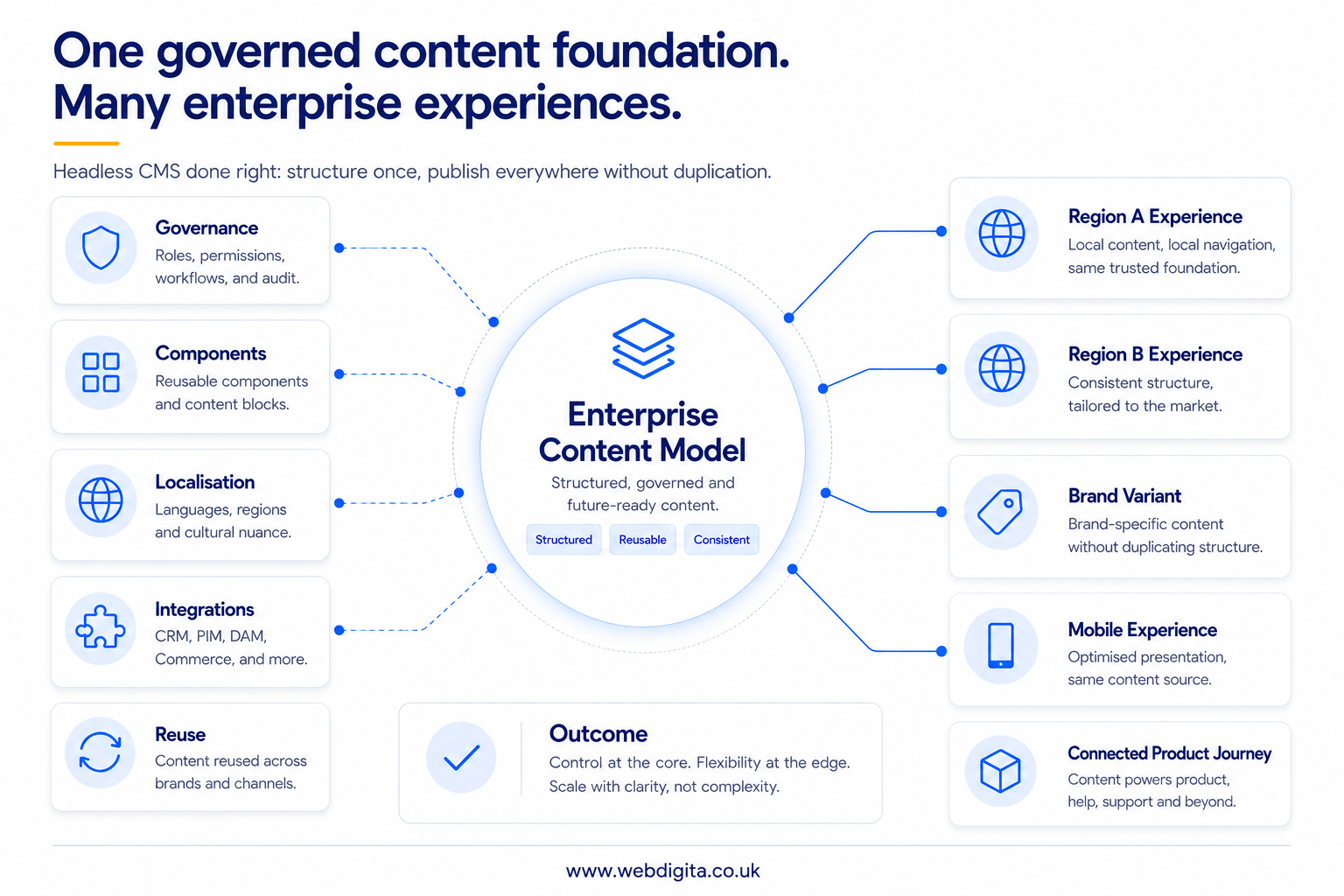
In other words, headless CMS for enterprise works best when scale is real and the governance structure already exists to support it – not when you are building both simultaneously.
When headless adds complexity instead of clarity
Headless can improve architecture while quietly making day-to-day work harder. If routine page changes, campaign launches, or localisation updates now require developer involvement as a matter of course, the publishing journey has lost confidence – even if the stack looks more capable on paper.
This is where organisations typically encounter difficulty. The focus falls on front-end flexibility, while workflow design, preview behaviour, rollback capability, and content ownership receive insufficient attention. Content sits in one place, presentation logic in another, integrations elsewhere, and the gaps between them belong to no one clearly. Urgent changes begin to feel risky rather than routine.
If your business primarily needs reliable publishing, strong template control, and low-friction updates, headless may be solving the wrong problem.
A familiar example is preview working in one environment but breaking in another, while SEO, analytics, and localisation accountability sit with different owners after launch. The architecture may be cleaner, but the operating model is not. Long-tail cost accumulates quietly through additional support requirements, slower fixes, and increasingly complex release coordination.
Do not choose headless if:
- Your content team needs to make frequent updates without developer support.
- Your site is genuinely single-channel and not multi-experience by nature.
- Ownership across content, engineering, SEO, and localisation is still unresolved.
- You are expecting automatic performance gains from architecture alone.
Performance deserves direct attention here. A headless build can be fast, but it can also be fragile if caching, rendering, search, analytics, and preview are not engineered with the same rigour as the front end. The architecture does not deliver performance – the implementation does. For a fuller picture of how performance decisions play out at scale, see our performance-first enterprise web design services.

Not sure if headless fits your publishing model?
We help enterprise teams assess whether a headless architecture will improve workflow or just add friction. Our platform recommendation service looks at your content operations, governance structure, and team capability before suggesting a direction.
No sales pitch. Just a clear view of what fits your operating model.
What enterprise teams should evaluate before they decide
My experience reviewing enterprise platform decisions across governance-heavy and integration-heavy environments consistently points to the same pattern: headless adds measurable value when publishing scale, integration complexity, and multi-channel needs justify the additional moving parts. When those conditions are absent or still developing, the extra structure rarely improves how work moves through an organisation – it simply adds more places for things to break.
That pattern is reliable enough that I treat it as the primary test. Before evaluating platforms, evaluate operating reality.
Start with publishing reality. Who updates content each week? How often do approvals move across teams? What genuinely needs to happen without engineering input? If content movement is already slow and developer-dependent, headless will compress that problem rather than resolve it. Accessibility control and localisation rules need to be understood here too – not as future considerations, but as current workflow facts.
Then assess governance. Look at content models, approval paths, accessibility standards, localisation rules, and template consistency across markets. If those foundations are loose today, a more complex architecture will surface the gaps rather than close them. Stakeholder alignment on ownership – across content, engineering, SEO, and design systems – is a prerequisite for headless success, not a deliverable that comes after the build.
Finally, examine delivery support. Ask any provider how preview works, how rollback is handled, who owns SEO and analytics configuration, how localisation is structured, and what ongoing support looks like once the build is live. Vague answers at this stage are a meaningful risk signal. Where senior technical due diligence is needed before committing, Fractional CTO support can reduce delivery risk materially – particularly when internal engineering resource is stretched across competing priorities.
Headless fit reality check:
- Business need: are you serving multiple brands, regions, or front ends from shared content today – or is that a projection?
- Workflow maturity: can content teams publish and manage updates confidently without consistent developer involvement?
- Governance: are approvals, accessibility, SEO, and component ownership clearly defined and reliably followed in practice?
- Integration load: does content and data genuinely need to move across several systems as a core operating requirement, not a future ambition?
- Team capability: do you have the internal or partner support to manage a more complex stack well over the long term?
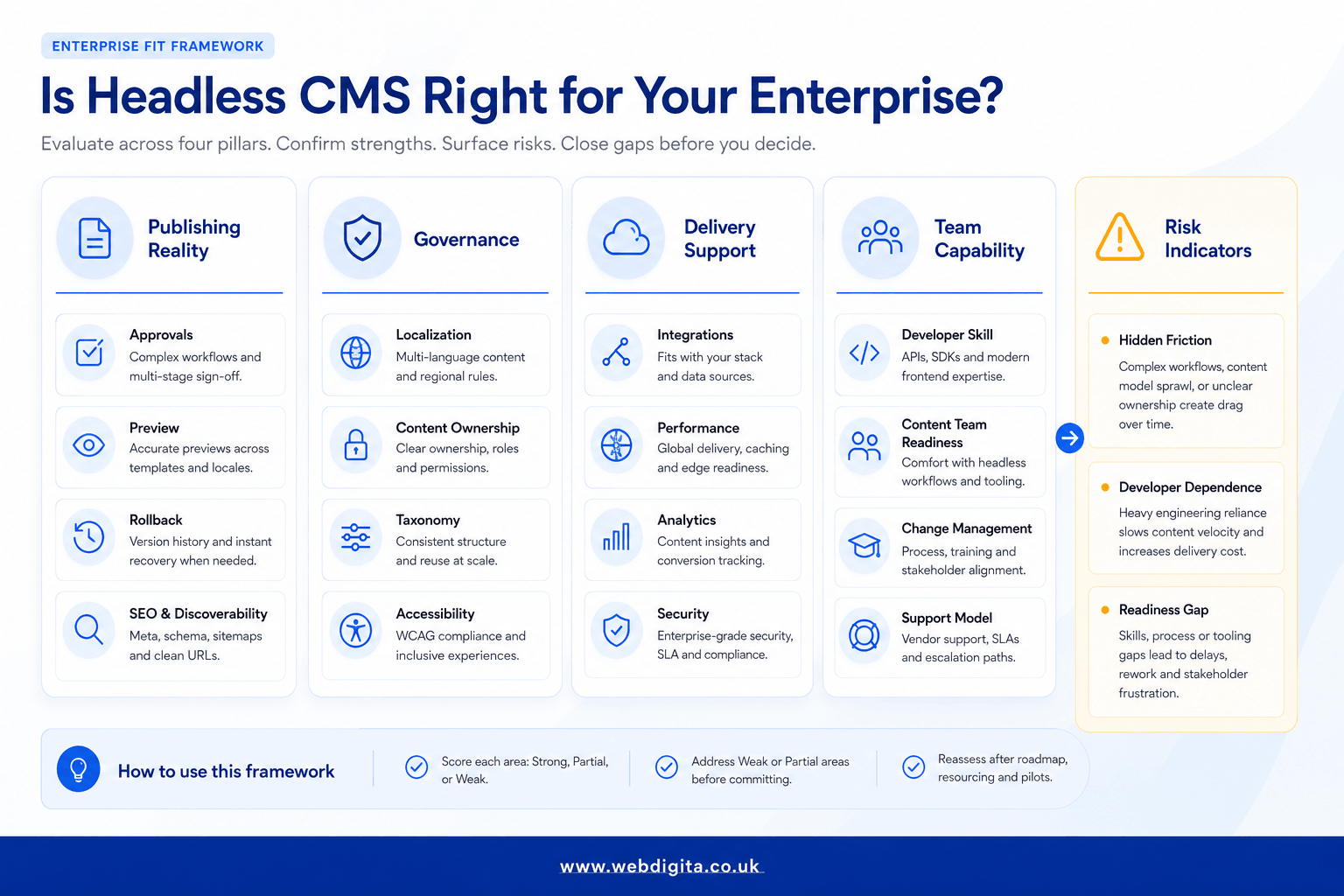
If the real issue is weak ownership across markets, address that first. In many cases, stronger governance and sharper template discipline will do more for consistency than a new architecture – including when it comes to managing search across teams, templates, and internal complexity, and when planning how the site will need to scale globally over time.
How to read a mixed picture before you commit
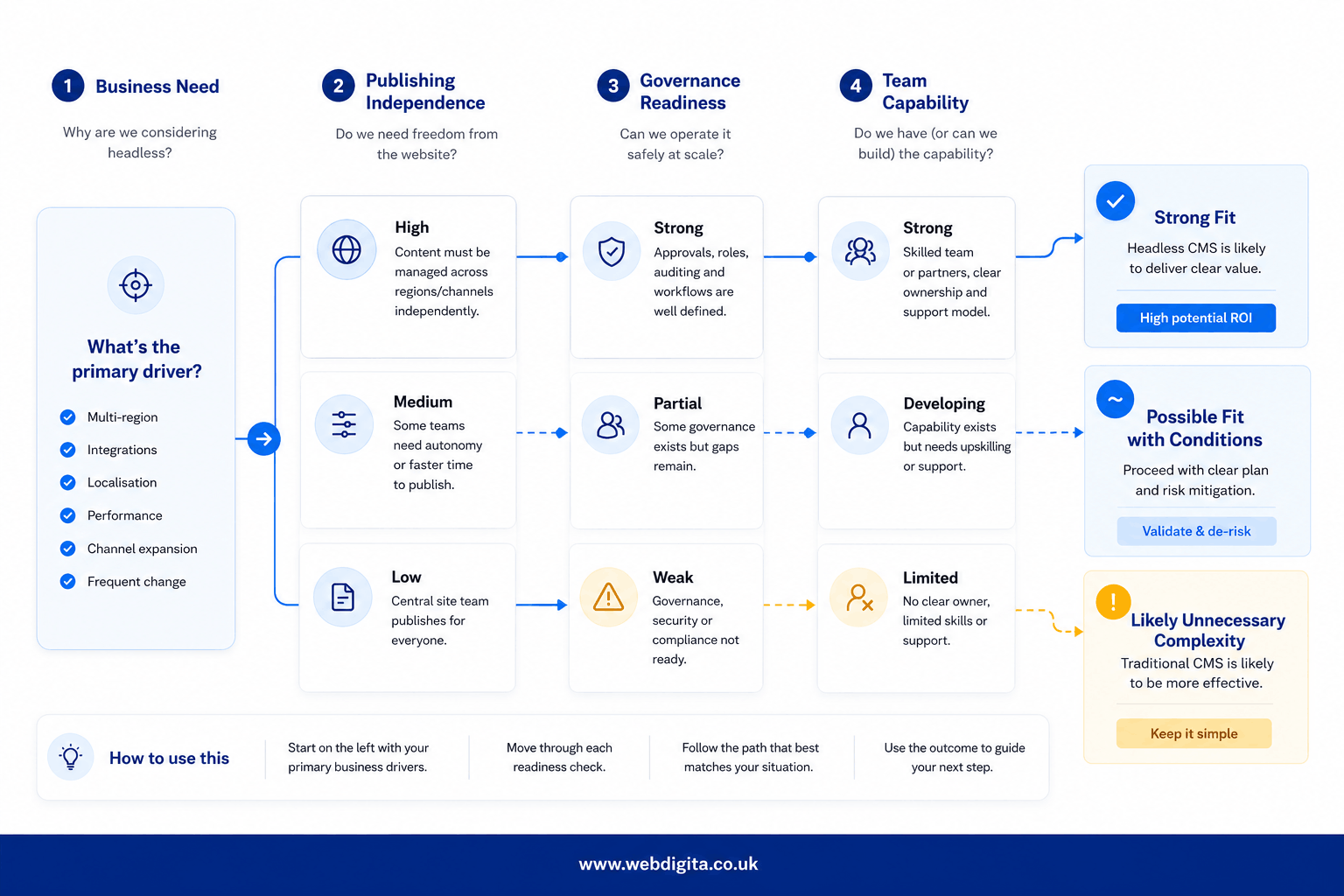
Most enterprise decisions do not resolve cleanly in either direction. The signals are typically mixed – strong integration needs sitting alongside immature governance, or seasoned content teams operating without clear localisation ownership. This is precisely where a structured evaluation framework earns its value: not to produce a verdict automatically, but to separate genuine architectural fit from conditional fit from avoidable complexity, based on the factors that most reliably predict delivery success.
The decision tree below maps the key questions in sequence. Work through it to identify where readiness gaps sit before you select a platform or engage a partner.
| Question | If yes | If no |
|---|---|---|
| Do you have real multi-region, multi-brand, or integration-heavy needs today – not projected ones? | Move to the next test. | A more traditional CMS setup is often the better fit. Revisit headless when scale is genuine. |
| Can your content team publish and manage updates without heavy developer dependence? | Move to governance and localisation. | Headless may still be appropriate, but only after workflow design and ownership are resolved first. |
| Are approvals, accessibility, localisation rules, and component governance clearly defined and working in practice? | Move to team capability. | This is a readiness gap, not a platform feature gap. Address it before changing architecture. |
| Do you have the internal capability or partner support to manage a more complex architecture sustainably? | Headless is likely a strong fit. | The long-tail cost of support, coordination, and release overhead may outweigh the flexibility gains. |
If the picture remains unclear after working through this, validate requirements before committing to a build. A short project discovery workshop can surface workflow, integration, and governance risks before they become expensive platform decisions. It is also the most direct route to a concrete platform recommendation grounded in your actual operating context – not a vendor shortlist.
Questions enterprise teams ask before choosing headless CMS
Common concerns about workflow, governance, and long-term operating cost when evaluating headless architecture.
1. What is a headless CMS and how does it differ from a traditional CMS?
A headless CMS stores and manages content separately from the front-end presentation layer. Unlike a traditional CMS where content and templates are tightly coupled, headless decouples them, delivering content via APIs to any front end. This separation allows one content source to feed multiple channels, but it also means publishing, preview, and updates often require more technical coordination than a traditional setup.
2. When does headless CMS make sense for an enterprise website?
Headless makes sense when you are managing multiple regions, brands, or channels from one content foundation and need strong governance across them. It works well when your design system and component library are mature, localisation is a real operating need, and your teams can handle a more technical publishing model. If you mainly need reliable publishing and low-friction updates, a traditional CMS is often the better fit.
3. Does headless CMS automatically improve website performance?
No, headless does not automatically improve performance. A headless build can be fast if caching, rendering, search, analytics, and preview are designed properly, but it can also be fragile if those elements are not handled well. Performance depends on how the front end is built, not just the architecture choice. Expecting speed gains from decoupling alone is a common mistake.
4. What are the main risks of choosing headless CMS for enterprise?
The main risks are slower publishing, more handoffs, and higher long-tail cost if workflow and governance are not designed properly. Content may sit in one place, presentation logic in another, and integrations elsewhere, with no one fully owning the gaps. Routine changes can start to feel risky rather than routine, and preview, rollback, SEO, and localisation often become harder to manage without strong delivery support.
5. How do I know if my team is ready for headless CMS?
Your team is ready if content teams can publish and manage updates without constant developer help, approvals and governance are clearly defined, and you have the internal or partner capability to manage a more complex stack over time. If those conditions are weak, headless will likely expose workflow and ownership gaps rather than solve them. Test the operating model before testing the platform.
6. Can headless CMS work for a single-brand enterprise website?
Yes, but only if you have real integration-heavy needs or plan to expand into multiple channels soon. If your site is fairly simple and not truly multi-channel, the added complexity of headless may outweigh the flexibility. A traditional CMS with strong template control and governance often delivers better flow for single-brand enterprises without deep integration requirements.
7. What should I ask a provider before committing to headless CMS?
Ask how preview works, how rollback works, who owns SEO and analytics setup, how localisation is handled, and what ongoing support looks like once the build is live. Also ask how content teams will manage routine updates and what happens when urgent changes are needed. If the answers are vague or assume heavy developer involvement, the long-term operating cost may be higher than expected.
8. Does headless CMS improve content governance for enterprise teams?
Headless can improve governance if your content models, approval paths, and component rules are already mature. It allows clearer separation between content, presentation, and integrations, which helps when managing multiple regions or brands. However, if governance is weak today, headless will not fix it. Weak content models and unclear ownership will be exposed by a more complex stack, not solved by it.
Conclusion
- Test the operating model before the platform. Headless adds value when enterprise publishing, scale, and integration needs justify the complexity. If those conditions are weak, the extra moving parts rarely improve flow.
- Validate workflow and governance readiness. Ask who updates content each week, how approvals move across teams, and what needs to happen without engineering input. If the answers are unclear, fix ownership before choosing architecture.
- Check delivery support properly. Ask any provider how preview, rollback, SEO, analytics, and localisation are handled, and what ongoing support looks like once the build is live. If the answers are vague, the risk is real.
- Use the decision tree to separate real fit from avoidable complexity. If your answers are mixed, validate requirements through discovery before committing to a platform or partner decision.
Need help choosing the right CMS architecture for your enterprise website?
WEBDIGITA works with enterprise teams to evaluate platform fit, design publishing workflows, and build websites that support scale without adding unnecessary complexity. We assess your content operations, governance needs, and team structure before recommending a direction.
Explore enterprise web design servicesOr speak to someone about your platform decision