Key Takeaways
Enterprise performance problems usually come from uncontrolled publishing and weak component governance, not just front-end code. Speed improves when you treat it as a design and operating model issue.
- Governance enables speed: Good governance gives teams approved patterns that are already performant, accessible and on-brand, rather than blocking them with process.
- Control sits in five areas: Components, templates, media, CMS permissions and performance budgets all need clear ownership and enforcement to prevent drift.
- Guardrails reduce friction: The best rules sit inside the CMS and design system, guiding editors towards better choices instead of relying on documentation alone.
- Decide improve or rethink: If your estate is full of duplicated modules, unclear ownership and constant exceptions, a structural reset is usually more realistic than ongoing optimisation.
- Speed holds through structure: Teams keep flexibility inside defined limits rather than adding drag with every update, so performance stays protected as the organisation scales.
Enterprise websites rarely become slow because of a single technical failure. They slow down because complexity grows faster than the system that governs it. Publishing freedom expands, heavier modules accumulate, media controls loosen, and template variation multiplies beyond what the architecture can carry with any consistency.
The answer is this: enterprise websites improve speed without losing governance by treating performance as a design and operating model problem, not a technical afterthought. That means tighter component discipline, deliberate page-template control, defined performance budgets, and publishing guardrails built into the CMS – so teams retain flexibility within limits rather than adding drag with every release. If you are reviewing a platform change, redesign scope or enterprise web design, understanding that distinction matters. Speed problems almost always sit in structure and governance before they sit in code.
This guide is written for enterprise marketers, digital leads, UX teams and platform owners navigating that decision – whether to tighten the current setup, or rethink templates, governance and publishing control from a more considered starting point.
What performance-first enterprise design really means
Performance-first enterprise design is not a front-end tidy-up. It is a way of structuring pages, components and publishing rules so the site stays fast as more teams, regions and content demands are layered on top of it.
The distinction I find most useful is between unmanaged freedom and structured freedom. Unmanaged freedom feels agile at first. It tends to create drag quickly. Structured freedom is different – teams still have room to publish, localise and adapt, but the patterns they work within are controlled so that speed, brand consistency and experience quality do not erode over time.
Performance should be measured in terms of journey flow, not only technical scores. If pages feel heavy, hesitant or visually inconsistent, users interpret that as lower quality – and they are not wrong. To make performance-first design hold at scale, ask clearly: who controls templates, who approves new components, and where are the limits enforced in the system rather than in a policy document?
Where enterprise websites usually get slow
Enterprise performance drift is almost always cumulative. One extra module, one oversized media block, one local template exception – each looks harmless in isolation. Across a large estate, they create measurable friction and genuine inconsistency.
What I see repeatedly in audits is that the root cause is rarely front-end code alone. Enterprise performance problems most often come from uncontrolled publishing and inconsistent component use – the same structural gaps that create visual drift also create weight and latency. If teams can create new page patterns faster than the system can govern them, treat that as a diagnostic signal, not a workflow preference.
Watch for these signs:
- Bloated page templates carrying too many optional sections by default
- Multiple versions of near-identical components with different behaviour or page weight
- Uncontrolled image, video or embed use inside editorial areas
- Regional or departmental teams bypassing approved page patterns to solve legitimate content needs
- Design system documentation that exists but is not enforced at the CMS level
It is worth distinguishing whether the slowdown is local or systemic. If the same patterns appear across templates, regions and content types, a few technical fixes will not hold for long. The issue is structural, and the response needs to match that.
Why governance is part of speed, not the enemy of it
Many enterprise teams still frame governance as restriction – which is precisely why speed improvement work gets resisted. But well-designed governance does not remove flexibility. It decides where flexibility is safe, where it needs approval, and where it should not exist at all.
There is a meaningful difference between restrictive governance, which slows editors down with process, and enabling governance, which gives them approved patterns that are already performant, accessible and on-brand. The second model is always the goal. If editors need constant exceptions to do ordinary work, your governance is likely too abstract or too weakly embedded in the system itself.
A pattern I see often in enterprise projects is regional teams needing campaign freedom while central teams need consistency. The answer is never unlimited local editing. It is a controlled set of page patterns, content slots and media rules that let local teams move at pace without creating template sprawl or performance debt. If you are unsure whether your architecture supports that balance, Fractional CTO support can help surface whether the problem sits in governance design, CMS configuration or deeper structural debt.
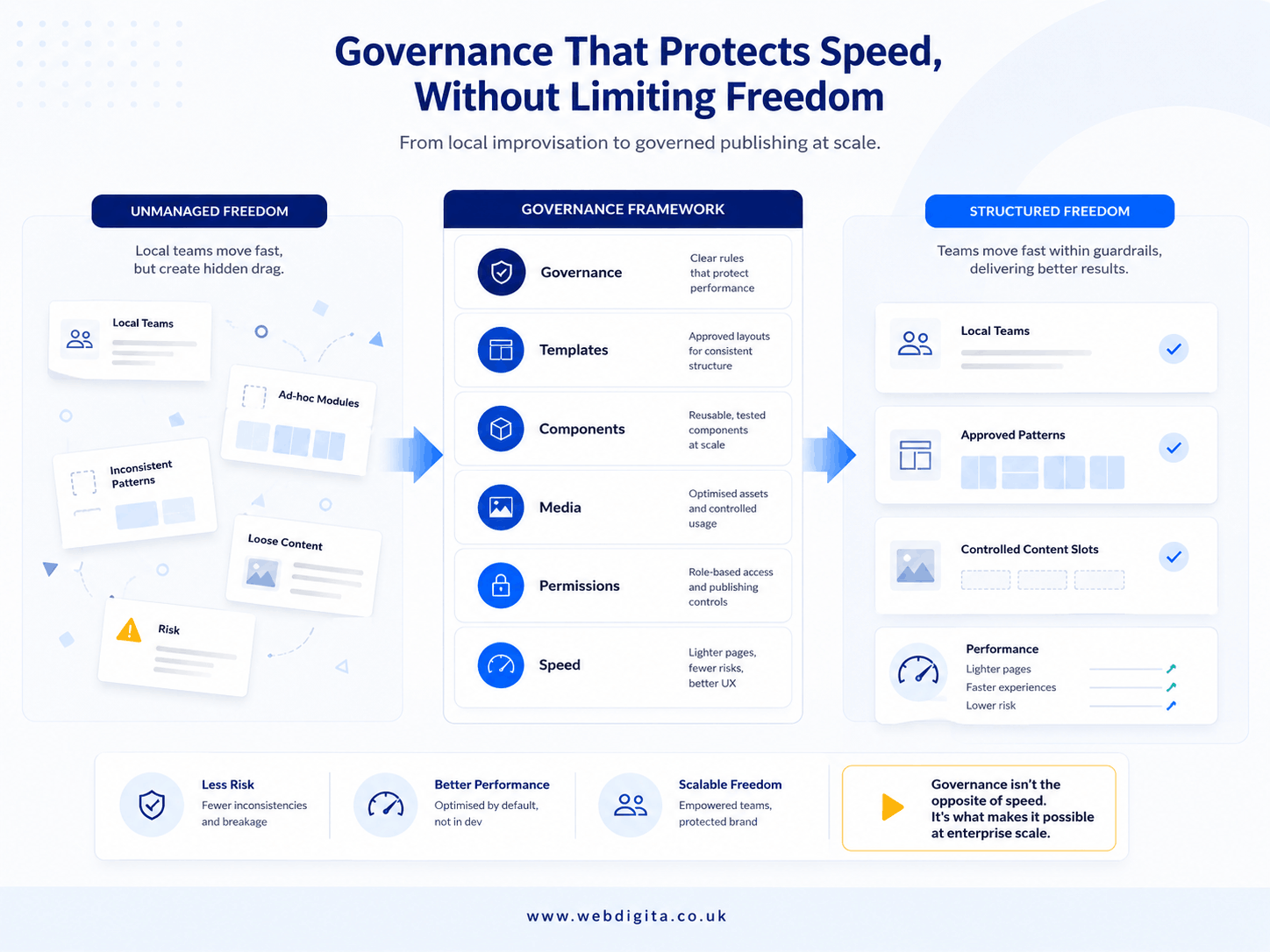
In practice, this tension most often appears when a site has a strong visual system but weak publishing controls. The brand looks coherent in design files. Live pages drift because too many teams can improvise inside the CMS without consequence.

Is your enterprise site slowing down because of governance gaps?
We audit enterprise websites to find where performance drift sits in templates, publishing controls and component use. You get a clear view of what needs tighter governance and what needs structural change.
No sales pressure. Just honest technical clarity before you decide.
Performance-first enterprise design control map
This control map shows where speed is protected, who should own each governance rule, and what tends to break when control is absent or unclear.
WEBDIGITA Performance Control Matrix: use this to assess whether your enterprise setup protects speed through structure – not only through after-the-fact optimisation.
| Control area | What should be controlled | Likely owner | Risk when unmanaged |
|---|---|---|---|
| Component libraries | Approved variants, behaviour and usage rules | Design system and UX leads | Duplicate modules, visual drift and heavier pages |
| Templates | Allowed layouts, section limits and page logic | Product owner or digital lead | Template sprawl and inconsistent journey flow |
| Media | File size, format, cropping and embed rules | Content operations | Slow mobile performance and unstable page weight |
| CMS permissions | Who can create, edit or publish structural changes | Platform owner | Uncontrolled publishing and governance gaps |
| Performance budgets | Limits for page weight, scripts and key templates | Engineering with digital leadership | Gradual decline hidden inside normal release cycles |
Review this map against real ownership, not assumed ownership. If nobody can clearly approve or reject a new component, that is not flexibility. It is a governance gap.
The guardrails that improve speed without blocking teams
The best guardrails reduce decision friction for editors. They sit inside the design system and CMS itself, so teams are guided towards better choices rather than being asked to remember a policy document and self-police.
If you want speed to hold at scale, rules need to live in the places where publishing decisions actually happen. Documentation alone is not sufficient. Ask whether your CMS prevents oversized media uploads, limits risky template combinations, and makes approved components genuinely easier to use than improvised alternatives.
Start with these checks:
- Set performance budgets for key page types – not only the homepage
- Limit component variants to those with a clear, documented use case
- Cap template complexity so pages cannot be layered indefinitely
- Apply media rules in the CMS, including file handling limits and embed restrictions
- Review whether local teams can meet real content needs within approved patterns – if they cannot, the patterns need redesigning, not the rules removing
If you are also managing cross-team search visibility, managing templates and internal complexity across enterprise SEO becomes part of the same governance conversation. Enterprise IA and CMS architecture are rarely separable once you are working at scale.
How to decide whether to improve the current system or rethink it
This is the decision most enterprise teams defer for too long, and the cost of that deferral is real. Further optimisation applied to a structurally compromised estate tends to mask the problem rather than resolve it – and the next release cycle reopens the same gaps.
My view, having worked through this assessment with teams managing complex content estates, is that the honest question is not “can we fix this?” but “can this system enforce better behaviour without constant manual intervention?” If the answer requires someone to personally approve every new template request or chase media compliance across regional teams, the system is not designed to scale. No amount of incremental improvement changes that.
The table below is a practical starting point for that conversation:
| Situation | Improve the current system | Rethink the structure |
|---|---|---|
| Template estate | Limited sprawl, mostly reusable patterns | Too many exceptions and overlapping layouts |
| Component library | Mostly stable, needs rationalisation | Fragmented, duplicated and weakly governed |
| Publishing control | Rules exist but need better CMS enforcement | Permissions and workflows allow structural drift |
| Team behaviour | Teams will work within clearer, embedded guardrails | Current model depends on repeated exceptions to function |
| Stakeholder alignment | Ownership is clear, accountability is shared | Governance responsibilities are assumed rather than agreed |
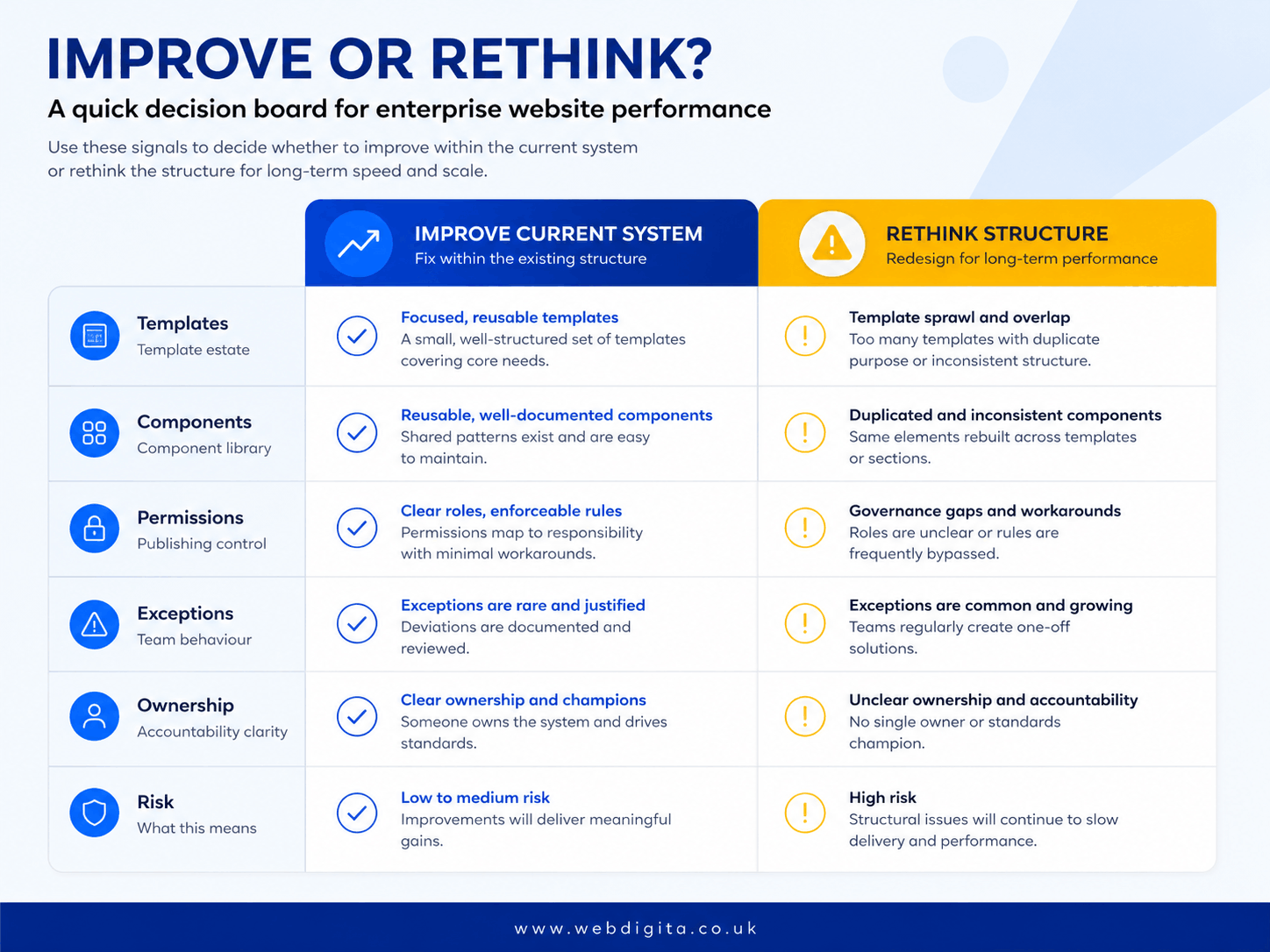
If the right-hand column describes your estate more accurately than the left, a structural reset is the more defensible investment. For teams working through that scope before committing to a direction, a project discovery workshop can surface those assumptions before they become build waste.
Questions teams ask before tightening enterprise performance control
Common concerns about balancing speed, governance and publishing freedom at scale.
1. What is performance-first enterprise design?
Performance-first enterprise design is a way of structuring pages, components and publishing rules so the site stays fast as more teams, regions and content demands are added. It treats performance as a design and operating model issue, not only a technical one. Teams keep flexibility inside defined limits rather than adding drag with every update.
2. Why do enterprise websites get slow over time?
Enterprise sites slow down because publishing freedom expands faster than the rules that hold the experience together. Pages gain heavier modules, looser media control and more template variation than the system can carry well. The problem is usually cumulative: one extra module or oversized media block may look harmless, but across a large estate they create real friction.
3. Is governance the enemy of speed?
No. Good governance does not remove flexibility. It decides where flexibility is safe, where it needs approval and where it should not exist at all. Enabling governance gives editors approved patterns that are already performant, accessible and on-brand, so they can move quickly without creating template sprawl or performance drift.
4. What are performance guardrails?
Performance guardrails are rules built into the design system and CMS that guide teams towards better choices instead of relying on documentation alone. They include performance budgets for key page types, limits on component variants, caps on template complexity, media rules in the CMS, and checks that local teams can meet real needs within approved patterns.
5. How do I know whether to improve the current system or rethink it?
If the problem sits in a few heavy templates or weak media control, improvement may be enough. If the estate is full of duplicated modules, unclear ownership and inconsistent publishing logic, a broader rethink is usually more realistic. Ask whether your current setup can enforce better behaviour without constant manual policing.
6. Who should own performance control in an enterprise setup?
Performance control should be shared across roles. Design system and UX leads own component variants and usage rules. Product owners or digital leads control templates and page logic. Content operations manage media rules. Platform owners control CMS permissions. Engineering with digital leadership sets performance budgets. If nobody can clearly approve or reject changes, that is a governance gap.
7. Can regional teams still have publishing freedom under performance-first design?
Yes. Performance-first design gives regional teams a controlled set of page patterns, content slots and media rules that let them move quickly without creating template sprawl. The answer is not unlimited local editing. It is structured freedom: teams can publish, localise and adapt, but within patterns that protect speed and consistency.
8. What should I check first if enterprise performance is declining?
Check whether the slowdown is local or systemic. If the same issues appear across templates, regions and content types, do not assume a few technical fixes will hold for long. Look for bloated page templates, multiple versions of near-identical modules, uncontrolled media use, teams bypassing approved patterns, and design system documentation that exists but is not enforced in the CMS.
Conclusion
Enterprise performance does not fail overnight. It erodes when publishing freedom expands faster than the rules that hold the experience together. If your site is slowing down despite ongoing optimisation, the issue is probably structural.
- Ownership: Check whether anyone can clearly approve or reject new components, templates or publishing logic. If not, that is a governance gap, not flexibility.
- Enforcement: Ask whether your CMS prevents oversized media, limits risky template combinations and makes approved patterns easier to use than improvised ones.
- Scope: If the estate is full of duplicated modules and constant exceptions, a broader rethink is usually more realistic than another round of minor fixes.
- Scale: Performance-first design means teams can still publish, localise and adapt, but within patterns that protect speed, trust and experience quality as the organisation grows.
Need help deciding whether to improve your current setup or rethink the structure?
We work with enterprise teams to review templates, governance models and publishing controls before scope is set. You get clarity on whether performance issues can be fixed within the current system or need a broader reset.
Book a discovery workshopOr if you prefer,