Key Takeaways
If two London agency proposals look similar on the surface, the real difference is usually in what sits underneath the design.
- Discovery depth changes cost fast. Workshops, information architecture and tighter scoping add upfront spend but reduce expensive rework later.
- Stakeholder complexity is a major pricing driver. More teams, approvals and competing priorities mean more senior coordination and governance.
- Cheap-looking quotes often shift work back to you. If content clean-up, compliance checks or decision-making are vague, the risk may simply be parked with your team.
- QA, accessibility and CMS setup are easy to under-specify. These quieter workstreams protect launch quality and day-to-day usability after go-live.
- Compare proposals line by line. A stronger visual concept is not enough if testing, launch support and delivery ownership are thin.
If two web design proposals from london based web design agencies differ by tens of thousands of pounds, the gap is almost never about the quality of the visuals. Look at strategy depth, governance, and QA rigour – those are the line items that quietly separate what appears to be the same service.
The short answer: Bespoke web design costs in London are driven by discovery depth, stakeholder complexity, information architecture, conversion design, design systems work, content restructuring, accessibility and compliance treatment, QA rigour, CMS complexity, governance overhead, and launch support. Responsive design and visual execution are a smaller share of total cost than most buyers expect. Projects typically range from GBP 5,000 for lighter builds to GBP 65,000-plus for enterprise rebuilds, with the floor of each band determined by how much delivery ownership the agency is actually carrying.
If you are seriously evaluating the best web design agency in london for your next project, that is exactly where your attention should be. A lower quote is not automatically the better one. Sometimes it simply means more assumptions baked in, more decision-making pushed onto your team, and more risk sitting quietly outside the proposal. If you want to test this early, a project discovery workshop is usually where the real scope becomes visible.
Why London bespoke web design quotes can vary so much
For high-value projects, London pricing is not purely a city premium. You are typically paying for senior time, tighter coordination, more workshop hours, and a delivery model built to withstand scrutiny. The right way to judge a quote is by the level of thinking and control wrapped around the build – not by the UX concept or the visual hierarchy in the initial mock-up alone.
Here is the contrast: One proposal may cover a lighter-scope site with limited discovery, a few rounds of design, and basic launch checks. Another may include stakeholder workshops, information architecture, content restructuring, accessibility review, technical audit work, governance, reusable design systems, and thorough QA. On the surface, both may promise a bespoke site – but they are not remotely comparable underneath.
The question worth asking is blunt: where has the agency placed the risk? If key decisions, content clean-up, approvals, or compliance checks still sit with your team, the quote may appear lean simply because the difficult work has been shifted back onto you. We see this regularly. The proposal looks clean because it is.
- Senior input: more strategy and oversight usually means a higher but safer quote.
- Scope definition: tighter scoping costs more upfront and often prevents expensive rework later.
- Governance: review cycles, documentation, and decision control all add time – and that time is real.
- Delivery expectations: faster timelines or higher standards of scrutiny increase effort. That cost has to land somewhere.
What bespoke web design projects in London typically cost
Most agencies will not publish pricing, and there are legitimate reasons for that – scope variation is real and a number without context can be misleading. That said, buyers deserve a working benchmark. Based on what we see across the London market, here is how projects tend to land.
| Project type | Typical range | What this usually covers | What it usually does not |
|---|---|---|---|
| Lighter bespoke site Small business, limited pages, minimal stakeholder complexity | GBP 2,000 – 5,000 | Basic discovery, custom design on a small page set, standard CMS setup, light QA | Stakeholder workshops, information architecture, content restructuring, accessibility audit, post-launch support |
| Mid-range bespoke project Growth business, multiple departments, design system needed | GBP 7,500 – 15,000 | Discovery workshops, information architecture, reusable component library, conversion-led design, cross-device QA, basic accessibility review | Deep content migration, formal accessibility remediation, complex integrations, ongoing governance |
| Complex bespoke build Multi-stakeholder, regulated content, significant content migration | GBP 15,000 – 30,000 | Full discovery and scoping phase, stakeholder management, information architecture, design system, WCAG-standard accessibility, thorough QA, CMS built around your team’s workflow, structured launch support | Ongoing CRO, post-launch marketing integration, major third-party system builds |
| Enterprise-level rebuild Large organisation, multiple integrations, governance-heavy | GBP 30,000+ | Everything above, plus formal governance structure, extensive stakeholder alignment, technical audit, phased delivery planning, dedicated senior oversight throughout | Scope-dependent – typically agreed as a separate phase after discovery |
A few things worth saying plainly. These ranges reflect genuinely bespoke work – not templated builds dressed up as custom. The floor of each band assumes reasonable client-side readiness: clear content ownership, accessible decision-makers, and an agreed approval process. If those are not in place, budget tends to drift upward regardless of project size.
The ranges also assume the agency is carrying meaningful delivery ownership. If a quote sits below the floor of the relevant band, it is worth asking what has been removed to get there.
The biggest cost drivers usually sit in discovery, structure, and stakeholder work
This is where buyers most often underestimate the budget. The expensive part is not always designing interfaces – it is arriving at the right structure, UX hierarchy, and decisions before design even begins. Drawing screens is the easy bit. Getting twenty stakeholders to agree on what those screens should say is not.
In my experience scoping these projects, the clients who arrive with underestimated budgets almost always have one thing in common: they have not accounted for the alignment work. When you are managing several departments, unclear content ownership, or competing opinions about what the site should achieve, the depth of discovery matters enormously. Look for stakeholder workshops, scope definition, information architecture, and content planning within the proposal. If those sections are thin, the project may move quickly in the early weeks and grind to a halt once real decisions need to be made. Week six is usually when this becomes obvious.
Custom UI costs more when it is built around conversion design principles, responsive design behaviour, and reusable design systems – rather than one-off page decoration. Landing page performance, visual hierarchy, and page speed considerations all shape how a design system needs to be structured and tested, and that structural thinking takes senior time. Content restructuring is rarely a minor effort either. If your existing pages are inconsistent, duplicated, or politically sensitive within your organisation, that clean-up requires genuine senior time. It is not glamorous work, but skipping it creates problems that are very visible after launch.
For a useful benchmark on hidden build variables, this piece on what actually changes the price of a complex web build is worth reading.
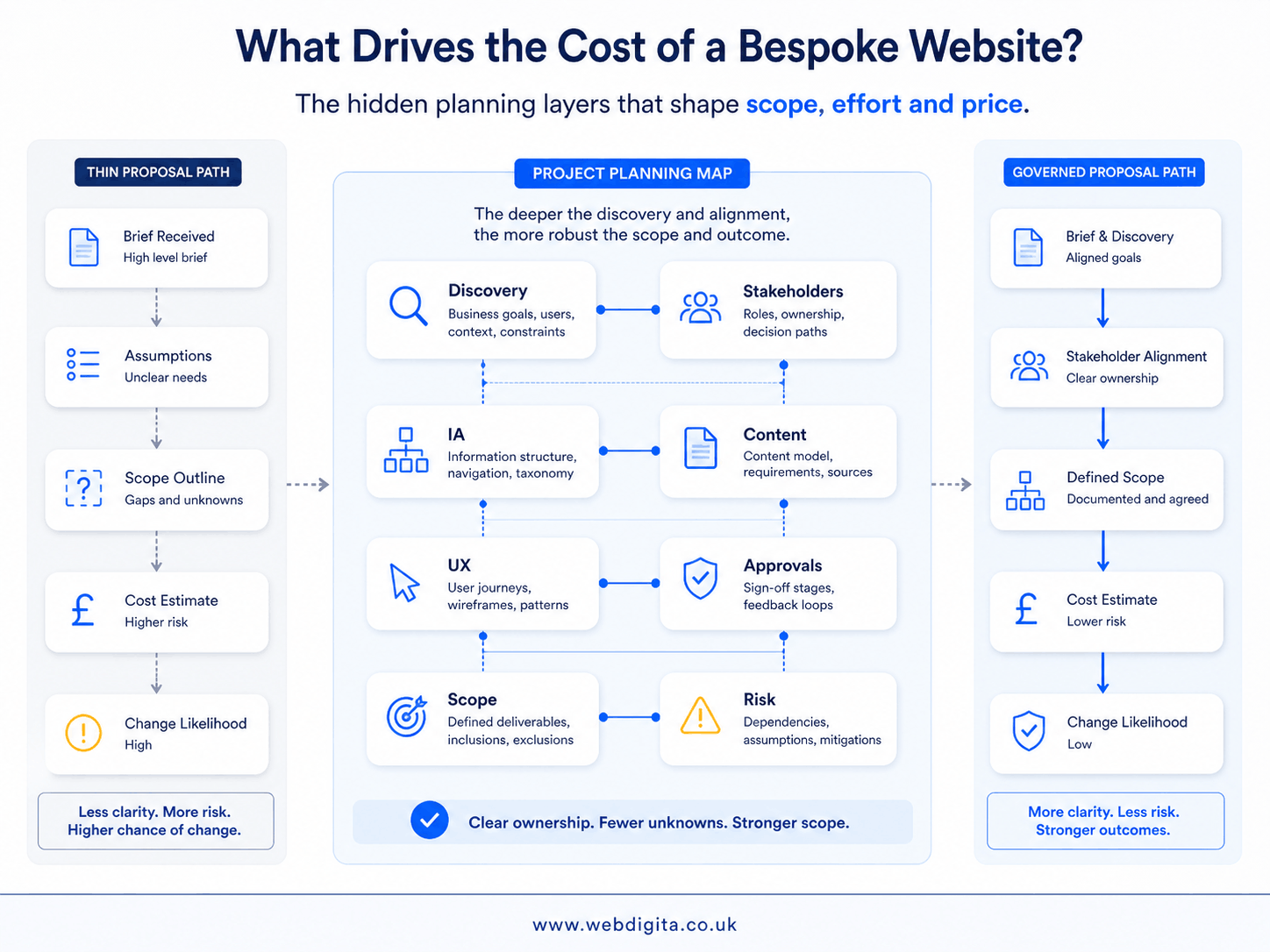
- Discovery workshops with the right decision-makers present
- Clear information architecture and defined page purpose
- Content restructuring or migration assumptions documented upfront
- A defined approval process and clear ownership on your side
Push back on any proposal that jumps from brief to design too quickly. It may feel efficient in week one, and expensive by week six.

Not sure what your quote is really covering yet
We can review the scope, assumptions, and hidden delivery risk in your proposal so you can see where discovery, QA, accessibility, and ownership may be underdefined.
Useful if you are comparing two serious agencies
QA, accessibility, compliance, and CMS complexity are where hidden risk often lives
These are the quieter cost drivers – but they matter because they protect the trust and functionality of your site long after launch. Check what testing is included, what accessibility standard the agency is working to, how compliance is handled, and whether the CMS setup is genuinely tailored to your team or simply a default WordPress installation rebranded as bespoke.
Here is a pattern we see often: a quote looks competitive because the visible design work is clearly costed, but the less visible delivery layers are vague or absent. Missing line items do not always signal efficiency – sometimes they signal exclusions, unstated assumptions, or risk being transferred to you. There is a difference. If your site includes forms, gated content, regulated messaging, or eCommerce functionality, ask explicitly what happens after launch and where the warranty period ends.
| Scope category | What increases effort | Pricing impact |
|---|---|---|
| Discovery depth | More workshops, clearer requirements, deeper scoping | High |
| Stakeholder work | Multiple teams, approvals, competing priorities | High |
| Custom UI and design systems | Reusable components, stronger consistency, conversion design | Medium to high |
| Content restructuring | Rewriting, migration planning, page hierarchy changes | Medium to high |
| Accessibility and compliance | Formal review, remediation, documented standards | Medium |
| QA depth | Cross-device testing, browser checks, form and journey testing | Medium |
| Technical audit work | Performance, page speed, tracking, integration review | Medium |
| CMS complexity | Custom fields, workflows, permissions, editor guidance | Medium to high |
| Governance overhead | Documentation, review cycles, sign-off management | Medium |
| Launch support | Go-live planning, rollback preparation, post-launch fixes | Medium |
For an external benchmark on accessibility expectations, the WCAG guidance from W3C is the standard reference. You do not need to become an expert – but you should ask whether the agency treats accessibility as a real, costed workstream or a vague promise buried in the small print. In our experience, vague promises tend to become your problem post-launch.
How to compare two proposals without choosing the wrong one
Price gaps between web design proposals from London based agencies almost never come from visual design effort. The pattern is consistent across the projects we scope: when two proposals differ significantly in cost, the explanation is almost always strategy depth, stakeholder management, accessibility and compliance treatment, and QA rigour – not the quality of the visual concept presented at pitch. If you go into evaluation expecting design quality to predict delivery quality, you will consistently choose the wrong agency.
That means the first thing to evaluate is operational detail, not concept work. Score each proposal against these dimensions before anything else:
- Discovery phase: Is it a defined workstream with clear outputs, or a vague mention of “initial discussions”?
- Stakeholder management: Does the proposal state who owns decisions and how sign-off works – or is alignment assumed to be your problem?
- Information architecture: Is IA a separate, costed deliverable, or absorbed into a generic “design” phase?
- Accessibility standard: Is a WCAG level specified, costed, and treated as a workstream – not a footnote?
- QA scope: Does it cover responsive design behaviour, cross-browser checks, journey testing, and form validation – or just “testing”?
- CMS build: Is it configured around your editorial workflow with documented guidance, or a default setup described as custom?
- Launch and post-launch: Are go-live planning, rollback procedures, and a warranty period explicitly stated?
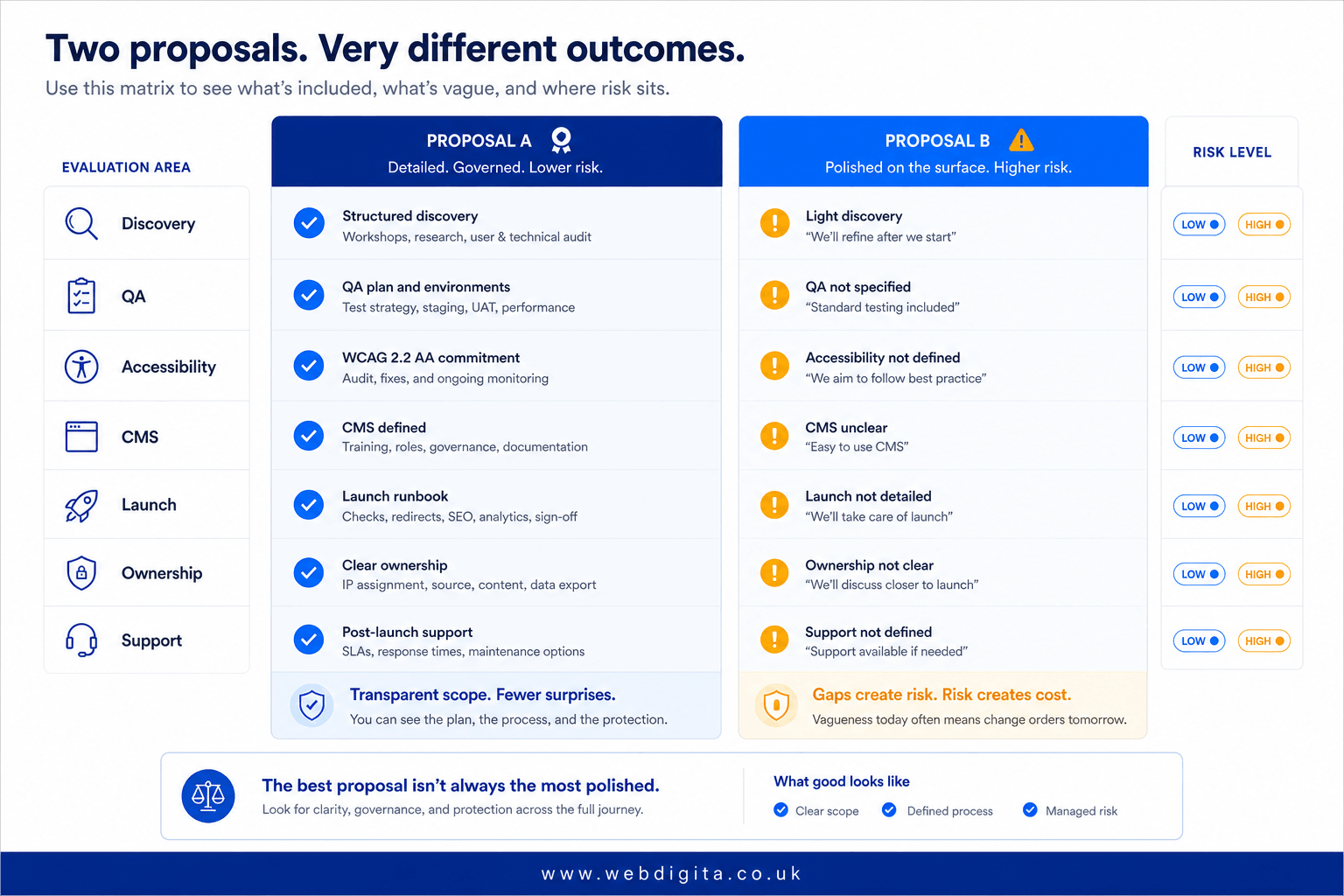
Watch for these red flags in any proposal:
- No clear discovery or workshop phase
- Vague language around testing, accessibility, or compliance
- Little or no detail on CMS setup, content migration, or launch support
- Approval rounds and ownership responsibilities left undefined
Also ask what can be phased if budget is tight, rather than forcing everything into release one. This is a legitimate conversation and any serious agency should be comfortable having it. This guide on how to phase the right work when budget is constrained can help you make that call with more clarity.
If you are now weighing agency fit, delivery ownership, and build complexity, the next step is not another generic price guide – it is a clearer scope. If you need support on a serious build or an eCommerce website project, speak to an eCommerce website development agency in London or request a free scoping review so you can compare proposals with greater confidence and fewer blind spots.
Questions buyers ask about bespoke web design costs in London
These are the points worth clarifying before you compare proposals or assume one quote is better value.
1. Why do bespoke web design quotes in London vary so much?
Because they are often not pricing the same thing. One agency has done proper discovery and priced what they found. Another has priced their assumptions. A third has removed the uncomfortable parts entirely and left them off the proposal. The visible design work is usually comparable. What sits underneath it rarely is.
2. What usually drives the cost of a bespoke web design project most?
Discovery and stakeholder work, by some distance. Getting the right people to agree on the right structure before a screen is drawn takes real senior time - and it is the part most often stripped out of a competitive quote. Visual design is rarely where the budget goes. It just looks like it is.
3. Does a lower web design quote usually mean better value?
Not in our experience. It usually means one of three things: the scope is lighter than yours requires, the harder work has been left vague, or the risk has been quietly transferred to your team. All three feel fine in week one. None of them feel fine by week six.
4. What should you compare when reviewing two agency proposals?
Look past the design samples. Check what the discovery phase actually covers, who owns content decisions, how many rounds of approval are included, what the QA process looks like, and what happens in the first month after launch. If any of those sections are thin or missing, that is not an oversight - it is a signal.
5. How important are QA and accessibility in web design pricing?
More important than most buyers realise until after launch. A site that breaks on certain devices, fails basic accessibility checks, or has forms that do not work properly is a business problem, not just a technical one. These workstreams are easy to underspecify in a proposal and expensive to fix once the project is signed off.
6. Should discovery be a separate phase in a bespoke web project?
For anything beyond a straightforward small site, yes. Discovery is where scope becomes real - where content problems surface, where stakeholder disagreements appear, and where the difference between what a client thinks they need and what they actually need becomes visible. Skipping it does not make those problems disappear. It just means they appear later, when they cost more to fix.
Conclusion
The right question is not whether a bespoke web design quote in London feels high or low. It is whether the proposal shows clear ownership of the work that usually causes delay, friction and post-launch problems.
- Check what discovery is included before design starts.
- Clarify who owns content, approvals and compliance decisions.
- Ask how QA, accessibility and launch support are actually handled.
If those areas are vague, the lower price may not be better buying. A clearer scope usually gives you a better decision than another round of headline price comparisons.
Need a clearer web design brief before choosing a London web design agency
If the real issue is scope clarity, stakeholder alignment, and delivery ownership, start with a structured discovery workshop that turns vague requirements into a more reliable web design project plan.
See Our Bespoke Web Design ServicesStill comparing proposals first