Key Takeaways
If the project is high stakes, the real test is not how polished the agency looks. It is whether the team can reduce risk once the work gets messy.
- Judge strategy before style. Strong agencies clarify business goals, user journeys, content reality and scope before talking about visuals.
- Test delivery confidence. Ask who owns UX, technical decisions, QA, approvals and post-launch support when pressure builds.
- Use a weighted scorecard. Scoring strategy, UX, technical depth and delivery confidence helps you avoid choosing the best pitch rather than the best fit.
- Push on vague answers. Surface-level responses on discovery, QA or support usually become delivery problems later.
- Speak to the senior team. The people shaping the work should be able to explain trade-offs, governance and escalation clearly.
The first impression is often the least reliable part of choosing a custom web design agency in London. In this market, polished decks, awards, and fluent UX language are easy to find. What is harder to spot is whether the team can carry a bespoke project once the real pressure starts: unclear stakeholders, messy content, technical constraints, approval delays, and commercial targets that cannot be solved with surface presentation alone.
If you are choosing for a high-stakes brief, you need to separate confidence signals from delivery confidence. That usually starts before proposal theatre, with sharper scoping and fewer assumptions. If you need that clarity early, a project discovery workshop in London can expose gaps in scope, ownership, and technical fit before you commit to the wrong partner.
The short answer: For a bespoke, high-stakes project, choose the agency that demonstrates the sharpest understanding of your brief – not the most polished pitch. Evaluate on discovery depth, IA capability, technical maturity, governance clarity, and how they handle stakeholder complexity. Portfolio aesthetics and credentials are easy to manufacture. Delivery confidence is not.
Test strategy and discovery depth first
A strong agency should make your brief feel clearer, not just more attractive. If early conversations stay at the level of moodboards, references, and interface trends, you are looking at a team that leads with polish rather than thinking.
Ask how they understand your business model, user journeys, decision friction, content reality, and conversion goals. Conversion design is not a layer added at the end – it shapes visual hierarchy, landing page structure, and every decision about what earns a click. You also need to check whether they can shape information architecture, not just page layouts. On a bespoke project, UX is not tidy wireframes; it is the logic that holds the whole experience together.
London adds a specific risk here. Premium presentation is common, so filter your shortlist by the quality of questions they ask, not by how finished the sales process feels. If an agency cannot challenge your assumptions early, they are unlikely to rescue the project later.
- Warning signs: they talk about visuals before users, promise certainty before discovery, or treat UX as a layer added after structure is fixed.
- They show portfolios without explaining the problem solved, the constraints involved, or what changed commercially.
- They rely on credentials, awards, or brand names when you push on process, ownership, or decision-making.
Check whether the team can carry the technical and delivery risk
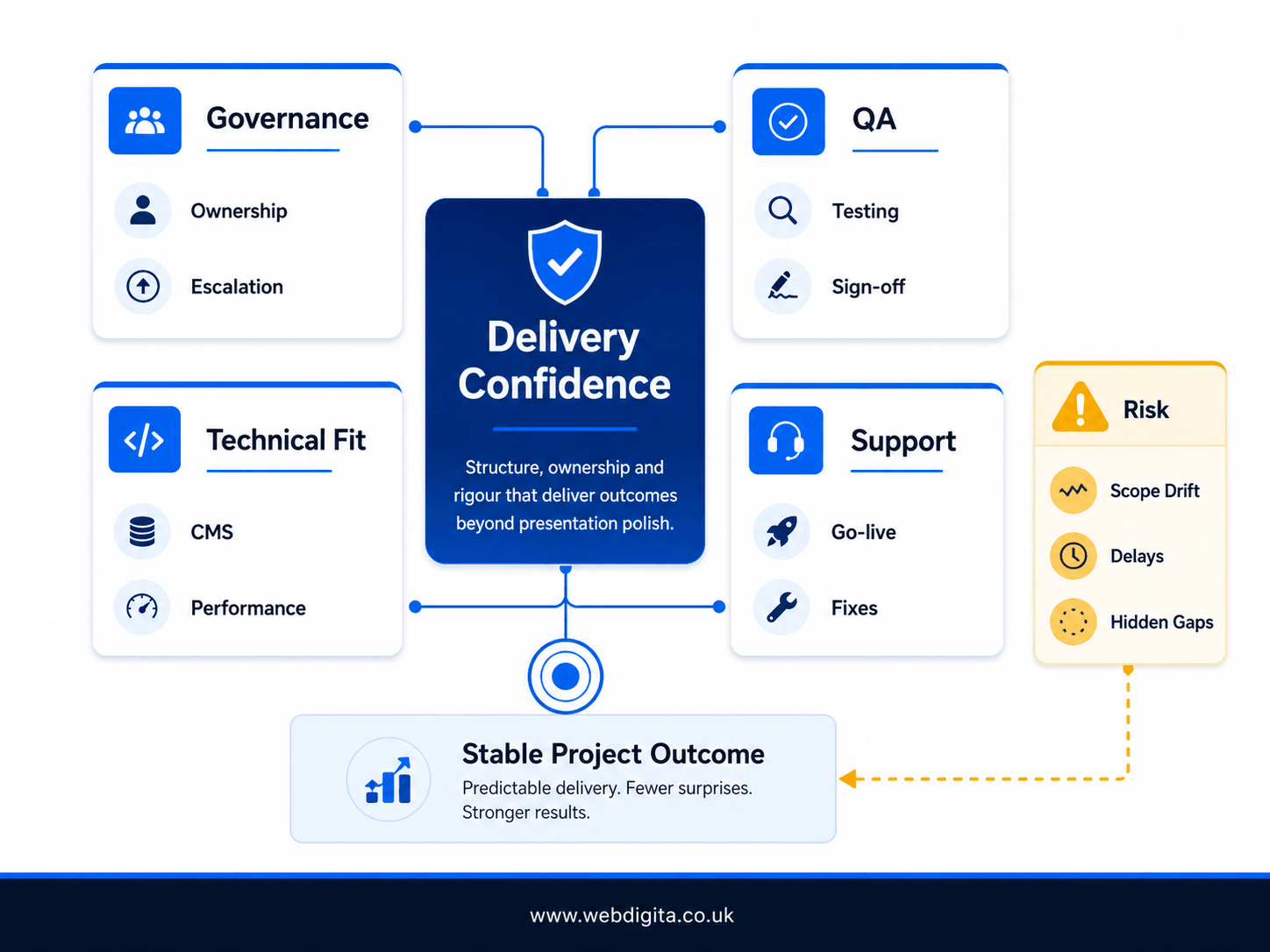
This is where many shortlists thin out. A bespoke site can look composed in Figma and still fail in build, QA, governance, or launch readiness. You need to know who is responsible for keeping the work coherent once design, content, development, and stakeholder feedback start pulling in different directions.
Ask about CMS fit, responsive design standards, Core Web Vitals and page speed awareness, design systems, QA process, and how they manage approvals. If WordPress is in scope, check whether they treat it as a strategic platform choice or a default. Do not assume post-launch support is included in any meaningful way. Ask what happens after go-live, who owns fixes, what is covered, and where warranty ends.
Scope drift on high-stakes projects most often starts with unclear content ownership, not unclear design direction. An agency that cannot define content responsibilities before build begins will cost you more in revision cycles than it saves in headline day rate.
What does good delivery confidence actually look like?
A strong team can explain decision paths, escalation routes, testing depth, and support boundaries in plain English. In our experience, the stronger agency fit nearly always comes from strategic clarity, governance, and technical maturity rather than polished credentials.
If the project has transactional or ongoing operational demands, ask how they provide website maintenance services once the site is live. Vague answers on support, QA, or ownership are a warning sign – those gaps usually become your problem after launch.
If you want a clearer picture of what a bespoke web design project in London typically costs, that guide is worth reading alongside this one.

Not sure which agency questions actually reveal delivery risk
If you want a second view on scope, governance, UX depth or technical fit, we can help you pressure-test the shortlist before you commit.
Useful if the sales process feels polished but vague
Use a weighted scorecard before you choose
Once you have spoken to two or three agencies, memory becomes unreliable. The strongest deck often feels like the best fit, even when the answers were thin. Score each conversation straight after the meeting while the detail is still fresh.
Keep the framework simple. You are not building a procurement machine; you are trying to make a better decision with less bias.
| Criteria | Weight | What to look for |
|---|---|---|
| Strategy and discovery | 30% | Sharp questions, commercial understanding, clear assumptions, realistic scoping |
| UX and IA depth | 25% | User journey logic, content structure, conversion thinking, visual hierarchy decisions |
| Technical depth | 20% | Platform fit, page speed and Core Web Vitals awareness, design systems, integration thinking, QA maturity |
| Delivery confidence | 25% | Governance, ownership, stakeholder handling, support model, escalation clarity |
Mark each area out of 10, then apply the weighting. If an agency scores highly on presentation but weakly on strategy or delivery confidence, do not let charisma close the gap.
| Area | Strong answer | Surface answer |
|---|---|---|
| Discovery | Explains how scope, users, content, and stakeholders are tested before design begins | Says they are collaborative and will work it out as they go |
| QA | Describes testing stages, responsibilities, and sign-off process | Says they always test thoroughly |
| Support | Defines ownership after launch and what ongoing support covers | Mentions support is available if needed |
Questions to ask a London web design agency before you commit
The right questions tell you more than another portfolio walkthrough. Speak to the people who will shape the work, not just the sales lead. If senior people disappear once the deal is signed, that matters.
Ask how they handle disagreement between stakeholders, what happens when content is late, and who makes the final call when design, SEO, and conversion priorities clash. Check whether they treat landing pages, search visibility, and content structure as part of UX – not as separate add-ons bolted on after build.
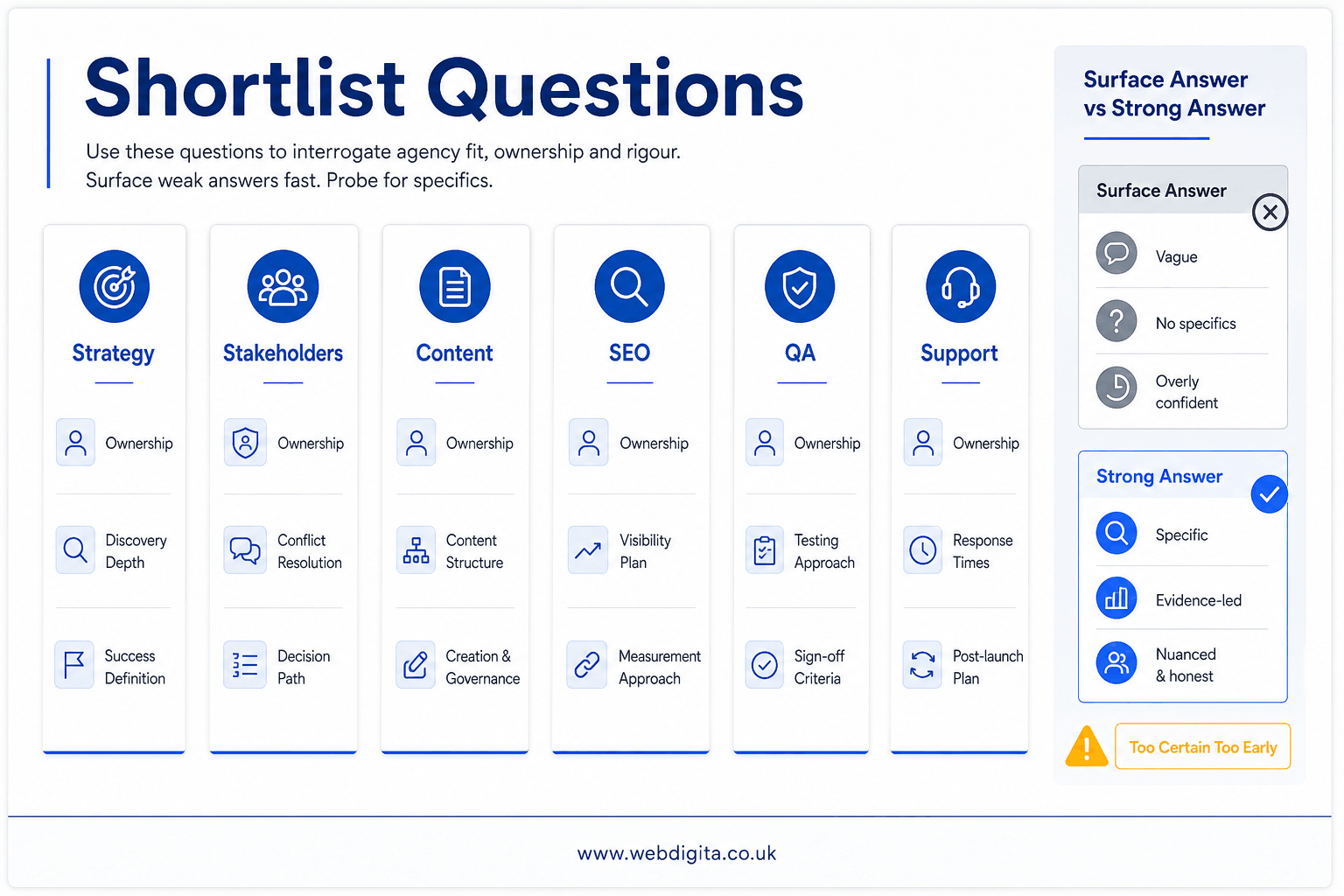
Push on over-confidence before discovery. In high-stakes projects, certainty too early rarely signals control – it usually means the agency has not yet seen the real complexity. The agencies that prove most durable in long engagements slow down in discovery and accelerate in delivery, not the reverse.
- Who owns strategy, UX, technical decisions, and delivery once the project starts?
- How do you manage conflicting stakeholder opinions without slowing the project down?
- What usually changes after discovery, and how do you control that without scope drift?
- How do content, SEO, and conversion goals shape structure before visual design begins?
- What does QA include, and who signs off each stage?
- What support model do you expect clients to need after launch?
If you are close to a decision, use those answers to judge fit, not chemistry alone. And if the project includes complex ecommerce, trading, integrations, or platform build work, speak to a team that has deep expertise with eCommerce website development in London before you finalise your shortlist. That conversation usually gives you a clearer view of scope, risk, and whether the agency in front of you can actually carry the job.
If you are evaluating a web design agency in London for a bespoke, high-stakes project and want a frank assessment of strategic fit, technical depth, and delivery readiness – no pitch, no deck – speak with our web design expert about your requirements.
Questions buyers ask about choosing a London web design agency
These are the questions that usually matter when the project is bespoke, commercially important and hard to get wrong.
1. What matters most when choosing a web design agency in London for a bespoke project?
What matters most is delivery confidence, not presentation quality alone. A strong agency should make the brief clearer, challenge weak assumptions and explain how strategy, UX, technical decisions and governance will work once the project starts. In London especially, polished sales processes are common, so the better test is how well the team handles complexity before design begins.
2. How can you tell if an agency is leading with polish rather than strategy?
You can usually tell by the questions they avoid. If early conversations focus on visuals, references and interface trends before users, content, scope and conversion goals, the agency is probably selling polish first. Another warning sign is certainty before discovery, especially when the project clearly has stakeholder, technical or content complexity.
3. Why is discovery so important on a high-stakes web project?
Discovery is important because it exposes risk before the build absorbs it. On a bespoke project, discovery should test scope, ownership, user journeys, content reality and technical fit before visual design starts. Without that step, agencies often end up designing around assumptions, which leads to rework, delays and avoidable scope drift later.
4. What should you ask about delivery and QA before appointing an agency?
You should ask who owns delivery, how QA is structured and what sign-off looks like at each stage. A credible agency should explain testing depth, escalation routes, approval handling and support boundaries in plain English. If the answer is vague or overly reassuring, that is usually a sign the delivery model is weaker than the pitch suggests.
5. Should post-launch support be part of the agency selection process?
Yes, post-launch support should be part of the decision from the start. You need to know what happens after go-live, who handles fixes, what support covers and where responsibility ends. Many agencies mention support casually, but unless ownership and boundaries are clear, the operational risk often shifts back to your team.
6. Is a weighted scorecard worth using when comparing agencies?
Yes, a weighted scorecard is a practical way to reduce bias. Once you have spoken to several agencies, the strongest presentation can distort memory and make weak answers sound stronger than they were. Scoring strategy, UX and information architecture, technical depth and delivery confidence gives you a more reliable basis for comparison.
Conclusion
Choosing a web design agency in London for a bespoke project is really a risk decision, not a presentation contest. The agency that feels most impressive in the room is not always the one best equipped to handle unclear scope, stakeholder friction and technical complexity once the project is underway.
If you are close to a shortlist, slow the decision down just enough to test strategy, governance and support in plain English. Ask who owns what, what changes after discovery, and how quality is protected when priorities clash. That usually tells you far more than another polished deck ever will.
Need a London team that can scope and deliver properly
For bespoke projects, the right starting point is usually structured discovery. It helps define scope, surface delivery risk, align stakeholders, and test technical fit before build begins.
Get A Free ConsultationStill weighing up your options