Key Takeaways
The real difference is not whether a site looks polished at launch. It is whether the build still works when your business adds campaigns, stakeholders, integrations, and new requirements.
- Start with operating fit: template-led design works best when offers, page types, and editor needs are stable.
- Watch for hidden cost: rigid layouts, developer dependency, and awkward CMS workarounds usually mean the cheaper route is becoming expensive.
- Judge control properly: if conversion journeys, governance, or content structures need to flex, bespoke gives you more room to shape the site around the business.
- Price the long tail: launch spend matters, but so do rework, redesign pressure, and the cost of extending the site cleanly later.
If the system is already forcing compromises in how your team sells, edits, or scales, the decision is no longer about design preference. It is about avoiding a weak operating model.
A template is a ready made suit that does not fit all. When it was cut for someone else’s proportions, you spend money on alterations that never quite solve the underlying problem.
The short answer: Bespoke website design is commercially justified when your site is acting as business infrastructure rather than a presentation layer. If your business manages complex conversion design, multiple stakeholders, operational integrations, or frequent campaign and content change, bespoke gives you the control that template logic cannot. If your offer structure is stable, your CMS needs are light, and your team can work comfortably within a defined system, a well-chosen template route remains a rational decision.
This guide is for founders, marketing leads, and stakeholder-heavy teams weighing platform fit, governance, and future change cost before a redesign or supplier selection decision. If you want to test your assumptions early, reaching out to a professional web design agency in london can expose dependencies before you commit to a project budget.
Where template-led delivery is still the right commercial choice
Template-led delivery – including well-configured WordPress builds – can be the smarter option when your business model is clear, your content structure is stable, and your team does not need unusual workflows. If your site mainly needs strong presentation, a sensible CMS, and a straightforward path to enquiry or sale, you should not force a bespoke build just to appear more serious.
A common example is a business with a focused offer set, a small number of landing pages, limited integrations, and one or two people managing updates. In that case, speed to launch and lower upfront spend is commercially rational. The key question is whether the business can adapt to the system, rather than expecting the system to cover every edge case.
What to check: if your page layouts, editor needs, and approval process are unlikely to change much over the next 12 to 24 months, a template-led route may be enough. But do not assume lower upfront cost means lower total cost over time. It only stays efficient while complexity stays low.
Where template-led builds start to create hidden cost
The break point is rarely about visual quality – it is about control. Once your site needs more landing page variation, tighter conversion design, more stakeholder input, cleaner governance, or deeper integrations, template logic starts shaping your business instead of supporting it.
You see this in awkward page structures, editors avoiding the CMS because it is too rigid, and teams creating workarounds to publish straightforward changes. If you are already hearing “we cannot do that without breaking the layout” or “we need a developer for every change”, treat that as a structural warning, not a resourcing problem.
In my experience reviewing delivery scopes across businesses at different growth stages, the pattern is consistent: bespoke projects reduce rework, remove scale constraints, and lower future redesign pressure precisely where template-led builds would have boxed the business in. That is not a bias toward bespoke – it is a pattern visible in project after project where the initial template choice looked efficient at launch, then became expensive the moment campaigns, new service lines, or operational integrations were added. The issue is not the template itself; it is that template logic encodes assumptions about your business that stop being true as you grow.
The tell-tale signs at the point of constraint:
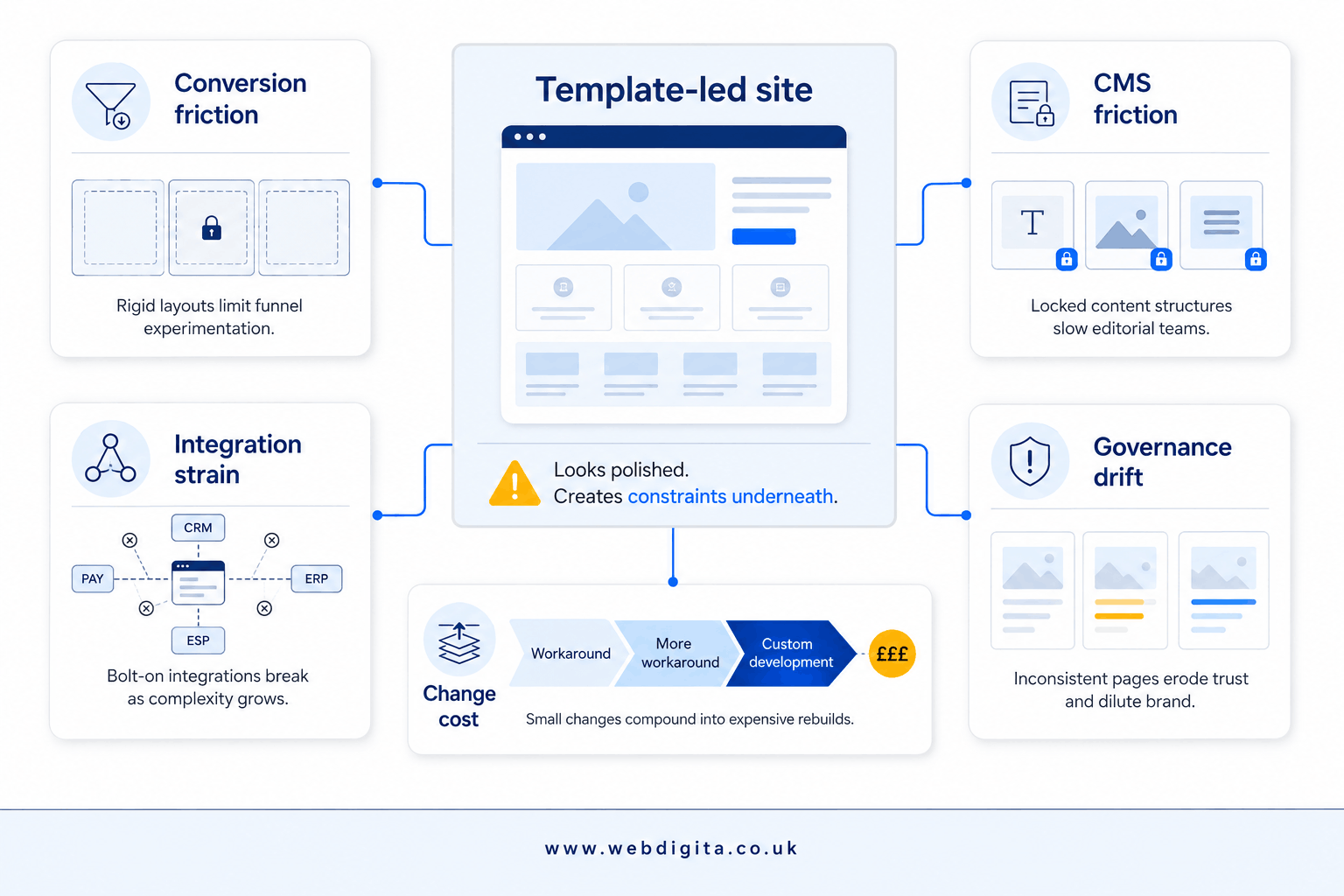
- Conversion design friction: you cannot shape landing pages around how users actually decide, because the template’s visual hierarchy overrides your UX intent.
- CMS friction: your team can edit content but not in a way that scales – and without proper design systems, brand and layout drift across editors and campaigns.
- Integration strain: forms, CRM, stock, pricing, or reporting need awkward bolt-ons that slow every subsequent change.
- Governance drift: multiple stakeholders create inconsistency because the system has no enforceable design rules or component logic.
- Change cost: each new requirement triggers workaround after workaround instead of clean extension.
If your site is already carrying two or three of those, I would challenge hard whether the “cheaper” route is still cheap. And if the site supports the business activity, clear post-launch ownership matters too – that is where website maintenance services become part of the commercial decision, not an afterthought.

Not sure if bespoke is solving a real business problem
We can review your site structure, CMS needs, stakeholder complexity, and change pressure to see whether a template-led route still fits or bespoke is commercially justified.
Free scoping review with practical feedback
Bespoke vs template: the comparison points that matter
Do not compare these routes on launch price alone. The decision turns on control, conversion design, editing confidence, and the cost of future change – not the initial invoice.
Read this as an ownership decision, not a style decision
WEBDIGITA Website Fit Matrix: use this to judge whether you are buying a faster launch or a better long-term operating model.
| Decision point | Template-led | Bespoke |
|---|---|---|
| Control | Good for standard layouts and predictable journeys | Built around your exact journeys, visual hierarchy, and rules |
| Upfront cost | Lower initial spend | Higher initial spend |
| Conversion design | Limited once you move beyond the template’s landing page logic | Full control over page structure, UX, and testing priorities |
| CMS and design systems | Works when editor needs are simple and consistent; design systems drift over time | Can match different teams, content models, governance needs, and enforce design system rules |
| Future change cost | Can become costly when requirements evolve beyond the original template assumptions | Usually easier to extend cleanly if scoped properly from the start |
| Total cost of ownership | Best when complexity stays low and offer structure is stable | Better when rework, growth, and operational demands are likely |
If you want a deeper view on budget logic, it may help to read what a bespoke web design project actually costs. Compare not just build spend, but redesign pressure, developer dependency, and lost conversion control over time.
How to decide if bespoke is commercially justified for your business
Bespoke becomes justified when the website is operating as infrastructure – not decoration. If your site has to support complex buying journeys, reflect a design system across multiple content types, or connect with operational tools in a maintainable way, you are scoping for control, not just launch speed.
Before you commit to either route, push hard on four questions:
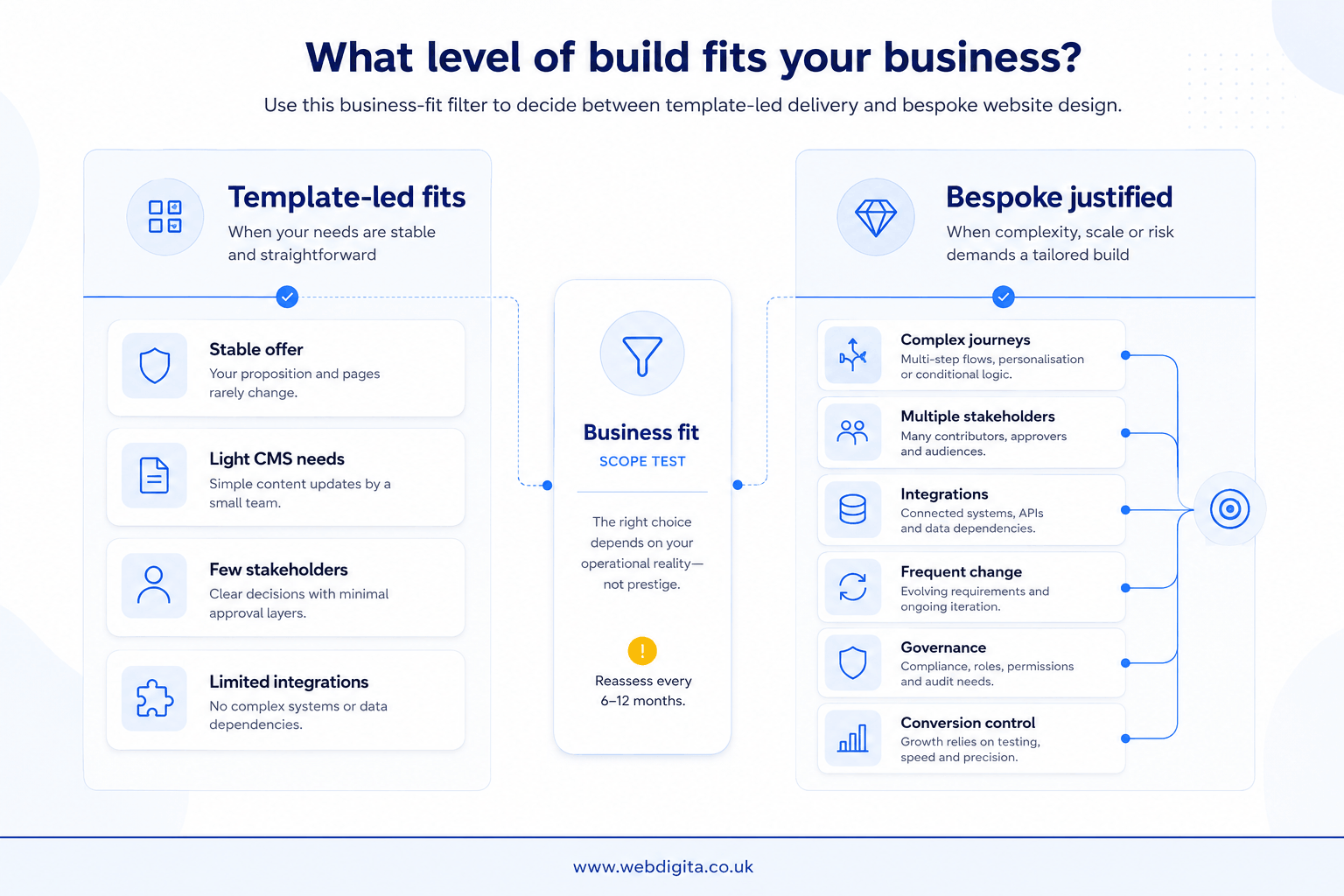
- Who owns content, and how often does it change? If multiple people publish regularly across different content types and campaigns, a template CMS will create friction quickly and design systems will drift.
- What systems need to connect? Shallow integrations are manageable in most platforms. Deep CRM, inventory, or personalisation logic will start to expose template limits fast.
- How stable is your offer structure? If new services, regional variations, or campaign-specific landing pages are likely within 18 months, template constraints will compound.
- What does change actually cost you? If every update requires a developer or risks breaking something else, the “cheaper” build is already extracting a hidden premium.
My view, having assessed delivery model decisions across founder-led and marketing-led businesses at different growth stages, is that the businesses that regret their platform choice are rarely those who overspent on bespoke. They are the ones who optimised for launch cost and then spent 18 months working around a system that was never built for their actual model – one where responsive design and page speed basics were fine, but conversion design, governance, and integration depth were not.
A founder-led business with one offer and a clean sales path may genuinely not need more than disciplined template-led delivery. But a business managing multiple services, regional variations, campaigns, integrations, and internal teams is often past that point already. If you are in that second group, the right conversation with a supplier is not about budget – it is about scope clarity and delivery fit.
If a bespoke website build is justified, and if the project also requires eCommerce functionality, then it all about defining a clear scope and the finding the right eCommerce development company to support where implementation complexity is real.
If you want to avoid buying the wrong level of build, get a free scoping review first. That gives you a clearer read on fit, assumptions, hidden dependencies, and whether bespoke website design is genuinely solving a business problem or simply adding cost.
Common questions about bespoke website design vs template-led builds
These are the questions teams usually ask when they are trying to avoid overbuilding, underbuying, or locking themselves into the wrong delivery model.
1. When is template-led website design the right choice?
Template-led website design is the right choice when your offer structure is clear, your content needs are stable, and your team can work comfortably within a defined system. It tends to suit businesses with straightforward page types, limited integrations, and a small number of people managing updates. The commercial advantage comes from speed and lower upfront spend, as long as complexity stays low.
2. How do you know when bespoke website design is justified?
Bespoke website design is justified when the website needs to support more than presentation. If your site handles complex buying journeys, multiple stakeholders, frequent campaign changes, or operational integrations, bespoke can protect revenue and reduce rework. The key test is whether a standard system supports the business cleanly or keeps forcing compromises.
3. Is bespoke website design always better for serious businesses?
No, bespoke website design is not always better for serious businesses. A serious business with a simple sales path and stable content can waste money on unnecessary complexity. Bespoke becomes the stronger option when control, governance, conversion design, or future change matter enough that template constraints would create hidden cost.
4. What hidden costs can come with a template-led build?
The hidden costs usually show up after launch. A template-led build can create developer dependency, awkward CMS editing, inconsistent page structures, and workarounds for integrations or campaign needs. Those issues rarely look expensive at the start, but they add friction every time the business needs to evolve the site.
5. Should you compare bespoke and template-led design on price alone?
No, you should not compare bespoke and template-led design on launch price alone. The better comparison is total cost of ownership, including rework, redesign pressure, CMS friction, and lost conversion control. A lower upfront spend only stays efficient if the site remains simple and the business does not outgrow the system.
6. What should a business check before choosing between bespoke and template-led design?
A business should check who edits the site, how often content changes, what systems need to connect, and how much flexibility future campaigns or service changes will require. It is also worth checking approval complexity and whether different teams need different content structures. Those answers usually make the right route much clearer.
Conclusion
This choice is easier when you stop treating it as a visual decision. A website that supports a simple offer and predictable content can perform perfectly well on a disciplined template-led build. A website that sits inside sales, marketing, operations, and stakeholder governance usually needs more than that.
What matters: Buy the level of control your business will actually use, not the level that sounds impressive in a pitch or feels cheaper on day one.
Next step: Before choosing a supplier, pressure-test how the site will be edited, extended, approved, and integrated over the next 12 to 24 months, because that is where the right build choice becomes obvious.
Choose the website build that fits how your business actually operates
If template constraints are already affecting conversion, editing, governance, or integrations, the next step is proper scoping. See how our bespoke web design service handles complex delivery needs.
See Our Bespoke Web Design ServicesNot sure yet?