Key Takeaways
B2B eCommerce growth usually stalls because the buying journey cannot handle demand cleanly, not because the market lacks interest.
- Measure throughput, not noise: traffic, product views and form fills matter less than active buying accounts, quote-to-order speed and reorder rate.
- Fix the commercial basics first: if buyers cannot see their real price, stock position or account-specific terms, they fall back to sales and revenue slows.
- Treat quotes as part of conversion: in many B2B journeys, the quote flow is the route to purchase, so inbox-based approvals and handoffs become a direct growth constraint.
- Make repeat buying easy: saved lists, order history, templates and quick reordering often move more revenue than another acquisition push.
- Use sales-assist selectively: self-serve should cover routine buying, while people step in for exceptions, negotiated terms and complex orders.
Most B2B eCommerce growth problems are not traffic problems. They are throughput problems – and the distinction has a direct cost.
The short answer: Revenue in a B2B buying journey moves when accounts can see their negotiated price, get quotes approved without delay, reorder from saved history rather than rebuilding baskets, and expand usage without manual sales intervention. More paid traffic does not fix those constraints. It sends more buyers into the same blocked journey and inflates acquisition cost without improving LTV or AOV.
That is why some firms keep spending on acquisition, redesigns, or even a fresh platform build and still do not move revenue in any meaningful way. Before you invest in more traffic or opt for an eCommerce SEO agency, you need to know where the buying journey is actually constraining growth.
This is for commercial leads, eCommerce managers, and digital transformation owners who need clarity before fixing repeat orders, approvals, quote flows, or sales-assist buying paths.
Why B2B revenue growth breaks in different places than DTC
B2B buyers do not behave like casual shoppers. One account may involve procurement, finance, site teams, and an approver who appears right at the end. If you measure success like a DTC shop – tracking sessions, form fills, or top-of-funnel CRO rates – you will back the wrong fixes.
In B2B, conversion is wider than checkout. It is whether an account can move from enquiry to quote, quote to order, and first order to repeat buying without friction. Negotiated pricing, role-based access, approvals, and sales-assist paths all shape revenue – and none of them show up cleanly in standard attribution reports.
That is why paid traffic can rise while revenue stays flat. Teams celebrate sessions or form fills while account activation and reorder rate barely move. That is usually where margin starts leaking – and where AOV stays artificially low because accounts cannot expand without involving sales.
| Vanity signal | Revenue signal that matters more |
|---|---|
| More traffic | More active buying accounts |
| More form fills | Faster quote-to-order progression |
| Higher product views | Clear pricing and stock visibility for the right account |
| More first orders | Higher reorder speed and account retention |
The few levers that actually move online revenue
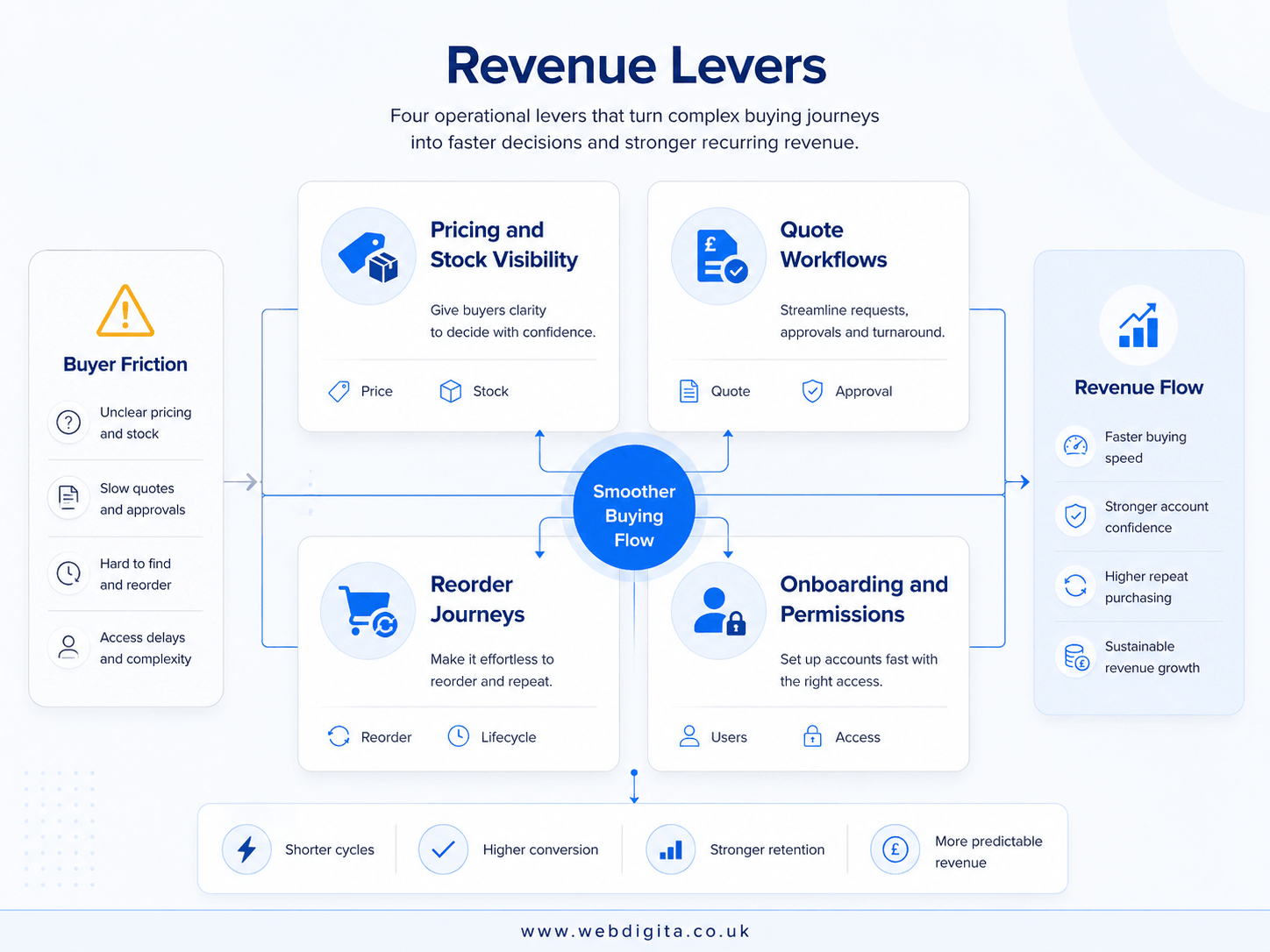
You do not need a 20-point growth plan. You need to fix the few levers that change buyer confidence and buying speed – and protect the retention and LTV that follow.
Pricing and stock visibility: if buyers cannot see their real price, availability, or contract terms, they hesitate or fall back to sales. That slows conversion and adds avoidable admin on both sides.
Quote workflows: in B2B, the quote is often the buying path, not the exception. If requests, approvals, and quote-to-order handoff still live in inboxes, demand stalls at the point of highest intent.
Reorder journeys: this is where revenue compounds. A buyer rebuilding the same basket line by line is slow revenue and low retention. Reordering from saved lists, templates, or order history in minutes is a materially different business.
Onboarding, permissions, and lifecycle comms: the first purchase is only the start. If adding users, setting permissions, and prompting the next order are clumsy, account growth stays dependent on sales and LTV stays low. Email automation that triggers on account activity – not post-purchase flows copied from DTC – is what separates high-retention B2B programmes from low ones.
- Show account pricing and stock to the right users.
- Cut quote-to-order delay.
- Make repeat buying fast from past orders, saved lists, or templates.
- Use onboarding and lifecycle comms to grow account usage without adding sales headcount.
A simple B2B growth flywheel for complex buying journeys
If you want a cleaner way to set priorities, use this flywheel. Each stage either feeds the next or suppresses it.
B2B growth flywheel: acquisition, onboarding, reorder, and expansion
Acquire: bring in the right accounts through search, paid, referrals, or sales outreach. Poor-fit demand only creates noise – and distorts your attribution.
Onboard: get the account live with the right pricing, permissions, product access, and quote route. This is where weak ownership usually shows up first, and where retention is won or lost before a second order is ever placed.
Reorder: make repeat buying fast through order history, saved baskets, quick SKU entry, and clear stock visibility. If buyers still place repeat orders manually, treat that as a commercial warning sign, not a workflow quirk.
Expand: grow account value through more users, wider category adoption, lifecycle comms, and sales-assist support where needed. Sales-assist should sit inside the journey, not outside it. AOV grows when accounts can grow themselves.
If you are still debating scope, audit the handoffs between these stages first. That is where friction hides. If the requirements are still fuzzy, a project discovery workshop can expose the assumptions before they turn into build rework.

Not sure which part of the B2B journey is blocking revenue
We can help you pinpoint where pricing, quotes, reorders, permissions, or onboarding are slowing account growth before you commit budget to traffic or a rebuild.
A practical first step for complex buying journeys
Where sales-assist and self-serve should work together
Many B2B teams create a false choice here. They either push everything to self-serve or keep too much with sales. Both hurt revenue – in different ways.
Self-serve should handle the repeatable work. Buyers should be able to see pricing, check stock, reorder, manage users, and follow clear approval routes without chasing a rep. That is the foundation of scalable retention.
Sales-assist should handle the exceptions. Complex quotes, unusual terms, large negotiated orders, or account-specific support still need people. The mistake is forcing normal buying through the same manual path as the exceptions.
This is also where self-serve expansion gets blocked. If one user cannot add colleagues, assign roles, or pass orders to an approver, the account stays artificially small even when demand is there. That is a direct LTV constraint, not a UX problem.
Red flags that show revenue is getting blocked
You do not need perfect attribution to spot a blocked journey. You need to ask the right questions of the right people – and look for patterns rather than isolated incidents.
These are the signals that consistently appear before a B2B revenue conversation starts:
- Buyers reverting to email or phone for routine orders. The clearest sign that the self-serve journey is not meeting the account’s actual needs. If sales are logging calls for repeat orders, that volume is a cost, not a relationship.
- Quote-to-order delay measured in days, not hours. If approvals sit in inboxes and orders stall at handoff, the bottleneck is workflow, not demand. No amount of paid traffic fixes this.
- One login per account. A single shared login means no role-based access, no delegation, and no expansion path. AOV is capped because the account cannot grow without manual sales involvement.
- Pricing visible only after login – or not at all. Hidden pricing forces buyers to qualify intent before they can evaluate you. It adds sales resource to every new account conversation and lengthens the buying cycle.
- No lifecycle comms beyond the order confirmation. If email automation stops at “your order is confirmed,” there is no structured path to repeat purchase, upsell, or account expansion. Retention becomes accidental.
- Attribution that only tracks acquisition. If your reporting shows traffic and first orders but nothing about reorder rate, account retention, or LTV, you are optimising the wrong stage. Growth looks stronger than it is until churn catches up.
Ask sales where buyers consistently drop back into manual contact. Ask support which account tasks still need intervention. Those two conversations will tell you more about blocked revenue than any dashboard.
More traffic does not fix broken throughput. It just sends more buyers into the same friction.
If you are seeing more than two of these signals in one account type, treat them as commercial blockers, not UX annoyances. You should also read why eCommerce growth stalls after early traction if you want a broader view of how these constraints compound over time.
What to fix first before you buy more traffic
The order matters. Fix the wrong thing first and you simply make the same weak journey look better – at higher acquisition cost.
I lead B2B eCommerce growth work here and have reviewed account journeys across distribution, manufacturing, and trade supply clients, consistently sees the same pattern: reorder flow and account experience move more revenue than top-of-funnel volume in almost every established B2B programme. His view, having assessed these journeys across sectors, is that most B2B teams underinvest in the mid-journey – pricing logic, quote handling, and repeat purchase flows – and then try to compensate with more paid traffic or another platform rebuild. That sequence is expensive and usually disappointing.
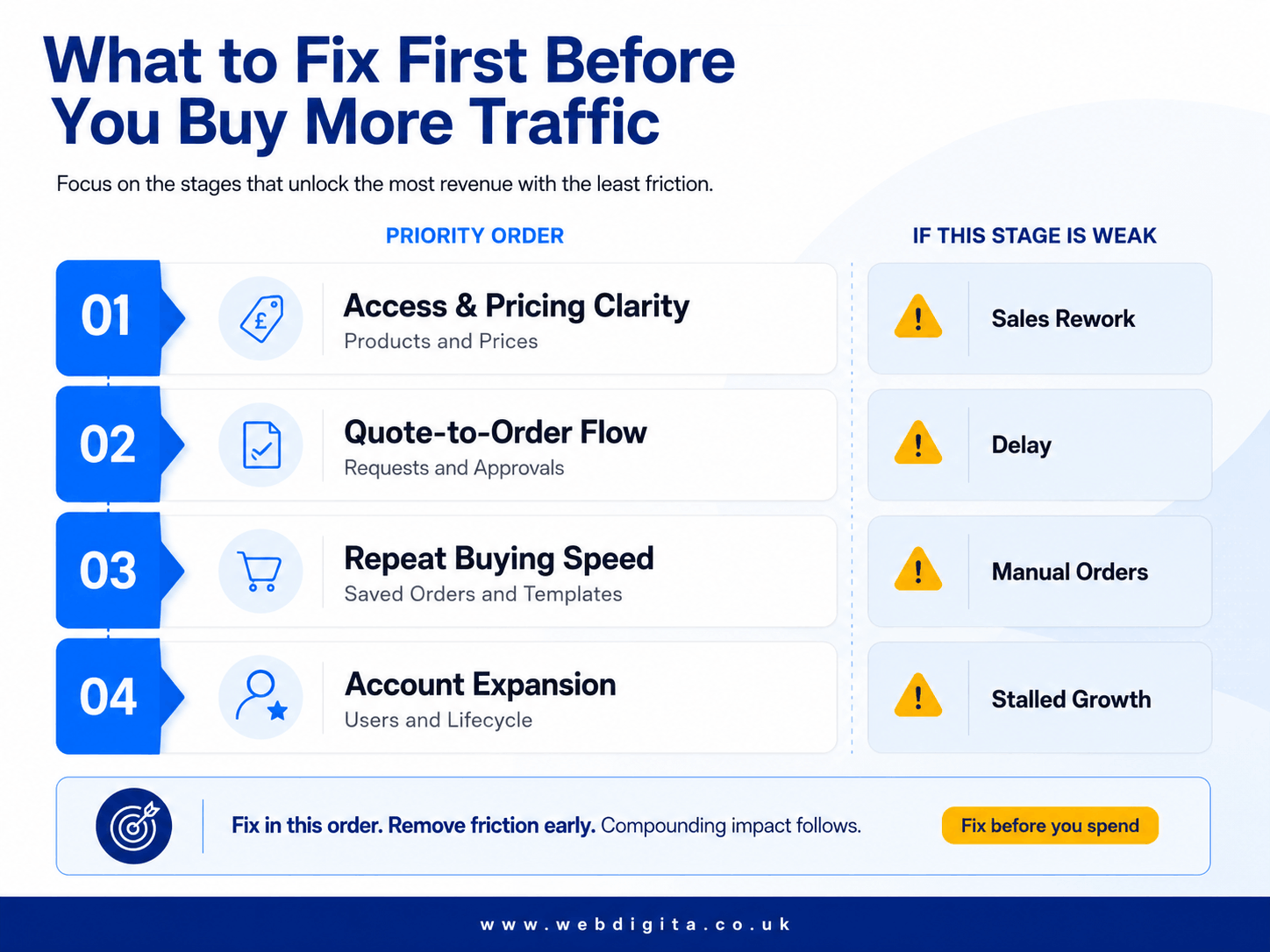
- Fix access and pricing clarity first. Buyers need the right products, prices, and permissions without chasing sales. This is the foundation everything else depends on.
- Remove quote-to-order friction next. Check how quotes are requested, approved, tracked, and converted into orders. Every day of delay here is a measurable revenue drag.
- Speed up repeat buying. Returning accounts should reorder in minutes. If they are rebuilding baskets or emailing for prices, retention and LTV are both at risk.
- Then support expansion. Use onboarding, role-based permissions, and lifecycle comms to grow account usage before adding more acquisition spend. AOV grows when accounts can grow themselves.
Before you approve more paid traffic or another platform project, ask three blunt questions: where do accounts stall, who owns each blocker, and what should be fixed before more demand hits the same constraints?
If those answers are still vague, do not fund the rebuild yet. Get the journey mapped properly first.
Questions buyers ask about B2B eCommerce growth strategy
These are the practical questions that come up when revenue is being blocked somewhere between first enquiry and repeat order.
1. Why does B2B eCommerce growth stall even when traffic is rising?
B2B eCommerce growth often stalls because the journey cannot convert demand efficiently. More traffic does not help if buyers still cannot see account pricing, get quotes approved, reorder quickly or manage user access properly. In that situation, extra demand creates more admin and more drop-off rather than more revenue.
2. What should a B2B team fix before investing in more acquisition?
A B2B team should fix access, pricing clarity, quote flow and repeat ordering first. Those are the points where good-fit accounts often get stuck. If buyers still rely on email, phone calls or manual help for routine tasks, more acquisition spend usually sends more prospects into the same friction.
3. What does conversion really mean in B2B eCommerce?
Conversion in B2B eCommerce is broader than checkout completion. It includes whether an account can move from enquiry to quote, quote to order, and first order to repeat purchase without unnecessary delay. That makes permissions, negotiated pricing, approvals and reorder tools part of conversion, not separate operational issues.
4. Should B2B eCommerce be self-serve or sales-assisted?
B2B eCommerce should usually be both, with each handling the right type of work. Self-serve should cover repeatable tasks like pricing lookup, stock checks, reordering and user management. Sales-assist should support exceptions such as complex quotes, unusual terms or large negotiated orders that need human judgement.
5. What are the clearest signs that revenue is being blocked in the buying journey?
The clearest signs are hidden pricing, slow quote response, clunky reordering, weak permissions and poor stock visibility. You may also see buyers dropping back into email or phone for tasks that should be routine online. Those patterns usually show that demand exists but the journey is slowing revenue down.
6. Why do reorder journeys matter so much in B2B growth?
Reorder journeys matter because repeat buying is where B2B revenue compounds. If returning customers have to rebuild baskets manually or wait for sales support, ordering stays slow and expensive. Fast reordering through saved lists, templates, order history or quick SKU entry removes friction from the most valuable part of the journey.
Conclusion
If revenue is flattening while demand still exists, the smarter move is usually to inspect the account journey before funding more acquisition or another rebuild. In B2B, growth tends to come from removing friction in the parts buyers repeat, delegate and approve, not from making the top of funnel look busier.
- Priority: start where accounts lose momentum, especially pricing visibility, permissions and quote handling.
- Ownership: make it clear who fixes each blocker across eCommerce, sales, operations and support, or the same issues will survive any platform change.
- Sequence: improve reorder speed and account setup before scaling traffic, so new demand hits a journey that can actually convert.
- Decision test: if the team still cannot explain where accounts stall and why, map the journey first and spend after that.
Fix the buying journey before you invest in more B2B demand
If revenue is stalling around pricing visibility, quote flow, repeat ordering, or account access, our B2B eCommerce development service helps turn those blockers into a clearer commercial roadmap.
Explore the serviceNeed a clearer starting point