Key Takeaways
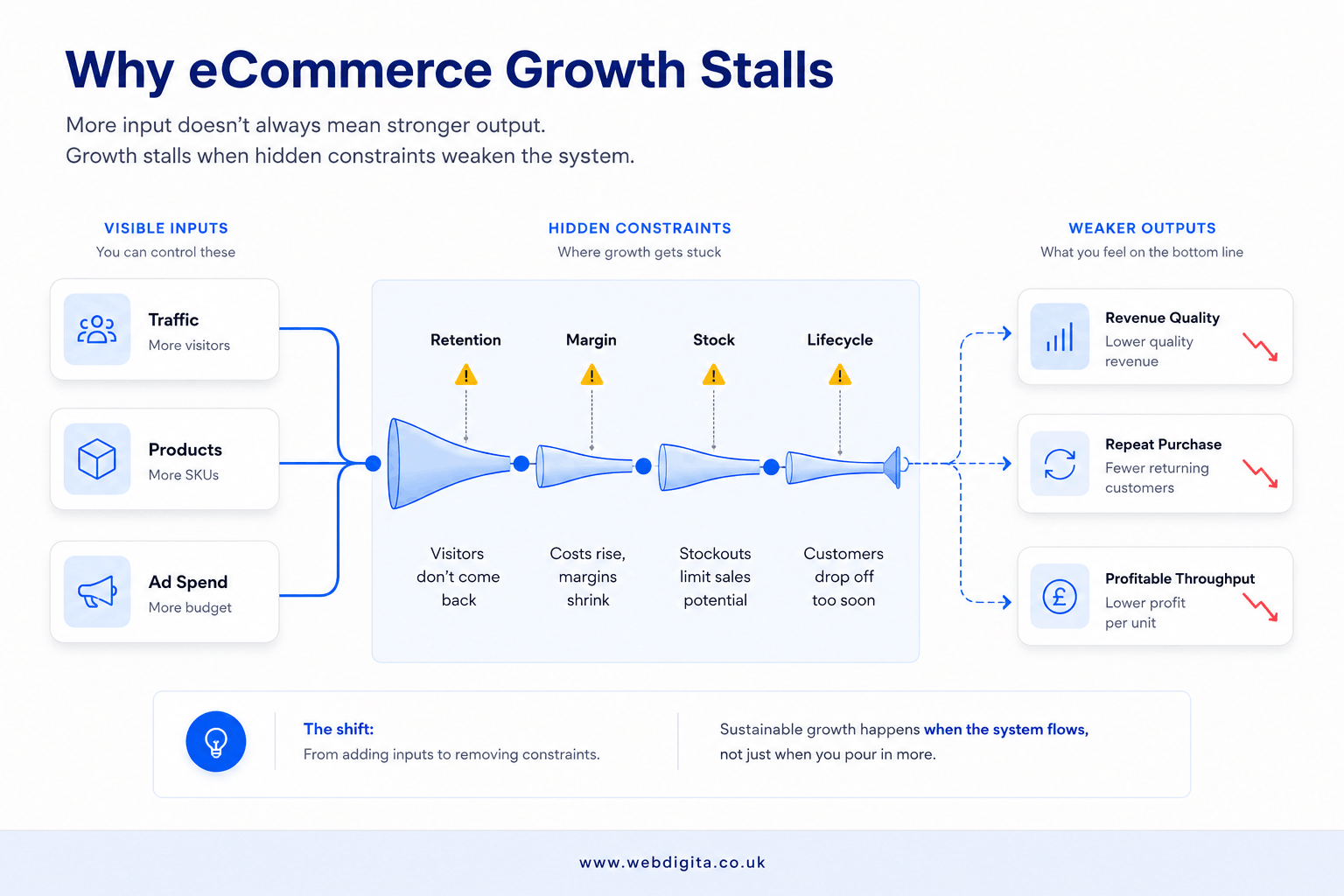
The hard part: stalled growth usually is not a traffic problem in disguise. It is a system problem where more spend, more SKUs or more campaigns keep feeding the same commercial constraint.
- Read the pattern, not one metric: rising sessions, higher spend or more orders can still mask weaker repeat purchase, thinner margins or poor throughput.
- Look for stacked blockers: CAC creep, weak retention, offer fatigue, margin pressure, stock issues, lifecycle gaps and channel dependency often compound each other.
- Check the business in sequence: demand quality, conversion path, repeat behaviour, margin health, stock reliability, then channel concentration.
- Prioritise by leverage: the first fix should be the issue doing the most damage to profitable throughput, not the one making the most internal noise.
What this means: if the model is constrained, scaling harder just makes the leak more expensive. Diagnose the bottleneck before funding more activity around it.
Growth rarely stalls because of one channel. The more common reason is messier: you keep adding traffic, products, campaigns and effort, but each extra push produces less. You are no longer compounding. You are dragging a constrained model forward, and the leak gets more expensive every quarter.
That is why more spend rarely fixes the real problem. If retention is weak, margins are thin, stock is unreliable, or your lifecycle journeys are patchy, extra demand hits a bottleneck faster. If you are already weighing platform changes, team changes or searching for an eCommerce website development agency in London, you need to diagnose the constraint before you fund more activity around it.
The short answer: Growth flattens even when traffic, products, or ad spend increase because more input does not fix a constrained model – it exposes it. Stalls happen when retention softens, margins shrink, stock becomes unreliable, or lifecycle revenue leaks. The blockers are almost always stacked, not isolated. The fix starts with identifying the real constraint, not the loudest symptom.
This guide is for founders and eCommerce leads who need to diagnose a plateau before the next planning cycle, budget decision or growth roadmap review.
What a growth stall really looks like
A real stall is not always a flat line on the revenue chart. More often it looks like more work for weaker returns: paid traffic still converts but CAC creeps faster than contribution; product count expands but AOV falls; sessions rise but repeat purchase stays soft.
Separate those signals early, because they point to different constraints. If sessions are up but retention is weak, the issue is not reach. If you add more SKUs and AOV falls, you may have created range complexity without improving offer strength. If paid traffic still converts but profit keeps shrinking, margin pressure is already in the room.
One simple test: Ask whether the business grows because the system is getting stronger, or only because the team is forcing more input into it. If it is the second, treat that as a warning sign. You need to look at throughput, margin and repeat purchase behaviour together, not in isolation.
The 7 blockers behind most stalled eCommerce growth
Most plateaus are not caused by one broken channel. They come from stacked blockers across the model. Resist the urge to jump straight into CRO, SEO or paid fixes until you can see which category is actually capping growth.
WEBDIGITA eCommerce Growth Stall Diagnostic: Match the visible symptom to the hidden drag before you decide what deserves budget first.
- CAC creep: Spend rises faster than efficient customer acquisition, so each new order costs more to win.
- Weak retention: First orders come in, but LTV stays soft because customers do not return often enough or at enough value.
- Offer fatigue: Launches keep happening, yet response drops because the proposition no longer feels fresh or distinct.
- Margin pressure: Revenue grows on paper, but discounts, fulfilment costs or product mix eat into the commercial gain.
- Stock constraints: Demand exists, but availability, fulfilment or replenishment issues choke throughput.
- Lifecycle gaps: Email automation, post-purchase journeys and reactivation flows are too weak to compound demand.
- Channel dependency: One channel carries too much of the load, so performance softens as soon as that channel becomes less efficient.
Operational drag sits underneath all of the above. Slow internal processes, unclear ownership and manual workarounds rarely show up on a single dashboard – but they slow the team’s ability to test, respond and fix. When ops drag is present, every other blocker takes longer to clear and costs more to resolve.
Several of these usually stack together. Do not assume the loudest symptom is the root cause. If traffic and spend are both rising, check whether retention, margin and stock are quietly cancelling out the gain.

Not sure which constraint is actually stalling your growth
We can help you separate traffic noise from the real bottleneck across retention, margin, lifecycle, stock and channel mix before you commit more budget.
Useful if the team keeps backing different fixes.
How to find the real bottleneck instead of blaming one metric
Single-metric thinking creates rework. Teams blame traffic when the real issue is repeat purchase, conversion when the real issue is stock availability, and paid media when the unit economics were already too thin to scale.
Check the system in order. Start with demand quality and attribution clarity. Then review the conversion path – landing pages, product pages, checkout friction and trust signals. After that, check repeat purchase behaviour, then margin health, then stock and fulfilment reliability, and only then look at channel concentration. Skip that sequence and you will optimise the wrong layer.
Mazhar’s view, having mapped revenue blockers across scale-stage eCommerce audits, is that the pattern which damages profitable growth most consistently is not a single broken channel – it is the combination of margin erosion, weak lifecycle automation and channel concentration compounding each other quietly over time. By the time it shows up as a revenue stall, the drag has usually been building for two to three quarters. Fixing one layer in isolation rarely holds.
If your team is split on what is broken, push for a structured review rather than another round of channel tweaks. A eCommerce project discovery workshop can help when assumptions, ownership and priorities are already muddy. Ask one blunt question: which constraint is doing the most damage to profitable throughput right now?
What to fix first when several things look broken
When everything feels messy, the worst move is to fix everything at once. That spreads ownership, slows learning and burns budget. Choose the first fix based on leverage, not noise.
If retention is poor and LTV is flat, more acquisition makes the leak bigger, not smaller. If stock is unreliable, more demand just creates frustration and refund risk. If margin is too thin, scaling the same model harder makes the business look busier while becoming less healthy. And if development debt is blocking key changes, it may help to think about phasing the right eCommerce work before investing further.
Use this checklist in your next planning session:
- Impact: Which issue is capping profitable throughput the most?
- Speed to validate: Which fix can you test quickly enough to reduce guesswork?
- Ownership: Who actually owns the change across marketing, trading, ops and tech?
- Downside if ignored: What gets more expensive or harder to reverse if you leave it alone?
Do not default to the easiest team-level task. Fix the constraint that unlocks the next stage of compounding. In practice, that might mean prioritising lifecycle before acquisition efficiency, stock before campaign scale, or margin work before CRO.
When your eCommerce growth strategy needs outside help
Sometimes the honest problem is not missing effort. It is that the team is too close to the system – and the diagnosis keeps reflecting whoever is loudest in the room rather than where the real commercial drag sits.
These are the signals that outside input is likely to move the needle:
- The stall crosses two or more functions and nobody owns the full commercial picture.
- Attribution is unclear – dashboards tell different stories depending on who pulls the report.
- You have already run several rounds of fixes with no meaningful change in profitable throughput.
- Every diagnosis somehow points back to the same department or channel.
- The team agrees something is broken but cannot align on what to prioritise or who acts first.
If the bottleneck is clearly in the buying journey – conversion, landing page performance or checkout our – eCommerce CRO service may be the right first step. If the issue spans acquisition, retention, margin and operations, you need a prioritised roadmap that covers the whole model, not a single-channel audit that stops at the channel boundary.
In my experience diagnosing stalled growth across scale-stage brands, the gap is rarely capability – it is perspective. When the internal team cannot step back from the day-to-day to see which constraint is doing the most commercial damage, the roadmap stays tactical and the stall continues.
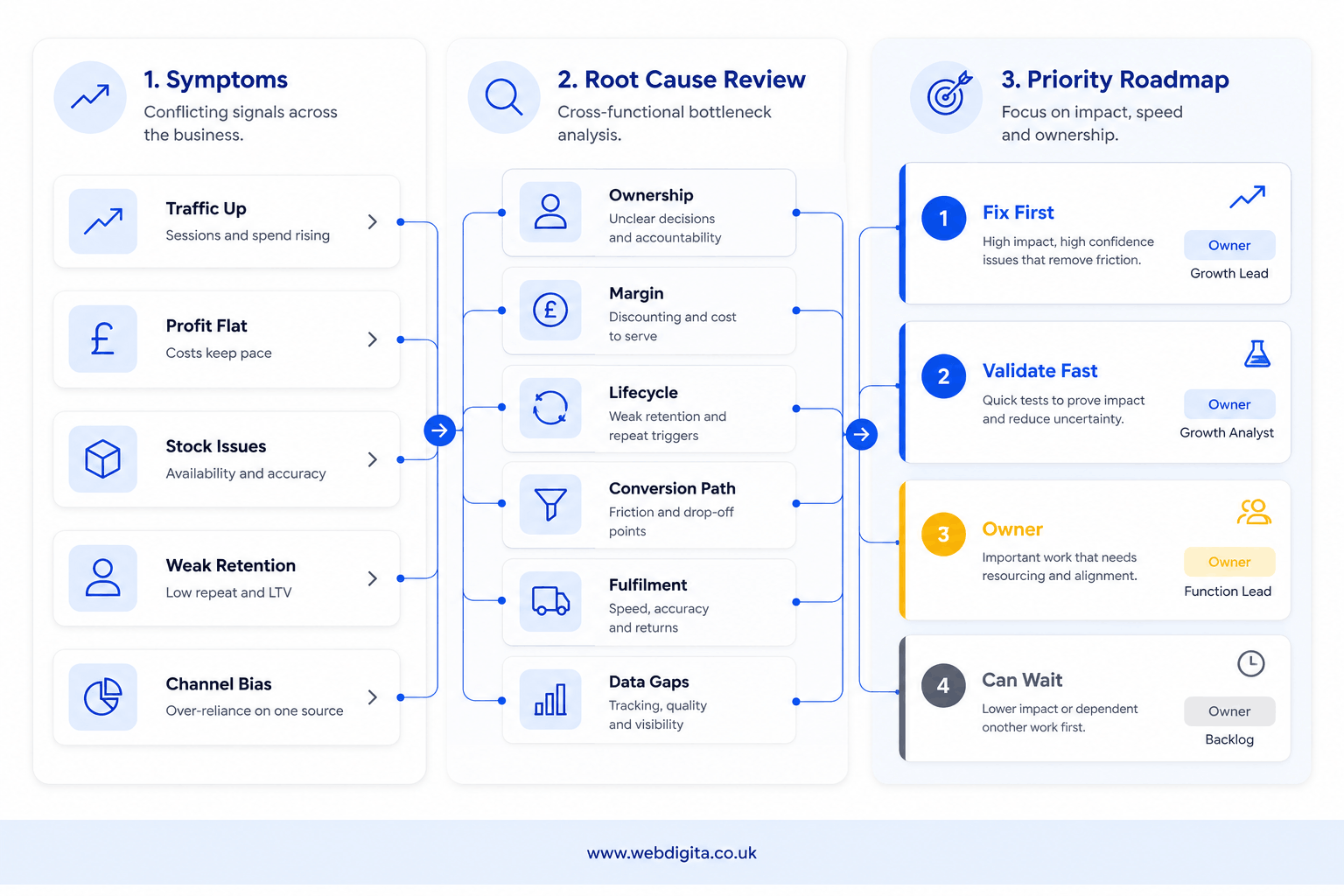
Come out of any review knowing what is broken, what to fix first, who owns it and what can wait. That is the difference between a busy growth plan and an actual eCommerce growth strategy.
If your growth has plateaued and you are not certain what to fix first, get a free personalised growth roadmap from Webdigita. You will leave with a prioritised plan across acquisition, retention, margin and operations – not another set of options to weigh up.
Common questions about stalled eCommerce growth
These are the questions teams usually ask when revenue still moves, but the model no longer feels like it is compounding.
1. What does stalled eCommerce growth actually look like?
Stalled eCommerce growth usually looks like more effort producing weaker returns. Revenue may still rise, but CAC creeps up, repeat purchase stays soft, margins tighten or stock issues limit throughput. The key sign is that the business needs more input just to maintain momentum, rather than getting stronger as it scales.
2. Why does more traffic not always fix an eCommerce growth plateau?
More traffic does not fix an eCommerce growth plateau if the bottleneck sits elsewhere. If retention is weak, conversion is held back by friction, margins are too thin or stock is unreliable, extra demand simply hits the same constraint faster. That can make the business look busier while commercial performance barely improves.
3. What should an eCommerce team check first when growth stalls?
An eCommerce team should first check demand quality before moving through the rest of the system. Then review the conversion path, repeat purchase behaviour, margin health, stock and fulfilment reliability, and only after that assess channel dependency. This order helps avoid fixing a visible symptom while the real bottleneck stays untouched.
4. How do you decide what to fix first when several things look broken?
You decide what to fix first by choosing the issue with the biggest impact on profitable throughput. The article suggests weighing impact, speed to validate, ownership and the downside of leaving it alone. That approach is more useful than picking the easiest task or the loudest internal complaint.
5. When does outside help make sense for stalled eCommerce growth?
Outside help makes sense when the stall crosses functions and nobody owns the full commercial picture. It is also useful when dashboards conflict, low-impact fixes have already been tried, or every team keeps blaming its preferred metric. The right support should clarify the bottleneck, priority order and ownership, not add more noise.
Conclusion
The practical call: when growth starts feeling heavier rather than stronger, stop asking which channel to push next and start asking which constraint is limiting profitable scale.
- Get specific: define the stall in commercial terms such as profit, repeat rate, stock availability or contribution, not just top-line revenue.
- Force one shared view: bring marketing, trading, ops and tech into the same diagnosis so each team is not solving a different version of the problem.
- Choose one first move: back the change that is easiest to validate and most likely to improve system strength, not just short-term activity.
- Use outside help carefully: if ownership is blurred or every team blames a different metric, external support should give you prioritisation and clarity, not more theatre.
Turn a stalled growth model into a clearer eCommerce roadmap
If growth has flattened despite more traffic, products or spend, our eCommerce growth support helps you find the real constraint and prioritise what to fix first.
Explore eCommerce supportNot ready for that yet