Key Takeaways
High-ticket buyers rarely enquire on curiosity alone. They wait until five confidence layers feel safe enough: product fit, company credibility, delivery confidence, commercial clarity, and a low-risk next step. If one layer feels vague, the buyer often pauses or leaves quietly.
Trust signals work as a system, not as isolated features. Missing one layer can quietly kill enquiries even when traffic and interest look strong.
- Product proof must show the offer will work in the buyer's real context, not just make broad capability claims
- Delivery and support visibility should explain who owns implementation, what happens after purchase, and how issues are handled
- Commercial clarity around inclusions, exclusions, warranties, and payment terms reduces the fear of hidden cost or wasted time
- The enquiry step must feel useful and structured, not vague or pushy, especially for major purchases where buyers expect a managed process
High-ticket buyers do not convert when a site feels unsafe, incomplete, or too generic for the seriousness of the purchase. If your site gets steady attention but few serious enquiries, the problem is rarely weak demand.
The short answer: Before a buyer of an expensive product or service will submit an enquiry, they need to trust five things – that the offer will work for their situation, that your company is credible and real, that delivery and support are properly owned, that the commercial terms carry no hidden risk, and that the next step will not waste their time. When any one of those layers is missing, buyers protect themselves by doing nothing.
That is the trust gap. This guide is for sellers of complex services, specialist equipment, premium B2B offers, and high-value eCommerce solutions who need to locate where confidence is breaking down before they change pages, forms, or journeys. If you want support diagnosing this more broadly, our lead generation agency in London works on exactly this problem.
Why interest does not turn into an enquiry on high-ticket pages
High-ticket buyers rarely enquire on curiosity alone. They wait until uncertainty drops to a level that feels commercially safe.
Separate trust into five areas: the product, the company, delivery and support, commercial terms, and the sales process. If one of those feels vague, the buyer pauses, compares options, or leaves quietly. They do not always tell you why.
Before and after: one page says the solution is bespoke, high quality, and trusted by clients. Another shows what is included, which ICPs it suits, how implementation works, what support looks like, what warranty applies, and what the first call will cover. Same offer, same traffic – very different level of perceived risk.
What buyers need to trust before they will risk contact
The buyer is not only asking, “Do I like this?” They are asking, “Is this safe enough to take further?” Check whether your pages answer that second question clearly.
Watch for gaps around technical proof, compliance data, support visibility, warranties, guarantees, and payment confidence. On an expensive purchase, vague reassurance is not enough. A procurement lead may like the offer but still hold back if warranty terms are fuzzy or no one explains who owns delivery after the sale.
- Product proof: evidence the offer will work in the buyer’s real context, not just broad claims.
- Technical and compliance proof: specifications, standards, certifications, or compatibility details where they matter.
- Delivery confidence: who is responsible, what implementation looks like, and how support issues are handled.
- Commercial clarity: what is included, what costs extra, how payment works, and where warranties or guarantees start and end.
- Relevant social proof: case studies, sectors, and testimonials that match the seriousness of the purchase – not generic five-star badges.
- Safe next step: what happens after the enquiry and what the buyer will get back from it.
Trust signals for transactions above ten thousand pounds are not a single feature. They work as a system, and the decision needs to feel manageable before the buyer ever speaks to sales.
The High-Ticket Trust Pyramid
In my experience auditing high-value funnels, the most common mistake is pushing harder on CTAs and traffic before diagnosing which confidence layer is missing. Strong calls to action rarely perform when the lower layers feel weak. The pyramid below is the diagnostic I use first.
High-Ticket Trust Pyramid: identify which layer is missing before you touch traffic, forms, or follow-up.
| Layer | What the buyer needs to trust | What to check on your site |
|---|---|---|
| 1. Legitimacy and safety | The business is real, credible, and safe to deal with | Clear company details, credible brand signals, secure payment or data handling cues |
| 2. Capability and fit | The offer suits their ICP and can do the job | Specific use cases, technical proof, sector relevance, clear scope |
| 3. Delivery confidence | The purchase will be fulfilled, implemented, or supported properly | Process visibility, ownership, timelines, support model, escalation paths |
| 4. Commercial confidence | The terms are fair, understandable, and not hiding risk | Pricing approach, inclusions, exclusions, warranties, guarantees, payment confidence |
| 5. Enquiry readiness | The next step will be useful and low-risk | Clear form expectations, response quality, no hard-sell feel, sensible friction |
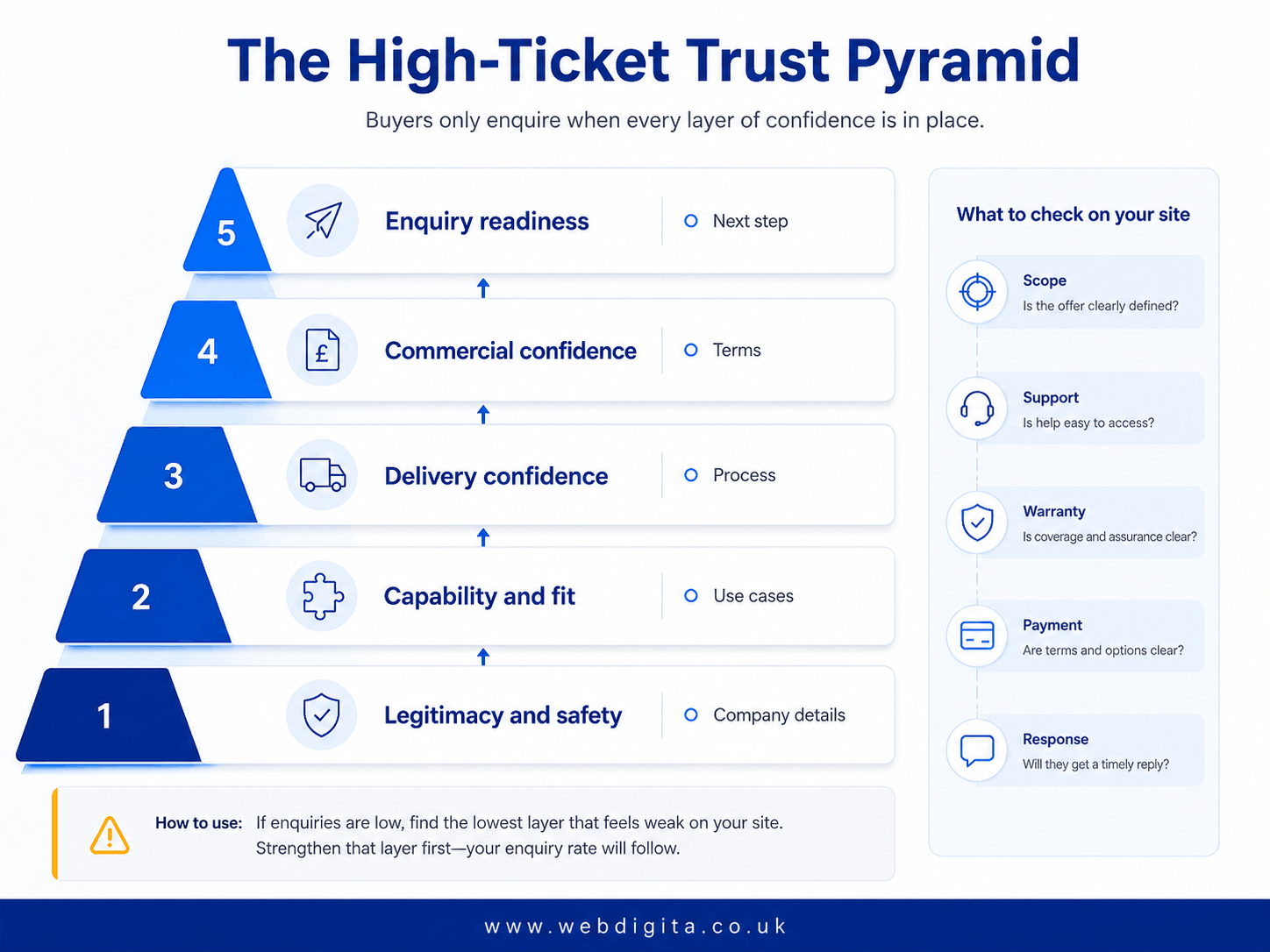
If lower layers are weak, higher-conversion elements underperform. Fix the missing layer first. If scope is still fuzzy, a discovery workshop is usually the right starting point before you treat low enquiry volume as a traffic problem.

Not sure which trust layer is missing on your site?
We can map the confidence gaps that are quietly blocking high-value enquiries, then show you which fixes will make the biggest difference to your pipeline without rewriting the whole site.
No hard sell, just a practical diagnosis of what buyers need to trust.
Where each trust signal should appear on the site
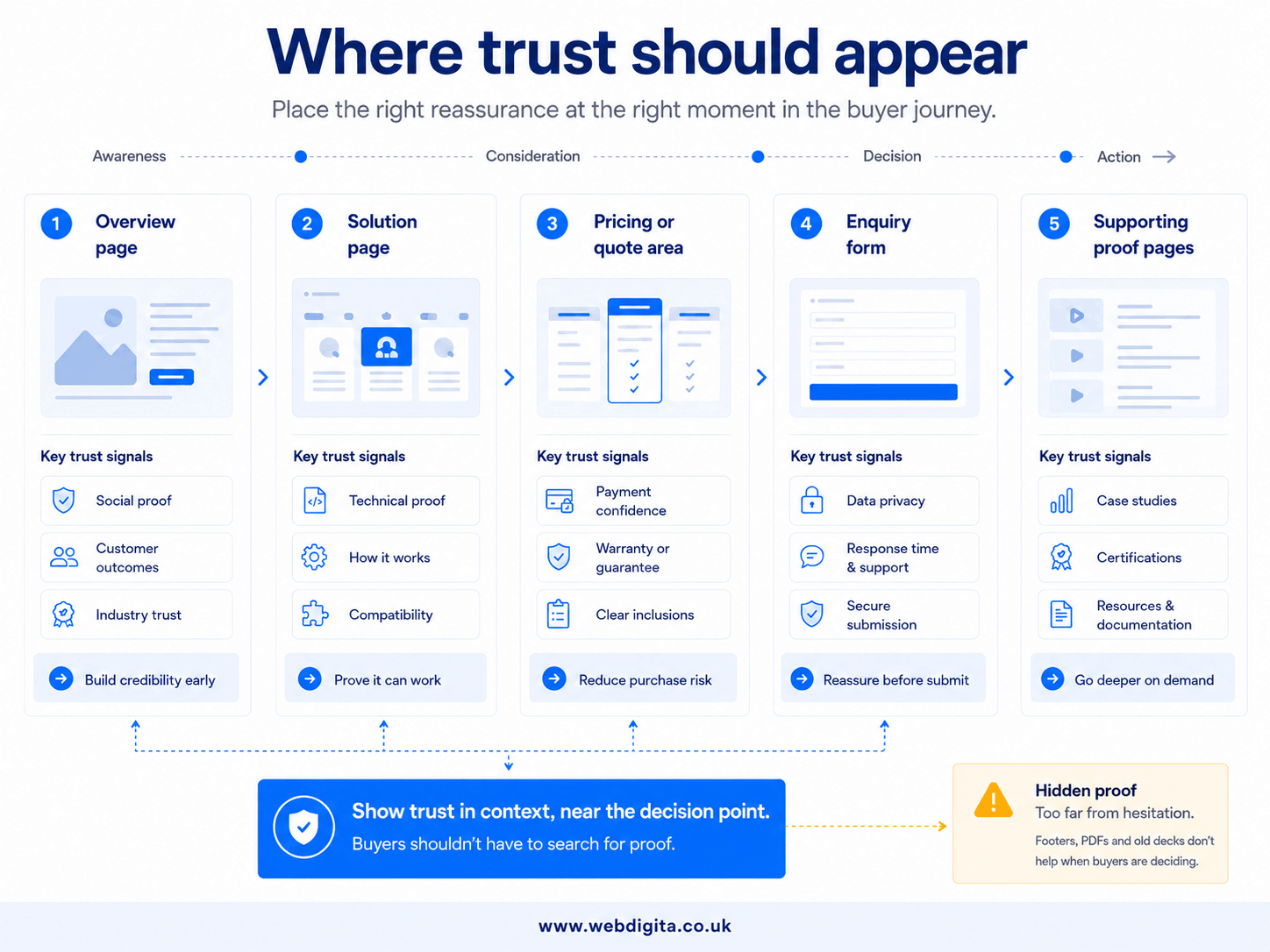
Placement matters more than most teams expect. Buyers should not have to hunt for the proof that makes a high-value decision feel safe.
Match each signal to the question the buyer is asking at that point. Overview pages should confirm fit and credibility. Detailed solution pages should carry the heavier proof around delivery, support, and technical detail. Supporting proof pages can add depth, but they should not be the only place key reassurance lives.
| Trust signal | Best location | Buyer question answered |
|---|---|---|
| Use case fit and technical proof | Service, solution, or product page | Will this work for my situation? |
| Delivery process and support visibility | Solution page and supporting proof pages | What happens after I buy? |
| Commercial terms, warranties, payment confidence | Pricing area, quote page, or near the CTA | What risk am I taking on? |
| Relevant social proof | Near decision points, not buried on one testimonial page | Who else trusted you with this level of purchase? |
| Next-step expectations | Enquiry form area | What will happen if I contact you? |
Do not hide delivery details, warranties, or support information in PDFs, old decks, or footer badges. The proof is often there – it just sits too far from the point of hesitation to do any work. If you are also looking at why high-ticket growth depends on pipeline quality, not just more traffic, this is the missing link: trust has to appear in context, not as background brand noise.
The trust gaps that quietly kill high-value enquiries
Most weak high-ticket pages do not fail because they look bad. They fail because they leave the buyer to carry too much risk alone.
The pattern I see repeatedly: steady traffic, polite interest, and almost no serious enquiries. High-value enquiry friction comes from missing confidence layers, not weak demand – and that distinction matters before you spend anything on more visitors or a site redesign. It is a diagnostic finding, not a theory. When we audit a sales pipeline that is stuck, the bottleneck is almost never awareness. It is one or two broken confidence layers that the CRM data cannot surface on its own.
Watch for: vague delivery language, no visible post-purchase support, unclear payment or warranty terms, and proof that is too broad to mean much for this buyer’s specific context. A buyer comparing suppliers may be ready to move, then stall because one site never explains who handles implementation if something goes wrong.
If the buyer has to guess what happens after they enquire, they will often protect themselves by doing nothing.
You also need the right amount of friction. Too much form friction feels like work before trust is earned, but too little can feel unserious for a major purchase. If you want to understand the kind of friction that quietly blocks trust and enquiries, that is often where the hidden loss sits.
How to check whether your next step feels safe enough to take
The form area is where trust gets tested. A buyer who was almost ready can still drop out if the next step feels vague, pushy, or time-wasting.
Ask a few blunt questions. Can the buyer tell who will reply, how quickly, and what that reply will contain? Do they know whether they are booking a useful conversation or stepping into a sales process they cannot control?
- Check whether the form asks for enough detail to signal seriousness, but not so much that it feels like unpaid consulting work.
- Check whether the page explains what happens next, who responds, and what the buyer can prepare.
- Check whether support, warranty, or implementation responsibility is visible near the CTA.
- Check whether the commercial boundaries are clear enough to reduce fear of hidden cost or wasted time.
A short form is not always safer. For a major purchase, buyers often want signs that the process is structured and their time will be handled properly. If ongoing website maintenance and support affects the decision, make that visible early – whether through SLAs, ownership.
How to prioritise fixes without rewriting the whole site
When I work through a trust audit with a client, the goal is not a full rewrite. It is finding the one or two confidence layers closest to the buying decision that are currently forcing the buyer to carry risk they should not have to carry.
Work through the pyramid in order. Layer 1 (legitimacy) is usually fine on established sites. Layers 2 and 3 – capability fit and delivery confidence – are where most high-ticket pages break down. Layer 4 (commercial confidence) is the one that kills deals silently, because buyers do not always raise it; they just stop responding. Layer 5 is the easiest to fix and often the most overlooked.
A practical starting sequence:
- Read your solution page as a buyer who has already shortlisted two competitors. Note every question it does not answer.
- Check whether delivery ownership, support model, and warranty terms are visible without clicking away.
- Check the form area. Does the buyer know what they are getting back and when?
- Map any ICP-specific proof – sector case studies, technical specifications, compliance data – to the pages where that buyer is most likely to hesitate.
- Fix the layer with the biggest gap first, not the one that is easiest to redesign.
If your site gets interest but not serious enquiries, diagnosing the trust gaps is a more reliable route to better results than changing headlines or adding traffic. A free personalised roadmap is usually the fastest way to identify which layer to fix first.
Questions buyers ask before making high-ticket enquiries
Common concerns that stop interest turning into contact on expensive purchases
1. Why do high-ticket buyers hesitate even when they seem interested?
High-ticket buyers hesitate because interest alone does not feel safe enough to justify contact. They wait until five confidence layers are clear: product fit, company credibility, delivery confidence, commercial clarity, and a low-risk next step. If one layer feels vague or risky, they often pause, compare options, or leave quietly rather than enquire.
2. What trust signals matter most for expensive B2B purchases?
The most important trust signals for expensive B2B purchases are product proof that matches the buyer's real use case, visible delivery and support processes, clear commercial terms including warranties and inclusions, relevant social proof from similar buyers, and a safe next step that explains what happens after enquiry. Generic reassurance is not enough at this level.
3. Where should trust signals appear on a high-ticket site?
Trust signals should appear where the buyer is asking the relevant question. Use case fit and technical proof belong on solution pages. Delivery process and support visibility should sit on solution pages and supporting proof areas. Commercial terms, warranties, and payment confidence need to appear near pricing or CTAs. Social proof works best near decision points, not buried on one testimonial page.
4. How much form friction is right for a high-value enquiry?
The right amount of form friction for a high-value enquiry balances seriousness with effort. Too much friction feels like unpaid consulting work before trust is earned. Too little can feel unserious for a major purchase. Buyers often want signs the process is structured and their time will be handled properly, so a short form is not always safer.
5. What should happen after a high-ticket enquiry form is submitted?
After a high-ticket enquiry form is submitted, the buyer should know who will reply, how quickly, and what that reply will contain. They should understand whether they are booking a useful conversation or stepping into a sales process they cannot control. Clarity around next steps, response quality, and preparation expectations reduces fear and increases follow-through.
6. Why do polished high-ticket pages still get low enquiry rates?
Polished high-ticket pages often get low enquiry rates because they look credible but still leave too many questions hanging. Buyers need more than design quality. They need visible proof around delivery, support, warranties, commercial terms, and what happens after contact. If those layers are missing or vague, the buyer protects themselves by doing nothing.
7. How do you prioritise trust signal fixes without rewriting the whole site?
Prioritise trust signal fixes by mapping the missing confidence layers and starting with the ones closest to the buying risk. Check whether the offer feels clearly suited to the buyer's use case, whether delivery and support are visible enough to reduce fear, and whether the next step feels useful rather than costly. That gives you a clearer starting point than changing headlines at random.
Conclusion
Most high-ticket pages do not fail because they look weak. They fail because they leave the buyer carrying too much risk alone. If your site gets steady interest but few serious enquiries, the issue is usually missing confidence layers, not weak demand or poor traffic.
- Start with the trust pyramid: check whether legitimacy, capability, delivery, commercial terms, and enquiry readiness are all visible where the buyer needs them
- Match proof to context: delivery details, warranties, and support should sit near decision points, not buried in footer links or separate PDFs
- Fix the missing layer first: if scope is still fuzzy or delivery feels vague, that is the priority before pushing harder on forms or follow-up
Diagnose the trust gaps before you redesign. That usually gives you a clearer route to better enquiries and a more practical roadmap than changing headlines or traffic sources at random.
If your site gets interest but not serious enquiries, the issue is usually trust debt, not demand
We help sellers of high-value products fix the confidence gaps that stop buyers from enquiring. Our approach starts with diagnosing which trust layers are missing, then building the proof, clarity, and process visibility that makes expensive purchases feel safe enough to take further.
See how discovery workshops workOr if you prefer,