Key Takeaways
Manufacturers improve lead quality by designing journeys around technical fit, buyer role and urgency rather than pushing for raw form-fill volume. Here's what matters most:
- Intent separation: Spec-stage researchers, procurement checks and urgent quote requests need different paths, not one generic contact form that creates noise for sales.
- Qualification signals: Capture application detail, product interest, delivery timing and buyer role so your team can judge fit and urgency before follow-up starts.
- Trust and relevance: Serious buyers leave when they cannot self-qualify quickly or when the site hides practical buying information behind vague capability language.
- Routing logic: Technical questions, supplier evaluation and quote-ready enquiries should go to the right owner with enough context to prioritise properly.
Industrial lead gen fails when the website behaves like a brochure instead of a technical qualifier.
If you are being pushed for more leads but most enquiries never turn into credible quotes, we want you to know that this is a genuinely common problem – and it is rarely about traffic volume. What we tend to find is that the site is treating every visitor the same, so spec-stage engineers, procurement teams running supplier checks, and buyers ready to quote today all fall into one vague form and land in sales as noise.
Manufacturers get higher-intent enquiries by designing lead generation around technical fit, buyer role and urgency – not raw form-fill volume. That means clearer product and application paths, CTAs matched to buying stage, forms that capture useful qualification signals, and routing that sends the right enquiry to the right team. If you want better-fit demand, the most effective move is to separate intent earlier rather than trying to squeeze more conversions from a generic path.
This guide is for manufacturers, industrial suppliers, and commercial or marketing teams who need clearer lead-quality signals before redesigning quote paths, improving routing, or reviewing sales-readiness at solution-evaluation stage.
What high-intent means in industrial markets
High-intent in manufacturing is not just a completed form. It is a visitor showing enough context for your team to judge fit, urgency and likely buying stage – and understanding that distinction is where a stronger industrial lead generation strategy begins.
The intent signals worth looking for: application detail, product interest, specification needs, delivery timing, buying role, and whether the person is asking a technical question or requesting a quote. If we are only counting conversions together, we are missing the difference between curiosity and commercial readiness.
Consider three visitors hitting the same product page. A spec-stage engineer wants drawings, tolerances or material guidance. A procurement buyer needs supplier reassurance, lead times and commercial terms. An urgent quote-stage visitor wants speed and confidence. If all three hit the same CTA, the result is mixed-quality leads and poor pipeline visibility – and that is not a sales problem, it is a journey design problem.
A common example we see: a manufacturer using one “contact us” form across every product page. The engineer submits a broad technical query, procurement asks for accreditation details, and a buyer needing a quote today leaves almost no context because the form does not prompt for it. The ICP (ideal customer profile) is implicit in how your paths are built – not just documented in a spreadsheet somewhere.
The honest answer to the industrial lead generation strategy question: fewer enquiries with stronger fit almost always outperform more enquiries with weak intent.
Where manufacturers lose fit and trust
Most manufacturers do not lose good leads because the market is not interested. They lose them because the website behaves like a brochure when the buyer needs proof, direction and a clear next step. We see this pattern regularly, and it is worth naming the three places where fit and trust tend to break down.
Technical relevance gaps: if your pages talk in broad capability language but do not show application fit, product detail, sector context or recommended use cases, serious buyers have to guess whether you are right for them. A visitor should be able to self-qualify within the first few clicks. If they cannot, they either leave or send a vague enquiry that consumes sales time without moving anywhere.
Trust architecture failures: buyers want reassurance before they commit time. That may be process clarity, quality standards, sector familiarity, delivery capability, or simply evidence that you understand the application. Trust drops fast when the path to a quote is unclear or when practical buying information is hidden behind generic marketing copy. A polished brand does not compensate for a journey that makes it hard to judge whether you are the right supplier.
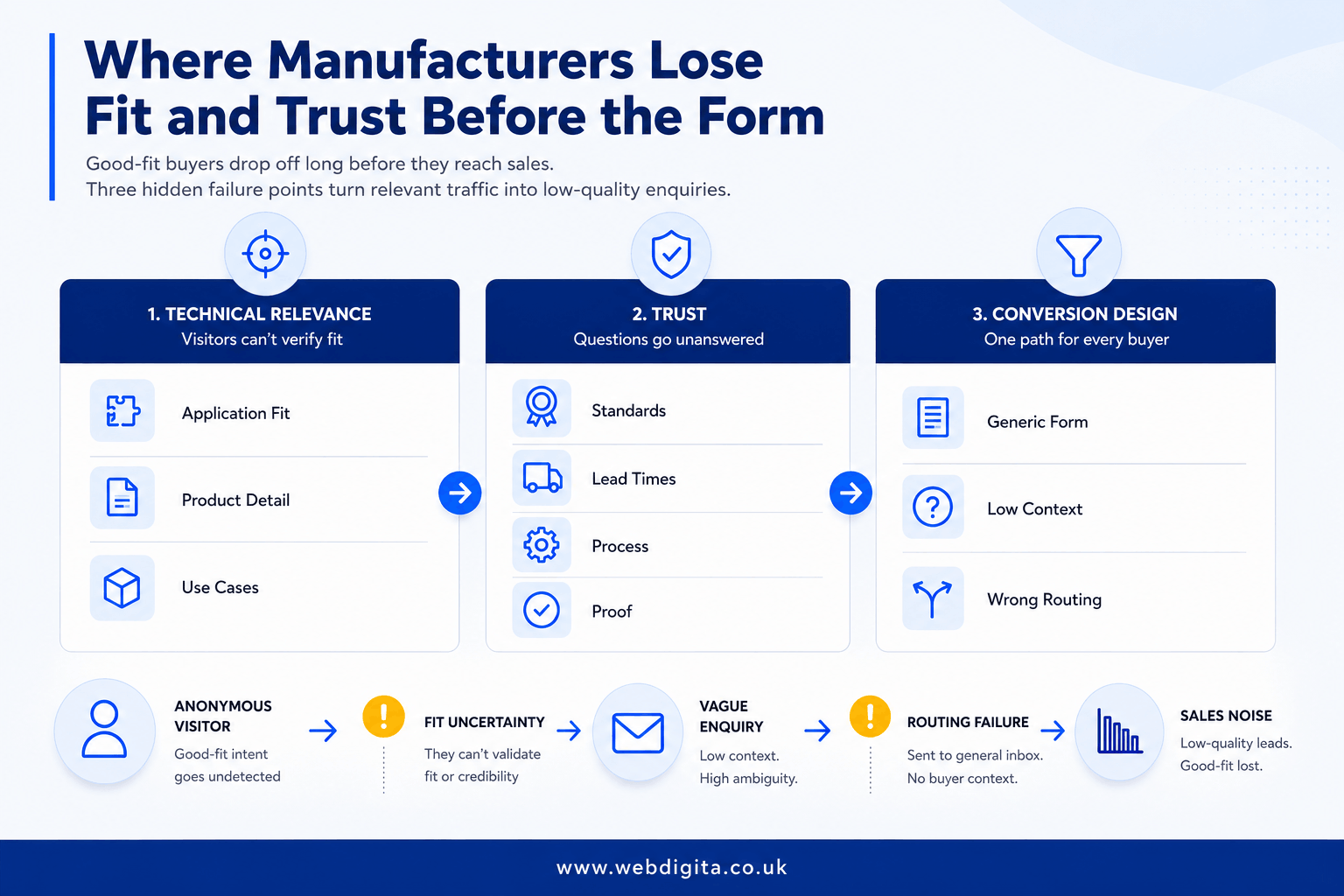
Conversion design problems: a single generic form creates two problems at once. It lets low-context leads through, and it makes serious buyers work harder than they should. The question worth asking together is whether your current form helps sales qualify the lead – or whether it just creates admin.
What we find consistently in industrial reviews: the visible issue looks like weak lead quality, but the underlying problem is that technical visitors have no structured way to explain application, quantity, timing or compliance needs. If you are seeing strong traffic but poor quote quality, that is almost always a qualification gap – not a campaign failure. And that holds whether the traffic is coming from outbound, LinkedIn outreach, cold email or organic search.
If you want a deeper view of conversion friction on lead-gen websites, that is often where these hidden losses show up first.
How to engineer a higher-intent enquiry journey
The good news is that the fix is usually more straightforward than teams expect. What it does require is some discipline in how the journey is structured – building it around how industrial buyers actually move, rather than around one universal CTA.
We suggest starting with three filters: product or application fit, buyer role, and urgency. Then build paths that let visitors identify themselves without forcing a long form too early. Making it easy for someone to choose between technical guidance, supplier evaluation and urgent quote request sounds simple – but it is the step most sites skip entirely.
The pattern we return to again and again is this: industrial lead quality improves when technical relevance and buyer qualification are built into the journey itself – not bolted on afterwards through CRM hygiene fixes or lead scoring workarounds in HubSpot. The software can support good qualification, but it cannot substitute for a well-structured path.
Industrial Enquiry Quality Checklist – use this to check whether your current journey qualifies intent before the form is submitted:
- Can a visitor find the right product or application path without guessing?
- Does each CTA match a real buying stage, not just a generic contact action?
- Are you capturing useful intent signals – role, requirement, timing, quantity?
- Is there routing logic for technical questions, procurement checks and quote-ready enquiries?
- Can sales see enough context in the CRM to prioritise follow-up without chasing for more information?
- Is lead scoring being used to surface urgent demand, not just aggregate all conversions equally?
The goal is not heavy forms – it is useful ones. Ask for the fields that improve routing and qualification, then stop there.
If you are at the point of redesigning paths or reviewing your assumptions, working through this collaboratively with a B2B lead generation specialist early in the process tends to surface the gaps before more budget goes into campaigns or rebuild work. And if your reporting still rewards raw conversions over sales-ready demand, that is worth addressing too – otherwise the team will keep optimising for the wrong signal.

Not sure whether your enquiry path is losing good-fit demand?
We can review your current journey, identify where technical buyers are dropping off or sending vague enquiries, and show you what a clearer qualification path would look like for your product range and buyer roles.
Takes 20 minutes. You get a practical plan, not a sales pitch.
Industrial high-intent enquiry architecture
We find it helpful to map the current journey against three buyer types and check where intent is being blurred. The goal is not to add friction – it is to separate demand types earlier so that the next step actually fits the buyer.
Specification-stage visitor
Likely intent: technical evaluation.
Best CTA path: product detail, drawings, tolerances, application guidance or technical consultation.
Qualification signals to capture: use case, required spec, material, compliance need, project stage.
Routing outcome: technical sales or engineering support.
Procurement-stage visitor
Likely intent: supplier comparison and commercial validation.
Best CTA path: capability proof, accreditations, lead times, MOQ guidance, onboarding steps or supplier review call.
Qualification signals to capture: buyer role, expected volume, approval process, commercial timeline.
Routing outcome: commercial or account team.
Urgent quote-stage visitor
Likely intent: immediate pricing and delivery decision.
Best CTA path: fast quote request with clear turnaround expectation.
Qualification signals to capture: quantity, timing, product requirement, delivery location, urgency.
Routing outcome: quoting team, priority handling.
We encourage you to map your current pages against those three paths and check where they collapse into one generic action. In our experience, separating journeys does not block demand – it makes good demand easier to identify and faster to handle.
A readiness check before you chase more enquiries
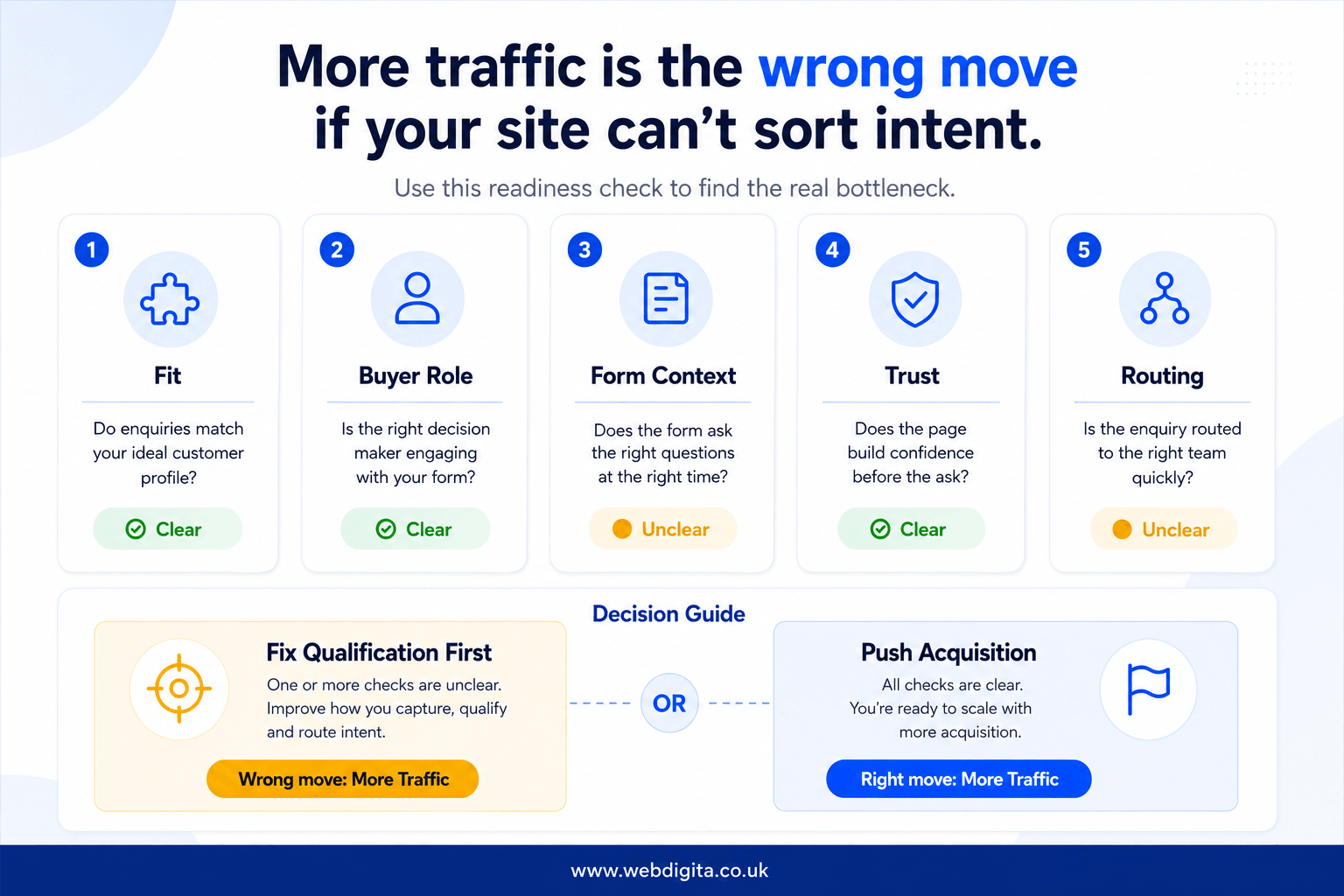
Before committing more budget to SEO, outbound, LinkedIn outreach or cold email, it is worth checking together whether the site can actually sort intent properly. If it cannot, more traffic tends to create more low-context admin – not more pipeline.
Five questions worth sitting with honestly:
- Can buyers tell whether you fit their application without having to contact you first?
- Can they choose the right path based on their role and urgency?
- Does the form collect enough context for sales to qualify the lead without a follow-up call?
- Is trust visible before the form – not just buried in a case study section?
- Does routing send the enquiry to the right owner quickly enough to matter?
If the answer is no to two or more of those, the issue is most likely conversion design and qualification quality – not demand volume. Getting the journey right first tends to deliver far more than the next campaign would.
The teams we work with most often are not short of traffic. They are short of clarity – on what the buyer needs at each stage, and on what the site is actually asking them to do. If that resonates, we would be glad to help you work through a practical, personalised roadmap with a specialist in industrial lead generation – one that gives you specific next steps rather than another round of noisy lead targets.
Better-fit demand starts with clearer paths, not more campaigns.
Questions manufacturers ask about industrial lead generation strategy
Practical answers on intent signals, qualification design and routing logic for higher-fit enquiries.
1. What does high-intent mean in industrial lead generation?
High-intent means a visitor is showing enough context for your team to judge fit, urgency and likely buying stage before follow-up starts. That includes signals such as application detail, product interest, specification needs, delivery timing, buyer role and whether they are asking a technical question or requesting a quote. If you are only counting form completions, you are missing the difference between curiosity and commercial readiness.
2. Why do manufacturers get so many low-quality enquiries?
Most manufacturers use one generic contact form across every product page, so spec-stage researchers, procurement checks and urgent quote requests all fall into the same vague path. That creates mixed-quality leads and poor pipeline visibility because the journey does not separate intent or capture useful qualification signals. The issue is usually conversion design and routing logic, not campaign targeting.
3. How should manufacturers separate intent on their website?
Design paths around three filters: product or application fit, buyer role and urgency. Make it easy for visitors to choose between technical guidance, supplier evaluation and urgent quote request, because those are different intent states and they need different handling. Use CTAs matched to buying stage, forms that capture useful signals, and routing that sends the right enquiry to the right team.
4. What qualification signals should industrial forms capture?
Capture the fields that improve routing and qualification without making forms heavy. That usually includes use case, required spec, material or compliance need, buyer role, expected volume, delivery timing, quantity and urgency. The goal is to give sales enough context to prioritise follow-up properly and judge whether the lead is spec-stage, procurement-stage or quote-ready.
5. Should manufacturers focus on more traffic or better conversion design first?
Fix conversion design and qualification quality before you chase more traffic. If your site cannot sort intent properly, more visitors just create more low-context admin for sales. Check whether buyers can tell if you fit their application, choose the right path for their role, and submit enough context to qualify the lead. If the answer is no, that is your priority.
6. How do you route industrial enquiries to the right team?
Use the qualification signals from your form to route enquiries based on intent. Technical questions should go to engineering support, procurement checks to the commercial or account team, and urgent quote requests straight to the quoting team with priority handling. If your CRM supports lead scoring, that can help, but routing logic should be built into the journey first.
7. What is the biggest mistake manufacturers make with lead generation?
The biggest mistake is optimising for raw conversion volume rather than sales-ready demand. That creates pressure to push more traffic into a weak journey, which just increases low-quality enquiries and wasted sales time. If your reporting still rewards form fills over fit and urgency, you are incentivising the wrong outcome.
Conclusion
Better-fit demand usually starts with clearer paths, not more campaigns. If your site is treating every visitor the same, you are likely losing good enquiries and creating admin noise for sales.
- Map your current journey against spec-stage, procurement-stage and urgent quote-stage intent, then check where those paths collapse into one generic action.
- Fix qualification and routing before you spend more on acquisition, because more traffic into a weak journey just creates more low-context leads.
- Ask whether your team can see enough context in the CRM to prioritise follow-up properly, and whether trust and technical relevance are visible before the form.
- If the journey is already clear and routing is strong, then it makes sense to push harder on SEO, outbound or LinkedIn rather than redesigning the funnel again.
Ready to turn your website into a technical qualifier instead of a brochure?
We help manufacturers design enquiry journeys that separate spec-stage researchers from quote-ready buyers, so your sales team gets clearer intent signals and fewer low-context leads. If you need better-fit demand, not just more form fills, we can build that.
See our B2B lead generation servicesOr talk to us first: