Key Takeaways
Most UK eCommerce budgets break because the quote priced a website when the business needed a trading system. Understanding what drives cost helps you set a budget that survives delivery.
- Platform and customisation depth matter more than design. A template-led Shopify build sits in a different budget band to a heavily customised one, and Magento or headless work typically costs more to build and support.
- Integration and B2B logic create the biggest cost jumps. ERP or PIM integration, customer-specific pricing, approval flows, and account hierarchies add engineering and testing overhead that is rarely visible in early estimates.
- Migration, discovery, and post-launch support are often under-budgeted. Product cleanup, redirects, data mapping, and ongoing maintenance are part of the real ownership cost, not optional extras.
- A cheaper quote is often cheaper because scope is vague. Ask what is included in migration, integration testing, business-rule handling, and where warranty ends before treating quotes as like-for-like.
Most ecommerce development budgets are set before the scope is understood. That is where the pain starts – not in the agency relationship, not in the platform choice, but in a quote that was written against a brief that nobody had properly interrogated yet.
The short answer: Ecommerce development cost in the UK ranges from a few thousand pounds for a simple template-led store to well into six figures for Magento, Adobe Commerce, headless, or integration-heavy programmes. What changes the price most is not the homepage design. It is platform choice, customisation depth, ERP or PIM integration, migration complexity, B2B logic, and the engineering work required to make the store actually operate after launch – most of which is invisible in an early quote.
This guide is for founders and commercial leads who need a realistic budget before comparing platforms, shortlisting agencies, or pricing a rebuild or replatform project.
What a realistic UK ecommerce development budget usually includes
If you want a budget that survives delivery, you need to price the whole operating model, not only the storefront. In practice, that means discovery, design and build, integrations, migration or replatform work, testing, launch support, and post-launch ownership.
Platform matters, but scope matters more. A lean Shopify build and a heavily customised Shopify build are not in the same budget band, and the same is true for WooCommerce, Magento, or headless work. If you are comparing quotes, ask what is included before treating them as like-for-like. I have reviewed enough agency proposals to know that the gap between two quotes at similar prices usually lives in what one of them has quietly excluded. If you need an eCommerce development agency to scope your proposal properly, push for a line-by-line view of what is build cost versus operational complexity.
Use these ranges as scoping bands, not fixed quotes.
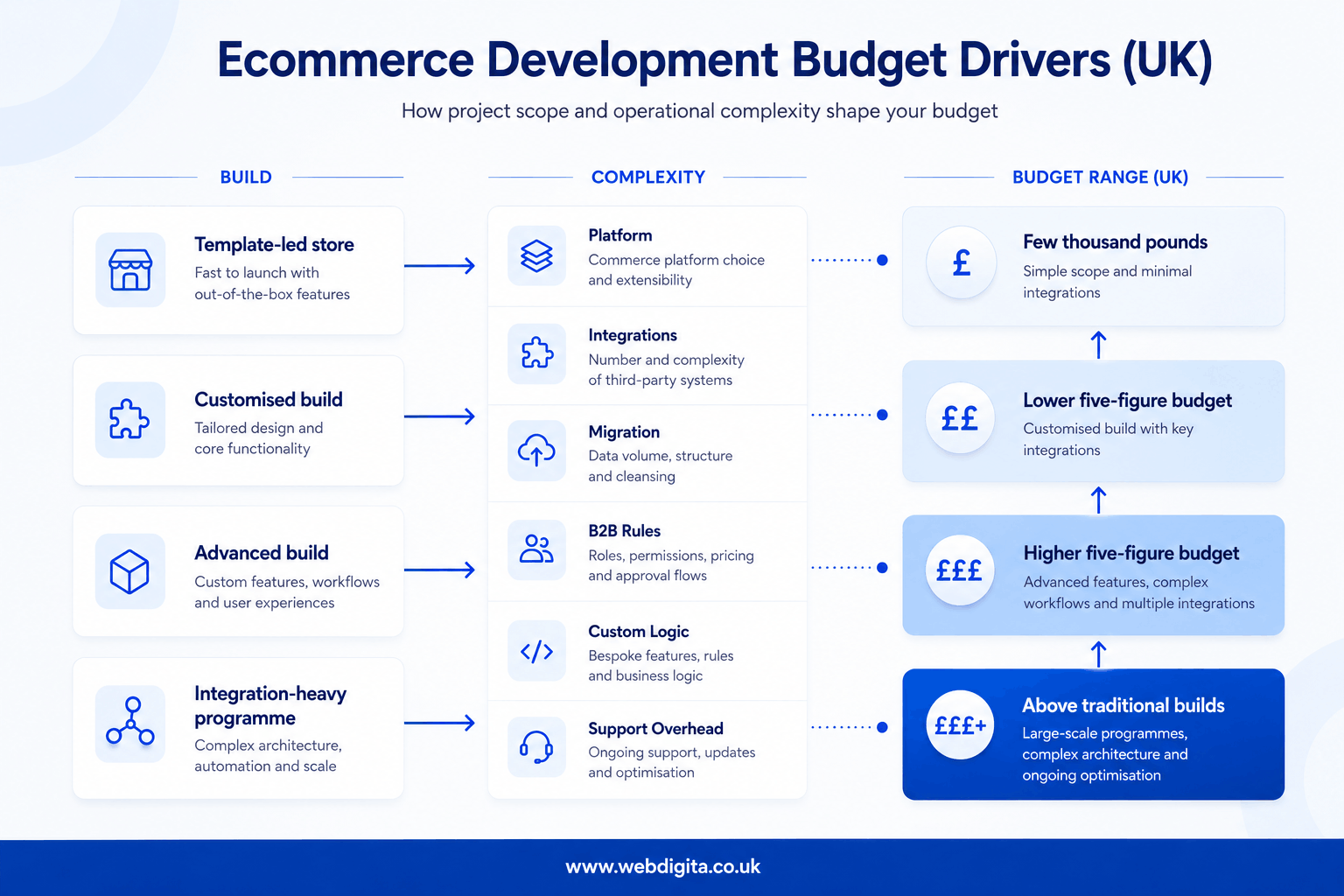
Cost driver matrix: project type, complexity, and typical UK price range
| Project type | Complexity cues | Typical UK price range |
|---|---|---|
| Small Shopify or WooCommerce build | Template-led design, light app setup, limited integrations, low custom logic | A few thousand pounds to around £10,000 |
| Mid-range customised build | Custom theme work, moderate feature depth, one or two integrations, migration handling | Around £10,000 to £25,000 |
| Advanced ecommerce build | Complex catalogue, custom account flows, subscriptions, loyalty, heavier testing | Around £25,000 to £50,000 |
| Magento, Adobe Commerce, or integration-heavy programme | ERP or PIM integration, B2B pricing, approval flows, multi-store, operational edge cases | Often £50,000 plus, depending on scope |
| Headless commerce programme | Separate front end, API dependency, multiple systems, higher support overhead | Usually above traditional builds at equivalent feature scope |
The decisions that change ecommerce development cost most
The biggest cost jumps come from architecture and business rules, not visual design. If you are trying to build a budget for ecommerce development cost UK buyers can actually use in a real procurement process, start by interrogating the decisions below before you ask anyone for numbers.
Platform choice: Shopify is generally quicker to launch. WooCommerce suits lighter custom builds and teams with existing WordPress infrastructure. Magento and Adobe Commerce carry more engineering and support overhead from day one. Headless pushes cost up further because you are funding a separate front end and significantly more integration dependency. Do not assume a platform is cheaper because the licence looks lower – the licence is rarely the expensive part.
Customisation depth: Custom checkout logic, subscriptions, loyalty mechanics, account portals, and complex pricing rules all add build and testing effort that compounds. The question to ask every agency is: which of these features are native to the platform, which rely on apps or extensions, and which need bespoke development? That answer changes both launch cost and long-term maintainability. Apps that look like shortcuts at build phase often become technical debt inside eighteen months.
- Highest impact on cost: ERP integration, B2B pricing logic, approval workflows, and headless architecture
- Medium impact: custom checkout behaviour, subscriptions, loyalty mechanics, and complex data migration
- Lower impact: light theme adjustments, standard payment gateway setup, and basic content migration
Integration load: ERP, PIM, stock sync, fulfilment, finance, and CRM work can move a quote sharply – not because the integrations are technically difficult in isolation, but because mapping, exception handling, and regression testing are rarely tidy. If you are planning integrations before development starts, define data ownership and failure handling early. Discovering those questions mid-build is expensive.
B2B complexity: Customer-specific pricing, tax rules, account hierarchies, quote requests, and approval chains create edge cases at a rate that surprises buyers who have only priced D2C stores. If an estimate mentions B2B but prices it like a standard consumer store, that is a red flag – not a bargain.

Not sure if your brief is ready for pricing?
Most ecommerce quotes break because the scope was unclear, not because the agency got it wrong. We can help you test whether your brief covers platform choice, integration dependencies, migration scope, and B2B rules before you compare agencies.
Quick scoping call, no obligation, clearer budget before you commit.
Where budgets actually break: discovery, migration, and the engineering work nobody quoted
This is the part buyers consistently under-budget, because it is less visible in the demo. It is also where rework, delay, and scope drift reliably start.
Discovery has a cost because ambiguity has a cost. A proper eCommerce project discovery workshop should surface requirements, dependencies, data ownership, acceptance criteria, and the assumptions baked into a proposal. If you skip it, you are not saving money. You are deferring cost into change requests, delivery friction, and post-launch firefighting.
Replatforming is rarely only a platform swap
Migration work includes product data cleanup, category restructuring, customer account decisions, order history handling, redirect mapping, content migration, and SEO continuity. Every one of those is a project in itself if the source data is messy – and it usually is.
In my experience managing builds across Shopify, Magento, and WooCommerce, the most consistent pattern is this: the visible brief looks modest, but the real complexity sits in ERP rules, duplicated catalogue data, and customer-specific pricing that nobody has written down properly. The storefront is not the expensive part. Untangling the operating logic underneath it is.
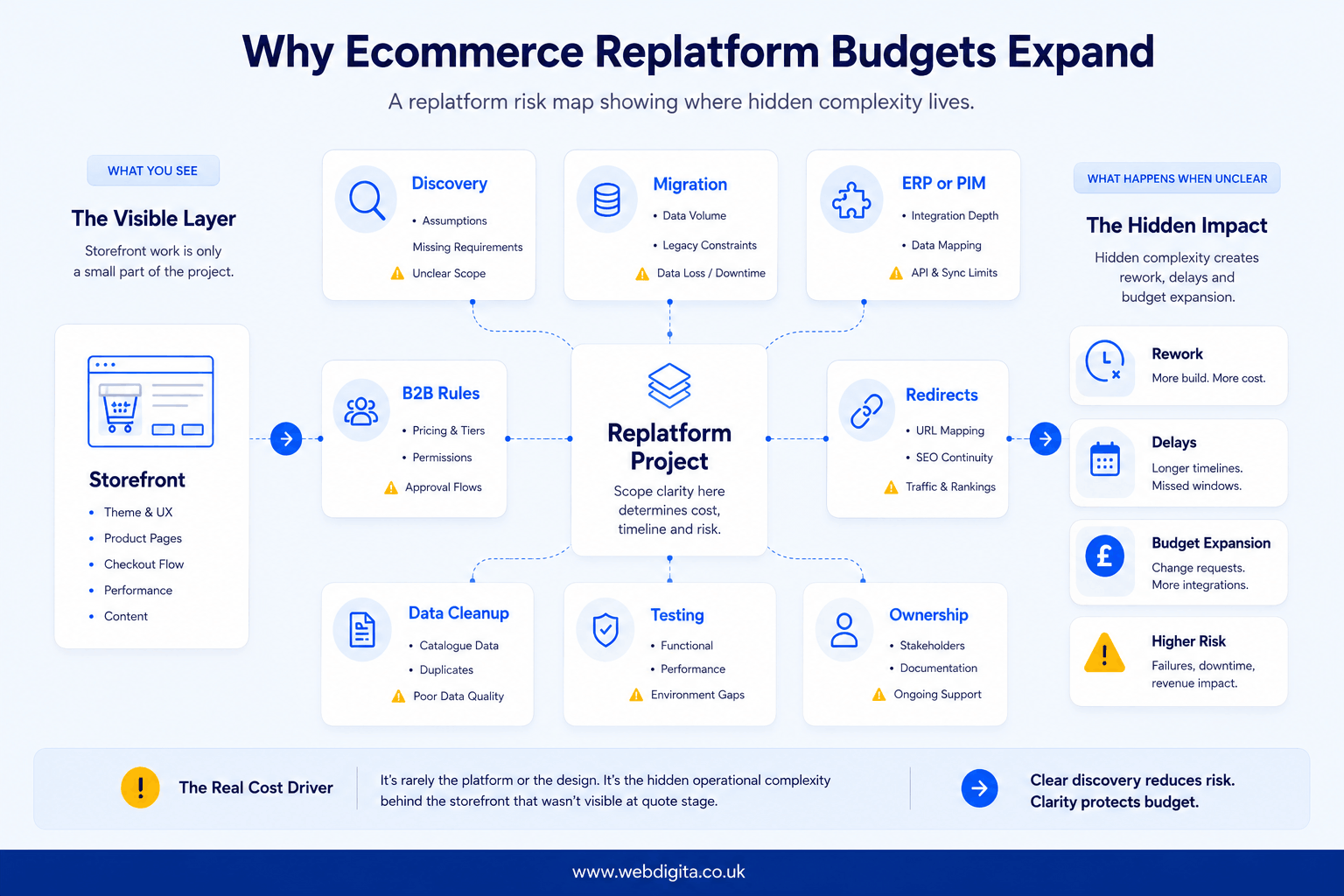
| Hidden cost area | Why it expands budget | What you should ask |
|---|---|---|
| Discovery | Unclear scope creates rework and change requests throughout delivery | What assumptions are still open in this proposal? |
| Migration | Dirty data, redirect mapping, and content decisions add significant manual work | What is included in data cleanup and validation? |
| ERP or PIM integration | Business rule complexity and exception handling increase testing overhead substantially | Who owns data mapping and failure state handling? |
| B2B pricing logic | Account structures, tiered pricing, and approval rules create edge cases at scale | Which rules are standard platform behaviour and which are bespoke? |
If a quote looks low, challenge what it says about migration, redirects, integration testing, and business-rule handling. That is where the missing work is hiding. For more on what discovery should actually produce, read what a proper eCommerce discovery workshop should produce before build starts.
Pricing models: fixed fee, staged delivery, or time and materials
The pricing model shapes risk as much as the number does. Fixed-fee projects transfer scope risk to the agency – which sounds attractive until the agency protects margin by narrowing what “in scope” means. Time and materials projects keep scope flexible but expose you to overrun if the brief is loose. Staged delivery is often the most practical middle ground: fixed scope per phase, with room to adjust between phases as you learn more.
My recommendation for anything above a straightforward template build: fix the discovery phase, agree on scope outputs before build begins, and only then price the build phase. Agencies that resist a paid discovery phase before quoting a complex project are usually the ones whose quotes expand most during delivery.
Ongoing cost: what ownership actually looks like after launch
Separate build cost from ongoing cost before you approve anything. Support, security updates, bug fixing, app or extension upkeep, performance monitoring, and release management are not optional for a live store. They are part of the real ownership cost, and that cost scales with how customised the stack is.
Headless is a useful illustration here. It can make sense when you need front-end flexibility or unusual experience architecture, but it typically costs more to build and more to support because the stack is split and every deployment touches more systems. If you do not have a clear commercial reason for that complexity, treat it cautiously.
A cheaper quote is often cheaper because discovery is thin, migration is vague, integration handling is assumed away, or support stops the moment the site goes live. Ask where the warranty period ends and where ongoing support begins. If you know the store will need regular updates and operational care, plan for eCommerce maintenance service as a separate budget line from day one.
How to set a budget that holds before you shortlist agencies
The brief you bring into a pricing conversation determines the quality of the quote you get back. A vague brief produces a low-looking number with assumptions embedded in the small print. A specific brief produces a number you can actually build a business case around.
Use this checklist to test whether your brief is ready for meaningful pricing:
- Platform direction confirmed or shortlisted with clear rationale
- Catalogue size, data structure, and data quality assessed
- Required integrations identified, especially ERP or PIM, with data ownership defined
- B2B rules, customer-specific pricing, and account hierarchy documented
- Migration scope confirmed – what is moving, what is being archived, and what needs cleanup
- Redirect strategy and SEO continuity requirements agreed
- Launch-critical features separated from post-launch phases
- Post-launch support model and ownership agreed before build contracts are signed
If you want a budget that holds through delivery, bring that brief into the conversation and force every assumption into the open. That is the difference between a quote that looks attractive and one that is actually usable.
Questions buyers ask about eCommerce development cost in the UK
Common budget and scoping questions before comparing platforms or shortlisting agencies
1. What is a realistic eCommerce development budget in the UK?
A realistic UK eCommerce budget ranges from a few thousand pounds for a simple template-led store to around £10,000 to £25,000 for a customised Shopify or WooCommerce build, and into higher five-figure territory for Magento, Adobe Commerce, or integration-heavy programmes. What changes the price most is platform choice, custom functionality, ERP or PIM integration, migration complexity, B2B rules, and the engineering work needed to make the store operate properly after launch.
2. Why do eCommerce budgets often break during delivery?
Budgets break when the quote priced a website but the business needed a trading system. The biggest gaps usually appear in discovery, migration, integration handling, and business-rule complexity. If scope is vague, migration is under-specified, or ERP integration is assumed away, the missing work surfaces as change requests and delivery friction. A cheaper quote is often cheaper because these areas are not properly included.
3. What drives eCommerce development cost more than design?
Platform choice, customisation depth, integration load, and B2B complexity drive cost more than visual design. ERP or PIM integration, customer-specific pricing, approval flows, subscriptions, loyalty mechanics, and custom checkout logic all add engineering and testing effort. Headless architecture pushes cost up further because you are funding a separate front end and more integration dependency. Ask which features are native, which rely on apps, and which need bespoke development.
4. Should I choose Shopify, WooCommerce, or Magento for my UK eCommerce build?
Shopify is often quicker to launch and suits businesses that want a managed platform with lower technical overhead. WooCommerce can suit lighter custom builds where you need more control over hosting and plugins. Magento or Adobe Commerce tends to carry more engineering and support overhead but suits complex catalogues, B2B logic, and integration-heavy programmes. Do not assume a platform is cheaper because the licence looks lower. Total cost of ownership includes build, support, and operational complexity.
5. What should be included in an eCommerce development quote?
A complete quote should include discovery, design and build, integrations, migration or replatform work, testing, launch support, and clarity on where warranty ends and ongoing support begins. Ask what is included in migration, redirects, integration testing, business-rule handling, and post-launch maintenance. If the quote is vague on these areas, you are likely looking at a partial estimate, not a usable budget.
6. How much does ERP or PIM integration add to eCommerce development cost?
ERP or PIM integration can move a quote sharply because it involves data mapping, exception handling, business-rule logic, and testing that is rarely tidy. The cost depends on how clean your data is, how many edge cases exist, and who owns failure states. If you are planning integrations before development starts, define data ownership and failure handling early, not after build begins, to avoid scope drift.
7. Is headless eCommerce more expensive than traditional builds?
Headless eCommerce usually costs more to build and more to support because the architecture is split between a separate front end and back end, creating more integration dependency. It can make sense when you need front-end freedom or unusual experience design, but if you do not have a clear commercial reason for that extra complexity, the higher cost may not be justified. Compare total cost of ownership, not just build cost.
8. What is the hidden cost of replatforming an eCommerce store?
Replatforming is rarely only a platform swap. Migration work includes product cleanup, category structure, customer accounts, order history decisions, redirects, content handling, and SEO continuity. The hidden cost sits in untangling dirty data, duplicate catalogue entries, and customer-specific pricing that was never documented properly. Ask what is being migrated, what is being archived, and what has to be cleaned before import.
Conclusion
The difference between a quote that looks attractive and one that is actually usable comes down to how clearly the brief defines scope, integration handling, migration work, and post-launch ownership before pricing starts.
A realistic UK eCommerce budget should price the whole operating model, not just the storefront, because the expensive part is usually untangling the business logic, not building the homepage.
- Separate build cost from ongoing support cost before you approve anything
- Force assumptions about migration, integrations, and B2B rules into the open early
- Ask where warranty ends and where operational care begins
- Treat discovery as a cost that prevents rework, not an optional extra
Ready to scope an ecommerce build that holds to budget and delivers properly?
We work with UK businesses who need realistic ecommerce development that accounts for platform choice, integrations, migration complexity, and operational edge cases before build starts. If you want a quote that survives delivery, start with clearer scope.
See how we scope ecommerce buildsPrefer to talk first?