Key Takeaways
A proper eCommerce development process moves through discovery, architecture, UX validation, staged build, serious testing and launch readiness with clear decision points at each phase.
- Discovery should map dependencies, not collect features. You need product data rules, integration behaviour, customer types and delivery risks documented before design starts, not after sign-off.
- Architecture decisions shape long-term cost. Platform choice, B2B capability, checkout security and integration logic need validating early because they affect maintainability, scalability and operational overhead.
- UX, data and integrations move together. Navigation, filtering, account areas and checkout behaviour depend on what product data can support and how external systems respond under pressure.
- Staged build and testing catch expensive problems early. Working staging environments, clear UAT ownership and edge-case testing for payments, tax, shipping and permissions matter more than happy-path QA.
- Launch readiness includes handoff, monitoring and support clarity. The first week after go-live should focus on checkout stability, order flow, integration health and clean separation between fixes and phase-two improvements.
Most ecommerce development projects go wrong not because of technical failure but because the process was skipped. That is not a dramatic claim. It is what you see when you have reviewed enough builds where the ERP rules were never mapped, the catalogue assumptions were never written down, and checkout was tested once on a happy path. Discovery was a kickoff meeting, architecture was a platform preference, and the first time real edge cases surfaced was during UAT.
The short answer: A rigorous ecommerce development process moves through discovery, solution architecture, UX and data validation, staged build, serious testing, launch readiness, and a structured post-launch handoff. Each phase has clear inputs, outputs, owners and decisions. If any of those phases is thin or absent, you are not buying a process – you are buying optimism.
This is a guide for buyers who want to tell the difference before they sign anything.
Discovery should reduce risk, not collect vague requirements
The first phase is not a polite kickoff and a feature wish list. It should expose how the business actually works, where the dependencies sit, and what breaks if those assumptions are wrong. Ask any supplier how they handle catalogue structure, customer types, fulfilment rules, payment logic and operational constraints before they start talking timelines.
Weak process versus real process: a weak process gives you a long list of requested features. A rigorous one gives you mapped integrations, product data rules, scope priorities, decision owners and known risks. That work belongs in discovery, not after design sign-off.
A catalogue can look simple until variants, bundles and customer-specific pricing collide with ERP rules. In my experience, if nobody can explain how products, filters, pricing logic and fulfilment exceptions are modelled before a single line of code is written, the project is not ready for build. Treat that as a warning sign, not a detail to revisit later.
Discovery outputs worth asking for:
- Prioritised scope, not an unranked wish list
- A dependency map covering ERP, PIM, payments, shipping, tax and third-party tools
- Product data and catalogue assumptions written in plain English
- Known delivery risks, open questions and named decision owners
Architecture decisions need to happen before the build starts looking busy
This is where good projects quietly separate themselves from expensive clean-up jobs. Platform and solution architecture decisions shape maintainability, scalability and operational overhead long before anyone can point at visible progress. Ask why Shopify, WooCommerce, Magento or headless commerce is being recommended for your specific model – not as a house preference dressed up as a recommendation.
My view, having managed builds across Shopify, Magento and WooCommerce at varying scales, is that B2B eCommerce capability changes the architecture picture faster than most buyers expect. Account hierarchies, customer-specific pricing, approval flows, quote logic and permissions are not small add-ons. They affect platform choice, admin workflows and integration behaviour from the start. Do not assume they can be patched in later without significant rework cost.
Checkout is the other place where early architectural choices come back to hurt you. Security, payment behaviour, tax handling, compliance and performance need designing in early because edge cases break pretty demos in production. Load testing is not one standard script run against a staging environment. It should reflect how your store is expected to behave when a promotion spikes traffic, when a payment gateway slows, and when fulfilment exceptions stack up simultaneously.
Watch for suppliers who promise a confident timeline before they have challenged traffic patterns, promotion spikes, integration bottlenecks or checkout sensitivity. That confidence is not competence. It is a proposal written before the hard questions were asked.
UX, data and integrations should move together, not in separate silos
Once architecture is set, the next mistake is splitting design, data and systems into separate tracks as if they barely touch. In ecommerce, they touch constantly. Navigation, filtering, merchandising, account areas and checkout behaviour all depend on what the product data can support and how external systems behave.
If you are reviewing wireframes or designs, ask what stock logic, pricing rules, shipping methods, tax handling, account states and exception paths those journeys assume. You need validated behaviour, not just approved screens. That is where a project discovery workshop can be useful, because it forces the awkward questions out before build accelerates.
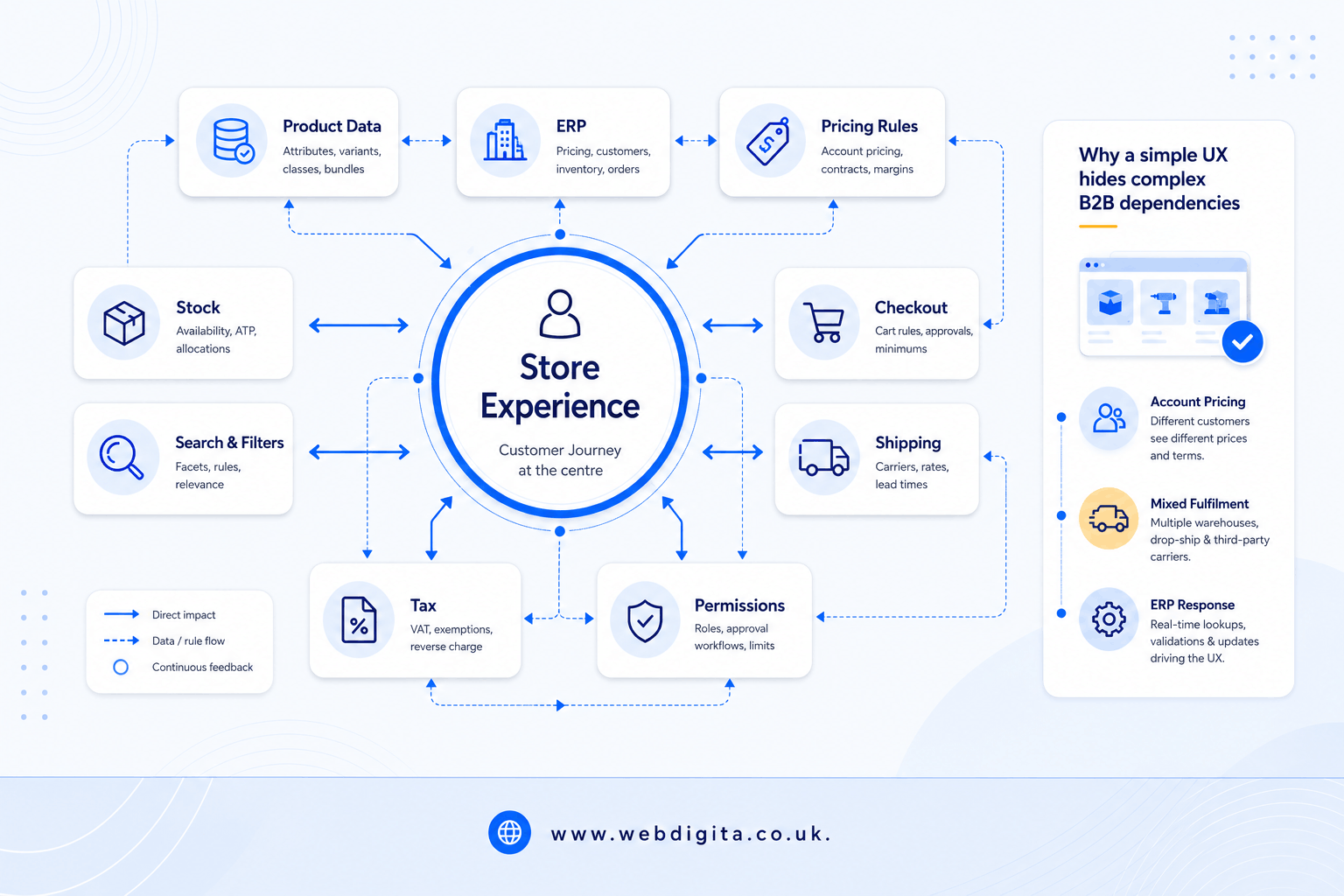
A common failure pattern I see repeatedly: a B2B catalogue with customer-specific pricing and mixed fulfilment rules. On paper, the UX looks straightforward. In reality, search visibility, permissions, checkout options and ERP responses shape what the customer can actually do. The visible problem looks like page design. The real issue sits in data ownership and integration behaviour – and the design team had no idea because nobody asked the data team the right questions.
Before development scales up, ask for agreed journeys, data assumptions, integration behaviour, exception handling and acceptance criteria written in plain English. If third-party systems are likely to drive the risk, also review planning eCommerce integrations before development starts.
A proper delivery phase includes staged build, serious testing and launch readiness
“Development and QA” is not a real process. You should expect staged releases on a working environment, review points that catch issues early, and clear ownership for content, product data and UAT. If you only see the site near the end, problems get expensive very quickly.
Working staging versions matter because they let you review real behaviour before final UAT. Ask what you will see at each stage, what is expected from your team, and who signs off journeys, data and integrations before the next phase moves on.
What the end-to-end process should look like at a glance
Discovery: inputs include business goals, catalogue rules, customer types and system landscape. Outputs should be scoped priorities, dependency mapping and delivery risks. Indicative duration: early phase, before solution commitment.
Architecture and solution design: inputs include discovery outputs, platform options and operational constraints. Outputs should be platform choice, technical approach, data model direction and integration logic. Indicative duration: short, focused phase before build planning.
UX, data and integration validation: inputs include journeys, product structure and system rules. Outputs should be validated flows, agreed assumptions, exception handling and clearer acceptance criteria. Indicative duration: overlaps with solution design, before build scales up.
Build and staged review: inputs include approved scope, designs and technical decisions. Outputs should be working increments, feedback loops and resolved defects. Indicative duration: main delivery phase with regular review points.
Testing and launch readiness: inputs include near-complete build, content, data and integrations. Outputs should be UAT sign-off, checkout checks, security review, performance checks and launch plan. Indicative duration: final pre-launch phase, not a last-minute scramble.
Launch and post-launch monitoring: inputs include approved release plan and support ownership. Outputs should be live monitoring, issue triage, backlog separation and handoff clarity. Indicative duration: immediate days and weeks after go-live.
Testing needs to go beyond happy-path QA. Ask how they test payment failures, tax and shipping logic, permissions, bad product data, integration timeouts, device-specific issues and checkout edge cases – not just whether pages load. Also ask how much work sits with your team. Product data review, content input and UAT ownership are rarely small jobs. I have seen projects stall for weeks because a client’s team underestimated their own content and data obligations.

Not sure if your ecommerce project is scoped properly?
Most builds go wrong because discovery was rushed or integration dependencies were never mapped. We run structured discovery workshops that expose catalogue rules, ERP behaviour, checkout logic and operational constraints before development starts.
Quick diagnostic call to see where the gaps sit
Go-live is where process gaps become operational problems
This is where I see weak processes reveal themselves most reliably. Access is scattered across individual inboxes, known limitations were never documented, support boundaries are undefined, and the first operational exception lands with nobody sure who owns it. That is not a launch problem. It is a process failure that started in discovery and compounded through every phase that followed.
The first week after go-live should not be improvised. Checkout stability, order flow, payment behaviour, integration health and admin exceptions need active monitoring – not a shared inbox and a hope. You should know in advance who watches what, what triggers an escalation, and what the response time commitment is.
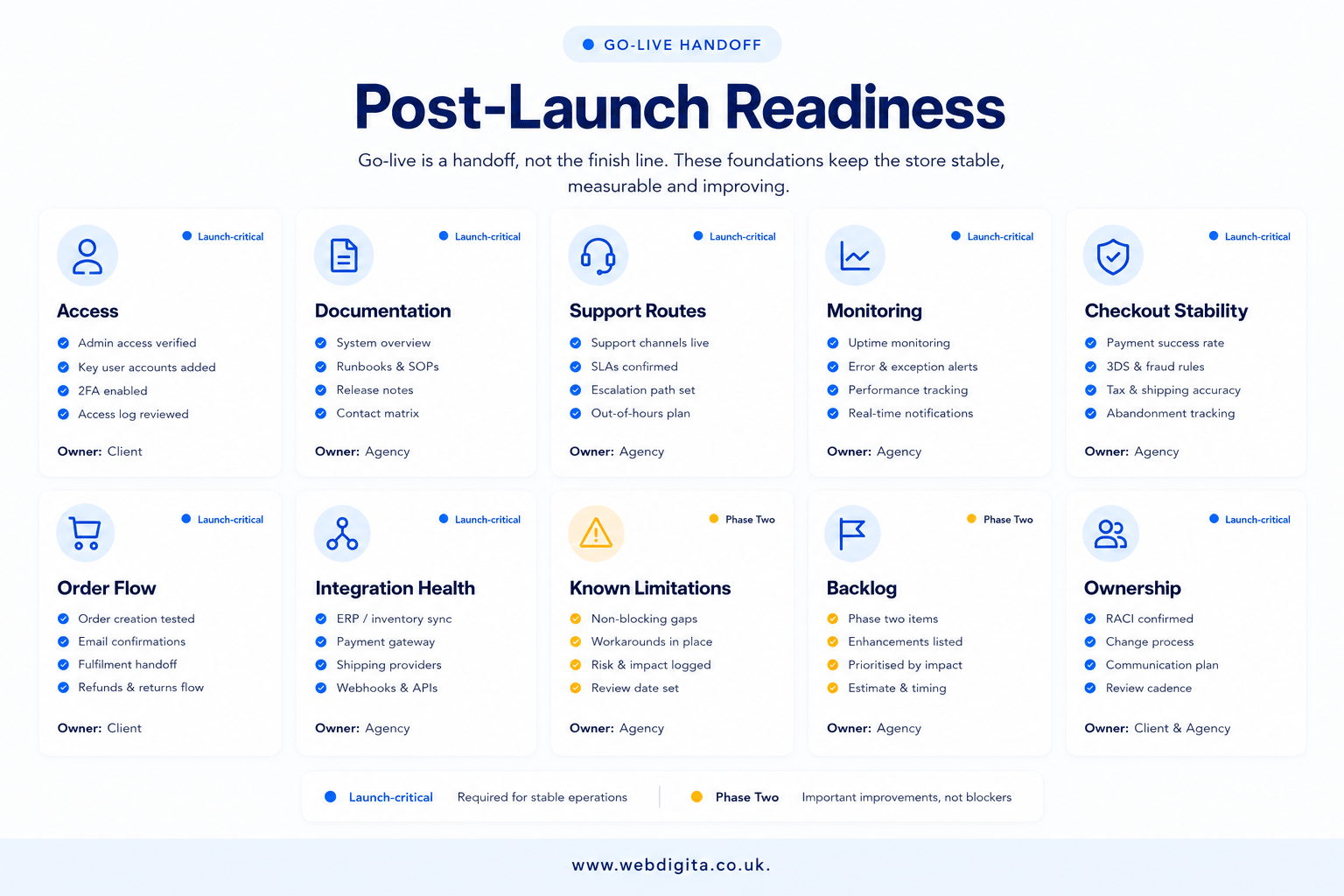
What a clean handoff actually requires:
- Documentation covering architecture decisions, integration configurations and known constraints
- Clear access ownership for hosting, CMS, admin, analytics and third-party platforms
- Defined support routes with named owners, not a generic support@ address
- A written split between launch-critical fixes and phase-two improvements – so the backlog does not become a negotiation about what was supposed to be in scope
That is also where eCommerce maintenance in London becomes a practical planning question rather than an afterthought. Who handles fixes, updates, monitoring and change requests once the project team steps back needs answering before launch, not after the first incident.
If you want a sober way to assess a supplier before you commit, ask them to walk you through their discovery outputs, architecture decisions, staged testing approach, launch readiness checklist and what the first two weeks after go-live look like operationally. If they can do that clearly without reaching for a generic deck, you are probably looking at a real process. If they hesitate or redirect to timelines and pricing, you have your answer. Also worth reading: how the process changes in a headless eCommerce build.
Questions buyers ask before starting an eCommerce development project
Common concerns about process, risk and delivery clarity when planning a serious eCommerce build.
1. What should discovery actually deliver before development starts?
Discovery should deliver prioritised scope, a dependency map covering ERP, PIM, payments, shipping and tax systems, product data and catalogue assumptions written in plain English, and a list of known delivery risks with named decision owners. A weak discovery gives you a feature wish list. A rigorous one gives you mapped integrations, data rules and clear scope priorities that reduce risk before design sign-off.
2. How do I know if the recommended platform choice is right for my business model?
Ask why Shopify, WooCommerce, Magento or headless commerce is being recommended for your specific model, not as a house preference. B2B capability, account hierarchies, customer-specific pricing, approval flows and quote logic affect architecture, admin workflows and integration behaviour. Platform decisions should be justified against your catalogue structure, customer types, fulfilment rules and operational constraints, not just feature lists.
3. Why do UX, data and integrations need to move together during development?
Navigation, filtering, merchandising, account areas and checkout behaviour all depend on what the product data can support and how external systems behave. If you review wireframes or designs without validating stock logic, pricing rules, shipping methods, tax handling and exception paths, you get approved screens but unvalidated behaviour. That is where expensive problems appear during UAT or after launch.
4. What does staged build and review actually mean in practice?
Staged build means working increments released on a staging environment at regular review points, not seeing the site only near the end. You should know what you will see at each stage, what is expected from your team, and who signs off journeys, data and integrations before the next phase moves on. That approach catches issues early when they are cheaper to fix.
5. What should testing cover beyond basic QA before launch?
Testing should cover payment failures, tax and shipping logic, permissions, bad product data, integration timeouts, device-specific issues and checkout edge cases, not just whether pages load. Load testing should reflect how your store behaves under traffic spikes, promotion pressure and integration bottlenecks. Edge-case validation matters more than polished demos because that is where real stores break.
6. What happens in the first week after launch if the process is done properly?
Early monitoring should focus on checkout stability, order flow, payment behaviour, integration health and admin exceptions. You should also expect clear documentation, access ownership, support routes and a clean split between launch-critical fixes and phase-two improvements. If a supplier cannot explain post-launch handoff without improvising, treat it as a delivery risk.
7. How much work should I expect to sit with my team during the project?
Product data review, content input and UAT ownership are rarely small jobs. Ask what is expected from your team at each stage, who signs off journeys, data and integrations, and how much internal resource is needed for catalogue preparation, content migration and user acceptance testing. That work often gets underestimated during scoping.
8. What are the warning signs that a development process is too thin?
Warning signs include confident timelines before traffic patterns, integration bottlenecks or checkout sensitivity have been challenged, feature wish lists without dependency mapping, UX sign-off without validated data assumptions, and no clear plan for post-launch monitoring or support handoff. If the process looks tidy but avoids awkward questions, it is probably a shortcut.
Conclusion
A proper eCommerce development process does not look impressive on a Gantt chart. It looks like clear ownership, validated assumptions, staged review points and honest risk management at every phase.
- Scope: Discovery should expose catalogue structure, integration dependencies and operational constraints before design starts, not after the build looks busy.
- Risk: Architecture decisions around platform choice, B2B capability, checkout security and integration logic shape long-term maintainability and cost, so validate them early.
- Ownership: UX, product data and integration behaviour need moving together with clear acceptance criteria, not split into separate silos that collide during UAT.
- Testing: Edge-case validation for payments, tax, shipping, permissions and bad data matters more than polished demos, so ask how those scenarios get tested before launch.
- Handoff: Post-launch monitoring, support boundaries, access ownership and backlog separation should be documented before go-live, not improvised when the first operational exception lands.
Need a supplier who understands what a proper ecommerce development process looks like?
We build Shopify, WooCommerce and headless ecommerce stores with proper discovery, architecture validation, integration planning and staged delivery. No shortcuts, no surprises, no post-launch scrambles.
See how we build ecommerce storesOr start with