Key Takeaways
- Map the operating model first: before anyone discusses APIs, get every live system, business entity, trigger, destination, and failure outcome onto one working map so hidden architecture work shows up before pricing.
- Set ownership at field level: stock, order status, customer data, shipping events, refunds, and consent all need a named source of truth, otherwise teams end up arguing with symptoms instead of fixing the design.
- Define sync behaviour in plain terms: decide what is one-way, two-way, event-based, real-time, near real-time, or batch, and agree what happens when updates arrive late, twice, or out of sequence.
- Price for failure handling, not just the happy path: retries, alerts, reconciliation, duplicate events, and manual fallback are where integration risk usually sits, and vague proposals here usually become support pain later.
- Treat early quotes carefully: if ownership rules, test cases, reconciliation, and post-launch responsibilities are still unclear, the estimate is still discovery-level rather than a firm delivery plan.
The build is rarely the hard part. The integrations are.
Whether you are connecting Shopify, WooCommerce, or Magento to an ERP, setting up inventory sync with a warehouse system, or wiring payment gateways and marketing tools into a coherent customer view – most ecommerce projects run into their hardest problems before a single API call is written.
The real work is agreeing which system owns stock, what an order status actually means, and what happens when the ERP says one thing and the storefront says another.
Before integrating your ecommerce platform with ERP, CRM, stock, shipping, or marketing systems, map every live system, assign source-of-truth ownership at field level, define sync direction and timing for each data entity, and document failure handling before development begins. Projects that skip this step price integrations like simple build tasks – and pay for it later in delays, data drift, and post-launch support.
The quote looks tidy, development starts, and a few weeks later you are paying to untangle decisions that should have been made before anyone touched an API. If you want a realistic scope before choosing an eCommerce development agency partner, map the operating rules first.
This is for ecommerce managers, operations leads, technical buyers, and founders scoping ERP, CRM, stock, shipping, or marketing integrations before quotes or supplier selection.
What to map before anyone starts building
Start with a plain system map. Put every live platform on the page: ecommerce platform, ERP, CRM, stock system, shipping tools, marketing tools, and any middleware already in the middle. If a system is meant to be temporary but still affects orders or stock, include it. Temporary systems have a habit of becoming permanent dependencies.
Then map the real business entities. Orders, order lines, sellable stock, reserved basket stock, customer records, addresses, prices, fulfilment updates, refunds, returns, and consent fields all need rules. Be specific about ownership at field level. For example, the ERP may own sellable stock while the storefront holds basket reservations, or the store may capture the first opt-in while the CRM owns consent history after that.
Before mapping, a quote may assume a simple order and inventory sync. After mapping, you often find status dependencies, warehouse timing, and exception handling that properly change the scope. That is not a coding surprise. It is hidden architecture work becoming visible.
Use this mapping table to expose hidden scope before pricing starts.
| Entity | Who owns it | Where it goes | What triggers it | If it fails |
|---|---|---|---|---|
| Order | Usually storefront at creation | ERP, CRM, shipping | Checkout completion or payment capture | Missed fulfilment or duplicate processing |
| Stock | Usually ERP or stock system | Storefront, marketplaces | Sale, return, manual adjustment, goods in | Overselling or dead stock shown as live |
| Customer record | Varies by process | CRM, marketing, ERP | Account creation, order, form submit | Duplicate records and broken automation |
| Shipping update | Carrier or shipping platform | Storefront, ERP, CRM | Label creation, dispatch, delivery event | Wrong order state and poor customer comms |
| Refund or return | Usually ERP or service workflow | Storefront, payments, CRM | Approved return or refund action | Finance mismatch and customer confusion |
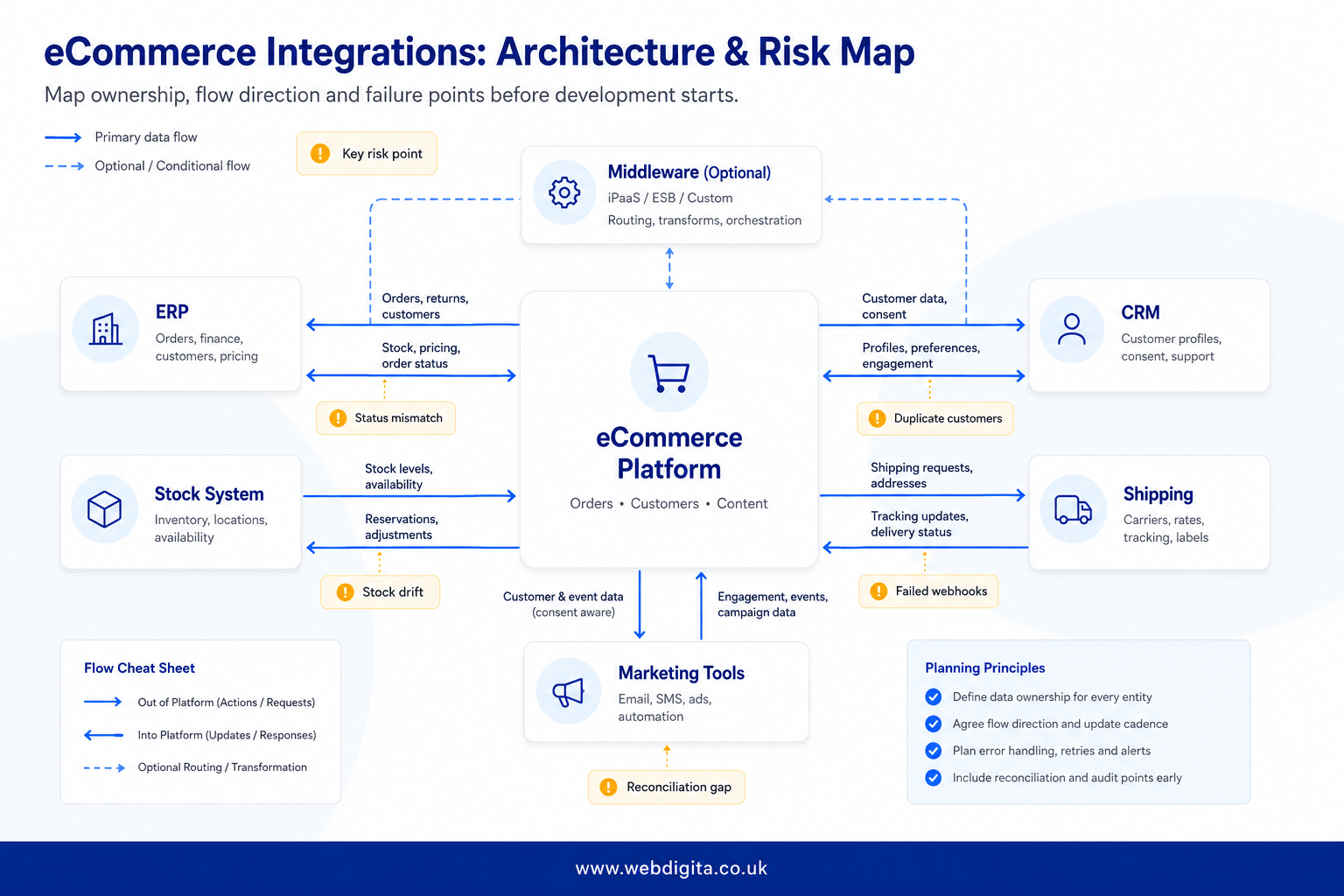
Five integration risk points that change your quote
Most scope surprises in an integration project come from the same five gaps. These are not edge cases – they are the places where verbal agreements break down, where test environments pass and production fails, and where post-launch support costs accumulate.
- Status mismatch between store and ERP. If the storefront shows “dispatched” while the ERP still shows “pending”, customer service fields the calls and someone reconciles the difference manually. The fix requires agreed status definitions before any field mapping begins – not during UAT.
- Inventory drift from delayed sync. Batch inventory sync feels fine in testing. Under peak order volume, even a short delay can mean overselling. Know your acceptable lag and document it before choosing a sync method.
- Duplicate customer records from weak matching rules. When two systems create a customer record independently, the CRM and ERP end up with different masters. Merging them post-launch is expensive and error-prone. Define matching logic – by email, phone, or account ID – before build starts.
- Failed webhooks leaving orders stuck. Webhooks fail silently if there is no retry logic and no alert. An order that never reached the ERP does not get fulfilled. Who monitors this after launch, and what is the manual fallback?
- Reconciliation gaps where no one checks alignment. The automation runs, everything looks fine, and months later finance notices the numbers no longer match. Reconciliation is not a one-time test – it needs a named owner and a regular schedule.
If a proposal does not address these five points directly, the scope is still at discovery level regardless of how detailed the API specification looks.
Set source-of-truth and sync rules before you discuss APIs
Most teams jump into endpoints too early. Ownership comes first. If you do not know whether stock lives in the ERP or the commerce platform, the API choice is secondary.
Define source of truth by data type. Set a clear owner for stock, customer master data, order status, shipping events, and marketing consent. One system does not need to own everything, but every important field needs an agreed owner.
Define sync direction and timing. Decide whether each flow is one-way, two-way, or event-based, then decide whether it must be real-time, near real-time, or batch. Real-time inventory sync may be essential for checkout UX; a marketing segment update every few hours may not be. Problems start when a batched process is treated like a live one.
Define conflict rules as well. If two systems update the same record out of sequence, which update wins? Are timestamps trusted? Can a manual edit in one system overwrite an automated update from another, or should it be blocked?
- Who wins if two systems update the same field?
- What happens if a webhook fails, retries late, or arrives twice?
- Which delays are acceptable, and which create operational risk?
- How are duplicate customers matched, merged, or rejected?
- Who owns reconciliation and alert thresholds when data falls out of sync?
If those answers are still vague, push for a detailed project discovery workshop before anyone treats the estimate as fixed.

Need a clearer view of integration scope before quoting?
We can help you map system ownership, sync rules, failure handling, and edge cases before they turn into change requests, delays, or support issues later.
Useful if the estimate still feels too tidy
Where integrations usually fail in real operations
The visible problem is often small: a delayed order update, an inventory figure that looks slightly off, or an email trigger firing to the wrong segment. The real problem is that nobody defined how the systems should disagree, recover, or reconcile.
In my experience scoping API, data flow, and operational dependencies across Shopify, Magento, and WooCommerce builds, the delivery risk rarely sits in the theme or front-end work. It sits in the integration layer – specifically in the gap between what was agreed verbally and what was actually specified as a sync rule or failure-handling procedure. Integrations, not theme changes, define delivery risk and final price. That pattern holds across almost every complex build, and it is the single most common reason a project that looked straightforward in the brief becomes expensive in the delivery.
Plan failure handling before the build starts. That means retries, alerts, manual fallback, and a named owner for exceptions. If a proposal handles the happy path well but stays vague on duplicate events, partial failures, or delayed updates, expect support pain later.
A common example is a refund processed in one system but not reflected in CRM or stock. The customer receives the wrong message, payment gateway reconciliation breaks, reporting no longer matches finance, and the team wastes time working out which record to trust. This is where things usually go wrong – not in the demo, but in the edge case nobody priced properly.
API constraints matter too, but keep the discussion practical. Ask about rate limits during peak order volume, webhook retry behaviour, and whether the platform exposes the event you actually need for partial fulfilment, returns, or status changes. If a key workflow depends on polling because the event does not exist, both scope and support overhead increase.
If you are already reviewing the integration scope before any quote is signed, treat any quote that prices integrations like a simple build task as a warning sign.
How integration choices change scope, timeline, testing, and support
Direct connections can be leaner, but they expose each dependency more clearly. Middleware – including headless commerce event routing layers and CMS integration pipelines – can improve control, retries, and transformation, but adds another platform to own, monitor, and pay for. Choose based on complexity and support reality, not what is fashionable.
| Option | Best when | Watch for | Support impact |
|---|---|---|---|
| Direct integration | Few systems, stable rules, limited transformation | Tight coupling and logic spread across systems | Fewer moving parts, but changes can be harder later |
| Middleware | Multiple systems, complex logic, frequent change | Extra ownership, monitoring, and platform cost | Better failure visibility and control, but more long-tail overhead |
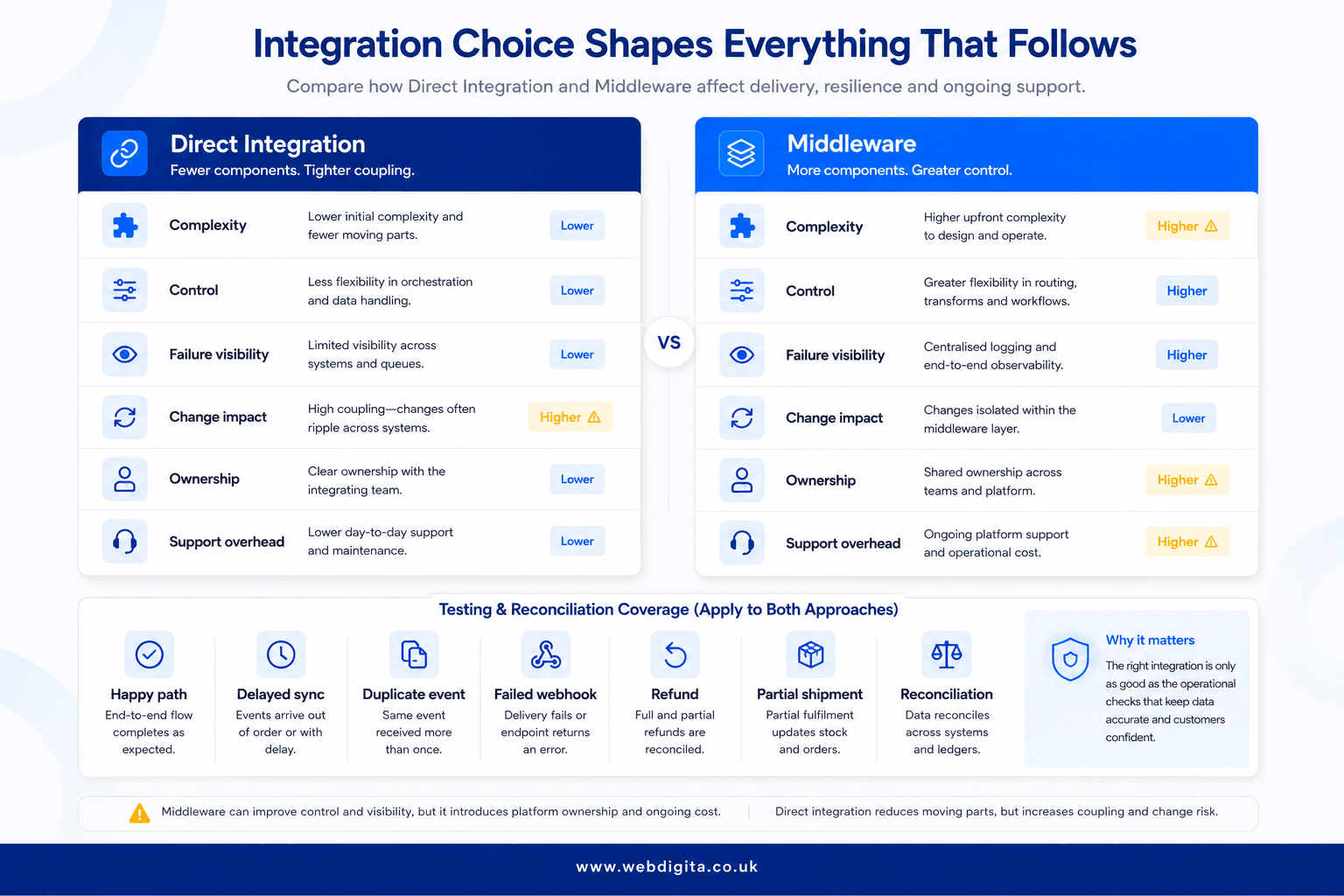
Ask for named test cases before development starts, not after. That should include happy path, delayed sync, duplicate event, failed webhook, cancellation, refund, partial shipment, and manual reconciliation. Reconciliation means proving that orders, stock, and customer updates still match across systems after the automation runs.
Supplier questions matter here as much as technical design. Who owns middleware? Who monitors failures after launch? Who writes reconciliation rules? What is included in post-launch support, and what becomes a change request? That is where eCommerce maintenance and support services matter.
If ownership rules, sync logic, failure handling, testing, and reconciliation are not mapped yet, the quote is still at discovery level. Treat it as provisional and start with choosing the right ecommerce development agency for a complex build.
Common questions about planning ecommerce integrations
These are the questions buyers usually need answered before they trust a quote or choose a delivery partner.
1. What should be mapped before ecommerce integration development starts?
You should map every live system, the key business entities moving between them, who owns each field, what triggers each sync, and what happens when a process fails. That includes orders, stock, customer records, shipping updates, refunds, returns, and consent data. Without that map, quotes often assume a simpler integration than the business actually needs.
2. Why is source of truth so important in ecommerce integrations?
Source of truth matters because each important field needs one agreed owner. If stock, order status, or customer data can be changed in multiple places without clear rules, mismatches become inevitable. The result is usually overselling, duplicate records, broken automations, or teams wasting time deciding which system to trust.
3. Should ecommerce integrations be real-time or batch?
It depends on the data and the operational risk. Stock and order updates often need real-time or near real-time handling, while some marketing or reporting updates can run in batch. The key is to decide this deliberately. Problems usually start when a batched process is treated as if it were live.
4. Where do ecommerce integrations usually fail in practice?
They usually fail in edge cases, not in the main demo flow. Common failure points include delayed webhooks, duplicate events, status mismatches, stock drift, partial fulfilment, refunds not syncing properly, and weak reconciliation. If failure handling is vague in the proposal, support issues tend to appear after launch rather than during scoping.
5. How do integration choices affect project scope and support?
Integration choices change both delivery complexity and long-term ownership. Direct integrations can be leaner when rules are simple, but they can create tighter coupling. Middleware can improve control, retries, and visibility, but it adds another platform to manage, monitor, and pay for. The right choice depends on system complexity and support reality.
6. When should a quote for ecommerce integrations be treated as provisional?
A quote should be treated as provisional when ownership rules, sync timing, conflict handling, testing, reconciliation, and post-launch support are still unclear. In that situation, the supplier is still pricing at discovery level rather than against a fully defined delivery plan. That does not make the quote wrong, but it does make it less reliable.
Conclusion
The useful question is not whether two systems can connect. It is whether the business has defined how orders, stock, customer records, and exceptions should behave once that connection is live. A technically possible integration can still be commercially messy if ownership, timing, and recovery rules are left open until build.
That is why the strongest buyers slow the process down before development starts. They ask where data is mastered, how failures are handled, what gets tested, and who owns support after launch. If those answers are still soft, compare suppliers on discovery quality before you compare them on price, because that is usually where delivery risk is being hidden.
Plan the integration architecture before you commit to build scope
If ERP, CRM, stock, shipping, or marketing flows are still loosely defined, start with a structured discovery workshop to set ownership, logic, testing, and support expectations properly.
Explore Our eCommerce Development ServicesNot ready for that yet