Key Takeaways
WordPress timelines depend more on scope clarity and content readiness than coding speed. Most delays come from loose requirements, late approvals, and mid-project changes rather than development bottlenecks.
- Simple brochure sites: typically 3 to 6 weeks if content is ready and decisions are quick, but page count alone does not predict delivery time.
- Marketing sites with custom templates: usually 6 to 10 weeks, with design rounds, CMS flexibility needs, and SEO requirements shaping the timeline more than build complexity.
- Custom WordPress builds: often 10 to 16 weeks or longer when bespoke theme architecture, integrations, REST API work, staging, QA, performance tuning, and security hardening are included.
- Total delivery time matters more than coding time: discovery, design, content population, QA, and launch prep add weeks that are easy to miss when comparing agency quotes.
I reviewed a proposal last year where a client had signed off on a ten-week WordPress launch. It looked reasonable on paper. What nobody had spotted: the quote assumed content was ready, design was pre-approved, and there were no third-party integrations in scope. None of that was true. The build finished in week eleven. The site went live in week twenty-three.
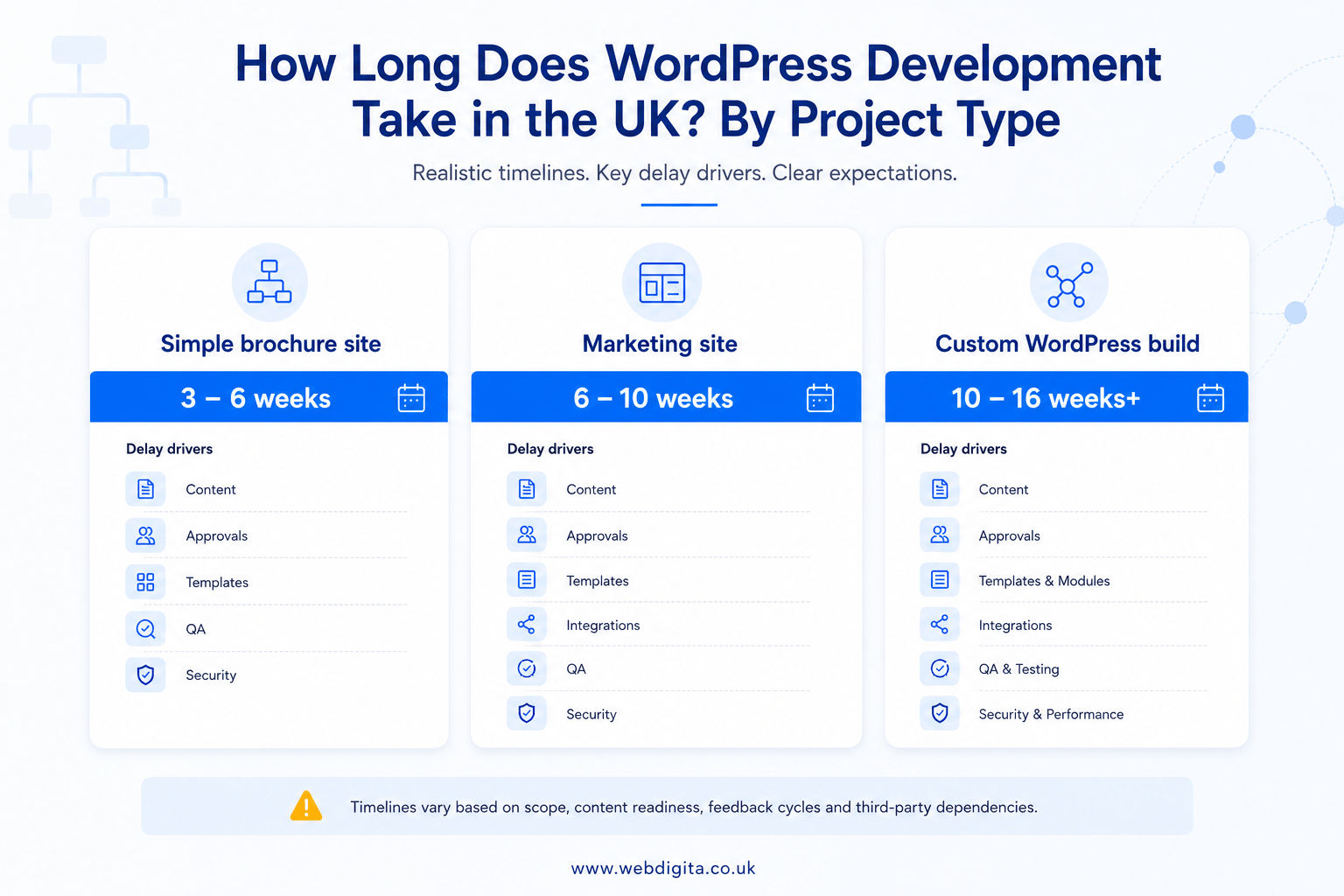
The short answer: In the UK, a WordPress brochure site with content ready typically launches in 3 to 6 weeks. A marketing site with Gutenberg templates, ACF-driven modules and flexible CMS components lands in 6 to 10 weeks. A custom WordPress build – bespoke theme architecture, Custom Post Types, REST API integrations, PHP and MySQL performance work, staging, QA, security hardening and Yoast SEO or WPML configuration – runs 10 to 16 weeks or more. That is total delivery time, not build time. The variable that reliably extends all three is editorial ownership, not technical complexity.
This guide is for founders and project leads who need a timeline they can actually defend.
What a realistic UK WordPress timeline looks like by project type
First, establish what is being timed. Most agencies quote build time. You need delivery time – discovery, design, development, content, QA and launch. Those are not the same number. If you compare proposals where agencies mean different things, you will get a useless comparison.
If you are evaluating a WordPress development agency in the UK, ask specifically what their quoted timeline includes. Then ask what it excludes.
| Project type | Typical UK timeline | What usually changes it |
|---|---|---|
| Simple brochure site | 3 to 6 weeks | Content readiness, page count, approval speed |
| Marketing site with multiple templates | 6 to 10 weeks | Design rounds, Gutenberg block scope, CMS flexibility, SEO and Yoast SEO configuration |
| Custom WordPress build | 10 to 16 weeks+ | Theme architecture, Custom Post Types, ACF field structure, REST API integrations, PHP/MySQL optimisation, WPML, QA depth, security and performance work |
The choice between a custom Gutenberg block build and an Elementor-based approach matters here. Elementor can shorten early design and layout work. It also introduces performance overhead and dependency risk that shows up during performance optimisation and load time QA. Neither is inherently wrong. But the decision needs to be made in discovery, not halfway through build, because it changes the entire theme architecture.
If you are still weighing up whether bespoke or template-led development is the right route, make that call before locking any timeline. It changes architecture decisions, build speed and long-term editing flexibility.
A common trap: a site that looks small on paper hides real complexity in WPML multilingual configuration, Custom Post Types, ACF-driven flexible content architecture, REST API endpoints feeding a mobile app, or CRM and form integrations. Page count is not the timeline driver. Scope is.
The phases that actually decide your launch date
Most delay does not live inside the coding window. It lives in discovery gaps, design revision cycles, content ownership failures, and post-development checks that get compressed because the launch date is already slipping.
Plan the full path. Otherwise a launch date is just a number someone invented under commercial pressure.
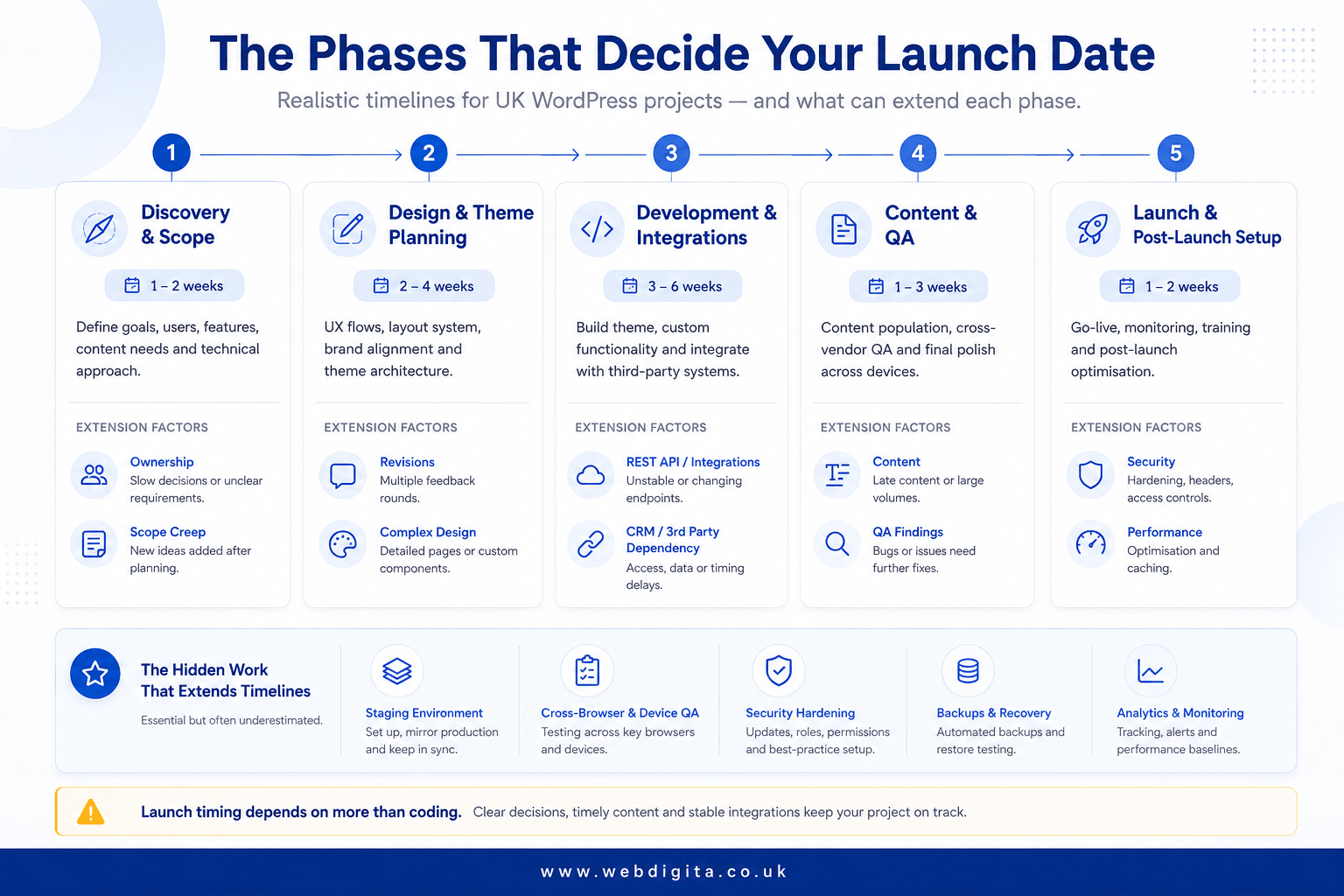
Discovery and architecture (3 to 7 days): This is where sitemap, user journeys, Custom Post Types, ACF field group structure, MySQL schema assumptions and technical constraints get defined. Weak discovery means rework in design and development. It is the cheapest phase to invest in and the most expensive to skip.
Design and Gutenberg block planning (1 to 3 weeks): Templates, page hierarchies and CMS component behaviour all need defining here. If the site uses ACF-driven flexible content fields, the block architecture needs signing off before build, not during it. Every undefined block type that surfaces mid-development adds scoping time, not just build time.
Development and integrations (2 to 6 weeks): This is where PHP, MySQL, custom plugin work and REST API design absorb the most unpredictable time. Integrations with third-party services – CRM, marketing platforms, payment gateways, booking systems – rarely run exactly to schedule. Budget buffer here.
Staging environment setup: A proper staging environment is not optional and it is not a quick job. It needs to mirror the production server configuration accurately enough that QA results are valid. If staging and production diverge on PHP version, MySQL configuration, caching layer or server-side rules, production-specific bugs will surface after launch. I have seen this happen on projects where staging was treated as a formality. The bugs always appear at the worst possible moment.
Content population and QA (1 to 3 weeks): Consistently the most underestimated phase. Content arrives late, assets are missing, page hierarchy decisions resurface and stakeholder feedback triggers redesign requests at the worst possible moment.
Performance optimisation strategy: This needs to be planned into delivery, not bolted on after launch when the client notices slow load times. On PHP-driven WordPress builds with multiple ACF flexible content fields, unoptimised MySQL queries or heavy plugin stacks, performance issues are often structural. Post-launch performance remediation costs significantly more than performance-informed development decisions made during build.
Security hardening requirements: WordPress sites attract automated attacks at scale. Hardening at the server and application level – PHP configuration, database credential hygiene, login protection, file permission structure, disabling XML-RPC where not needed, and web application firewall configuration – is delivery work, not optional aftercare. If it is not in the proposal, it has either not been planned or it is going to be invoiced separately later.
Backup and update management protocol: A site that goes live without a tested backup and restore process and a defined update schedule for WordPress core, plugins and PHP is not a completed project. It is a liability. Who runs updates, on what cadence, and against what staging process? For sites with eCommerce components, this intersects with a broader eCommerce website maintenance services or equivalent ongoing support. Either way, this protocol needs defining before launch, not six months later when a plugin update breaks the site on a Saturday evening.
| Phase | Typical duration | What extends it |
|---|---|---|
| Discovery and scope | 3 to 7 days | Unclear ownership, changing requirements, weak information architecture |
| Design and Gutenberg block planning | 1 to 3 weeks | ACF block structure undefined, extra revision rounds, unclear content hierarchy |
| Development and integrations | 2 to 6 weeks | Custom plugins, REST API work, CRM or third-party dependencies |
| Staging, content and QA | 1 to 3 weeks | Staging/production divergence, late copy, missing assets, stakeholder delays |
| Performance, security and launch | 3 to 7 days | Performance remediation, security hardening gaps, backup and update protocol undefined |

Not sure whether your timeline assumptions are realistic?
We can walk you through what a credible WordPress delivery plan looks like for your scope, including discovery, design, build, QA and launch prep. No pressure, just clarity on what sits inside the timeline and what usually extends it.
Quick call to check whether your plan covers the work that matters.
Theme architecture and custom plugins – where scope commitment matters
The theme architecture decision reliably determines whether the build is fast or painful. Three routes come up consistently on UK WordPress projects.
A fully bespoke theme built on WordPress core gives maximum flexibility, a clean PHP performance profile and full control over the template hierarchy. It takes longer upfront. It is cheaper to maintain and extend over a three-year horizon.
A starter theme – Underscores, Sage, or a structured framework with opinionated PHP architecture – accelerates initial build. ACF and Custom Post Types integrate cleanly. Teams familiar with the framework move fast. Teams unfamiliar with it lose that speed advantage quickly.
An Elementor-based build uses the page builder’s own widget and template layer. Fast for marketing teams to manage post-launch. Problematic at scale if the plugin stack grows, if page builder rendering creates MySQL query overhead, or if performance benchmarks are tight. I have seen Elementor-driven sites with forty-plus active plugins generate enough database load to require dedicated caching infrastructure just to pass Core Web Vitals. That was not in the original budget.
Custom plugin development is consistently underquoted. Any functionality that does not exist in the WordPress plugin repository as a maintained, performant, production-ready solution needs building from scratch. That means a PHP development standard needs to exist – covering how database interaction, REST API endpoint registration, caching strategy and update compatibility are handled. If an agency cannot articulate that standard, the custom plugin work will create problems: MySQL performance degradation, plugin update conflicts, or PHP version incompatibility as the platform matures.
REST API design matters most on projects where WordPress functions as the content backend feeding a separate front-end, a mobile application, or a third-party system. Endpoint structure, authentication method, rate limiting and response caching are not development afterthoughts. They need scoping in discovery. Getting this wrong adds weeks of rework when the integration fails under real load.
What usually makes WordPress projects take longer
The honest problem is not WordPress itself. WordPress is fine. The problem is ambiguity – in scope, in content ownership, in decision-making authority, and in what the agency’s proposal covers versus what it assumes you will handle.
Four patterns I see on almost every delayed project.
Content is not ready and nobody owns it. The development team finishes on schedule. The site goes live six weeks late because copy is still being drafted and image assets are still being sourced. In my experience, this is the single most common cause of launch delays on UK WordPress projects. The fix is straightforward: appoint a content owner on day one and set a content freeze date at least two weeks before planned launch.
Stakeholders want fast delivery but approve slowly. No revised timeline resolves this. Only a decision framework does.
Integration and plugin choices arrive mid-build. Every integration that lands after scope is agreed adds re-scoping, re-testing and sometimes re-architecture time. These decisions need to be made in discovery.
The project starts as a brochure site and becomes a custom platform. I have seen a five-page proposal evolve into a full custom WordPress build because requirements were not documented clearly enough to prevent scope creep. By the time anyone named it, the timeline was already gone.
If a proposal skips staging, QA, security hardening or launch prep, treat the speed as a warning sign, not a win.
Ask how custom functionality will be delivered. A quick plugin stack shortens early build time and accumulates update debt, test debt and MySQL overhead. A cleaner custom approach costs more upfront and causes significantly less pain once the site is live.
How to judge whether an agency timeline is credible
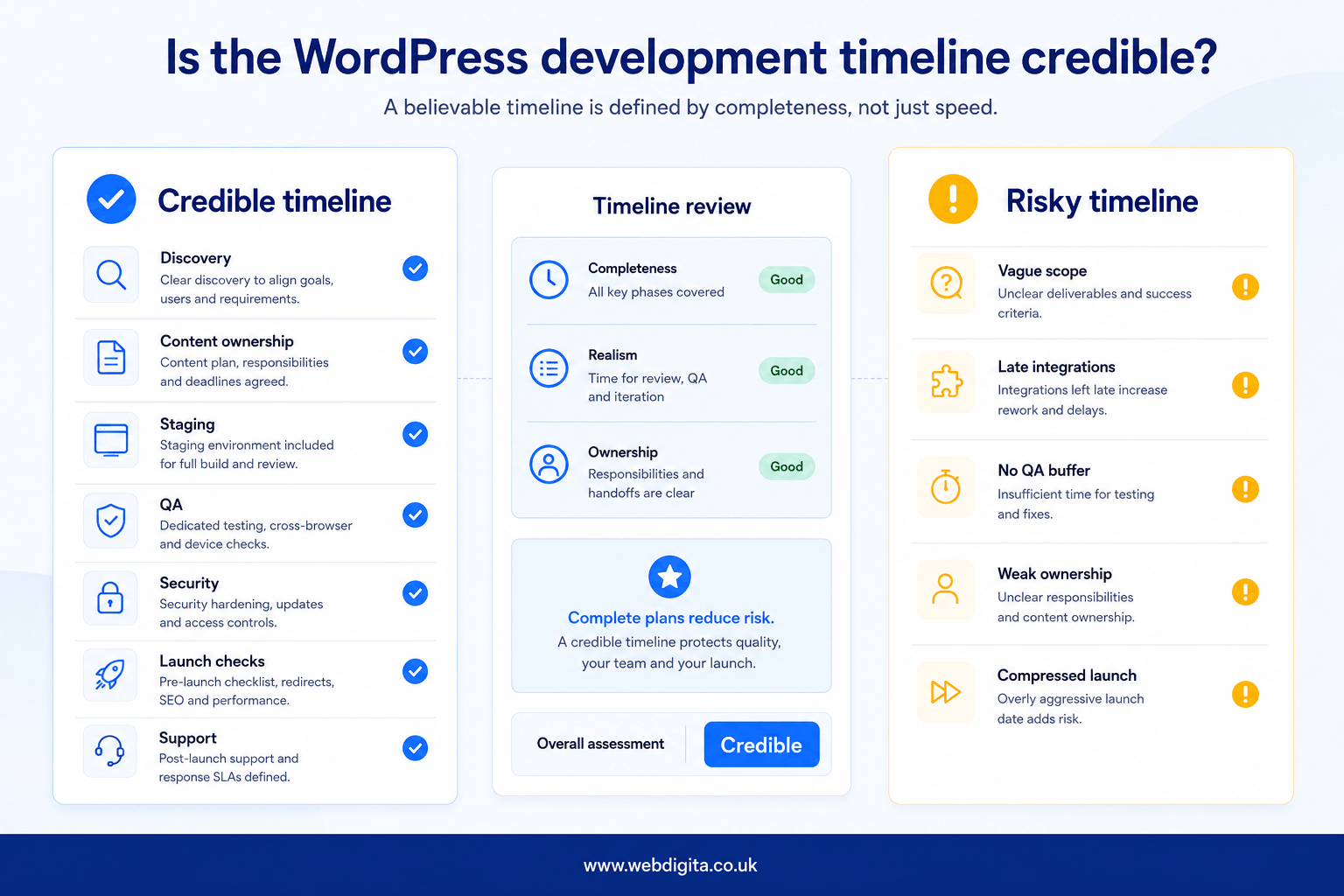
A credible timeline is not shorter or longer. It is more complete. You need to know what is included, who owns the critical dependencies, and where risk sits if something slips.
Push on the gaps rather than the headline date. Ask whether the proposal covers discovery, content handling, staging environment setup, QA, PHP and MySQL performance work, security hardening, launch checks, backup and update management protocol, and post-launch support.
- Who owns content, approvals and dependency decisions on your side?
- How many design and feedback rounds are included?
- Is the theme architecture bespoke, starter-theme-based, or Elementor-driven – and has that decision been made?
- What custom plugin or REST API work is assumed in scope, and to what PHP standard?
- What is the staging configuration, and does it mirror production accurately?
- What happens if QA finds issues in the final week before launch?
- What is the backup and update protocol, and who owns it after go-live?
Speed and certainty trade against each other. A compressed plan works for a well-scoped brochure site. If you are dealing with ACF-heavy templates, REST API integrations, WPML multilingual setup or future eCommerce development needs, the timeline needs to accommodate testing, performance work and operational readiness – not just the point at which development ends.
For projects with significant eCommerce scope, it is worth speaking with a eCommerce development company at this planning stage rather than retrofitting it later.
If you want a launch date you can trust, do not ask only how fast build starts. Ask how complete the plan is before build starts. Those are very different questions.
Questions teams ask before starting WordPress development
Common timing, scoping, and delivery questions that shape realistic UK WordPress project planning.
1. What is the fastest realistic timeline for a WordPress site in the UK?
A straightforward brochure site with ready content and quick approvals can be delivered in 3 to 6 weeks. That assumes clear scope, minimal custom functionality, and no design rework. Anything faster usually means something has been excluded, such as QA, staging, or launch prep. Always ask what the timeline includes before treating speed as the main decision factor.
2. Why do WordPress projects take longer than the initial estimate?
Most delays come from scope creep, late content, slow approvals, and mid-project changes rather than slow development. A project that starts as a simple brochure site but quietly becomes a custom platform build will take longer. Missing copy, unclear page hierarchy, and unresolved integration decisions stall progress even when the code is ready.
3. How long does a custom WordPress build take compared to a template-led site?
A custom WordPress build with bespoke theme architecture, integrations, REST API work, and proper QA typically takes 10 to 16 weeks or more. A template-led site can be faster, often 3 to 6 weeks, but offers less design freedom and future editing flexibility. The choice depends on whether you need a unique structure or can work within template constraints.
4. What phases add the most time to a WordPress project?
Content population and QA often add more time than expected, especially if copy arrives late or stakeholder feedback is slow. Discovery and scope definition also matter because weak planning creates rework later. Development itself is rarely the bottleneck unless custom plugins, integrations, or REST API work are involved without clear requirements.
5. Should I expect delays if integrations are needed?
Yes, if integrations are added late or dependencies are unclear. CRM connections, third-party forms, and API work need time for setup, testing, and error handling. If those requirements are not scoped upfront, they will extend the timeline. Ask how integrations are being handled and whether testing time is included in the plan.
6. How do I know if an agency timeline is realistic?
A credible timeline includes discovery, design, content handling, staging, QA, performance work, security hardening, and post-launch support. If those phases are vague or missing, the timeline is incomplete. Ask who owns content and approvals on your side, how many design rounds are included, and what happens if QA finds issues close to launch.
7. What is the difference between build time and total delivery time?
Build time is how long the coding takes. Total delivery time includes discovery, design, content population, QA, launch prep, and post-launch setup. Some agencies quote build time only, which makes the timeline look shorter than it really is. Always ask what is included before comparing estimates.
8. How much time should I allow for content and QA?
Content population and QA typically take 1 to 3 weeks combined, but that assumes content is ready and feedback is quick. If copy is missing, images are not optimised, or stakeholders are slow to approve, that phase can stretch. Plan for content ownership and approval speed before locking the launch date.
Conclusion
The real question is not how fast an agency can code. It is how ready your project is to move without rework. Loose scope, missing content, slow approvals, and late integration decisions cause more delay than WordPress itself ever will.
| Decision point | What to check |
|---|---|
| Timeline credibility | Does it include discovery, design, content handling, QA, performance work, security hardening, and post-launch support? |
| Content ownership | Who is responsible for copy, images, and page hierarchy decisions on your side? |
| Custom functionality | Is the theme architecture custom, adapted, or template-led? What plugin or REST API work is assumed? |
| Launch readiness | What happens if QA finds issues close to go-live? What support exists after launch? |
Ready to plan a WordPress build that launches on time without rework?
WEBDIGITA delivers custom WordPress sites with clear architecture, clean code, proper QA and post-launch support. We scope the full delivery path upfront so you know what sits inside the timeline and what could extend it.
See how we build WordPress sitesOr talk through your project first: