Key Takeaways
AI merchandising often rewards the wrong behaviour by pushing bestsellers that convert fast but contribute less once margin, fulfilment, discounting, and returns are factored in. If your dashboard shows revenue growth but margin stays flat, the logic may be optimising for volume rather than contribution.
- Optimise for contribution, not just conversion. Factor in margin, stock depth, discount exposure, fulfilment cost, and returns risk so AI rewards products that leave the business in a stronger position after the order is fulfilled.
- Build commercial guardrails around automation. Keep margin-sensitive decisions in-house, such as category weighting, discount limits, and stock protection rules, then let AI automate ranking inside those boundaries.
- Treat categories differently. Low-return accessory ranges can handle more automation, while bulky or high-return categories need tighter rules and slower testing to avoid hidden cost leakage.
- Connect product surfacing to POAS. Better merchandising logic improves profit on ad spend by landing paid traffic on products that produce stronger contribution, not just more orders.
Revenue-only reporting is risky because it hides margin erosion. The real question is whether your AI is rewarding what sells most or what makes the business more money after all costs are included.
A recommendation engine that lifts revenue while quietly pushing low-margin products is not smart. It is expensive.
The short answer: eCommerce brands should configure AI merchandising to optimise for contribution margin – factoring in COGS, fulfilment cost, discount exposure, and returns risk – not just revenue or conversion rate. That means using margin-aware signals to rank, surface, and constrain products, so the engine rewards what makes money after the order is fulfilled, not just what gets clicked.
If your AI is surfacing the fastest-selling products by default, it may be rewarding exactly the wrong behaviour. The dashboard looks strong, but margin gets squeezed by low-contribution bestsellers, discount-heavy items, awkward fulfilment costs, or products that come back too often. We see this pattern more than it should be happening.
This guide is for eCommerce operators, merchandisers, trading leads, and growth teams reviewing recommendation logic, category rules, or tool changes before the next optimisation cycle. If your team is also thinking about how marketing technology connects to commercial outcomes, that is usually where the margin conversation starts.
What AI merchandising should optimise if margin matters
Start with contribution, not just revenue. Margin leakage is harder to spot, which is why many ecommerce AI merchandising setups look healthy on the surface while quietly making the product mix worse underneath.
If margin matters, your merchandising logic should optimise for contribution – not just sales volume. Look beyond product price and ask what is left after COGS, fulfilment, discounting, and likely returns. If you are planning platform changes or deeper merchandising logic, this is usually where a good eCommerce development agency adds a lot move value, because it’s less about features and more about technical control.
The scenario we keep coming back to: one bestseller converts brilliantly, so the engine keeps surfacing it on category pages, search results, and cross-sell slots. But once discounting and fulfilment are included, it contributes less than a slightly slower-moving alternative. That is the real question: is your AI rewarding what sells most, or what leaves the business in a better position after the order is fulfilled?
Category context matters too. Bulky items, seasonal lines, fragile products, and accessory ranges do not behave the same way – one margin rule across the whole catalogue rarely holds.
Where margin gets lost when AI is trained on the wrong signals
The pattern is consistent: many brands optimise what sells most, not what makes most money after COGS, shipping, and discounts. That gap between revenue performance and contribution quality is where we focus first, because it is almost always larger than expected.
AI will optimise whatever signal you feed it. If that signal is revenue or conversion rate alone, it becomes very good at scaling the wrong mix.
Low-margin bestsellers often take over because they convert fast and create strong feedback loops. Discount-led products can do the same, training the system to lean harder on offers instead of healthier contribution. This is where teams get caught out: sales are up, but gross profit barely moves.
Inventory logic matters too. If AI keeps pushing shallow stock, slow-to-replenish lines, or products with expensive delivery profiles, you create avoidable trading pressure. Bundle logic is another missed lever. If bundles are only used to chase AOV, they can still weaken contribution once discounting, pick-pack cost, and attachment rates are factored in.
- Warning sign 1: Top recommendation slots are dominated by discounted or low-margin products.
- Warning sign 2: Category winners barely change even when stock depth or returns patterns worsen.
- Warning sign 3: Reporting celebrates revenue lift, but nobody can connect product surfacing to contribution or profit quality.

Not sure if your merchandising logic is protecting margin or eroding it?
We can review your current setup, identify where AI is rewarding the wrong products, and map out what needs fixing before you push harder on automation or change tools.
No sales pitch. Just a clear view of what to fix first.
How to build margin-aware rules into product surfacing
You do not need to remove AI to protect margin. You need to give it better boundaries. In most stores we work with, the right setup is not fully manual or fully automated – it is controlled automation with clear commercial guardrails.
What to keep in-house and what AI can automate
We keep margin-sensitive decisions in-house where judgement matters most: category weighting, discount exposure limits, stock protection rules, and which products should never dominate key slots. AI then automates ranking inside those boundaries, using live signals without breaking the commercial model.
If you are syncing merchandising logic into CRM, lifecycle, or campaign workflows, you also need clear ownership of the data feeding those decisions.
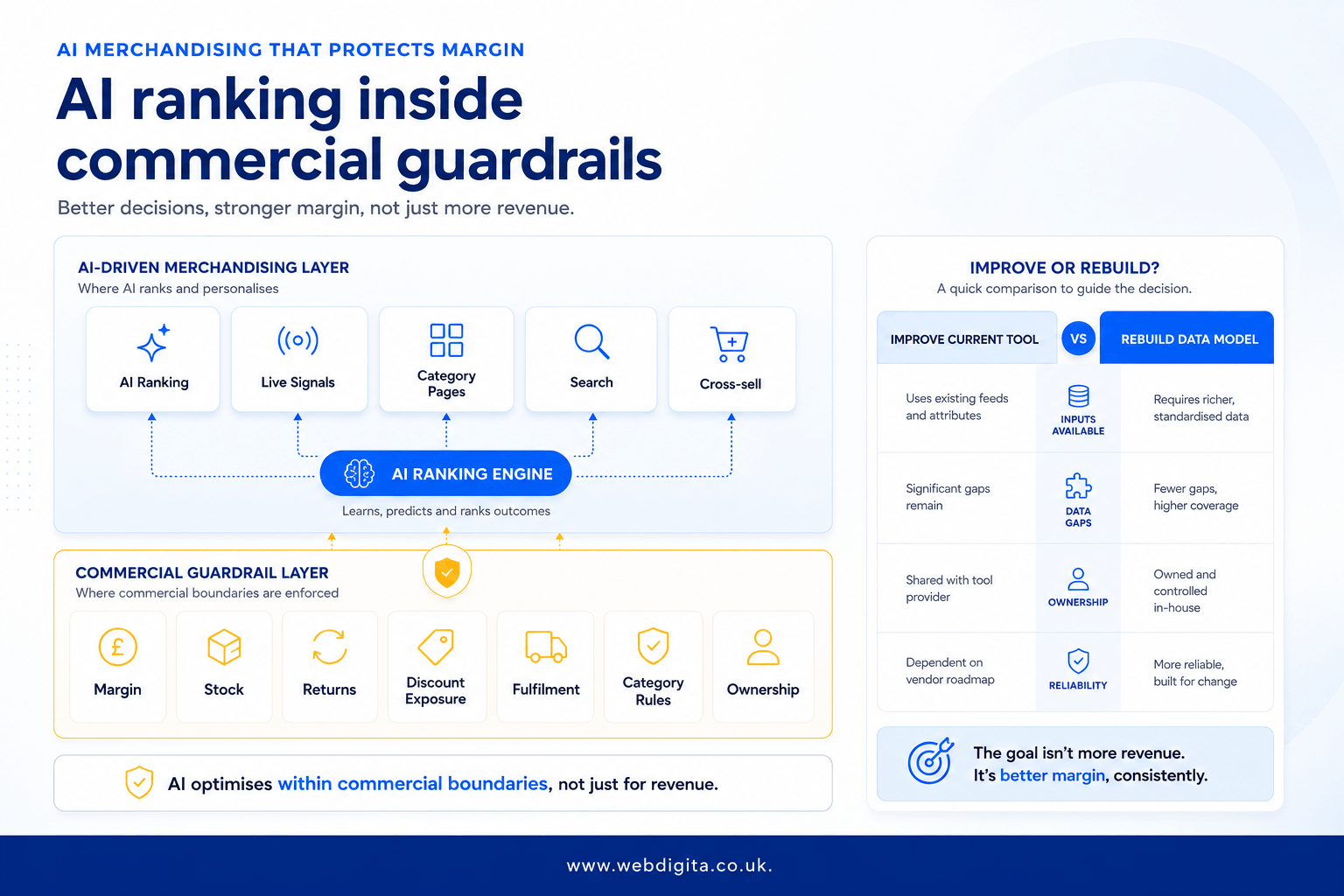
Improve or rebuild? If the current tool can already accept margin, stock, and returns inputs, you may only need better rules and cleaner ownership. If those inputs are missing, unreliable, or trapped across systems, the issue is deeper. Rebuilding parts of the data model or tooling is often the safer move than patching rules on top of a broken signal.
Category logic: treat each category differently. A low-return accessory category can usually handle more automation. A bulky, high-returns category often needs tighter rules and slower testing.
Visibility rules: protect against overexposure of discounted or low-contribution items, even if they convert well. If accessories, refills, or attach products improve contribution, give them stronger visibility in the right journeys rather than letting the engine default to the obvious bestseller. The same principle applies to scaling eCommerce without eroding margin.
Margin-aware merchandising decision tree
You do not need a perfect model first. You need a repeatable path that tells you when AI should push harder, test carefully, constrain visibility, or reduce exposure.
| Signal | What to check | Risk if ignored | Action |
|---|---|---|---|
| Contribution margin | Healthy or weak after core costs | Revenue rises while profit quality falls | Boost healthy contributors, do not auto-promote weak ones |
| Discount reliance | Only wins when heavily discounted | AI learns to favour margin erosion | Limit exposure or test in controlled slots |
| Stock depth | Shallow stock or unreliable replenishment | Trading pressure and wasted visibility | Protect with rules or reduce surfacing |
| Fulfilment and returns | High delivery cost or high return risk | Hidden cost wipes out apparent gains | Constrain aggressive promotion |
| Category context | Supports bundles or stronger attach behaviour | Missed contribution upside | Promote with intent, bundle, or deprioritise |
The goal is not less automation. It is better weighting. If AI is behaving unpredictably, check the decision logic before rushing to replace the tool.
How product surfacing affects POAS and what to check next
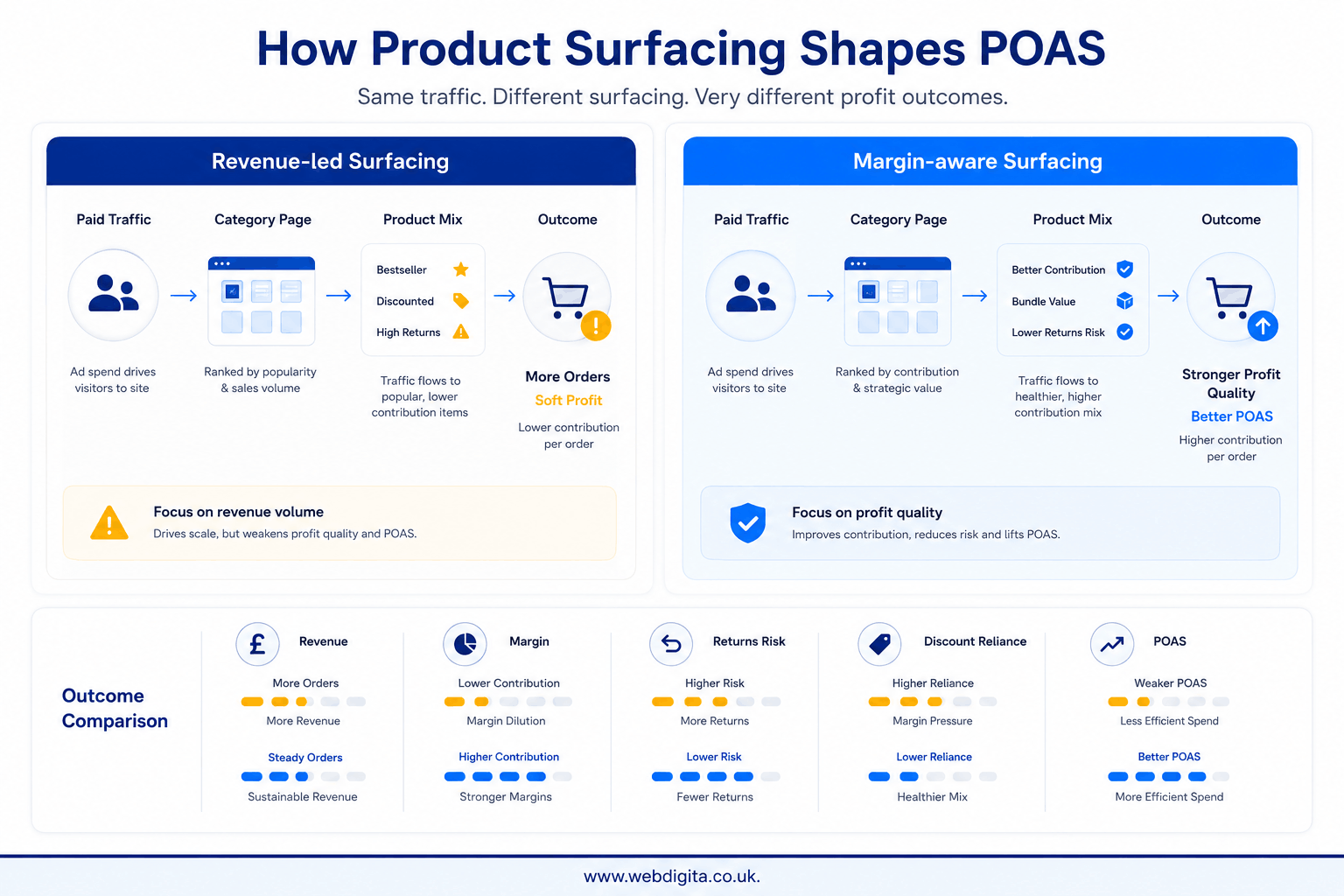
Better product surfacing can improve POAS because paid traffic lands on products and categories that produce stronger contribution – not just more orders. If ads keep sending demand into weak-margin products, media can look efficient while the actual business outcome stays soft.
A simple before-and-after contrast helps here. In a revenue-led setup, a category page keeps surfacing the fastest seller because it wins the click and converts quickly. In a margin-aware setup, that same page gives more space to a slightly slower product with better contribution, lower returns, or stronger bundle value. The top-line result can look similar, but the commercial outcome is healthier.
That is why revenue-only reporting creates a blind spot. The brands we work with who make this shift find that the gap between what looks good in the dashboard and what actually improves profit quality is almost always where the real problem sits.
If you want a neutral definition of POAS, Shopify explains profit on ad spend clearly. The practical job on your side is connecting product-level profitability back to what gets surfaced and funded in your paid channels.
Here is where to focus next if you want merchandising to drive profit quality, not just volume:
- Confirm whether product-level profitability inputs are available in your current tool and whether you trust them.
- Review your recommendation logic for revenue bias, discount bias, and bestseller lock-in – these are the three patterns that compound fastest.
- Audit category weighting so that margin, returns risk, and fulfilment cost are treated differently across catalogue segments, not with a single global rule.
- Set discount exposure limits so AI cannot learn that discounting is the primary path to surfacing.
- Align merchandising and paid reporting so POAS reflects product mix quality, not just order value or ROAS.
If you are deciding whether to improve the current setup or rebuild parts of it, get clear on ownership, data gaps, and the rule logic first. A project discovery workshop can help you pin that down before anyone changes tools.
If you would like a free personalised roadmap, start by identifying where your current AI is rewarding volume over contribution – then fix the weighting before you push harder.
Questions teams ask before changing AI merchandising logic
Common concerns about optimising for margin without breaking automation or slowing down testing.
1. What does margin-aware AI merchandising actually mean?
Margin-aware AI merchandising means the system optimises for contribution, not just revenue or conversion rate. It factors in margin, fulfilment cost, discount exposure, returns risk, and stock depth so the products being surfaced improve profit quality after all costs are included. Revenue and conversion still matter, but they support the decision rather than define it.
2. How do I know if my AI is eroding margin instead of protecting it?
Check whether top recommendation slots are dominated by discounted or low-margin products, whether category winners barely change even when stock or returns patterns worsen, and whether reporting celebrates revenue lift without connecting product surfacing to contribution or profit quality. If sales are rising but gross profit is flat, the AI may be rewarding volume over contribution.
3. Can I protect margin without removing AI automation completely?
Yes. Most stores do not need to remove AI, they need better boundaries. Keep margin-sensitive decisions in-house, such as category weighting, discount limits, and stock protection rules, then let AI automate ranking inside those guardrails. Controlled automation with clear commercial rules usually works better than fully manual or fully automated setups.
4. Should every category use the same merchandising rules?
No. Bulky items, seasonal lines, fragile products, and accessory ranges behave differently, so one margin rule across the whole catalogue rarely holds up. Low-return accessory categories can usually handle more automation, while high-return or expensive-to-ship categories need tighter rules and slower testing to avoid hidden cost leakage.
5. How does product surfacing affect POAS?
Better product surfacing improves profit on ad spend because paid traffic lands on products and categories that produce stronger contribution, not just more orders. If ads keep sending demand into weak-margin products, media can look efficient while the business outcome stays soft. Aligning merchandising logic with POAS means optimising for profit quality, not just order value.
6. What inputs does AI need to optimise for contribution instead of revenue?
AI needs product-level margin, fulfilment cost, discount exposure, returns risk, stock depth, and category context. If those inputs are missing, unreliable, or trapped across systems, the AI will default to optimising for revenue or conversion alone. At that point, the issue is usually data quality or tooling gaps rather than the algorithm itself.
7. What are the warning signs that AI is rewarding the wrong product mix?
Top recommendation slots dominated by discounted or low-margin products, category winners that never change even when stock or returns patterns worsen, and reporting that celebrates revenue lift without connecting product surfacing to contribution or profit quality. If sales are up but margin is flat, the AI may be optimising for volume rather than contribution.
8. Should I improve the current setup or rebuild the merchandising logic?
If the current tool can already use margin, stock, and returns inputs, you may only need better rules and clearer ownership. If those inputs are missing, unreliable, or trapped across systems, the issue is deeper and rebuilding parts of the data model or tooling may be the safer move. Get clear on ownership, data gaps, and rule logic before changing tools.
Conclusion
If your AI is lifting revenue but margin is not moving, the issue is usually weighting, not the tool itself. Most eCommerce merchandising setups can protect margin without removing automation, but only if contribution, stock depth, discount exposure, and fulfilment cost are factored into the decision logic rather than treated as afterthoughts.
| Decision point | What to check before pushing harder |
|---|---|
| Product surfacing logic | Is AI rewarding contribution or just conversion and revenue? |
| Category weighting | Are margin, returns risk, and fulfilment cost treated the same everywhere? |
| Discount exposure | Is the engine learning to favour discounted products because they convert faster? |
| POAS alignment | Does paid traffic land on products that improve profit quality, not just order volume? |
If your merchandising logic is pushing volume but squeezing margin, the issue is usually fixable without replacing the whole stack.
We help eCommerce teams audit recommendation logic, rebuild margin-aware rules, and connect product surfacing to contribution rather than just conversion. Whether you need tighter category controls, better inventory logic, or cleaner POAS reporting, we can map the commercial fix before you commit budget.
See our eCommerce Consulting ServicesOr if you want a