Key Takeaways
Scaling safely comes down to one question: does each extra order leave enough behind once the hidden drag is counted? The article makes the case for judging growth through contribution margin, not headline revenue, and for fixing the constraints that get worse as volume rises.
| What to examine | Why it matters before scale |
|---|---|
| Discounts and paid acquisition | If conversion depends on sharper offers and heavier media spend, growth can raise revenue while weakening flexibility. |
| Returns, shipping and fulfilment | Post-purchase costs often strip out the value of new orders, especially when delivery promises or warehouse processes do not hold up. |
| Channel and product mix | Best sellers are not always best contributors, so you need visibility by channel, campaign and order type. |
| Weekly operating signals | Watch contribution margin, return rate, shipping cost and support load together so rising sales do not hide worsening economics. |
More orders do not automatically mean a stronger business. Fast growth with weak unit economics can damage the business – not strengthen it. If discounts are doing the selling, returns are climbing, shipping costs are creeping up and paid traffic is carrying too much weight, scale just makes the leak bigger. At that point, you are not building momentum. You are scaling rework.
The short answer: To scale eCommerce revenue without killing margin, diagnose contribution margin by channel and order type before increasing spend. The brands that scale profitably fix discount pressure, returns, fulfilment drag and channel economics first – then push volume through the products and acquisition sources that actually leave money behind.
If you want to scale eCommerce business performance without killing margin, you need to look past revenue and into contribution margin. That means checking what is left after promos, returns, fulfilment drag, support load and channel costs have taken their cut.
If you are planning platform changes or heavier growth investment, this is also where you need the support of a technically strong eCommerce website development agency team to back you up, because weak systems make weak economics harder to see and more expensive to fix.
Where margin usually leaks before scale
The honest problem is that most brands do not lose margin in one dramatic place. It leaks in layers: some above the order line, like discount pressure and weak channel economics, and others after the sale, like returns, shipping costs, fulfilment drag and support burden.
You should start with contribution margin, not vanity revenue. Ask what each extra order leaves behind once the real delivery costs are included. If you cannot answer that by channel, campaign or order type, treat that as a warning sign.
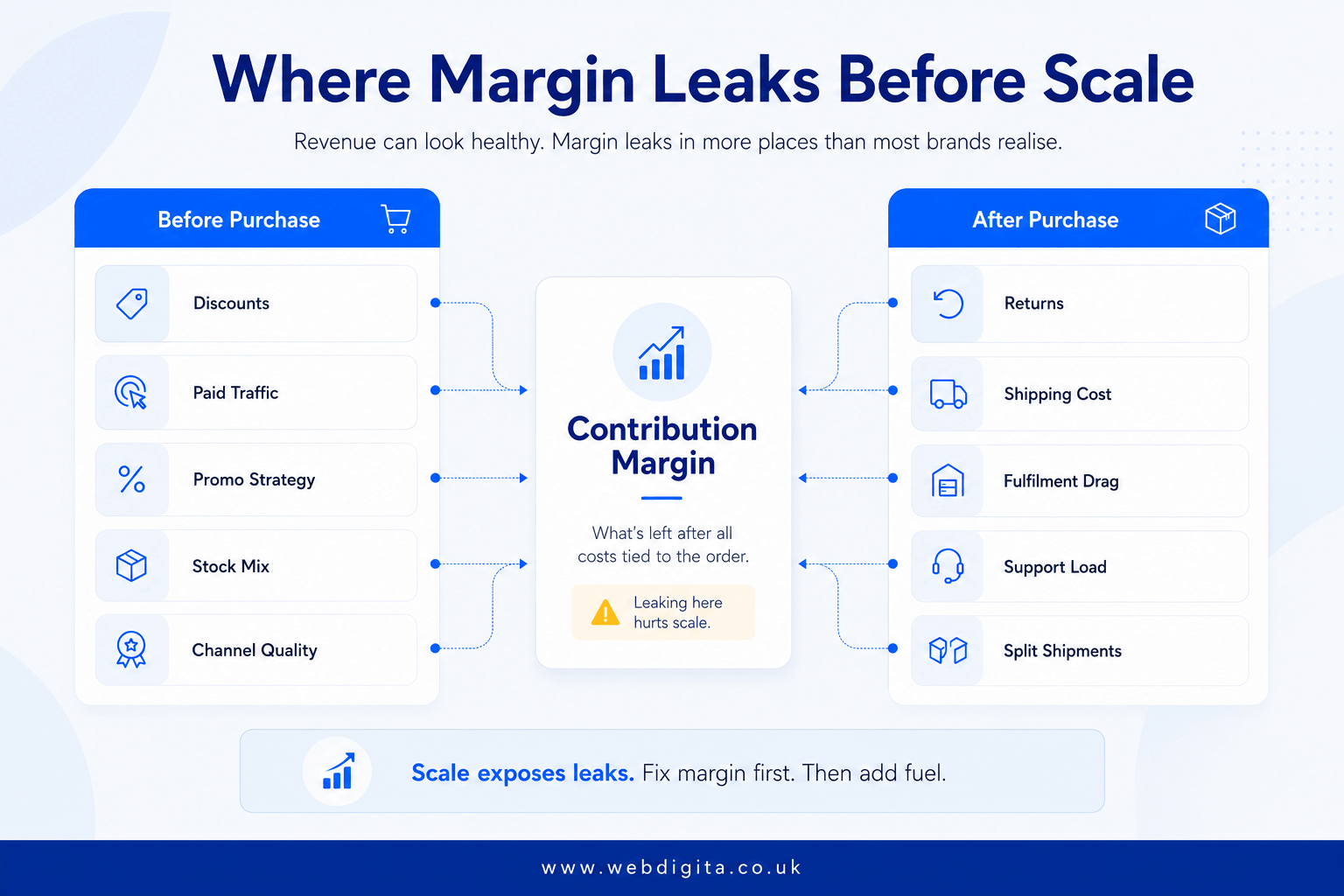
Check the leaks on both sides of the sale
- Before purchase: discount-led conversion, rising paid traffic dependency, poor CRO on landing pages, weak promo strategy and channels that bring low-LTV customers.
- After purchase: returns, expensive shipping promises, pick-pack inefficiency, customer service load and damaged margin from split shipments or stock issues.
- Across both: low AOV, weak retention, poor attribution and gaps that hide which orders are actually worth buying.
A common example is a store that looks healthy because revenue is up, while the real shift is towards lower-margin SKUs sold through heavier discounts. You need to check whether your best-selling products are also your best contribution products. They often are not.
If you are seeing growth but cash feels tighter, do not assume finance is being overly cautious. In our experience, that usually means the order mix, promo model or fulfilment model is carrying more drag than the dashboard shows. If you want a wider view of the structural issues behind that, it is worth reading why eCommerce growth often stalls before the next stage of scale.

Not sure where margin is leaking before you scale harder
We can help you pinpoint the drag across promos, returns, shipping, fulfilment and channel mix so you know what to fix before adding more spend or complexity.
A practical diagnostic, not a generic growth chat.
Why pushing harder can make the economics worse
Bad scale usually comes from forcing demand through a model that is already under strain. More spend buys more orders – but it also buys more low-quality customers: customers acquired under heavy offers, with shorter LTV and higher return rates, who are unlikely to come back without another deal.
The pattern is consistent across growth reviews: top-line revenue looks fine, but underneath it, contribution margin is being eroded by promo overdependence. Revenue rises, yet the business becomes harder to run, because every future target now needs the same discount depth and media pressure to land. Meanwhile, channels with genuinely better unit economics – retention, email automation, repeat purchase – stay underinvested because paid traffic appears to be working.
My view, having worked through this pattern repeatedly with growing eCommerce brands, is that weak contribution margin almost always precedes a cash flow problem – not the reverse. By the time the numbers look bad at the top line, the margin damage is already several quarters deep.
Revenue is not proof of health if each extra order carries more drag than the last.
Picture a brand increasing paid spend to hit a sales target. Conversion holds because offers sharpen, but returns rise, shipping subsidies widen and support tickets climb as fulfilment stretches. On paper, growth happened. In reality, the business paid more to create more work – and weak attribution meant nobody could see clearly where the damage was coming from.
If you are about to invest in a rebuild, replatform or major growth push, I would challenge the assumptions before budget is committed. A proper eCommerce growth discovery workshop can definitely help to identify where margin damage is really coming from, especially when the issue is spread across pricing, operations and data rather than one obvious failure.
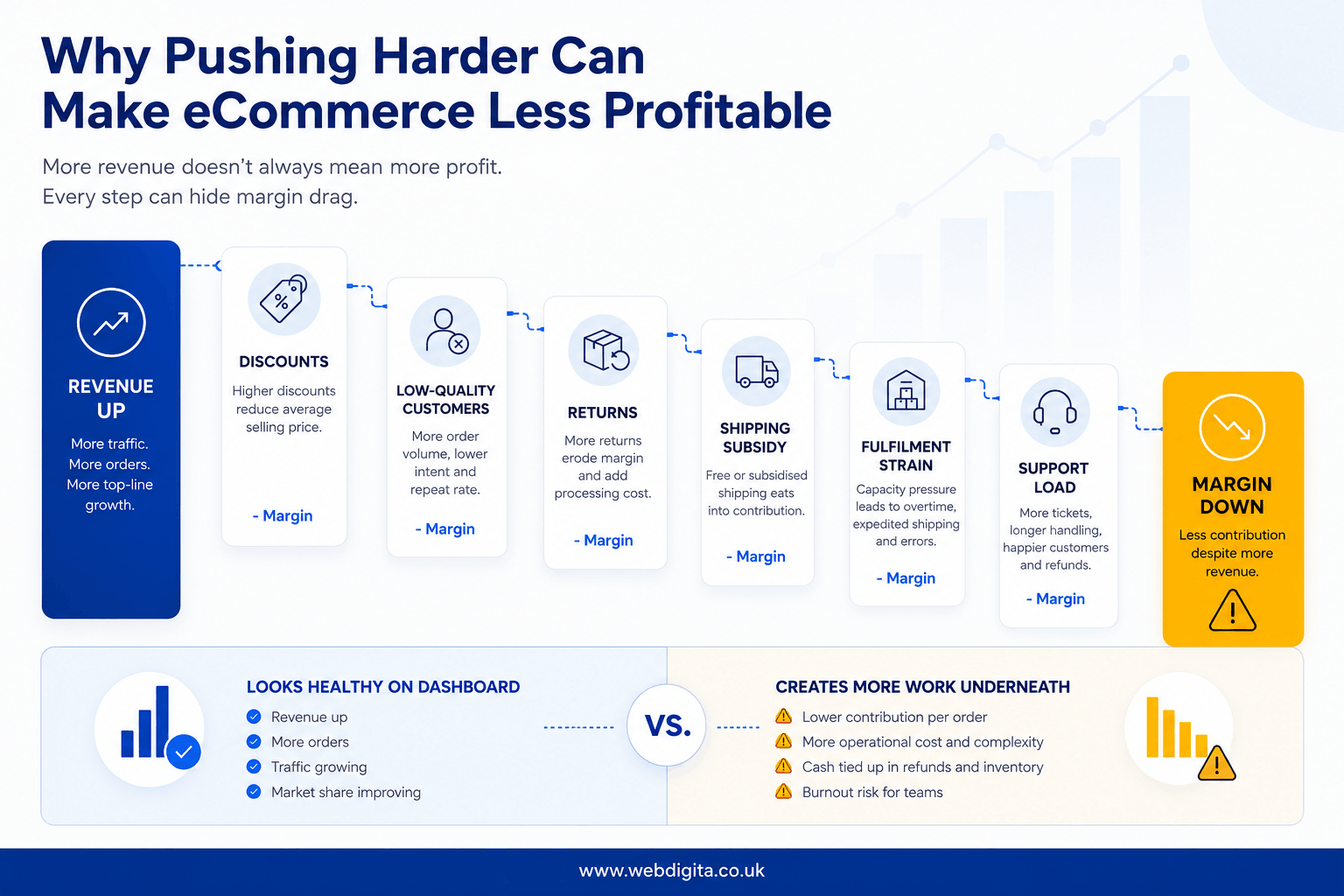
Margin leak waterfall from gross revenue to contribution margin
WEBDIGITA Margin Leak Diagnostic: use this to see where healthy-looking revenue is stripped back before it becomes usable contribution margin.
| Stage | What comes off | What you should check |
|---|---|---|
| Gross revenue | Top-line sales value | Do not stop here. This is only the headline number. |
| Net after discounts | Promos, bundles, voucher pressure | Are offers driving profitable demand or masking weak conversion? |
| Net after returns | Refunds, reverse logistics, damaged stock | Which products, channels or promises create avoidable returns? |
| Net after shipping | Subsidised delivery, split shipments, carrier cost | Is your shipping promise commercially sustainable at higher volume? |
| Net after fulfilment and support | Warehouse drag, pick-pack cost, service load | Does volume improve throughput or just create more manual work? |
| Contribution margin | What is left to fund growth and overhead | Can you see this clearly by channel, campaign and order type? |
What to fix before you scale harder
You do not need to rebuild everything. You need to fix the constraints that get worse as volume rises. Start with the issues that have the biggest commercial leverage, then monitor them weekly so you can see whether scale is strengthening the business or hollowing it out.
You should prioritise in this order:
- Pricing and promo discipline: cut lazy discounting and check whether offers are training customers to wait rather than buy at full price.
- Channel economics: compare CAC, AOV, LTV, return rate and repeat behaviour by channel – not just revenue. Paid traffic may look efficient until you factor in returns and single-purchase behaviour.
- Returns and fulfilment: fix product expectation gaps, delivery friction and warehouse inefficiency before adding more order volume.
- Support burden: check where service demand is really coming from, because support cost often exposes deeper UX, CRO or operational failures.
- Stock mix quality: push products and bundles that improve contribution, not just turnover.
Do not assume every margin problem needs a full platform rebuild. But if your data is fragmented, attribution is weak or operational fixes keep breaking under load, you may need better systems and clearer ownership. That is where regular website maintenance & housekeeping becomes commercially relevant, not just technically tidy.
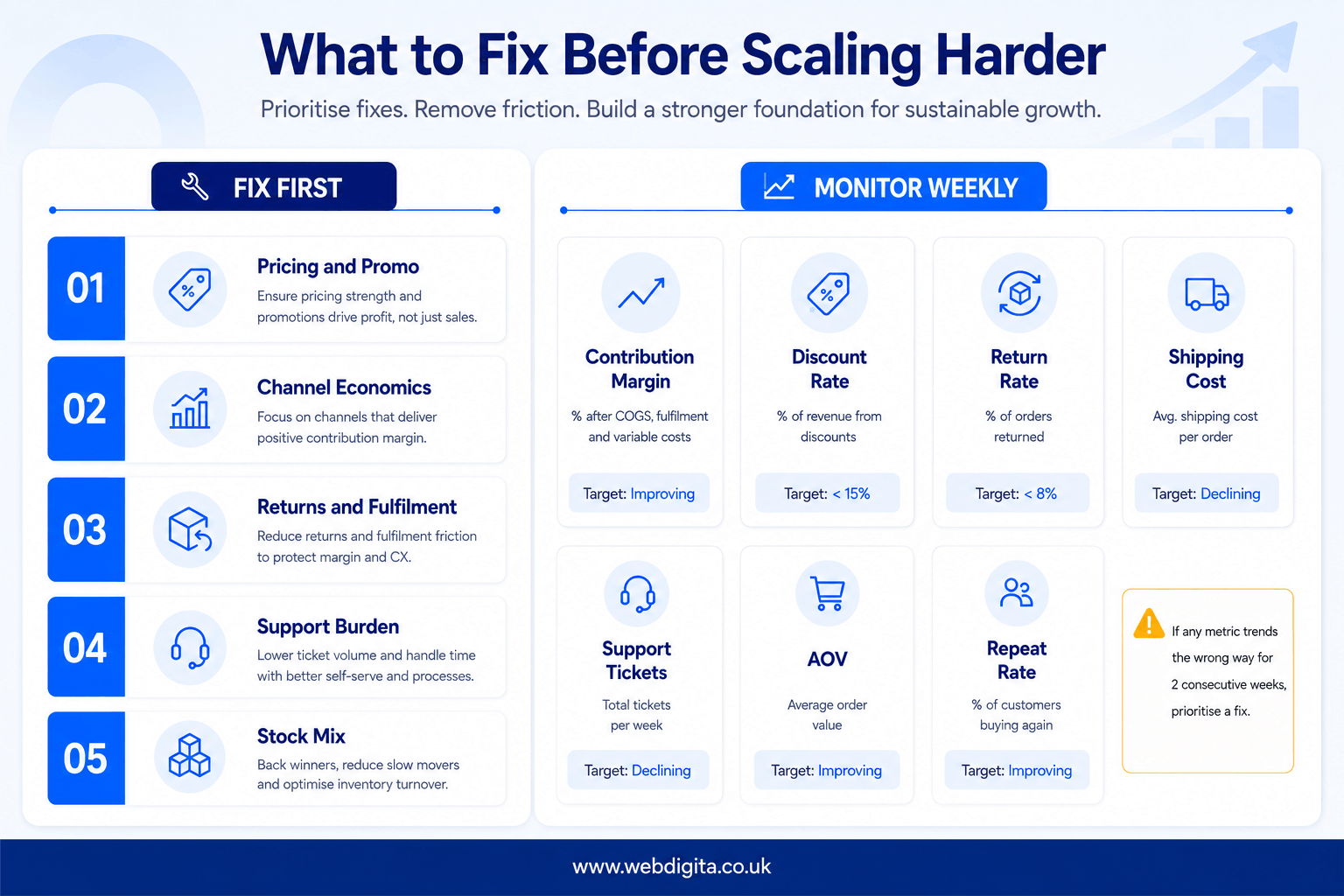
What to monitor weekly
- Contribution margin by channel and campaign
- Discount rate versus conversion lift
- Return rate by product, promise and acquisition source
- Shipping cost per order and split-shipment frequency
- Support tickets per 100 orders
- AOV, repeat rate and LTV by acquisition channel and product mix
If one of those worsens while revenue rises, slow down and diagnose before pushing harder. I would treat unclear contribution margin by channel as the biggest red flag.
If you cannot see clean economics across campaigns, products and post-purchase drag, you are guessing – and guessing at scale gets expensive fast. A profitability-led scale review should give you a fix order, not more noise: what to repair now, what to monitor weekly and what can safely be pushed once the margin leaks are under control.
Questions buyers ask before scaling an eCommerce business harder
These answers focus on the margin checks, warning signs and operational issues that matter before you increase spend or volume.
1. What does it really mean to scale an eCommerce business without killing margin?
It means growing order volume without letting discounts, returns, shipping costs, fulfilment drag and channel costs wipe out the value of that growth. The article argues that revenue alone is not enough. You need to know what each extra order contributes after the real commercial and operational costs have been taken out.
2. Why is contribution margin more useful than revenue when planning scale?
Contribution margin is more useful because it shows what is actually left to fund growth and overhead. Revenue can look healthy while promo pressure, reverse logistics and support costs are quietly eroding the business. If contribution margin is unclear by channel, campaign or order type, scale decisions become far riskier.
3. What are the most common margin leaks before an eCommerce brand scales?
The most common margin leaks are discount-led conversion, rising paid media dependency, returns, subsidised shipping, fulfilment inefficiency and support burden. Weak product mix and poor retention also matter. The key point is that margin usually leaks in layers, both before purchase and after the sale, rather than from one obvious problem.
4. Can pushing harder on paid traffic make eCommerce economics worse?
Yes, pushing harder on paid traffic can make the economics worse if the underlying model is already strained. More spend may buy more orders, but it can also bring lower-quality customers, heavier discounting, more returns and more service demand. That creates top-line growth while making the business less flexible and less profitable.
5. What should an eCommerce team fix before investing in faster growth?
An eCommerce team should fix the constraints that get worse as volume rises. In the article, that starts with pricing and promo discipline, then channel economics, returns and fulfilment, support burden and stock mix quality. The aim is not to rebuild everything, but to remove the issues that make growth more expensive than it looks.
6. Which metrics should be monitored weekly before scaling harder?
The most useful weekly metrics are contribution margin by channel and campaign, discount rate versus conversion lift, return rate, shipping cost per order, split-shipment frequency, support tickets per 100 orders, AOV, repeat rate and stock sell-through. Watching these together helps you spot when revenue is rising but commercial quality is slipping.
7. Does every margin problem mean an eCommerce platform rebuild is needed?
No, not every margin problem needs a platform rebuild. Some issues sit in pricing, operations or channel strategy rather than technology. The article's point is that better systems become commercially relevant when data is fragmented, attribution is weak or operational fixes keep failing under load, because poor visibility makes margin damage harder to diagnose.
Conclusion
If growth feels harder than it should, the issue is usually not demand alone. It is that the commercial model, operational model or reporting model cannot carry more volume cleanly. The sensible move is to tighten the economics before you add more pressure.
- Start with visibility: if you cannot see contribution margin clearly by channel and order type, you are making scale decisions with missing information.
- Fix the drag first: promo dependency, return-heavy products, shipping subsidies and service load tend to become more expensive, not less, as volume rises.
- Separate system issues from strategy issues: not every problem needs a rebuild, but fragmented data and weak ownership will keep masking the real cause.
- Push once the model holds: when extra demand improves usable margin rather than creating more rework, scale becomes a commercial decision instead of a gamble.
Fix the commercial and technical constraints before you scale eCommerce harder
If weak data, fragmented systems or operational workarounds are hiding contribution margin, the right eCommerce development support can help you repair the model before growth spend makes it worse.
Explore eCommerce developmentNeed a clearer fix order first