Key Takeaways
eCommerce consulting in the UK ranges from a few thousand pounds for a focused review to a lower five-figure budget for broader roadmaps or implementation oversight. Ongoing growth support often starts in the low thousands per month and rises with scope.
- Scope drives cost more than anything else. An audit is different from a roadmap, and a roadmap is different from active delivery leadership. Cheaper quotes often exclude the hard parts such as implementation oversight, tracking fixes, or stakeholder alignment.
- Hidden costs sit outside the consulting fee. Analytics setup, tracking fixes, tool licences, dashboard design, and QA are often separate budget lines. If these dependencies are not clear upfront, they usually appear later as rework or delay.
- Compare what is included, not just the headline number. Ask what deliverables you get, how often you meet, who does the work, how much senior input you receive, and whether the output is a usable plan or just a strategy deck.
- Results take time and follow-through. Good consulting gives you clarity and priorities quickly, but commercial gains depend on testing, measurement, and delivery support. A cheap strategy deck with no owner often goes nowhere.
eCommerce consulting projects fail on budget assumptions made before the brief was properly defined. Two quotes can look identical on price and still cover completely different levels of strategy, channel scope, senior involvement, and delivery support. If you compare headline numbers without checking what each engagement actually includes, you end up comparing two different jobs.
In the UK, eCommerce consulting typically ranges from a few thousand pounds for a focused strategic review to a lower five-figure project fee for a full growth roadmap. Ongoing retainers often start in the low thousands per month, rising with channel complexity and the level of senior input required. What drives the price most is scope: how many channels are in play, how reliable your data and measurement already is, how much senior strategic input you need, and how much implementation responsibility sits with the consulting team versus yours. This guide breaks down each driver so you can pressure-test quotes before committing budget.
What UK eCommerce consulting typically costs – and why quotes vary so much
If you are researching eCommerce consulting cost UK, start with the engagement model, not the number. A focused advisory review, a strategic roadmap, analytics infrastructure setup, implementation oversight, and an ongoing growth retainer are all priced differently – because they involve fundamentally different levels of ownership, time, and risk. A quote without a clear scope description is not a quote. It is a starting position.
As a rough UK guide: a focused advisory review typically starts at a few thousand pounds for a well-scoped brief. A full eCommerce strategy consulting engagement covering acquisition, retention, LTV, CAC, AOV, and channel prioritisation moves into the high single thousands or lower five figures – especially when stakeholder alignment and delivery sequencing are part of the scope. A meaningful growth retainer often starts in the low thousands per month and rises when the work includes multi-channel coordination, test-and-learn cadences, or senior oversight of DTC or B2B eCommerce initiatives.
The most common confusion in budget conversations comes from comparing audits against roadmaps as if they are the same type of work. An audit tells you what is wrong. A roadmap tells you what to do and in what order. An ongoing retainer does both, continuously, while holding you accountable to the plan. Before you compare quotes, confirm which of those three things you actually need right now. The engagement type changes not just the price but the entire shape of the work.
The cheapest consulting quote is often the one that leaves you paying later – for missing analysis, unclear ownership, or a strategy that nobody can execute.
The cost drivers that change the price most
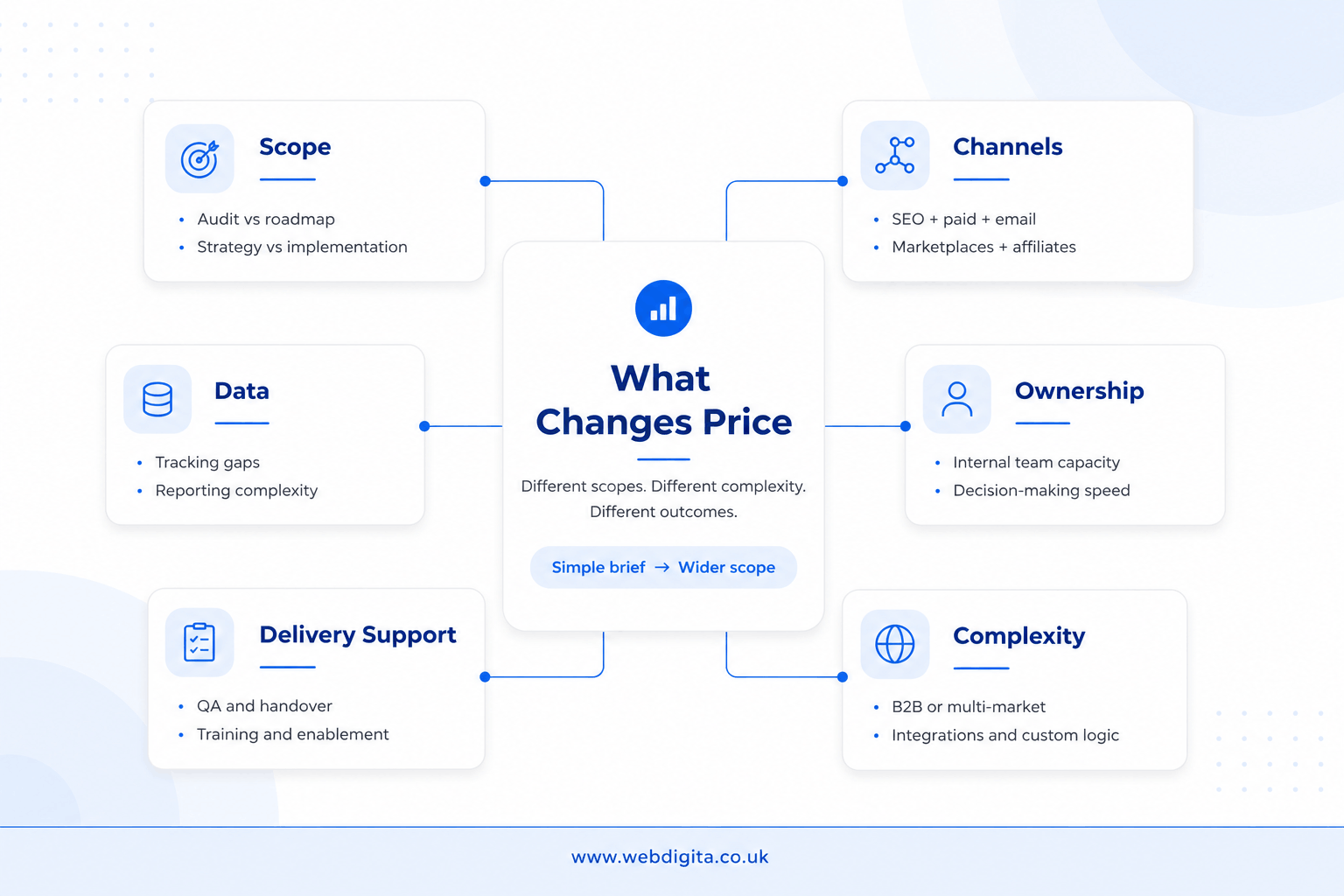
Scope is the single biggest driver. An audit of one channel is a contained piece of work. A growth roadmap covering acquisition, CRO, retention, loyalty mechanics, LTV optimisation, CAC efficiency, AOV uplift, and platform friction across an omnichannel or DTC model is a significantly different project – not just in time, but in the analytical depth and cross-functional alignment required. That difference in scope often accounts for the largest price gap between quotes that look superficially similar.
Channel mix adds cost faster than most clients expect. If one consulting team is expected to align SEO, paid media, email, retention, and merchandising into a coherent growth roadmap, the coordination overhead is real. Each channel produces its own data, its own attribution questions, and its own implementation dependencies. We consistently find that multi-channel scope is the variable most often underestimated in an initial brief – and the one most likely to drive scope creep once the work starts. If multi-channel complexity is already creating friction, naming it before the brief is finalised will save the project from being repriced halfway through.
This is where briefs regularly break down: a brand asks for a growth review, but once the work starts it becomes clear that tracking is unreliable, reporting is fragmented across three platforms, and nobody internally owns implementation. What looked like a strategy project becomes a data infrastructure job first. The original quote was not wrong. The brief was just too thin to catch it.
Complexity also rises sharply for B2B eCommerce models, subscription businesses, multi-market stores, and setups where customer data is spread across disconnected tools. The more fragmented your stack, the more time the consulting team needs to build a shared understanding of where growth is actually coming from before they can tell you where to find more of it. Every layer of technical or organisational complexity adds real time to the work.
Team involvement on your side is a less discussed but genuinely significant cost driver. External consulting works best when it has a named internal owner – someone who can action priorities, approve changes, and keep implementation moving. If that owner does not exist or is stretched across other priorities, the consulting scope tends to expand legitimately to fill the gap. Build that assumption into your cost estimate from the start, not after the first invoice arrives.

Not sure what your eCommerce setup actually needs?
Most consulting briefs start too broad or miss the real constraint. We run a focused scoping review to map what is working, what is stuck, and where budget should go first.
No obligation. Just a clearer view of priorities before you commit budget.
Cost driver matrix: project type, complexity, and typical UK price range
Use this as broad UK scoping guidance, not a fixed market rate card. Every engagement is shaped by brief quality, data readiness, and the level of senior input required. Prices reflect the UK market only and will vary by agency model and seniority.
| Project type | Complexity | What usually increases effort | Typical UK price range |
|---|---|---|---|
| Focused audit or advisory review | Low | Single store, limited channels, clear brief | A few thousand pounds |
| Strategic growth roadmap | Medium | Cross-channel planning, prioritisation, stakeholder alignment | High single thousands to lower five figures |
| Analytics and measurement setup | Medium to high | Tracking gaps, attribution issues, dashboard design, data cleanup | A few thousand pounds to lower five figures |
| Growth retainer | Medium to high | Ongoing testing, reporting, channel coordination, senior oversight | Low thousands per month upward, depending on scope |
| Implementation oversight | High | Developer coordination, QA, dependencies, delivery management | Lower five figures or ongoing monthly support, depending on scope |
If a quote still feels vague after reviewing this framework, push for clearer scope assumptions before approving budget. A project discovery session is often the most efficient way to surface the real scope before you commit to a number that may need to shift once the work starts.
What sits outside the consulting fee – and gets missed in budgets
Consulting fees cover strategy, analysis, and oversight. They almost never include the tooling, data infrastructure, or implementation work that makes strategy actionable. If your tracking is unreliable, your attribution is broken, or your reporting is split across tools that do not talk to each other, that needs fixing before any consulting recommendation becomes usable. That work is almost always a separate budget line.
Analytics and data infrastructure is the most commonly missed cost. Setting up proper event tracking, building attribution models that reflect how customers actually convert, cleaning historical data so it can be used for benchmarking, and designing dashboards that surface what matters to decision-makers – that is skilled, time-consuming work. Some consultants include light guidance on this within their fee. Most stop at the recommendation and leave setup, QA, and handover to your team or a specialist. If it is not clearly defined in the scope document, assume it is not included.
Tooling costs sit outside the consulting fee unless explicitly stated otherwise. The platforms, automation tools, CRM systems, testing software, loyalty programme infrastructure, and reporting tools required to execute a growth roadmap all carry their own licence and setup costs. If the recommended omnichannel stack involves three or four tools you do not already have, the total cost of the engagement is meaningfully higher than the consulting invoice alone. We recommend building a separate tooling budget line before any engagement is signed off, so there are no surprises once the strategy work begins.
- Ask what is included in the consulting fee and what is explicitly excluded.
- Check whether analytics setup, tracking fixes, dashboard design, and QA are separate budget lines.
- Ask which tool licences or platform costs you will be paying directly throughout the engagement.
- Confirm who owns implementation, approvals, and handover at each stage.
- Watch for unstated assumptions about internal resource – if they are not written down, they will become a problem later.
In-house vs external eCommerce growth support: what the economics actually look like
We regularly work through this question with founders and commercial leads who are trying to decide whether to hire in-house or bring in external support. The answer depends less on the cost comparison and more on what kind of problem you are actually trying to solve – and how quickly you need senior thinking applied to it.
An in-house hire looks cheaper on paper. A mid-level eCommerce growth manager in the UK typically carries a salary somewhere between £40,000 and £65,000. But add employer national insurance contributions, pension, benefits, and recruitment fees – which typically run at 15 to 20 per cent of first-year salary – and the effective cost in year one is closer to 1.3x to 1.5x the headline figure. That is before accounting for the three to six months it takes a new hire to build context, establish working relationships, and begin contributing at a genuinely strategic level.
External consulting starts contributing from day one, at the level of seniority you actually need. That is the variable most in-house vs agency cost comparisons miss. A growth retainer is not a cheaper version of an in-house hire. It is access to cross-channel pattern recognition, delivery frameworks, and strategic experience that a single hire would take years to accumulate independently. The relevant question is not which option costs less per month. It is which option gets you to better decisions faster.
In-house tends to make more sense when the workload is steady, the role is well-defined, and you need someone embedded in the day-to-day operations of your team over the long term. External tends to make more sense when the problem is complex and shifting, when you need senior input quickly without a three-month recruitment window, or when you are trying to build a strategy framework that internal resource can own once the direction is clear. The most effective model we see in practice is often a hybrid: external consulting to define the strategy and build the measurement foundation, in-house to own ongoing execution once priorities are established and accountability is clear.
What results to expect – and how long they realistically take
This is the question most clients want answered directly, and the one that gets hedged most often in proposal conversations. We prefer to be specific about it.
Structural improvements – clearer priorities, a usable growth roadmap, reliable measurement, better data foundations, and a shared view of where CAC and LTV actually sit – can often be delivered within the first four to eight weeks of a well-scoped engagement. That does not mean you will see revenue movement in week eight. It means you will stop making growth decisions with incomplete information, which is where a significant proportion of eCommerce marketing budget gets wasted before any consulting engagement begins.
Commercial gains – meaningful improvement in conversion rates, retention, AOV, and channel ROI – follow the implementation and test-and-learn cycle. Depending on the current state of your analytics, the quality of your traffic, and the pace at which your internal team can action priorities, expect to see measurable movement at three to six months for focused CRO or retention work, and six to twelve months for broader growth roadmap results. Proposals that promise faster commercial returns without qualifying what they can actually control are worth pressing for specifics.
Loyalty and lifecycle improvements tend to take longer still. Building a loyalty mechanic or retention programme that meaningfully changes LTV requires enough customers in the cohort, enough time to observe behaviour across multiple purchase cycles, and enough test iterations to distinguish what is working from what is noise. If you are expecting meaningful LTV movement in three months, that expectation is worth revisiting before the brief is signed off.
The pattern we see most often in projects that underperform on results: the consulting engagement was scoped correctly, but implementation was too slow, the internal owner changed mid-project, or the measurement foundation was not in place to attribute results to the right interventions. Results are a function of consulting quality plus implementation pace plus time. Consulting is only one of those three variables.
Minimum commitment for meaningful results
A one-off review or audit can deliver genuine diagnostic clarity – an honest account of where your growth ceiling is, what the priority interventions should be, and how to sequence them. That is a legitimate use of consulting budget, and for some businesses it is all that is needed to give an internal team a clear direction they can execute against.
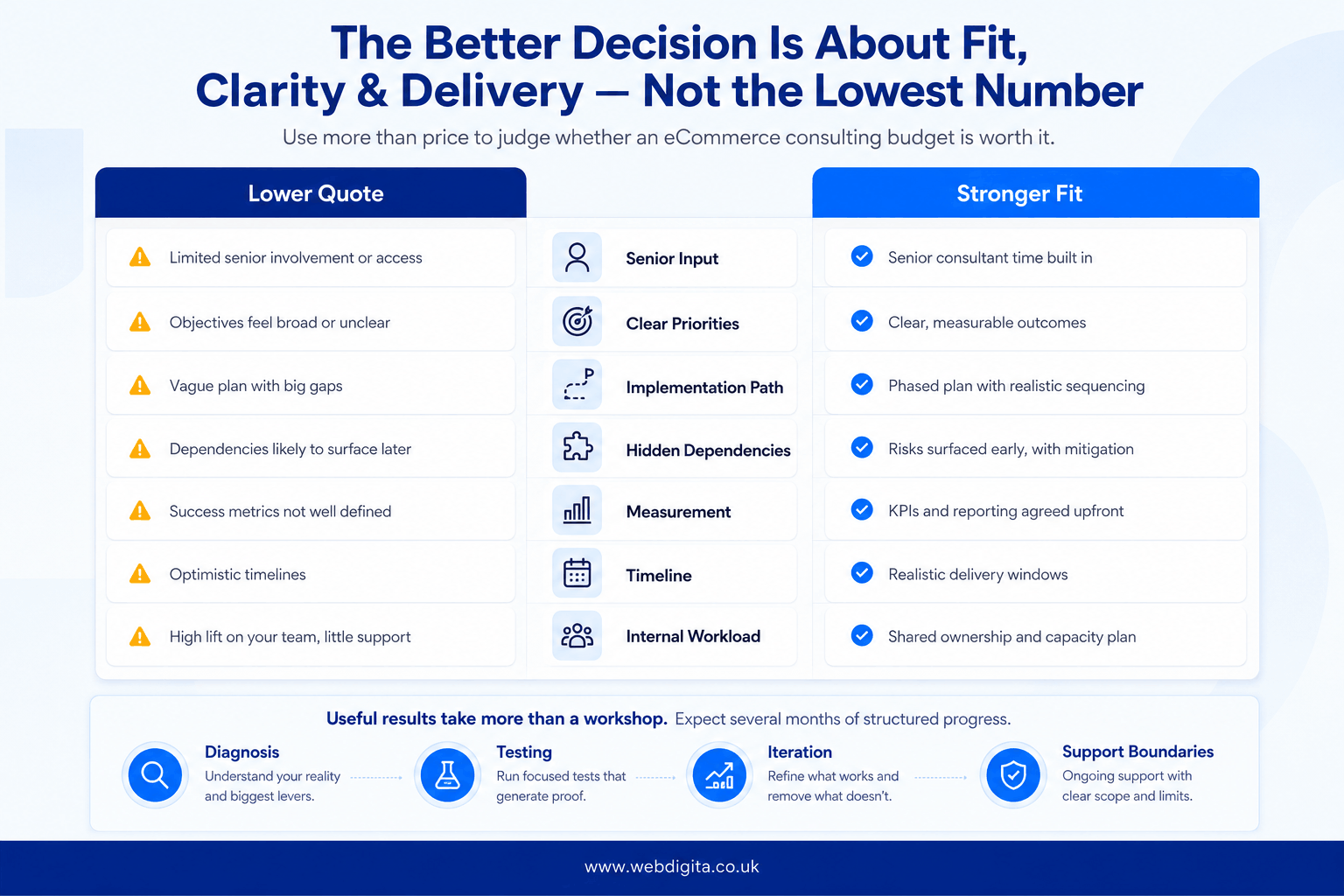
If you want testing, iteration, and measurable commercial improvement, a single workshop or strategy document will not get you there. In our experience, engagements under three months rarely reach the implementation depth needed to produce meaningful results. A realistic minimum for a growth retainer that includes channel coordination, test-and-learn cadences, and regular reporting is usually four to six months. If a proposal is suggesting meaningful commercial results in a shorter window, ask exactly which metrics they expect to move, by how much, and how they will be measured independently.
For DTC brands testing a new market, or B2B eCommerce businesses building a self-serve channel alongside a direct sales function, the minimum useful runway is typically longer – because the baseline is further from the goal and the number of interdependencies is higher. Be honest about where you are starting from when you build your commitment assumption, and make sure the consultant you are evaluating is being equally honest in return.
How to compare quotes and decide where to commit
The question is not which option is cheapest. It is which option gives you the clearest priorities, the strongest senior involvement, the most realistic delivery path, and the fewest hidden dependencies on your internal team.
When we review consulting proposals with clients, we look for four things: a clearly described scope that matches the brief, explicit statements about what is excluded from the fee, named assumptions about internal resource and decision-making pace, and a realistic picture of what the output looks like at each stage. A proposal that glosses over any of these is very likely to reprice once the work is underway.
If you are moving from strategy into delivery, the boundary between consulting and implementation support needs to be clear before anything is signed. eCommerce maintenance and ongoing support costs are often the first thing to surface once a strategy starts moving into execution – particularly if your store needs concurrent QA, fixes, or post-launch stability work running alongside the growth programme.
The sensible next step is not to pursue the lowest number first. It is to start with a scoping conversation based on your goals, your current data maturity, your internal capacity, and the delivery constraints that will shape what the work actually involves. A quote built on a clear brief is far more likely to stay accurate throughout the engagement. Related reading: what actually moves revenue in a B2B eCommerce growth strategy.
Questions buyers ask about eCommerce consulting cost in the UK
Common questions about pricing, scope, and what sits inside or outside the consulting fee.
1. How much does eCommerce consulting cost in the UK?
eCommerce consulting in the UK typically ranges from a few thousand pounds for a focused audit or advisory review to a lower five-figure budget for a broader strategic roadmap or implementation oversight. Ongoing growth retainers often start in the low thousands per month and rise with scope, channel mix, and delivery support. The final cost depends on what is included, how much senior input you get, and whether the work covers diagnosis, prioritisation, or active delivery leadership.
2. What drives the cost of eCommerce consulting?
Scope is the biggest driver. An audit is priced differently from a roadmap, and a roadmap is different from ongoing delivery support. Channel mix matters too—aligning SEO, paid media, email, retention, and merchandising increases complexity. Other factors include tracking quality, data fragmentation, multi-market setups, B2B models, and how much internal capacity you have. The more moving parts, the more time is needed to create something your team can actually use.
3. What sits outside the consulting fee?
Consulting fees usually cover strategy, analysis, and advisory work. Analytics setup, tracking fixes, dashboard design, tool licences, platform costs, QA, and implementation often sit outside the fee. Some consultants include light setup guidance, while others stop at advice and leave execution to your team. If these dependencies are not clear upfront, they usually appear later as rework, delay, or wasted budget.
4. Is eCommerce consulting better value than hiring in-house?
It depends on the workload and the role. External consulting is often more efficient when you need senior input quickly, cross-channel visibility, or a defined piece of work. In-house tends to make more sense when the workload is steady and the role is clear enough to own day to day. Recruitment time, management overhead, narrower specialist coverage, and slower ramp-up all have a cost that makes in-house less efficient for short-term or strategic work.
5. How do I compare eCommerce consulting quotes properly?
Do not compare headline numbers alone. Check what deliverables are included, how often you will meet, who is doing the work, how much senior input you get, and whether the output is a usable plan or just a strategy deck. Ask what sits outside the fee, such as analytics setup, tracking fixes, tool costs, or QA. Also ask what minimum commitment is needed for useful results. A cheaper quote is not always more efficient—it may simply leave out the hard part.
6. How long does it take to see results from eCommerce consulting?
Good consulting can give you clarity, priorities, and better visibility quite quickly, often within weeks. Commercial gains such as conversion improvement, retention gains, and channel efficiency usually take longer because they depend on testing, measurement, and follow-through. That is why a cheap strategy deck with no owner often goes nowhere, while a tighter roadmap with actions, dependencies, and delivery support is more likely to move.
7. What is the difference between a strategic roadmap and an audit?
An audit is a focused diagnostic review that identifies issues, gaps, or opportunities. A strategic roadmap goes further by prioritising actions, aligning stakeholders, and creating a delivery plan. Audits are usually priced in the low thousands, while roadmaps can move into the high single thousands or lower five figures depending on scope. If you need diagnosis only, an audit may be enough. If you need prioritisation and a delivery path, a roadmap is more useful.
8. Do I need ongoing consulting or just a one-off project?
It depends on what you want to achieve. One-off consulting can be enough for diagnosis, prioritisation, or a clear roadmap. If you want testing, iteration, and measurable improvement, you will usually need several months of support, not a single workshop. Ongoing retainers are more useful when the work includes active delivery leadership, reporting, channel coordination, or continuous optimisation.
Conclusion
The right eCommerce consulting budget depends on what you need to move, how much internal capacity you have, and whether you want diagnosis, prioritisation, or active delivery leadership. Before you approve any quote, check what sits inside the fee and what sits outside it.
| Decision point | What to check |
|---|---|
| Scope clarity | Are deliverables, meetings, senior input, and handover clearly defined? |
| Hidden dependencies | Does the quote assume your team will handle tracking, QA, implementation, or tool setup? |
| Delivery ownership | Who owns follow-through, testing, reporting, and iteration after the initial work? |
| Minimum commitment | Is one workshop enough, or do you need several months for meaningful improvement? |
If you are comparing quotes and the cheapest option feels vague, it probably is. Start with a scoping review based on your goals, current setup, and delivery constraints before committing budget. The best consulting investment is the one that gives you clarity, priorities, and a realistic path forward, not just a strategy deck.