Key Takeaways
- Discovery must settle ownership and workflow logic before build starts: who sells, who fulfils, how fees work, and what B2B rules apply. If those decisions drift into the build phase, rework becomes expensive.
- Architecture and integration planning expose weak suppliers early: platform choice matters less than proving the stack fits marketplace rules, vendor workflows, payment splits, and future scale without workarounds.
- Staged releases with risky journeys tested first prevent late surprises: vendor dashboards, checkout edge cases, ERP sync and performance gates should appear early in staging, not saved for final review.
- Handover and vendor onboarding support are part of delivery: a technically sound marketplace with poor seller adoption or unclear post-launch ownership is still a weak commercial result.
Most eCommerce marketplace development projects fail not because of technical issues but because the discovery process was skipped. I have seen it enough times to stop being surprised. The supplier shows a confident feature list, the timeline looks reasonable, and the brief gets signed off before anyone has settled how the marketplace actually works. The real costs arrive later – as rework, integration surprises, checkout failures and a launch that is technically live but commercially shaky.
The short answer: A rigorous ecommerce marketplace development process runs from discovery through architecture, integration planning, staged build, risk-led testing, launch readiness and post-launch handover. Each phase needs clear inputs, named outputs, decision gates and signed-off owners before the next phase opens. If a supplier cannot show you that path in writing, you are not looking at a process. You are looking at a quote with optimism attached.
This guide is for ecommerce leaders, operations teams and commercial buyers comparing suppliers, tightening a weak brief or shortlisting a multi vendor marketplace developer before scope and budget decisions become harder to reverse.
What a real marketplace discovery phase has to settle before build starts
Discovery is where good projects get cheaper and bad ones get expensive. Every assumption that survives discovery becomes a rework ticket later. I have watched teams skip this phase to “get moving faster” and end up six weeks behind by week four.
Discovery must settle how the marketplace works in practice, not just which screens need designing.
Start with ownership: Who sells, who owns stock, who fulfils, who handles returns, and how fees or commissions work. Buyer and seller journeys need mapping early – including approvals, disputes, onboarding friction and edge cases when rules break. If you have B2B eCommerce requirements such as account pricing, quote requests, approval flows, tax handling or payment terms, those go into discovery immediately. They are architecture decisions. Treating them as later tweaks is how you end up rebuilding checkout logic two weeks before launch.
Watch for missing client-side owners: If legal, operations, content or vendor onboarding have no named owner on your side, delivery slows fast. The build keeps moving while legal review or seller setup stalls the release. That is not the agency’s problem. It becomes yours.
- Business model, fulfilment ownership and fee logic agreed
- Core buyer and seller journeys mapped
- B2B eCommerce rules and edge cases documented
- Product data structure and approval logic defined
- Integration dependencies listed with owners
- Internal sign-off roles named before build approval
For a deeper view of what scoping rigour looks like in practice, see how I approach eCommerce development and the discovery work that sits upstream of any build commitment.
Architecture and integration decisions are where weak processes usually show
This is where weak suppliers start waving platform logos around. Shopify. WooCommerce. Magento. Headless commerce. All valid – but platform choice is not the architecture decision. It is what comes after the workflow and constraint picture is clear.
I have reviewed shortlists where the agency recommended a platform because it was what they knew best, not because it fit the marketplace model. That is a problem that does not appear until checkout is built and ERP integration is a mess.
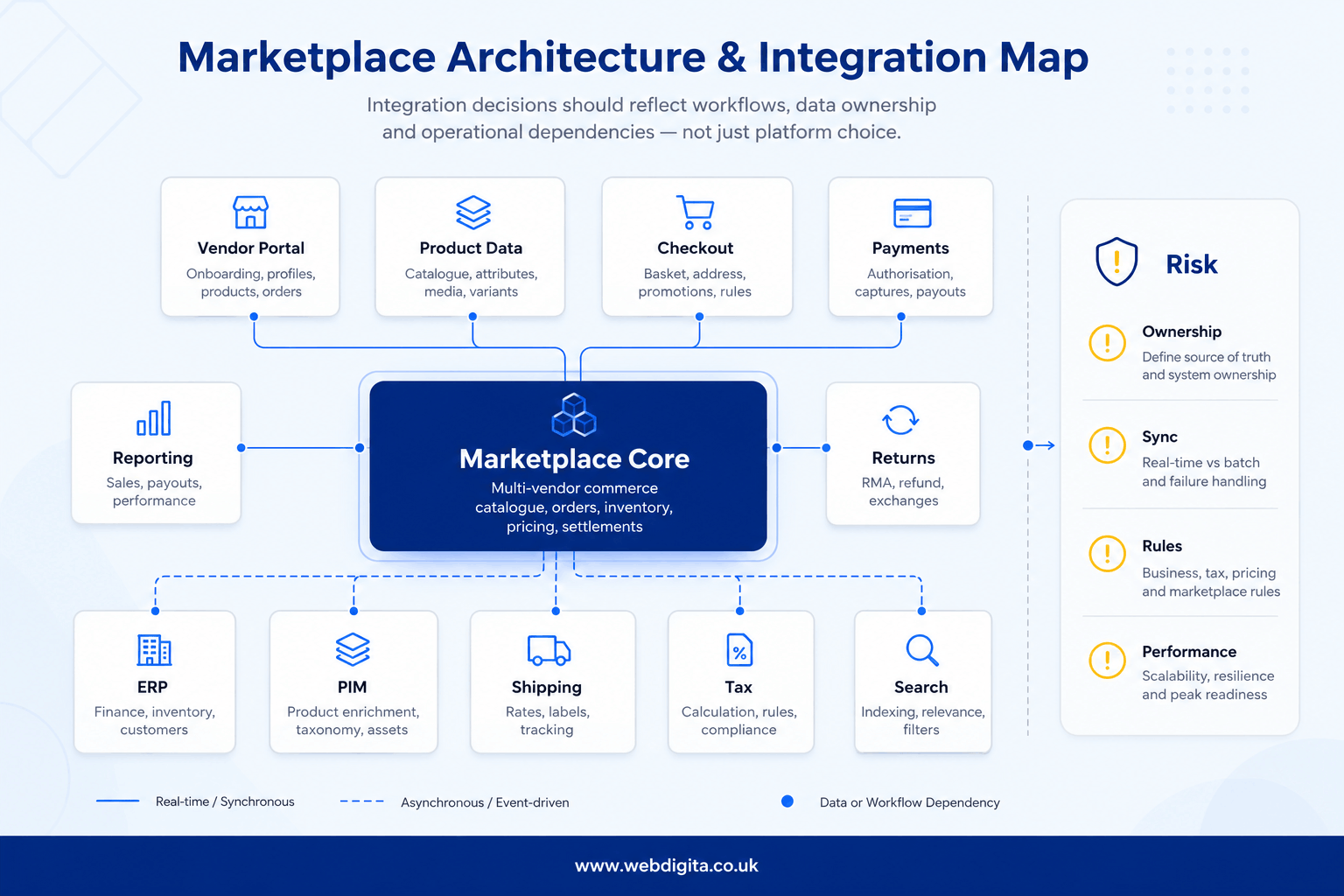
Ask what the recommendation is based on. You should get clear answers on ERP integration points, PIM feed handling, payment splits, shipping logic, tax services, search behaviour and vendor-specific catalogue rules. If any of those are treated as add-ons to figure out later, scope is already slipping.
Checkout and security need answers early: in a multi-vendor marketplace, cart rules, vendor combinations and payment flow logic get complicated fast. You need to know what is handled natively by the platform, what requires custom development and what creates performance risk under load. Any serious supplier should be building to standards aligned with PCI Security Standards Council guidance from day one, not as an afterthought.
A common failure pattern: the storefront brief looks simple, so the team assumes ERP stock sync can be handled later. Then vendor stock ownership, fulfilment rules and checkout logic do not align. The code is not the hard part at that point. Untangling the logic is. And it costs more than getting it right in discovery.
If you are evaluating platform fit more closely, read how the platform selection process should actually run rather than accepting a stack recommendation at face value.
A process map without gates is not a process – it is a timeline with good intentions
Here is what I look for when reviewing a supplier’s process documentation: phases, inputs, outputs and decision gates. If those four things are not explicit, what you are reading is a delivery schedule dressed up as a methodology.
Gates matter. Discovery should not end until scope, owners, risks and a decision log are agreed and signed. Testing should not close until defects are understood, performance evidence is documented and operational readiness is confirmed. “We keep moving” between phases is not agility. It is risk transfer – onto you.
The table below shows what each phase should produce, and roughly how long to expect:

Not sure if your marketplace brief is clear enough to build from?
We run structured discovery workshops that settle business model, workflows, integration dependencies and B2B rules before architecture or platform decisions are locked. You get a decision log, risk map and agreed scope, not a quote with hope attached.
Used by ecommerce teams comparing suppliers or fixing weak briefs before build starts.
Marketplace development process flow
| Phase | Key inputs | Main outputs | Rough duration band |
|---|---|---|---|
| Discovery | Business model, journeys, B2B eCommerce rules, data needs | Agreed scope, owners, risks, decision log | Short to medium |
| Solution design | Discovery outputs, platform options, system constraints | Architecture, ERP integration plan, acceptance criteria | Medium |
| Build | Approved designs, backlog, technical specs | Working staged releases, configured integrations | Medium to longer |
| Testing | Working features, test cases, vendor scenarios | Defect resolution, performance evidence, go-live readiness | Medium |
| Launch readiness | Legal sign-off, content, support paths, monitoring | Release plan, rollback plan, ownership handover | Short |
| Post-launch | Live data, support model, backlog priorities | Stabilisation, onboarding support, maintenance plan | Ongoing |
If the brief is still fuzzy heading into supplier conversations, a project discovery workshop is the fastest way to surface the assumptions that will otherwise surface as build costs.
Build and testing should prove the risky parts early, not save them for the end
Long silent build periods are a red flag on marketplace work. In my experience, a near-final reveal after weeks of closed development almost always means the risky journeys were deferred – and by the time they surface, there is no budget left to fix them properly.
I want to see regular working releases, with the hardest journeys shown first. Vendor dashboard actions, product approval rules, checkout behaviour, payment edge cases, security controls and ERP or PIM sync logic should all appear early in staging. If scalability matters – and on any marketplace with real catalogue scale it does – load testing should be planned around checkout, search, concurrent activity and catalogue size from the start, not scheduled into the final week as a confidence exercise.
Legal review, content population and vendor testing also need to sit inside the delivery plan. Every time I see these treated as client-side side tasks, they end up on the critical path at the worst moment.
| Rigorous approach | Late-stage habit | What it usually causes |
|---|---|---|
| Staged releases with buyer and seller testing | Big reveal near the end | Late rework and weak acceptance |
| Integration behaviour tested with realistic data | Mocked or assumed system behaviour | Sync failures at launch |
| Performance and load gates planned early | Speed checked after build | Checkout friction and unstable launch |
| Legal, content and vendor readiness tracked in plan | Operational tasks left to the client late | Go-live delay despite finished code |
Delivery is not finished at launch: handover, ownership and vendor onboarding support matter
A marketplace can go live and still fail commercially. If sellers cannot onboard cleanly, if admin teams do not understand what they own, or if support boundaries are undefined after go-live, the launch is half done at best.
This is also where polished proposals often get vague. I have seen suppliers produce thorough-looking documentation right up to the final sprint, then become evasive when asked to commit specifics around handover. That evasiveness is information.
Push for handover detail before the final sprint: Admin documentation, release responsibility, backlog handling, issue triage, monitoring, warranty boundaries and post-go-live ownership all need to be explicit. Not summarised. Explicit.
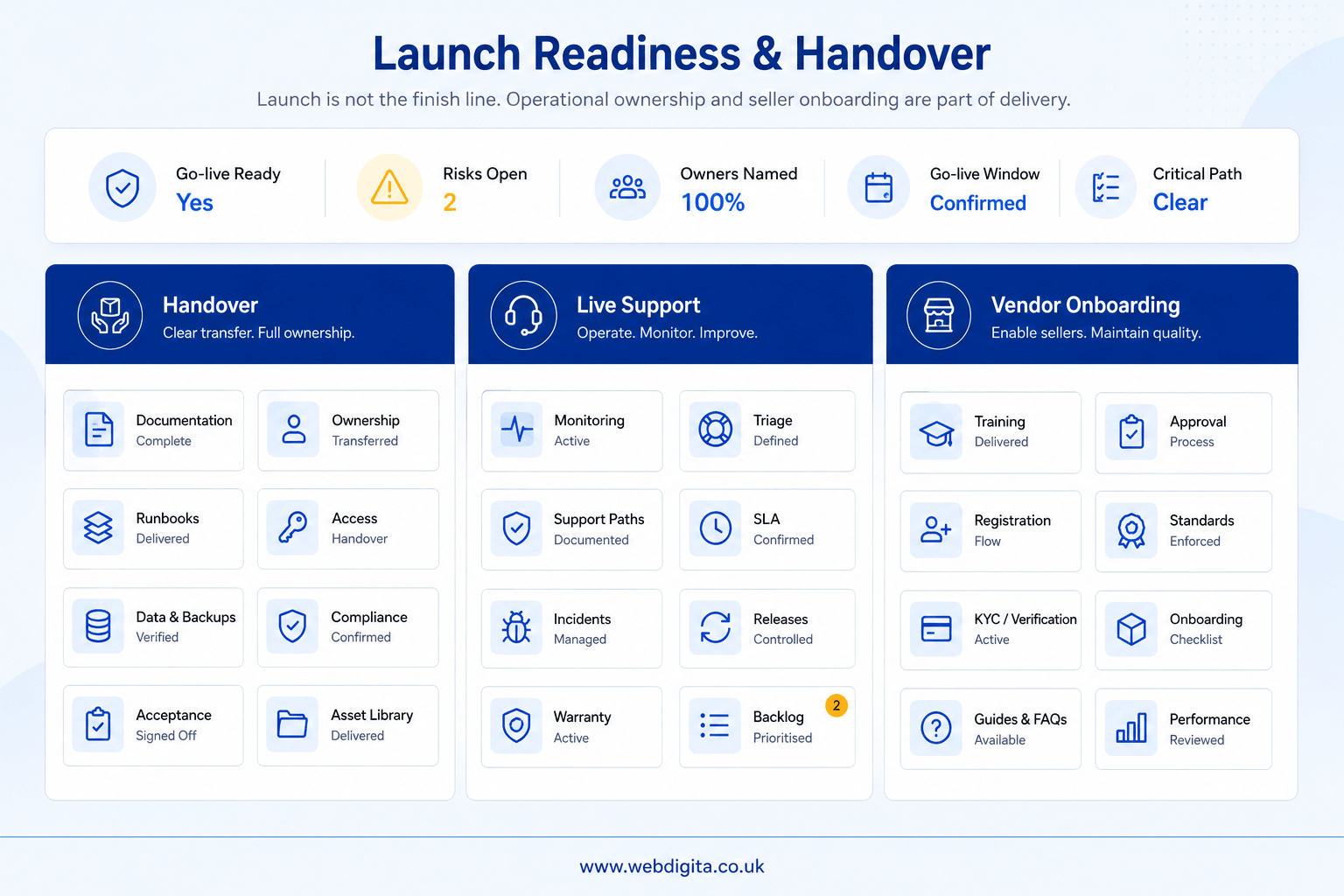
Vendor onboarding is part of the build: How vendors are invited, trained, approved and supported affects whether the marketplace actually works at scale. A technically sound platform with poor seller adoption is still a failed project. If ongoing fixes and releases are expected post-launch, the support model needs to be clear now – whether that sits internally or with a specialist in eCommerce maintenance.
- Who owns live issue triage after launch?
- What documentation will your team actually receive?
- How are vendor onboarding and approval supported?
- What sits inside warranty, and what becomes backlog?
- How are releases, fixes and monitoring handled after go-live?
Vague answers to those questions now will be expensive answers later. Before supplier conversations turn into budget commitments, read what actually drives the cost of eCommerce marketplace development in the UK.
Questions buyers ask before committing to marketplace development
Common concerns about process, ownership, integration and post-launch support
1. What should discovery actually settle before the build phase starts?
Discovery should settle business model logic, fulfilment ownership, fee structures, buyer and seller journeys, B2B rules, product data structure, approval workflows, integration dependencies and named client-side owners for legal, operations and content. If those decisions are left open, the build phase becomes guesswork and rework becomes expensive.
2. How do I know if the proposed platform actually fits marketplace requirements?
Ask what the recommendation is based on. You should expect clear answers on ERP integration, PIM feeds, payment splits, shipping logic, tax services, search and vendor-specific catalogue rules. If those are treated as add-ons for later or dismissed as simple, the architecture has not been properly tested against your workflow.
3. What does a rigorous testing phase look like for a marketplace build?
Testing should include staged releases with vendor dashboard actions, product approval rules, checkout behaviour, payment edge cases, security controls and ERP or PIM sync logic tested early in staging. Performance and load testing should be planned around catalogue size, search, checkout and concurrent activity, not left to the final week before launch.
4. Why does vendor onboarding matter as part of the development process?
A marketplace can go live and still fail commercially if sellers cannot onboard cleanly, if approval workflows are unclear, or if admin teams do not understand ownership. Vendor onboarding support, training and approval processes should be part of the delivery plan, not treated as a post-launch operational task.
5. What should handover include after a marketplace goes live?
Handover should include admin documentation, release responsibility, backlog handling, issue triage ownership, monitoring setup, warranty boundaries and clarity on who owns what after go-live. If those details are vague before launch, support costs and operational friction increase quickly.
6. How long does a typical marketplace development process take?
Discovery typically takes a few weeks to a couple of months depending on complexity. Solution design and build phases can range from a few months to longer depending on integration depth, vendor workflows and B2B requirements. Testing, launch readiness and post-launch stabilisation add further time. Suppliers who compress timelines without showing the decision gates are usually hiding risk.
7. What are the most common causes of marketplace project delays?
Delays usually come from weak discovery that leaves business logic unclear, missing client-side owners for legal or operations sign-off, integration assumptions that fail during testing, and operational readiness tasks such as content population or vendor onboarding left too late. Code is rarely the bottleneck.
8. Should I expect regular working releases during the build phase?
Yes. Long silent build periods are a bad sign on marketplace work. You should expect regular staged releases with the risky journeys shown first, including vendor dashboards, checkout logic, payment edge cases and integration behaviour tested with realistic data early in staging.
Conclusion
The suppliers who talk most confidently about timelines are often the ones who skip the hard scoping questions. A rigorous marketplace development process forces those decisions early, tests the risky parts first, and hands over a platform with clear ownership and working vendor support. If a supplier cannot show that path in detail, you are looking at optimism rather than delivery capability.
Before committing to scope or budget, make sure discovery is structured to surface ambiguity rather than hide it. The cost of fixing weak assumptions after build starts is always higher than the cost of settling them properly at the beginning. If the process feels vague now, it will feel expensive later.
Ready to move from brief to build with a marketplace process that proves the risky parts early?
WEBDIGITA delivers multi-vendor marketplace builds with staged releases, integration testing, performance gates and clear handover. We work with ecommerce teams who need evidence of delivery capability, not feature lists and cheerful timelines.
Review our eCommerce development approachPrefer to talk first?