Key Takeaways
Platform selection should start with discovery, not demos. The first job is mapping catalogue complexity, order flows, fulfilment rules, team capability, and delivery constraints before any platform names come up. If a supplier jumps straight to recommendations, they are skipping the work that prevents expensive mistakes later.
Hard constraints must be separated from preferences. If a platform cannot handle your pricing logic, ERP dependency, or account structure cleanly, a nicer CMS editor or bigger app marketplace does not rescue the decision. Score non-negotiable requirements separately so the shortlist reflects delivery reality, not marketing labels.
Handoff is part of selection, not admin at the end. A proper process should leave you with a preferred platform rationale, known trade-offs, scoped assumptions, an integration map, a risk log, implementation priorities, and clear ownership across eCommerce, IT, operations, finance, and marketing before delivery begins.
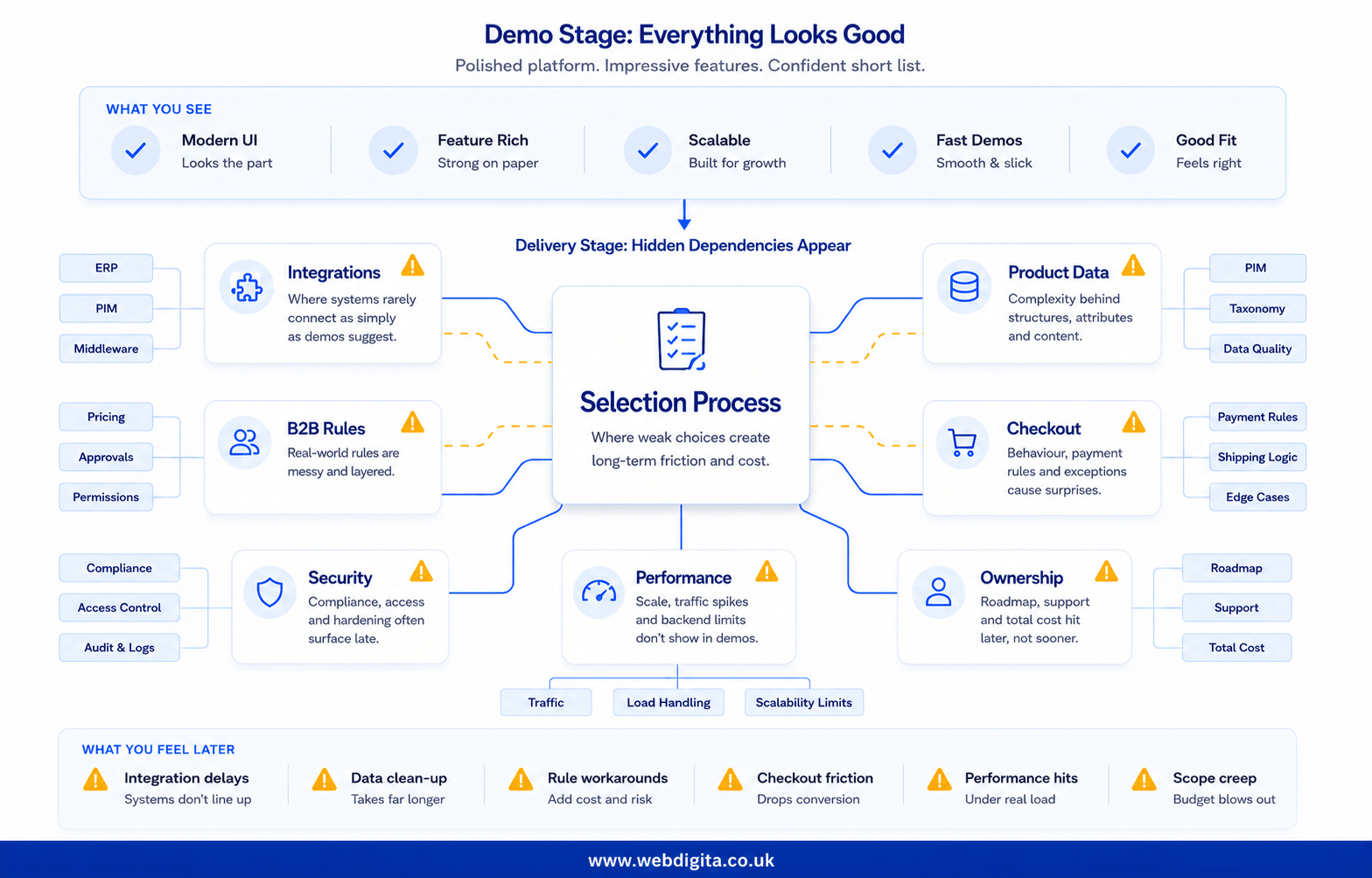
Most eCommerce platform selection projects go wrong not because of tech team failed but because the process was skipped. A team watches polished demos, compares feature grids, and picks the platform that looked best on the day. The real constraints – ERP integration, product data complexity, B2B pricing rules, checkout behaviour under load – surface later in delivery. By then, the shortlist was built on the wrong evidence, and the build is already paying for it.
Short Answer: A sound eCommerce platform selection process runs from structured discovery through requirements shaping, scored evaluation, vendor review, a formal decision gate, implementation planning, and a delivery-ready handoff – with defined inputs, outputs, and stakeholder involvement at each stage. Skipping any phase does not save time. It moves the cost into delivery, where it is significantly more expensive to fix.
If you are trying to avoid a weak brief, wasted budget, or a shortlist built on demo theatre, this is the process to look for. It is for eCommerce leads, IT, operations, finance, marketing, and commercial buyers who need a platform decision they can actually deliver.
What a real platform selection process needs to answer before any shortlist exists
The first job is not comparing Shopify, WooCommerce, Magento, or a headless commerce route. It is working out what your business needs to run, support, and scale. If platform names come up before anyone has mapped catalogue complexity, order flows, fulfilment rules, team capability, and delivery constraints, the process is already drifting.
Good suppliers slow this down on purpose. Weak ones jump to recommendations. A proper process surfaces architecture decisions early – especially when headless commerce is being treated like the grown-up option by default. It is not. You need to know whether the extra flexibility is worth the added operational overhead, dependency risk, and maintainability burden for your team or your eCommerce development agency.
Most common type of failure is when a retailers requirements that looks straightforward until discovery uncovers bundle logic, customer-specific pricing, and ERP-owned stock rules. On a demo call, several platforms look fine. In delivery, that is where the shortlist falls apart.
Before any serious comparison, discovery should produce:
- A clear business model and channel picture
- A product data model covering variants, bundles, pricing rules, and B2B structures
- An integration map for ERP integration, PIM, payments, shipping, tax, and other systems
- Delivery constraints around budget, timeline, ownership, and internal capability
- An early architecture direction, including whether headless commerce is justified by the operational reality
If a supplier skips those outputs and moves straight to platform advice, treat that as a warning sign rather than efficiency.
How discovery should turn into a delivery-ready evaluation framework
Raw requirements are not enough. You need a way to turn them into a scoring model, otherwise the loudest stakeholder or the best demo wins. That is how bias gets dressed up as strategy, and it happens more often than most buyers realise.
A rigorous supplier will score against delivery reality, not marketing labels. Group requirements into architecture, integrations, checkout optimisation and security, B2B eCommerce capability, content and merchandising, reporting, and operational overhead. That keeps the conversation tied to testable fit. If those discovery outputs are still vague, this is usually where a project discovery workshop support becomes useful.
Separate hard constraints from preferences
Not every requirement belongs in the same scoring bucket. Split non-negotiable constraints from weighted preferences. If a platform cannot handle your pricing logic, ERP integration dependency, or account structure cleanly, a nicer CMS editor or a bigger app marketplace does not rescue the decision.
This discipline also matters in vendor review. A serious supplier will show why a platform passed or failed each hard constraint, then score the softer areas separately. A weaker one will blur everything together so the recommendation looks cleaner than it is.
| Category | What you need to test | What the output should be |
|---|---|---|
| Architecture | Monolithic vs headless commerce fit, hosting model, maintainability, team capability | Recommended direction with trade-offs documented |
| ERP integration | Sync direction, data ownership, failure handling, exception rules, middleware decisions | Dependency map and risk notes |
| Checkout optimisation and security | Payment flow, fraud controls, compliance needs, performance under load | Known constraints and validation points |
| B2B eCommerce capability | Account hierarchies, pricing logic, approvals, quoting, repeat ordering | Fit assessment with edge cases called out |
| Scalability | Traffic assumptions, catalogue growth, order volume, support model | Practical growth limits and testing approach |
Ask to see the scoring logic behind the recommendation. If the framework cannot show why one platform is stronger under your actual constraints, it is not rigorous enough.

Not sure if your platform brief covers the right ground?
We run structured discovery sessions that surface integration constraints, product data complexity, and B2B requirements before any shortlist gets built. That way, the platform decision fits your delivery reality rather than demo theatre.
Quick diagnostic call to see where the gaps usually sit.
The end-to-end process flow from discovery to handoff
A real process has stages, review points, and outputs. It does not stop when someone says “we prefer Platform X”. You need to know what goes in, what comes out, who needs to be involved, and roughly how long each phase should take.
Low internal involvement is usually a bad sign. A proper selection process needs recurring review sessions with eCommerce, IT, operations, finance, and marketing – not constant meetings, but enough to test assumptions before they become delivery problems. If finance only appears at contract stage, or operations only sees the plan after launch, you are storing up rework that will arrive at the worst possible moment.
Process flow: phases, inputs, outputs, and likely duration
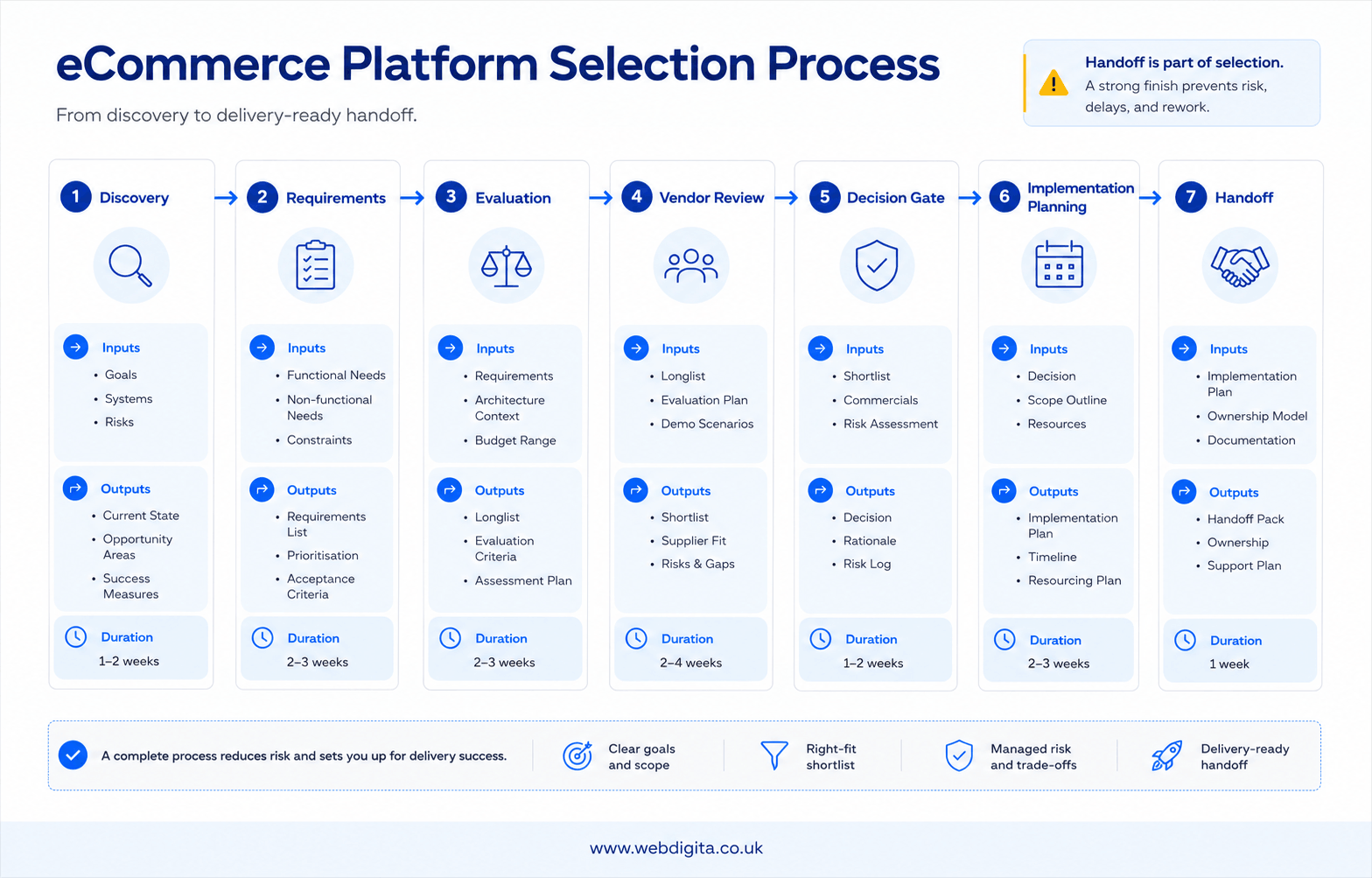
| Phase | What goes in | What comes out | Likely duration |
|---|---|---|---|
| Discovery | Business goals, pain points, systems landscape, stakeholder input | Requirements baseline, risks, architecture questions | Short to medium |
| Requirements shaping | Discovery findings, product and operational detail | Prioritised requirements and decision criteria | Short |
| Platform evaluation | Criteria, vendor responses, technical review | Scored shortlist with trade-offs | Medium |
| Vendor review | Demo scripts, solution approach, delivery assumptions | Supplier fit view and implementation confidence | Short to medium |
| Decision gate | Shortlist evidence, stakeholder review, commercial checks | Preferred platform and approved rationale | Short |
| Implementation planning | Chosen platform, scope assumptions, integration detail | Handoff pack, risk log, delivery priorities | Medium |
| Handoff | Approved plan and ownership model | Delivery-ready brief for build and support teams | Short |
In practice, that means a steady meeting rhythm rather than one big workshop and a final reveal. IT needs time for architecture and ERP integration review. Finance needs visibility on licence, implementation, and support cost assumptions. Marketing and operations need to test whether the chosen setup creates extra manual work later – because it often does, and no one mentioned it during selection.
If you want a deeper view of what discovery should create before build starts, see what a proper eCommerce discovery workshop should produce before build starts.
Where weak selection processes break under technical reality
ERP integration risk is where most weak selection work starts to crack – and in my experience managing builds across Shopify, Magento, and WooCommerce, it is almost always the last thing a supplier wants to discuss in detail before they have the contract. You need to check data ownership, sync direction, failure handling, and exception rules early. Discovering that your ERP integration assumptions were untested after platform sign-off is an expensive lesson.
B2B eCommerce is another consistent trap. Ask for specific handling of account structures, approval flows, customer-specific pricing, quote logic, and repeat ordering. If the response is a vague “yes, the platform supports B2B”, assume the edge cases have not been tested. B2B eCommerce capability that works in demos and B2B eCommerce capability that works under your actual pricing and account rules are two different things. I have seen that gap widen considerably once build starts.
Checkout optimisation and performance also get oversimplified. Brand name is not the same as fit. You need to know what can be customised safely, what depends on apps or third-party extensions, and how performance behaves under your real catalogue and traffic conditions – not the vendor’s benchmark environment. Architecture decides what can be supported later. That decision, made early without proper testing, creates constraints that persist through the entire lifespan of the platform.
A familiar pattern: finance chooses the cheapest proposal, then discovers ERP integration ownership was excluded from scope and middleware decisions were left open. Operations inherits manual stock fixes because the sync rules were never pinned down during selection. Those are not launch issues – they are selection failures that arrived late.
Watch for these red flags:
- The supplier recommends a platform before discovery is complete
- ERP integration and third-party dependencies are treated as a later technical detail
- B2B eCommerce capability is discussed in broad labels, not workflows and edge cases
- Checkout optimisation and security are assumed rather than tested against your actual rules
- Scalability is described with generic claims and no growth assumptions tied to your catalogue
If ERP integration risk is one of your biggest unknowns, read about planning eCommerce integrations before development starts.
What good handoff actually requires – and where it usually goes wrong
Handoff is not admin at the end of selection. It is the moment where every assumption left vague during the process becomes someone else’s problem in delivery. If the handoff pack is thin, the build inherits ambiguity, and ambiguity in a build becomes scope drift, missed integration dependencies, and post-launch firefighting.
A delivery-ready handoff should contain: preferred platform rationale with documented trade-offs, scoped assumptions, a tested ERP integration map, product data and PIM notes, a risk log with open items assigned, implementation priorities, and clear ownership across eCommerce, IT, operations, finance, and marketing. If any of those are missing, the handoff is not ready.
Contract boundaries need to get specific here. Who owns migration assumptions? Who owns middleware choices? Who owns performance testing, security obligations, and post-launch support? These questions sound procedural but they define who absorbs cost when something goes wrong – and something always goes wrong. Vague handoff is how suppliers limit their exposure while you inherit the uncertainty.
Post-launch support is where the same pattern repeats. Ask what happens after go-live, where warranty coverage ends, and what the eCommerce maintenance plan looks like if the store needs active support rather than passive monitoring. The platform choice may be entirely sound. The problem is usually that no one defined who deals with what when it breaks.
Before handoff sign-off, get answers to these:
- Which assumptions are still untested, and who owns closing them before build starts?
- Which ERP integration points carry the highest delivery risk?
- What product data or B2B eCommerce rules could still change platform fit?
- What is explicitly included in the handoff pack for the build team?
- How will post-launch support, maintenance, and issue ownership work in practice?
If you want a sensible next step, start with a roadmap conversation rather than a rushed platform vote. The right process narrows the decision, documents the trade-offs, and makes delivery significantly less painful.
Related reading: the full eCommerce development process after platform selection.
Questions buyers ask before choosing an eCommerce platform
Common questions about platform selection, discovery, and what a proper evaluation process should cover before you commit to a vendor.
1. What should happen before you start comparing eCommerce platforms?
Discovery should happen first. You need to map your business model, product data structure, integration dependencies, order flows, fulfilment rules, team capability, and delivery constraints before any platform names come up. If a supplier jumps straight to platform recommendations without that work, they are guessing. A proper process surfaces architecture decisions early, especially whether headless commerce is justified or just adds unnecessary complexity for your team.
2. How do you avoid choosing a platform based on a polished demo?
Use a scoring framework that separates hard constraints from weighted preferences. Test platforms against your actual pricing logic, ERP sync requirements, B2B workflows, and checkout rules, not generic feature grids. Ask suppliers to show why a platform passed or failed each non-negotiable constraint, then score the softer areas separately. If the scoring logic cannot explain the recommendation under your real delivery conditions, the process is not rigorous enough.
3. What are the most common platform selection mistakes?
The biggest mistake is choosing a platform before discovery is complete. Others include treating ERP and third-party integrations as a later technical detail, discussing B2B capability in broad labels rather than testing workflows and edge cases, assuming checkout and security fit without validation, and leaving support and maintenance as an afterthought. Most of these failures happen because the process was too fast or too disconnected from the people who will run the store.
4. How long should a proper platform selection process take?
It depends on complexity, but expect discovery and requirements shaping to take a few weeks, platform evaluation and vendor review another few weeks, and implementation planning before handoff to add more time. Rushing this to hit a launch date usually creates more delay later when integration assumptions break or B2B edge cases surface during build. A steady meeting rhythm with eCommerce, IT, operations, finance, and marketing is more reliable than one big workshop and a final reveal.
5. Should finance be involved in platform selection from the start?
Yes. Finance needs visibility on licence costs, implementation assumptions, integration ownership, middleware decisions, and post-launch support models before the platform is chosen. If finance only appears at contract stage, you risk discovering that integration work was excluded, support boundaries are vague, or the total cost of ownership is higher than the proposal suggested. Involve finance early so commercial assumptions are tested before they become delivery problems.
6. What should handoff include at the end of platform selection?
Handoff should include a preferred platform rationale, known trade-offs, scoped assumptions, an integration map, product data notes, a risk log, implementation priorities, and clear ownership across eCommerce, IT, operations, finance, and marketing. You should also know who owns migration assumptions, middleware choices, performance testing, security obligations, and post-launch support. If handoff is vague, the build team inherits ambiguity and scope drift.
7. How do you know if a platform can handle B2B requirements?
Ask for specific handling of account structures, approval flows, customer-specific pricing, quote logic, and repeat ordering. Test edge cases such as tiered pricing, multi-level approvals, and account hierarchies. If the supplier reduces B2B capability to a vague statement that the platform supports it, assume the workflows have not been tested. B2B is where weak selection work usually breaks under delivery pressure.
8. What integration risks should you check before choosing a platform?
Check data ownership, sync direction, failure handling, and exception rules for ERP, PIM, payment gateways, shipping tools, tax engines, and other systems. Ask who owns middleware decisions, what happens when sync fails, and how product data conflicts are resolved. Integration risk is where weak selection processes usually crack, especially when dependencies were treated as a later technical detail rather than a core selection constraint.
Conclusion
Platform selection is not about picking the best technology. It is about choosing the platform that fits your business model, integrations, team capability, and delivery constraints without storing up problems for later. Most failures happen because the process was too fast, too demo-led, or too disconnected from the people who will actually run the store.
- Start with discovery before shortlisting platforms, so you understand what your business actually needs to run and scale.
- Score platforms against hard constraints first, then weighted preferences, so the recommendation reflects delivery reality rather than feature theatre.
- Involve eCommerce, IT, operations, finance, and marketing throughout the process, not just at contract stage.
- Treat handoff as part of selection, so the build team inherits a delivery-ready brief rather than vague assumptions and scope drift.
- Ask what happens after launch, where warranty ends, and how post-launch support and maintenance will work before you sign.
If you want a sensible next step, start with a roadmap conversation rather than a rushed platform vote. The right process should make the decision narrower, clearer, and safer before delivery begins.
Ready to run a platform selection process that actually holds up in delivery?
WEBDIGITA runs end-to-end eCommerce platform selection from discovery through to handoff, covering architecture decisions, integration mapping, B2B capability review, and delivery-ready planning. We work with eCommerce leads, IT, operations, and finance to build shortlists that survive technical reality.
See our eCommerce platform selection processOr start with