Key Takeaways
Revenue-led eCommerce SEO starts with the pages closest to buying intent, not the broadest keyword opportunities. Here's what separates commercial traction from ranking noise:
| Focus area | Why it matters for revenue |
|---|---|
| Category pages first | They capture scalable buying intent better than individual products and convert qualified demand more consistently when backed by stock depth and margin. |
| Technical fixes on money pages | Indexation issues, weak internal links, and faceted navigation problems suppress your most commercially important pages before keyword work can help. |
| Measurement tied to page type | Track qualified traffic by category, assisted revenue, and organic contribution to profitable ranges rather than rankings in isolation. |
| Alignment with merchandising | SEO that ignores stock levels, seasonality, and promotional focus creates visibility for pages the business cannot convert profitably. |
I have seen this exact failure more times than I care to count. The rankings go up. The impressions chart looks beautiful. The Head of eCommerce takes it to the board. And then someone asks: where is the revenue? Silence. Because the strategy was chasing visibility – not qualified demand, category page authority, margin alignment, or index control.
The short answer: A serious eCommerce SEO strategy should prioritise category pages capturing buying intent, technical control over what gets indexed, internal links channelling equity into commercial pages, and measurement tied to revenue – not rankings in isolation. Blog content, keyword volume, and broad expansion come later, if at all.
Why ranking-led eCommerce SEO stalls revenue
The red flag is predictable: lots of SEO activity, weak commercial movement. More impressions, more non-brand clicks, maybe more top-10 terms – but the traffic lands on pages that do not convert, or does not match how your customers actually buy.
Search volume is not demand quality. A broad query can look attractive in a report and still send low-intent visitors who browse, compare, and leave. Ask which queries map to profitable categories, repeat purchase behaviour, or higher average order value. If the answer is vague, the strategy is already drifting.
It gets worse when the site itself is working against you. If your templates, filters, or internal links need rework, rankings alone will not save it. That is why SEO work has to connect platform decisions to crawl control, page depth, and commercial page structure – not just keyword targeting. Do not assume the problem is keyword coverage if the real issue is page type and site architecture. The right place to start that conversation is with eCommerce SEO services built around commercial outcomes, not activity metrics.
What actually drives organic revenue in eCommerce
Revenue comes from a smaller set of assets than most teams expect. Category pages do the heavy lifting because they sit closest to commercial intent while still capturing broader demand than a single SKU can.
Category pages first. If you are choosing where to invest, start with categories where search demand, margin, stock depth, and conversion potential align. Product pages matter – but mainly as support for long-tail capture, brand demand, and specific SKU intent. Check whether your products are being asked to rank for terms a stronger category page should own instead.
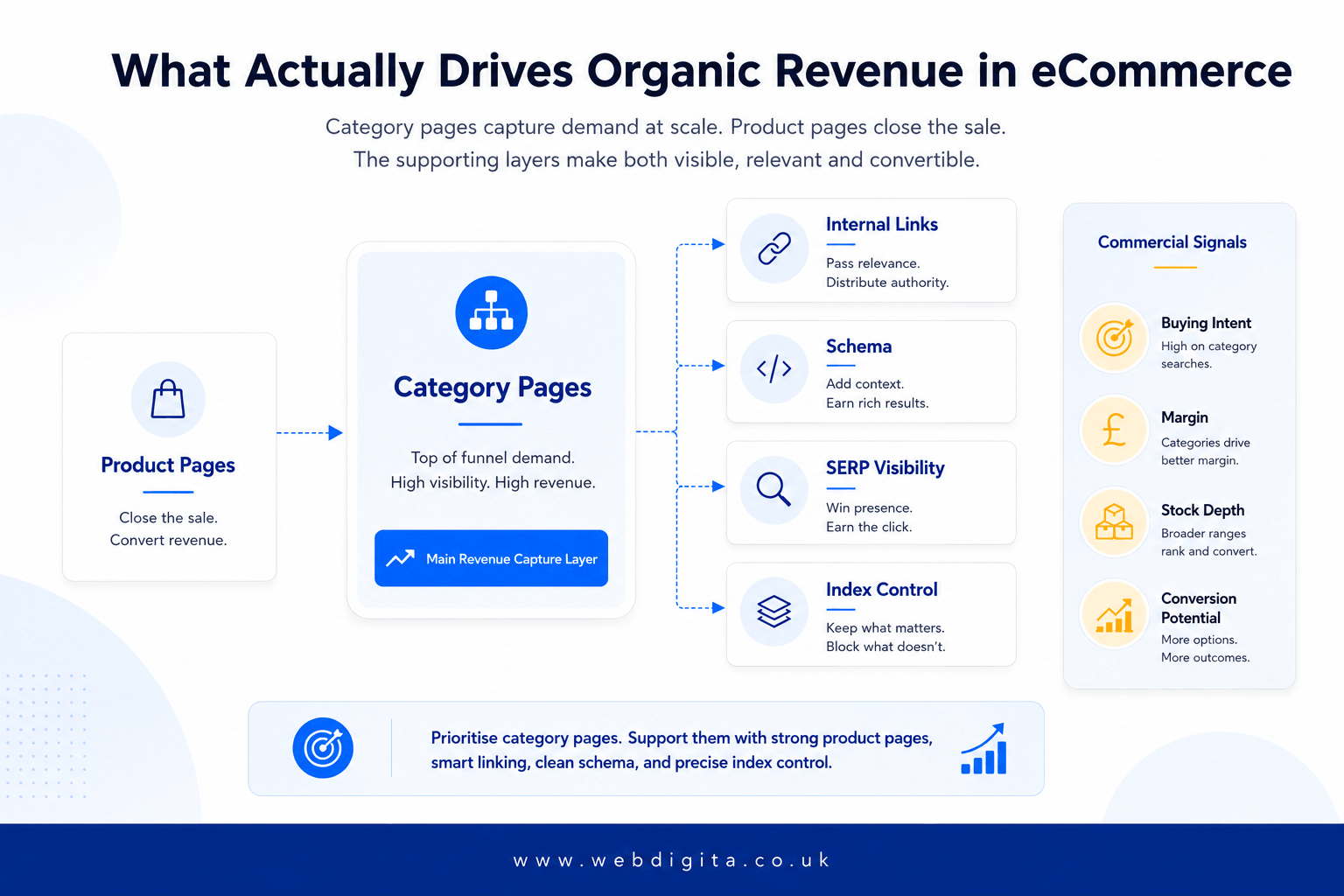
Here is the pattern I have seen consistently across years of eCommerce projects: revenue growth came from better category targeting, cleaner site structure, and tighter canonical tag and indexation control – not from chasing more keywords. The teams that moved organic revenue doubled down on category page authority, fixed crawl budget waste from faceted navigation, and routed internal link equity into their top commercial pages. The teams that spread effort across more keywords and more content saw impressions improve and revenue stay flat. Every time.
Schema markup, content depth, and SERP features are not separate wins. They support the pages that can actually make money. If you are evaluating eCommerce SEO support, push on whether the plan is built around commercial page types or just broader keyword expansion. That single question tells you whether the strategy is serious.
| Work area | Revenue role | What to prioritise | What to avoid |
|---|---|---|---|
| Category pages | Primary demand capture | High-intent terms, template depth, internal links, stock-backed ranges | Thin copy and generic optimisation spread across every category |
| Product pages | Long-tail and SKU intent capture | Unique value, product schema, variant clarity, strong parent-child linking | Expecting every product to rank for broad commercial terms |
| Technical fixes | Protects visibility of money pages | Indexation, canonical tags, crawl paths, faceted navigation, rendering | Fixing low-impact issues while key commercial pages stay suppressed |
| Content support | Builds relevance and assists conversion paths | Buying guides, comparison support, FAQs tied to categories | Blog output with no route into commercial pages |
How to prioritise categories, products, and technical fixes when resources are limited
Most teams do not have unlimited development time, content capacity, or platform flexibility. You need a triage model, not a wish list. Prioritise work that unlocks commercially important pages fastest and with the least rework.
A common mistake is treating technical SEO as a separate lane. In project work, this shows up when faceted navigation creates thousands of weak URLs, canonical tags are inconsistent, and crawl budget is burned on pages that should never compete for indexation. Treat that as a revenue problem, not a hygiene task.
- Start with category leverage: which categories have real demand, healthy margin, and enough product depth to convert?
- Check suppression: are those pages being held back by indexation issues, duplicate URLs, weak internal links, or poor templates?
- Weigh implementation reality: can your platform or dev team fix the blocker quickly, or will it sit in backlog for months?
- Protect focus: do not spread effort across every product line if two or three categories could move revenue first.
You also need clear ownership. Ask who controls templates, who signs off merchandising changes, and who can actually implement technical fixes. If nobody owns that chain, the strategy will look smart on paper and stall in delivery.

Not sure which pages deserve SEO priority in your store?
We can help you map category demand, indexation blockers, and technical constraints before you commit budget to the wrong work. A short diagnostic call usually clarifies what should move first.
No pitch. Just a clearer view of where organic revenue could come from.
A revenue-led SEO strategy framework
You do not need a bigger SEO plan. You need one where every layer connects to a commercial outcome. Here is how I structure it.
WEBDIGITA Organic Revenue Framework
Use this before committing to any SEO workstream. Four questions. If your current plan cannot answer all four, the prioritisation is not ready.
| Layer | Revenue role | The question your plan must answer | Warning sign it cannot |
|---|---|---|---|
| Category pages | Capture scalable buying intent | Which specific category pages can win qualified demand and convert profitably at your current stock depth? | Plan targets high-volume terms with weak commercial fit or thin category range |
| Product pages | Capture SKU and long-tail demand | Which products deserve direct visibility versus structural support from a stronger parent category? | Product pages and category pages competing for the same terms, splitting equity |
| Technical control | Remove blockers on commercial visibility | What is suppressing indexation, crawl efficiency, or internal link equity on your money pages right now? | Audit noise drowning out the two or three issues that are actually hurting revenue |
| Measurement | Prove commercial contribution | Are you tracking qualified traffic, category visibility, and revenue contribution by page type – not aggregate organic sessions? | Reporting improved rankings with no page-type or revenue context attached |
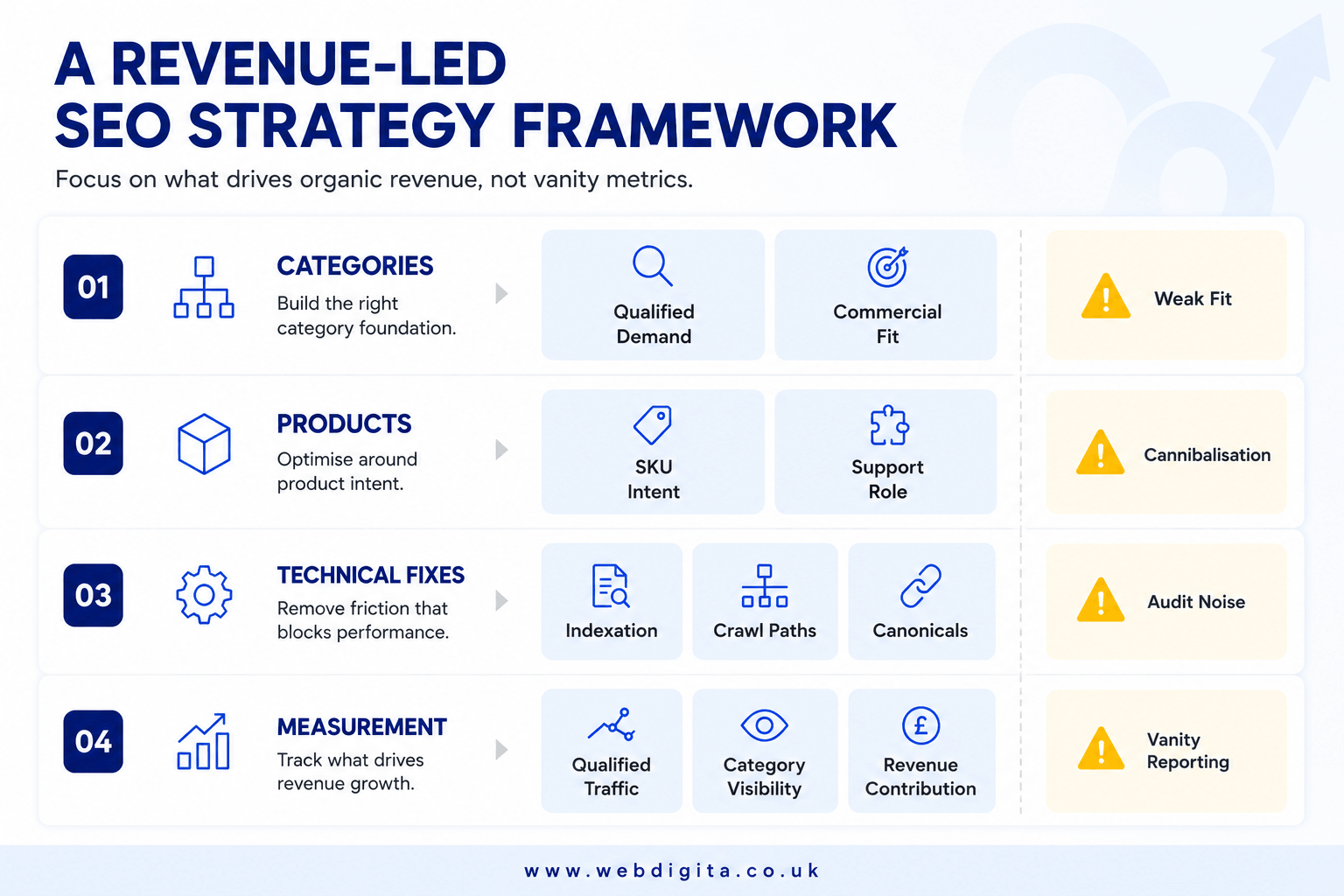
If the blockers span SEO, development, and merchandising, you need one joined-up owner view – not three disconnected workstreams reporting to different people.
SEO, merchandising, seasonality, and measurement – how they connect
SEO does not operate in a vacuum. Most strategies fail quietly here – not because the keyword work was wrong, but because the commercial context was ignored.
Pushing visibility into categories with weak stock, poor margin, or wrong seasonal timing does not create leverage. It creates noise. I have seen teams pour three months of SEO work into a category that merchandising had already decided to wind down. Nobody told the SEO agency. That is a coordination failure disguised as an SEO failure.
Seasonality changes priority. Plan category work before the demand spike, not during it. If you are optimising a winter gifting category in November, you have already lost the indexation window. The work needed to happen in August. Align SEO with merchandising decisions – range depth, promotional focus, discontinued lines – because Google cannot rank what your business is not ready to sell.
Measurement needs the same discipline. The metrics that matter are: qualified traffic by page type, category page visibility for commercially important terms, assisted revenue by channel, and organic contribution to your highest-margin ranges. Aggregate organic sessions is a vanity number. It tells you the channel is working. It does not tell you whether the right pages are winning.
If you need a calibrated expectation on timelines before committing budget, it is worth understanding what a realistic eCommerce SEO timeline looks like – because rushed judgement causes bad decisions as often as slow delivery does.
When you are comparing providers, ask specifically how they handle platform constraints, merchandising dependencies, and cross-team backlog. Vague answers mean they have not done it at scale. And if the problem is bigger than SEO alone – platform architecture, category structure, indexation strategy – a scoped discovery conversation will save you from a misdirected brief.
For a broader view of how organic fits into commercial growth, see what actually moves revenue in complex eCommerce buying journeys.
Questions teams ask before building an eCommerce SEO strategy
Common concerns about prioritisation, technical blockers, and aligning SEO with commercial outcomes.
1. Why do category pages usually matter more than product pages for eCommerce SEO?
Category pages sit closer to buying intent while capturing broader demand than individual SKUs can. They convert qualified traffic more consistently when backed by stock depth, margin, and strong internal linking. Product pages still matter for long-tail and specific SKU intent, but expecting every product to rank for broad commercial terms usually creates weak competition with your own categories.
2. What technical SEO issues block eCommerce revenue most often?
Indexation problems, inconsistent canonicals, faceted navigation creating thousands of weak URLs, and poor internal linking to commercial pages suppress visibility before keyword work can help. Crawl budget waste and rendering issues also hold back money pages. Treat these as revenue blockers, not just technical debt, because they stop your most important pages from competing.
3. How should eCommerce SEO align with merchandising and seasonality?
Plan category SEO work before demand spikes, not during them. Align visibility efforts with stock depth, margin decisions, promotional focus, and discontinued lines, because Google cannot rank what your business is not ready to sell properly. If SEO pushes traffic into weak ranges or poor seasonal timing, you create noise for the business rather than leverage.
4. What should eCommerce SEO measurement focus on instead of rankings?
Track qualified traffic by page type, category visibility for commercially important terms, assisted revenue, and organic contribution to profitable ranges. Rankings without page-type or revenue context tell you nothing about commercial performance. If your reporting cannot show which categories are capturing buying intent and converting profitably, the measurement model is broken.
5. Should eCommerce SEO prioritise content or technical fixes first?
Fix technical blockers on money pages first. If indexation, canonicals, or internal linking are suppressing your most commercially important categories, content work will not save it. Once those pages can compete properly, content depth, schema, and supporting guides become useful. Prioritise the work that unlocks revenue-generating pages fastest with the least rework.
6. How do you decide which eCommerce categories deserve SEO investment?
Look for categories where search demand, margin, stock depth, and conversion potential align. Check whether those pages are being suppressed by technical issues, weak templates, or poor internal links. Avoid spreading effort across every product line if two or three categories could move revenue first. Commercial fit matters more than keyword volume.
7. What is the biggest mistake eCommerce teams make with SEO strategy?
Chasing visibility without checking whether the traffic can convert profitably. High search volume does not mean high-quality demand. If the strategy is built around broad keywords rather than page value, margin, and qualified intent, you will lift impressions and traffic while revenue barely moves. Prioritise commercial page types over keyword expansion.
Conclusion
If your eCommerce SEO plan is built around keyword volume rather than page value, margin, and qualified demand, you are optimising for the wrong outcome. The work that moves revenue usually sits at the intersection of category targeting, technical control, and merchandising alignment, not in chasing more impressions across weaker page types.
Before adding more SEO budget or agency resource, check whether your current strategy can answer which categories deserve visibility, what is suppressing your money pages, and how organic contribution is being measured against commercial outcomes. If those answers are vague, fix the prioritisation model before scaling the work.
Need an eCommerce SEO strategy that aligns with your platform, merchandising, and revenue goals?
We build SEO plans around category leverage, indexation control, and commercial page types, not keyword volume. If your current approach is lifting traffic without moving revenue, we can help you reset the priorities.
See how we approach Ecommerce SEOOr if you prefer,