Key Takeaways
Platform familiarity matters less than delivery depth. The real budget sits in architecture, integrations, release workflows, and who can make technical changes without breaking the store.
- Shopify, Magento, and headless commerce create different delivery conditions, even when the SEO brief looks identical. Template control, developer handoff, and release process change effort more than platform choice.
- Category optimisation, faceted navigation, variant canonicals, schema ownership, and Core Web Vitals on mobile often cost more than expected because they depend on technical constraints, not just better headings.
- Vague scoping leads to wasted spend. Define platform version, theme control, developer availability, integration dependencies, and QA ownership before project start to tighten risk and effort.
- Red flags include quotes that ignore faceted navigation, variant handling, schema ownership, or release dependencies, and teams that separate SEO recommendations from development feasibility.
Most eCommerce SEO failures are architecture decisions made before the agency was hired. The platform structure was chosen without SEO ownership in mind. The theme was locked before redirect logic was mapped. The faceted navigation was configured without anyone defining which filtered URLs should index. By the time a brief lands, the structural constraints are already built in.
The short answer: When evaluating an eCommerce SEO partner’s technology stack experience, platform recognition is a starting point – not evidence of delivery capability. The real question is whether they can manage faceted navigation, product schema, canonical tags, Core Web Vitals, crawl budget, and internal linking architecture on your specific build. Those variables – not the platform logos on the proposal – determine what the work actually costs and what it delivers.
This guide is for technical leads and founders researching what to assess before shortlisting or approving a technical SEO budget. We will walk through the requirements that shape scope, the platform differences that change delivery, and the questions that reveal whether a provider has genuine implementation depth.
Platform experience is not the same as technical delivery depth
A team can name the platform and still miss the hard part. Shopify, Magento, and headless commerce can all support strong eCommerce SEO, but they create very different delivery conditions – and those conditions shape effort, risk, and cost far more than the strategy layer does.
What matters is how a recommendation becomes a shipped change. If a provider cannot explain template control, developer handoff, release process, integration dependencies, and technical ownership, what you are hearing is pitch depth rather than implementation depth.
A simple example: on Shopify, a category page change may depend on theme logic and app behaviour. On a headless build, the same change may depend on frontend routing, rendering decisions, and deployment rules. The SEO requirement can be identical. The delivery job is not.
Platform logos do not prove delivery capability. Ask how the same task gets shipped on your stack specifically – and pay attention to how much detail comes back.
In our experience, budget drift almost always starts here. The brief is signed off on a strategy. The cost is discovered in the implementation conditions.
Which technical requirements usually change the budget
The same SEO brief can be inexpensive to write and expensive to implement. The gap sits in the technical conditions underneath the strategy, where development time, QA overhead, and release effort quietly accumulate.
Site architecture and crawl budget: Internal linking structure, crawl budget allocation, and category page architecture all affect how efficiently search engines can discover and index your highest-value pages. Category optimisation typically costs more than it appears because it involves template control, copy placement, internal link hierarchies, and merchandising rules – not just heading rewrites. A large catalogue can quietly drain crawl budget on parameter pages, stale product URLs, and low-value variant permutations if nobody owns the architecture decisions. We find this is one of the most consistently under-scoped areas in early eCommerce SEO briefs.
Faceted navigation and variants: Filters can generate large volumes of low-value URLs. Product variants can create duplicate or competing pages if canonical tags are handled without a clear ownership model. You need to know who defines indexable filter logic, who sets canonical rules, and how both will be tested before any release goes live. We have worked with teams who inherited faceted navigation configurations that had been generating crawl budget waste for over a year without anyone identifying the source.
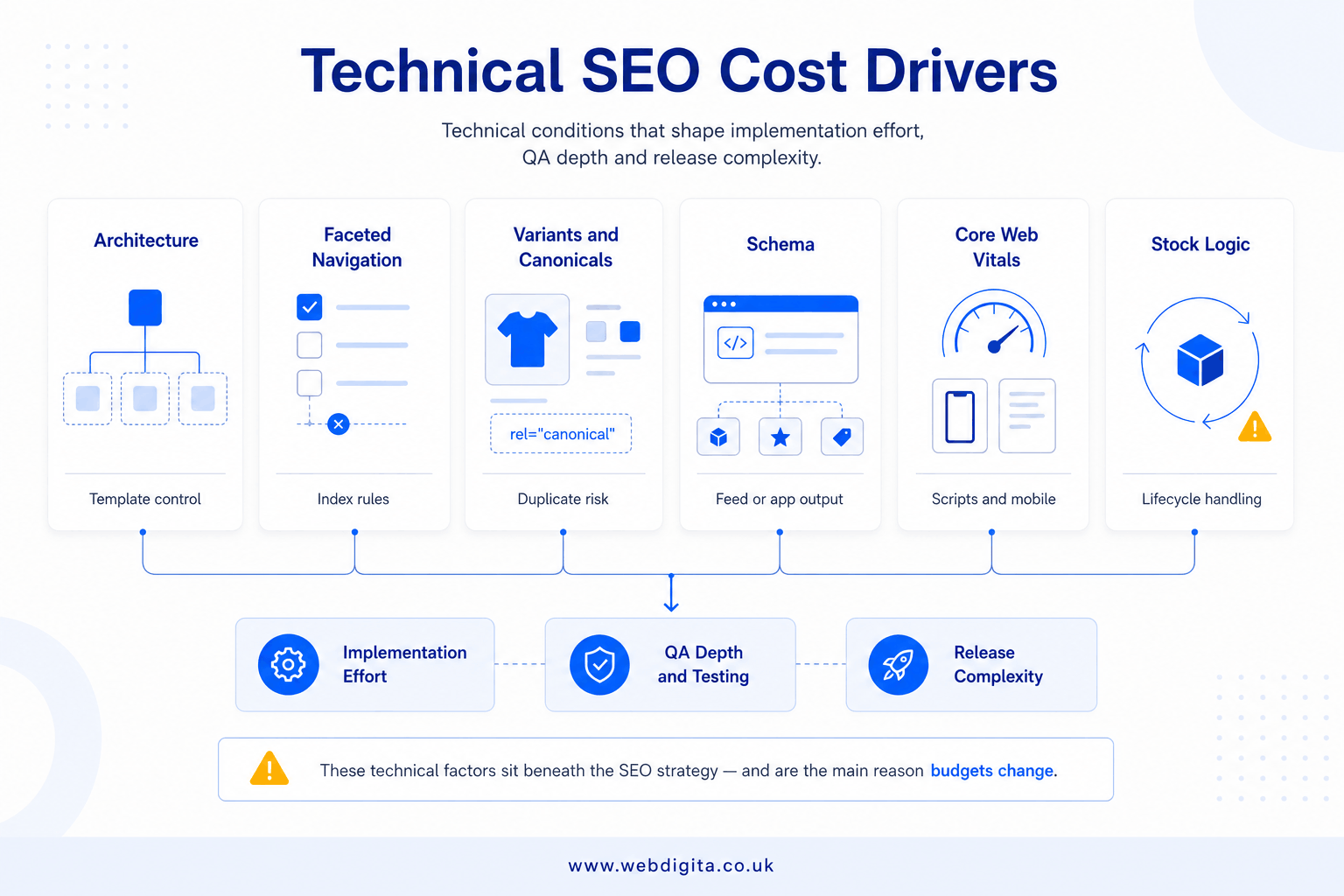
Product schema, Core Web Vitals, and mobile: Product schema ownership is rarely clearly defined – it may sit in templates, third-party feeds, or app output, and each carries different implementation risk. Core Web Vitals on product and category pages are often shaped by frontend choices made years before the SEO engagement began: theme code, third-party script load, image handling. Most eCommerce traffic arrives on mobile, so a page that looks acceptable in a desktop audit can still be critically slow where the majority of sessions land. Out-of-stock handling carries more SEO risk than most teams anticipate. For more on that specific area, see handling out-of-stock product pages without losing rankings.
How Shopify, Magento, and headless setups change the implementation approach
Platform choice changes the delivery method – not just the label on the proposal. A provider who cannot give you a platform-specific explanation of how work gets implemented on your stack is quoting a strategy, not a delivery plan.
On Shopify, the visible SEO issue usually looks tractable in an audit. The actual change sits behind theme limits, app conflicts, and script weight. Category page templates, canonical handling on collections, and international routing all behave differently from custom builds. We regularly see estimates that look straightforward on paper become more complex once theme ownership, app dependencies, and QA sign-off are properly defined.
On Magento, catalogue depth, layered navigation configuration, customer group logic, and ERP or PIM integration complexity all slow implementation in ways that rarely surface in an initial estimate. A faceted navigation clean-up that looks like a two-week job on a mid-size Shopify build can take considerably longer on Magento once integration dependencies are properly mapped.
With headless commerce, eCommerce SEO depends heavily on frontend engineering discipline. Rendering decisions, routing architecture, preview environment limitations, and deployment governance directly affect whether canonical tags, product schema, and internal linking behave consistently across every page state. We often encounter briefs that look clean on the surface but stall because filter URL rules, canonical ownership, or post-deployment crawl testing were never defined as part of the original build scope.
If you are comparing quotes from multiple providers, ask each how the same task would be handled on Shopify, Magento, and headless. If the answers sound broadly similar across all three, that is usually worth investigating further.

Not sure if your stack is ready for technical SEO
We can review your platform setup, integrations, and release process to identify what will help or block SEO delivery before you commit budget. Most technical gaps show up in the first conversation.
Takes 20 minutes. No obligation, no sales pitch.
Technical checklist: key requirements to define before project start
A vague brief produces a vague estimate. We recommend working through this checklist before sign-off to tighten ownership, effort, and risk – and to arrive at a project discovery workshop with the right questions already framed.
- Platform and version, plus hosting or frontend framework
- Theme or template control, and who can make changes to each
- Developer availability, release process, and QA ownership
- Key integrations: ERP, PIM, stock sync, reviews, subscriptions
- Crawl budget health: parameter pages, stale product URLs, index bloat
- Faceted navigation rules and which filtered URLs should be indexed
- Variant handling, canonical tag logic, and duplicate content controls
- Product schema ownership: templates, third-party feeds, or apps
- Internal linking architecture across category, product, and content pages
- Core Web Vitals baseline on product and category pages, especially mobile
- Out-of-stock rules, redirects, and product lifecycle decisions
- Migration risk if URLs, platform, or catalogue structure are changing
Red flags that usually lead to wasted spend or hidden long-tail cost
Some answers sound reassuring in a pitch and still leave real risk unaddressed. The most common ones involve confident framing without any specifics about how the work actually gets released.
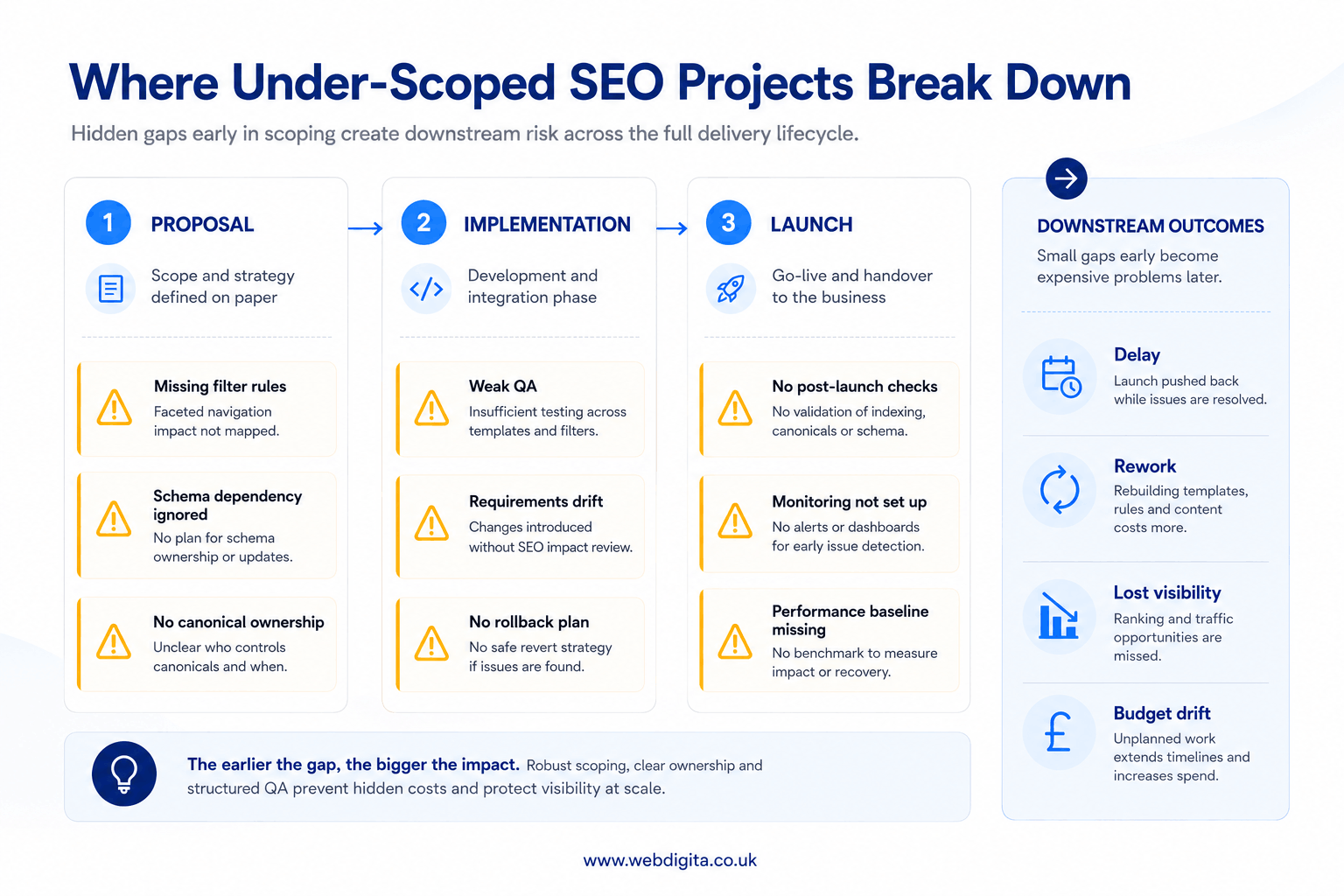
If a quote ignores faceted navigation, variant canonical tags, product schema ownership, category page constraints, or crawl budget, the scope is probably under-defined. If SEO recommendations arrive without a development feasibility check, you are often paying for analysis rather than a delivery plan.
A pattern we see frequently in post-migration reviews: the estimate covered keyword work, redirect mapping, and content recommendations, but not rollback planning, QA sign-off, post-launch crawl monitoring, or indexation checks. That gap does not stay theoretical for long. It typically surfaces as a visibility drop six to twelve weeks after launch, at which point the agency scope has ended and the cost of fixing it falls entirely on your team.
It is also worth watching for providers who treat Core Web Vitals as a generic speed task. On eCommerce sites, product page performance is tied directly to frontend architecture decisions – script load, image handling, third-party app weight – that often predate the SEO engagement by years. A surface-level audit will not reach those. For more detail on what actually makes a difference here, this guide on Core Web Vitals for eCommerce SEO is worth reviewing before briefing providers.
What to ask before you shortlist an eCommerce SEO partner
By this stage, the question is not really whether they know your platform. It is whether they can reduce implementation risk on your specific stack, with your specific integration and release constraints.
We have found these questions consistently separate implementation-ready thinking from pitch capability. How would you handle category page optimisation on our platform, and who checks development feasibility before a recommendation is signed off? Who owns QA and release coordination? How do you manage integrations that affect product schema, stock logic, or canonical tags? What is the process if indexation or performance drops in the weeks after launch?
If you are on Shopify, also ask how they work with theme constraints, app conflicts, and performance trade-offs – and whether they can support broader Shopify development if the SEO audit exposes structural build issues.
The most productive conversations we have start with a client who brings their stack details, integration list, release process, migration plans, and known SEO pain points already written down. That replaces a generic scoping exercise with something both sides can actually work from.
Related reading: what actually changes the cost of eCommerce SEO. If your audit is likely to surface structural build work alongside SEO, checkout our eCommerce development services for how we can approach that scope alongside the SEO engagement.
Questions teams ask before choosing an eCommerce SEO partner
Common questions about platform experience, technical delivery, and budget clarity for eCommerce SEO projects.
1. Does platform experience really matter for eCommerce SEO?
Platform experience matters, but delivery depth matters more. A team can name Shopify, Magento, or headless commerce and still miss the hard part. What changes budget and risk is how recommendations become shipped changes—template control, developer handoff, release process, integration dependencies, and technical ownership. Platform logos are a starting point, not proof of capability.
2. Which technical requirements usually increase eCommerce SEO budgets?
Category page optimisation, faceted navigation, variant canonicals, product schema ownership, Core Web Vitals on mobile, and out-of-stock handling usually cost more than expected. These tasks depend on template control, app behaviour, integration logic, and release workflows, not just better headings. The gap between strategy and implementation is where budget drift starts.
3. How does Shopify change the way eCommerce SEO is implemented?
On Shopify, the visible SEO issue may look simple, but the real trade-off often sits in theme limits, app conflicts, and script weight. A category page change may depend on theme logic and app behaviour. Template control is usually more constrained than on Magento or headless builds, which changes how recommendations are delivered.
4. What makes eCommerce SEO harder on Magento than Shopify?
Catalogue size, layered navigation, customer group logic, and integrations can make sensible SEO changes slower and more expensive to release on Magento. The platform supports strong SEO, but delivery depends on developer availability, release process, and integration dependencies. The same brief can take longer to implement than on Shopify.
5. Why does headless commerce create different eCommerce SEO delivery conditions?
With headless commerce, SEO depends heavily on frontend engineering discipline. Rendering, routing, preview environments, and deployment governance all matter. Clean filter rules, stable canonicals, and release ownership must be properly defined. A brief that looks straightforward can stall if these conditions are not clear before project start.
6. What should I define before starting an eCommerce SEO project?
Define platform version, theme or template control, developer availability, release process, QA ownership, key integrations, faceted navigation rules, variant handling, canonical logic, product schema ownership, Core Web Vitals baseline on mobile, out-of-stock rules, and migration risk. Vague scoping produces vague estimates and usually leads to budget drift.
7. What are the red flags when choosing an eCommerce SEO partner?
Watch for quotes that ignore faceted navigation, variant canonicals, schema ownership, category page constraints, or release dependencies. If SEO recommendations are separated from development feasibility, you may be buying a document rather than a delivery plan. Also avoid teams that treat Core Web Vitals as a generic speed task without understanding frontend choices, scripts, and app load.
8. What questions should I ask before shortlisting an eCommerce SEO partner?
Ask how they would handle category optimisation on your platform, who checks feasibility before recommendations are signed off, who owns QA and release coordination, how they deal with integrations that affect schema or canonicals, and what happens after launch if indexation or performance drops. If the answer sounds identical across Shopify, Magento, and headless, that is usually a warning sign.
Conclusion
Platform experience is a starting point, not proof of delivery capability. The real question is whether a partner can reduce implementation risk on your stack, with your integrations, your release process, and your technical constraints.
- Scope: Define platform version, theme control, developer availability, integration dependencies, faceted navigation rules, variant canonicals, schema ownership, and QA process before project start.
- Risk: Watch for quotes that ignore release workflows, post-launch monitoring, rollback planning, or indexation checks. That gap usually comes back as delay, rework, or lost visibility.
- Ownership: Ask how recommendations become shipped changes, who checks feasibility before sign-off, who owns QA and release coordination, and what happens after launch if performance or indexation drops.
- Delivery: Bring your stack details, integration list, release process, migration plans, and known SEO pain points to the next conversation. That gives both sides a much clearer starting point.
Ready to fix the technical SEO issues your platform is hiding
We work with Shopify, Magento, and headless commerce builds to deliver technical SEO that fits your stack, your integrations, and your release process. No generic audits. No recommendations that cannot ship.
See our eCommerce SEO serviceOr talk through your setup with