Every eCommerce agency has launched stores, the ones that prevent replatforming in two years are very less. After two decades managing the technical debt of builds that looked clean in the demo and fell apart under real load, I can tell you the difference usually comes down to a handful of questions most buyers never think to ask.
The questions that reveal genuine expertise are the ones that force an agency to explain trade-offs, failure handling, and ownership – not just capabilities. If they can talk clearly through platform choice, product data structure, ERP integration, checkout performance, PCI responsibility, B2B rules, and load testing, you are probably looking at real delivery depth. If they stay vague, jump to features, or treat edge cases as phase two, you are looking at surface capability dressed as ecommerce web development expertise.
This guide is for founders, eCommerce leads, and commercial buyers comparing agencies for replatforming, integration-heavy builds, or B2B shortlist decisions.
Ask how they make platform and architecture decisions
If an agency starts with a platform recommendation before it has challenged your catalogue, operations, and integration load, slow the conversation down. Ask why Shopify, WooCommerce, Magento, or headless commerce fits your business model – and what extra cost or operational overhead comes with that choice.
Ask this directly: what complexity actually requires headless, and what would simply add moving parts? A credible agency will talk about trade-offs, not trends. Do not accept a platform-first pitch dressed up as strategy.
Ask how they would model your product data before design starts. They should be able to explain variants, bundles, pricing rules, stock ownership, and how bad source data will be cleaned or governed. If that gets brushed off as admin setup, treat it as a warning sign. In my experience, product data architecture is where the majority of replatforming pain originates – not the front end.
B2B requirements are another stress test. Ask how customer-specific pricing, approval chains, quote requests, account permissions, and restricted catalogues affect architecture, support overhead, and maintainability. If they talk about these as small add-ons, they have not carried the weight of them in delivery. B2B eCommerce is not a feature set. It is a different data model.
A pattern I see repeatedly on shortlists: one agency shows a polished front end and talks confidently about conversion, then starts wobbling when ERP sync, account hierarchies, and customer-specific pricing come up. That is usually where the real project starts.
If you are comparing providers, ask them what technical debt they are deliberately avoiding, not only what they plan to build.
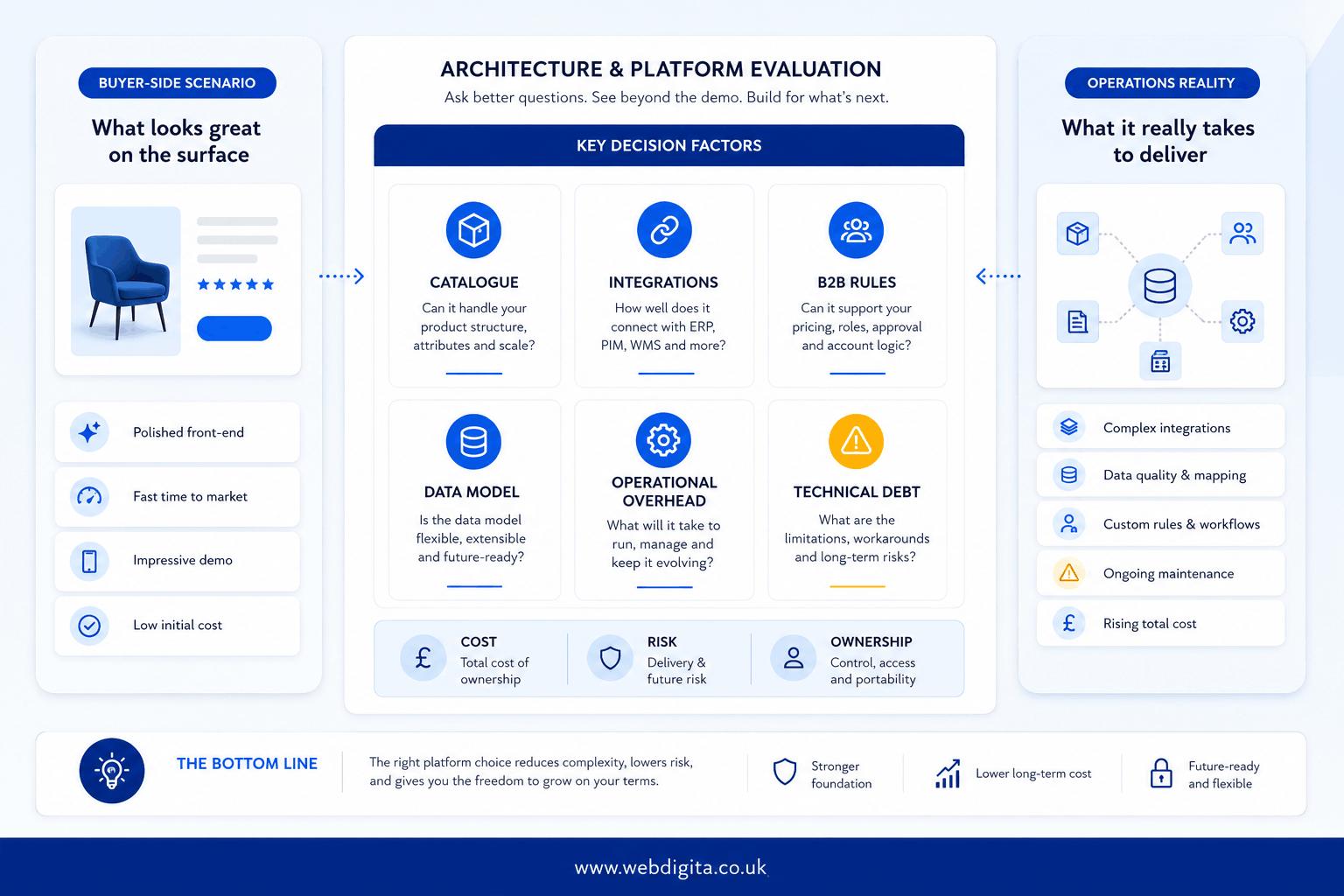
- Strong answer: clear trade-offs, platform limits, ownership questions, and reasons one architecture reduces future rework.
- Weak answer: platform-first pitching, generic flexibility claims, and edge cases pushed into phase two.
Test their depth on integrations, checkout, security and scale
This is where weak agencies become slippery. Ask how they scope ERP and third-party integrations, which system is the source of truth, how sync direction works, and what happens when data fails halfway through an order or stock update.
Push on failure handling: what retries exist, who gets alerted, and what manual fallback is used when the ERP or another connected system returns wrong data? If they cannot explain failure modes and ownership, the risk has simply been transferred to your operations team. If you want a deeper view of that risk before build starts, read about planning integrations before development starts.
Checkout is another honesty test. Ask which parts of the payment flow sit inside PCI scope, who owns compliance boundaries, how payment flows are tested, and how checkout speed is protected when apps, scripts, or custom logic are added. Do not assume “secure” means anything useful unless responsibilities are documented. For baseline PCI guidance, the neutral reference is the PCI Security Standards Council.
Then ask about scale. What traffic assumptions are tested? Are promotions or peak periods simulated? When does load testing happen, and what thresholds would trigger architecture changes? If the answer is “we will review that post-launch”, you are being asked to trust hope over a plan. I have seen that conversation happen at the worst possible time – Black Friday, a PR spike, a wholesale catalogue unlock – and it is expensive.
Pretty builds survive demos. Checkout, integrations, and scale are where they meet reality.
If requirements still feel fuzzy, push for a project discovery workshop before you compare proposals line by line. That is usually where assumptions around data, dependencies, and acceptance criteria finally become visible.

Not sure which questions will expose weak delivery depth?
We can walk you through the technical and operational questions that reveal whether an agency has genuine eCommerce capability or just polished pitch materials. No obligation, no sales pressure.
Used by commercial leads comparing agencies at shortlist stage.
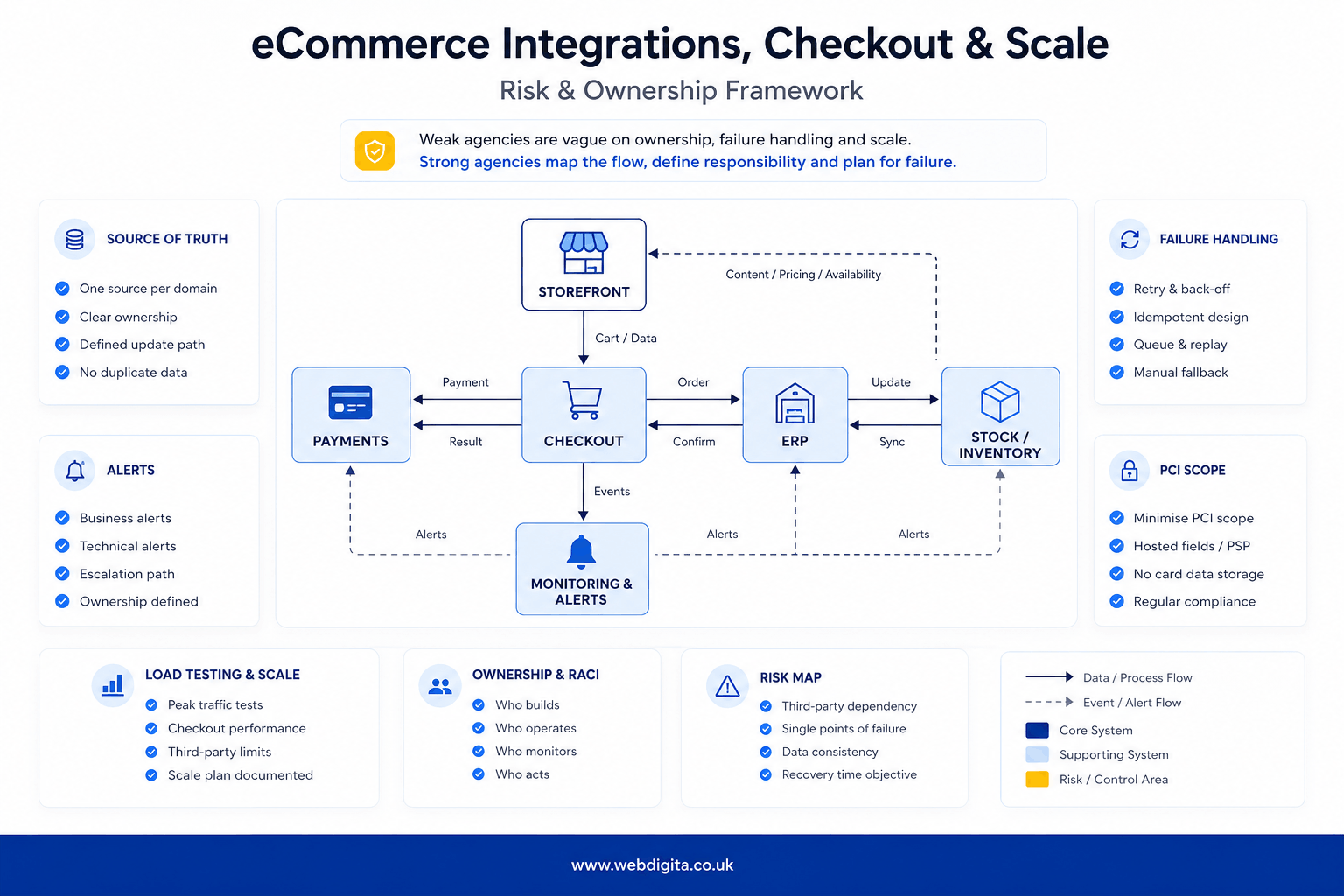
Agency evaluation scorecard: capability vs evidence vs red flags
| Capability area | What a credible agency should explain | What should worry you |
|---|---|---|
| Platform and architecture | Why the platform fits your catalogue, operations, integrations, and growth constraints | Defaulting to a favourite platform without trade-offs |
| Product data model | How variants, bundles, pricing rules, stock logic, and messy data will be structured and governed | Treating data modelling as admin setup |
| ERP and third-party integrations | Source of truth, sync direction, failure handling, monitoring, alerts, and ownership | Vague API talk with no operational detail |
| Checkout and PCI | Payment flow risks, PCI responsibility, test approach, and speed impact of added scripts | Hand-waving around compliance or checkout performance |
| B2B capability | Account structures, customer pricing, approvals, quotes, permissions, and restricted access | Calling B2B eCommerce features simple add-ons |
| Scalability and load testing | What gets tested, when, how peaks are simulated, and what changes if thresholds fail | No clear load testing method or timing |
Ask how success is measured after launch. A serious answer starts with baseline instrumentation and connects site speed, conversion rate, average order value, checkout completion, and operational stability to a scheduled review. “The site is live” is not a success model. It is a handover with the risk transferred back to you.
What good post-launch ownership looks like – and why it matters at shortlist stage
Most buyers evaluate agencies on what they build. The ones who get burned a second time evaluate them on what happens after launch.
Before you sign anything, establish exactly who owns post-launch fixes, performance monitoring, platform updates, and warranty boundaries. If that stays vague, the build may be fine – the operating model will not be. This is where eCommerce maintenance becomes part of the buying decision, not an afterthought.
The agencies that handle this well will tell you upfront what is inside support scope and what triggers a new statement of work. They will have a monitoring setup ready from day one, not improvised when something breaks. They will talk about Shopify version updates, WooCommerce plugin conflicts, Magento security patches, and checkout optimisation cadences as scheduled responsibilities – not reactive firefighting.
The ones that deflect these questions with “we will handle it” or “our team is always on hand” are usually describing reactive support with no contractual basis. That sounds reassuring. It is not.
Ask these three questions before shortlist stage ends:
- What is inside your post-launch support scope and what falls outside it?
- How are platform updates, plugin conflicts, and security patches handled – and who initiates them?
- What does your incident response process look like if checkout stops working at 2am on a peak trading day?
If the answers are specific and procedural, that is a good sign. If they are warm and vague, that is a cost you will absorb later.
If answers still feel polished but thin, insist on a scoped technical review before budget is committed. Get a free scoping review or speak with an engineer who will challenge the architecture, dependencies, and delivery assumptions before you sign. And if you are moving into contract-stage due diligence, read what to ask an ecommerce development agency before you sign.
Questions buyers ask before choosing an eCommerce development agency
These questions help you separate genuine delivery depth from polished pitches and surface capability.
1. What should I ask an eCommerce agency about platform choice?
Ask why they recommend a specific platform for your catalogue, operations, and integration load, and what trade-offs come with that choice. A credible agency will explain what complexity actually requires headless, what would simply add moving parts, and what operational overhead or technical debt each platform creates. Do not accept a platform-first pitch dressed up as strategy.
2. How do I test an agency's depth on integrations?
Ask which system is the source of truth, how sync direction works, and what happens when data fails halfway through an order or stock update. Push on failure handling: what retries exist, who gets alerted, and what manual fallback is used when the ERP or another system is wrong. If they cannot explain failure modes and ownership, the risk has simply been left for your team to absorb later.
3. What should I ask about checkout and PCI responsibility?
Ask which parts of the payment flow sit inside PCI scope, who owns compliance boundaries, how payment flows are tested, and how checkout speed is protected when apps, scripts, or custom logic are added. Do not assume secure means anything useful unless responsibilities are clear. If answers stay vague, treat it as a warning sign.
4. How do I know if an agency understands B2B eCommerce?
Ask how customer-specific pricing, approval chains, quote requests, account permissions, and restricted catalogues affect architecture, support overhead, and maintainability. If they talk about these as small add-ons or phase two features, they probably have not carried the weight of them in delivery. B2B requirements are a stress test for real capability.
5. What should I ask about load testing and scalability?
Ask what traffic assumptions are tested, whether promotions or peak periods are simulated, when load testing happens, and what thresholds would trigger architecture changes. If the answer is basically we will review that later, you are being asked to trust hope, not a plan. Scalability should be tested before launch, not discovered after it.
6. How do I compare agencies without getting sold to?
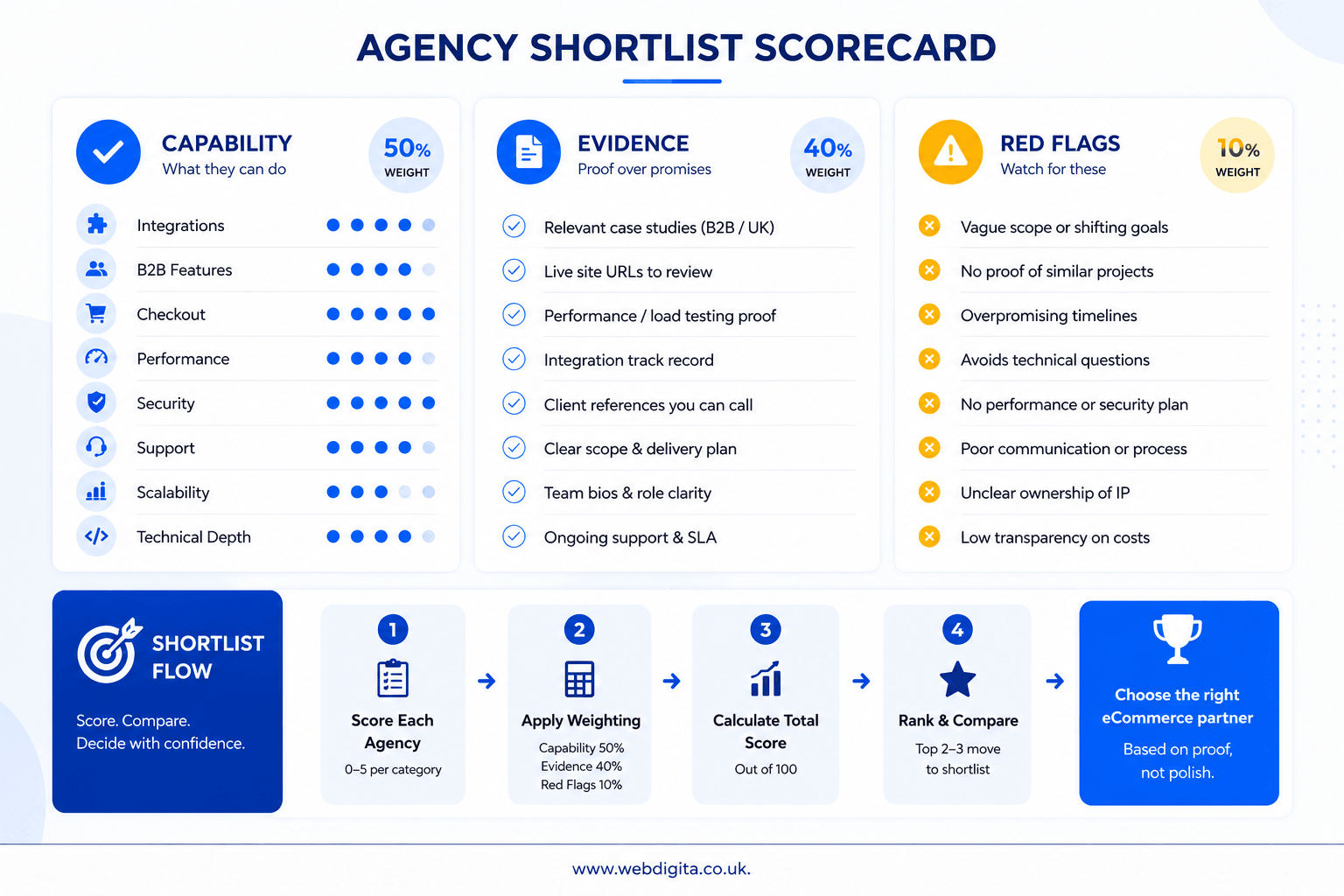
Score each conversation on three things: capability, evidence, and red flags. Capability is what they say they can handle. Evidence is whether they explained the hard parts clearly. Red flags are where answers became vague, defensive, or strangely optimistic. Give more weight to clear scoping logic, integration ownership, B2B detail, checkout testing, and honest platform trade-offs.
7. What should an eCommerce discovery workshop produce?
A proper discovery workshop should produce clear product data models, integration scoping, architecture trade-offs, B2B rules, checkout flow logic, and acceptance criteria before build starts. If the workshop output is just wireframes and a feature list, it has not done the hard work. Discovery is where assumptions around data, dependencies, and edge cases finally become visible.
8. What red flags should I watch for when choosing an agency?
Watch for no load testing approach, no clear post-launch support boundary, repeated we can work that out later answers, platform-first pitching without trade-offs, treating data modelling as admin setup, vague API talk with no operational detail, and hand-waving around compliance or checkout performance. These are usually where scope drift, rework, and support pain start getting priced into your future.
Conclusion
Most eCommerce projects look fine in the demo. The real test comes when the catalogue gets messy, the ERP starts dictating reality, checkout slows under load, or a B2B rule appears that nobody modelled properly. By then, the agency has already been paid, scope is already drifting, and you are left funding the gap between a tidy pitch and a working operation.
The agencies that survive delivery are the ones that can explain trade-offs, dependencies, failure handling, and ownership before the contract is signed.
Before you commit, make sure you know who owns post-launch fixes, performance monitoring, platform updates, and warranty boundaries. If that stays vague, the build may be fine but the operating model will not be. Use the scorecard, push on the hard questions, and insist on a scoped technical review before budget is committed. The agencies that welcome that level of scrutiny are usually the ones worth working with.
Ready to move from shortlist comparison into proper technical scoping?
WEBDIGITA builds eCommerce platforms for businesses that need integration depth, B2B capability, and operational resilience. We scope platform architecture, ERP sync, checkout performance, and post-launch support before build starts.
See Our eCommerce Development ServiceOr speak with