Key Takeaways
Choosing an eCommerce SEO agency becomes harder when your store has faceted navigation, variant duplication, stock changes, and a full dev queue. The right questions expose whether an agency understands delivery constraints or just sells theory.
A strong agency should explain how they would audit your store before making recommendations, handle faceted navigation and canonical trade-offs without blanket rules, and measure progress honestly without pretending everything moves in six weeks.
Use a scorecard to compare capability, evidence, and red flags across architecture, facets, schema, Core Web Vitals, and measurement. Score each answer for specificity, practical fit, and delivery realism. If proposals still feel hard to compare, a short scoping step will expose assumptions faster than another sales call.
When your store carries real complexity – faceted navigation, variant duplication, stock changes, slow product templates, and a full dev queue – weak agency fit turns into wasted budget and eCommerce SEO work that never quite reaches revenue.
The short answer: The questions that reveal genuine eCommerce SEO expertise focus on architecture diagnosis before tactics. Ask how an agency would assess your category structure, crawl paths, and template logic before recommending anything. Test their decision logic on faceted navigation, canonical strategy for product variants, and Core Web Vitals at product page level. If their answers stay at keyword or backlink level, they are describing theory – not delivery experience.
If you are at shortlist stage comparing agencies for a platform-heavy store, a category growth push, or a technical clean-up, this guide gives you the specific questions and signals to separate real capability from a well-rehearsed pitch. We use the same framework in our own eCommerce SEO scoping process, and apply the same standard when supporting clients through agency shortlists.
Ask how they would audit your store before making recommendations
A strong agency should not jump straight to tactics. In eCommerce SEO, the real issues usually sit in structure, templates, and operating constraints – not just a missing keyword map. We see this distinction clearly in proposal reviews: three agencies can all promise a full audit, but only one will ask about your template logic, merchandising rules, and the constraints your development team is working under.
That gap matters because it tells you who has actually delivered eCommerce SEO at scale and who is pitching a process they have not stress-tested. We understand how difficult it can be to spot this distinction when every proposal document looks similarly thorough – which is why the evaluation conversation is more revealing than the proposal deck itself.
Use these questions early in the evaluation:
- How would you assess site architecture, crawl paths, and category depth before suggesting changes?
- What would you review on category pages beyond copy and title tags?
- How would you evaluate internal linking between categories, subcategories, and products?
- What platform or template constraints would you want to understand before scoping any work?
A strong answer should cover page types, indexation patterns, internal search, filter behaviour, template logic, and the likely friction with development or merchandising teams. It should also show order of thinking: what they would inspect first, what they would defer, and why. That sequencing reveals how they approach prioritisation under real delivery constraints – which is exactly the kind of judgement you need once you have signed.
A weak answer tends to sound broad without substance: “We will do a full SEO review” with no mention of page types, or a jump to traffic projections before they have understood how the store is built. We have reviewed proposals from agencies that offered 90-day keyword roadmaps without asking a single question about template architecture or indexation logic. That is not a minor gap – it is the gap that causes the six-month check-in where results have stalled and nobody can explain why.
The category page question is where we see the clearest capability split. Agencies with real eCommerce SEO delivery experience will talk about how faceted navigation affects category crawlability, how product count changes crawl depth, how sorting logic interacts with canonical tags, and what happens when merchandising rules push products below the visible fold. Agencies without that experience will talk about H1 tags and meta descriptions. Both answers use SEO vocabulary. Only one tells you the agency has managed this problem at catalogue scale.
Test their technical depth on the issues that usually break eCommerce SEO
This is where general SEO knowledge stops being enough. Faceted navigation, variant duplication, product schema, and page performance are the areas where most eCommerce SEO strategies fail quietly – and where the gap between agencies is most clearly visible.
Ask how they manage faceted navigation and crawl budget. A credible answer should explain when filtered URLs may deserve indexation – because there is genuine search demand behind a specific combination – and when they should be consolidated or restricted because they create duplication and crawl waste. The right choice depends on demand data, duplication risk, and how your category hierarchy works. An agency that applies one fixed rule across all filter combinations is substituting policy for diagnosis, and you will pay for that in crawl budget leakage you may not notice for months. For context on what a well-structured audit of crawl budget issues looks like, see our guide to identifying and fixing crawl budget issues in eCommerce SEO.
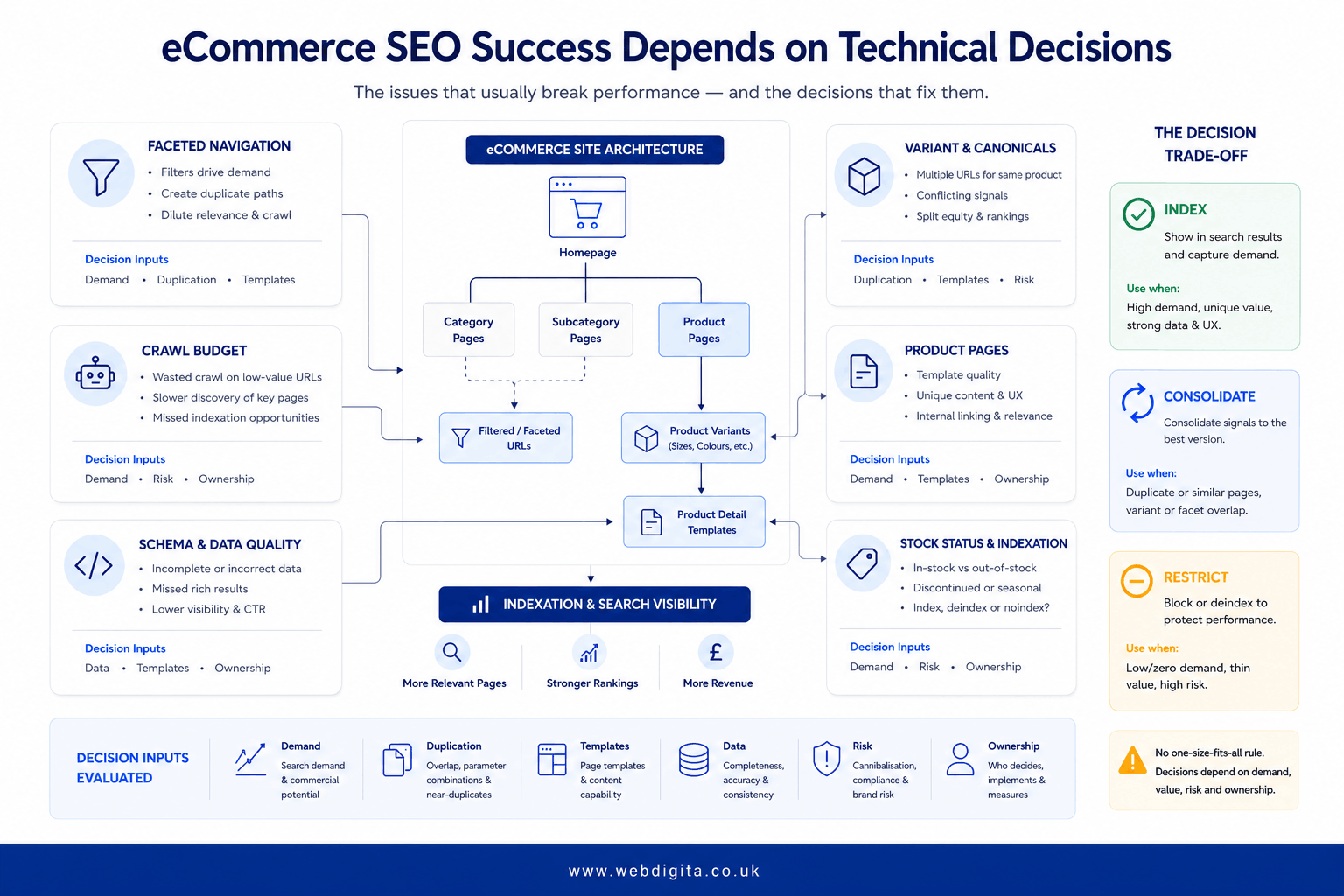
Ask the same about canonical strategy for product variants. If an agency says every variant should always canonicalise to the parent URL, push on that. Sometimes that is correct. But if your variants carry distinct search intent – colour-specific searches, size-specific searches, model-specific searches – a blanket canonical strategy quietly removes organic demand you have already earned. The agency should be able to explain the decision logic, not just state their default position.
We often see this go wrong after a store launches filters and variant URLs in a rush. Months later, Google is spending crawl budget on low-value filter combinations while the strongest category pages are under-supported. The problem is rarely one canonical tag in isolation. It is the absence of decision logic behind the entire setup – and an agency that did not ask the right questions before implementation began.
On product schema, the question to ask is not whether they implement it, but how they handle the relationship between your schema, your product feed, stock status, and template rendering. Agencies that treat schema as a plugin installation will set it up at the page level without thinking about how dynamic price data, out-of-stock flags, or review aggregation interact with structured data at render time. We have worked with stores that had technically valid schema failing rich result tests because the template logic overrode the structured data at the point Google rendered the page. That is a harder problem to fix than getting schema right the first time.
For Core Web Vitals, ask specifically about product page performance – not homepage performance. Product pages carry the heaviest load: image carousels, review widgets, recommendation engines, size pickers, stock availability scripts. A meaningful answer should address template weight, third-party script impact, mobile experience, and the practical trade-off between rich product content and render speed. For a deeper benchmark on what actually moves the needle, see what actually matters in Core Web Vitals for eCommerce SEO.
When you ask about out-of-stock products, listen for nuance. The right answer is not always a redirect. Preserving ranking equity on a seasonal or returning product matters. And handling out-of-stock product pages without losing rankings requires a policy that distinguishes permanently discontinued items from temporarily unavailable ones. If the agency’s answer is “redirect everything,” they have not managed a real catalogue under commercial pressure.
Weak answers in this area tend to sound tidy but stay shallow: blanket noindex rules, generic page speed advice, schema described as a setup task rather than a data architecture decision. Ask for the reasoning behind every recommendation and listen for trade-offs, dependencies, and conditions. Confident bullet points without conditions are usually a sign the approach has not been tested against a messy real-world catalogue.

Not sure which agency questions matter most for your store?
We help eCommerce teams test agency fit before they commit. Our diagnostic calls cover technical depth, delivery dependencies, and the trade-offs that usually surface after the brief is signed.
No pitch. Just a clearer view of what good looks like.
Use a scorecard to compare capability, evidence, and red flags
If you are comparing several agencies, use the same lens for each one. Without a consistent framework, the smoothest pitch tends to win – and smoothness does not correlate with delivery capability. We find that buyers who commit to scoring every agency against fixed criteria almost always make a better decision than those who rely on overall impression.
Agency evaluation scorecard: capability vs evidence vs red flags
| Area | Capability to test | Evidence to look for | Red flag |
|---|---|---|---|
| Architecture and crawlability | Can they explain category depth, crawl paths, and internal linking? | Specific audit approach and likely friction points | Talks only about keywords or backlinks |
| Facets and canonicals | Can they handle filters, variants, and duplication trade-offs? | Clear decision logic, not one fixed rule | Blanket canonical or noindex advice |
| Schema and templates | Do they understand product data and template dependency? | Mentions feed logic, template rollout, and testing | Schema treated as a plugin tick-box |
| Core Web Vitals | Can they talk about product-page realities? | Focus on template weight, media, scripts, and mobile UX | Generic page speed checklist only |
| Measurement and prioritisation | Can they tie work to revenue and sequence it properly? | Explains impact, effort, ownership, and reporting | Promises results without dependencies |
Score each agency’s answer against the same criteria:
| Score | Meaning |
|---|---|
| 3 | Specific, practical, and tied to your store |
| 2 | Reasonable, but light on evidence or trade-offs |
| 1 | Generic, evasive, or disconnected from delivery |
If an agency consistently lands below two across the technical areas, the evaluation conversation has already told you what working with them will feel like. It is worth trusting that signal – agencies rarely perform better in delivery than they do in a structured evaluation conversation where they are actively trying to impress.
A note on portfolio evidence. Case studies and client logos are a useful starting point, but they tell you little about how an agency handled your kind of complexity. Ask for the specific problem they solved – not the outcome headline. An agency that can describe the crawl budget problem they fixed on a 40,000 SKU catalogue, including the constraints, the decisions, and what they would do differently, is showing you something a logo wall cannot.
Ask how they measure progress and what happens in the first 90 days
A capable agency should be honest about what moves first and what takes time. In our experience, this is where the biggest gap between pitch and delivery becomes visible – not in the technical questions, but in how agencies handle the honest conversation about timelines, dependencies, and ownership.
Ask which KPIs they would track from week one. Strong answers include organic revenue attribution, category-level visibility, qualified organic traffic, conversion path impact, and indexation health. Rankings matter, but they are a lagging indicator on large catalogues where category-level gains rarely move evenly. An agency whose entire reporting model rests on keyword positions will struggle to communicate value in months three and four when some categories improve and others do not – and that is a difficult conversation to have once the contract is running.
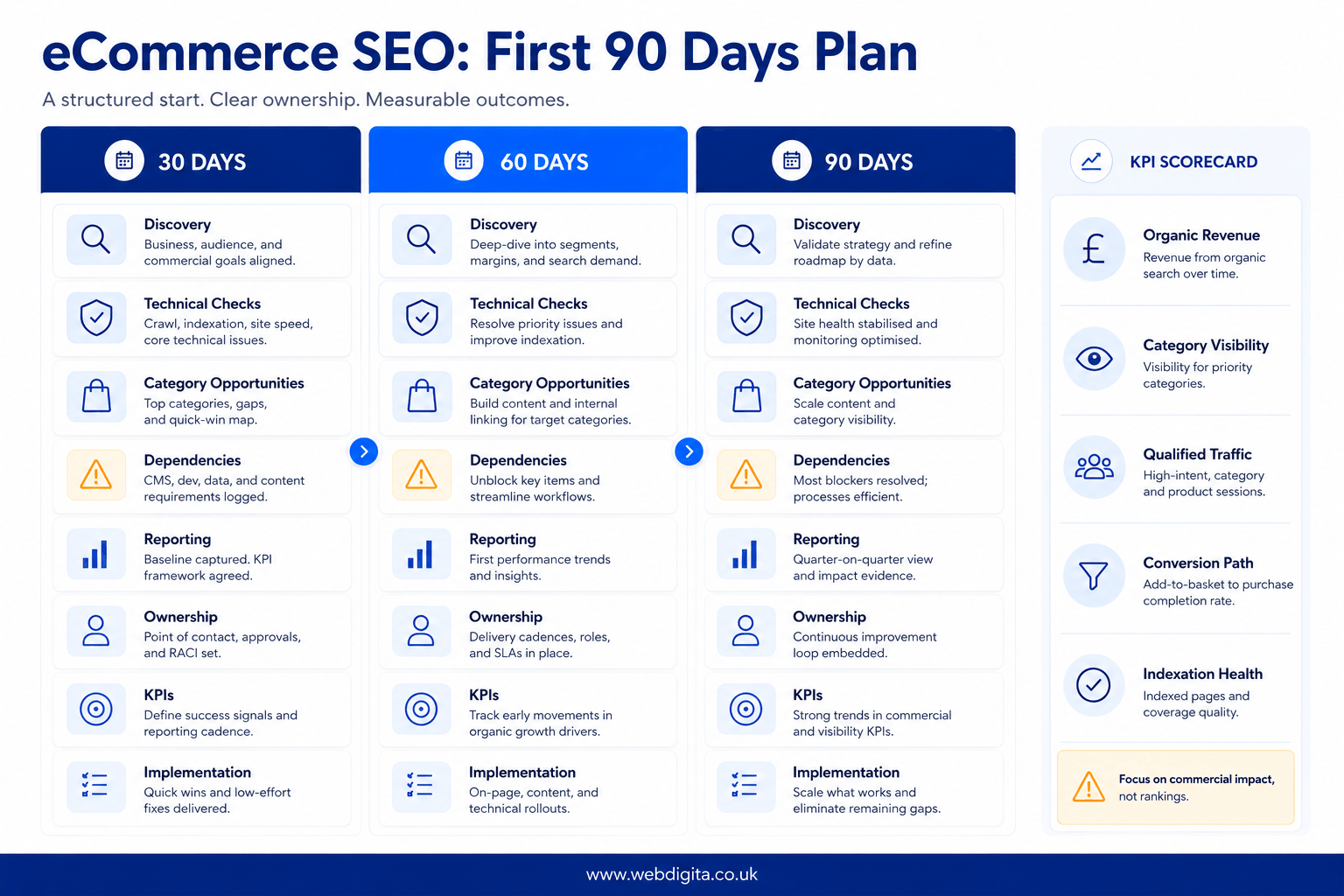
Ask what the first 30, 60, and 90 days would involve. A good answer should cover discovery, technical checks, category opportunity assessment, implementation dependencies, and reporting rhythm. It should also be clear about ownership. If development, merchandising, or content teams need to act on recommendations, a strong agency will say so upfront and show how they plan to manage that dependency. We regularly see agencies promise quick wins in the first month that turn out to require three rounds of development work and two sign-off cycles. That is not a quick win – it is a roadmap gap that becomes a relationship problem at the six-month mark. For a fuller picture of what a well-structured eCommerce SEO engagement looks like end to end, see what the eCommerce SEO process should actually look like.
Challenge any promise of significant traffic or sales uplift in the first six months without conditions. A better question is: what signals should move first, what depends on implementation being completed, and what could slow results? The honest answer to that tells you whether the plan is commercially sound or constructed to be easy to sell.
Final shortlist questions to put to each agency:
- What would you change first, and why that before anything else?
- Which recommendations depend on development or template changes?
- How will you report progress if rankings move before revenue does, or vice versa?
- What would make you challenge our current category, variant, or stock-handling setup?
Strong agencies answer these with sequencing, trade-offs, and clear ownership. Agencies without real delivery experience stay vague on implementation or sidestep the harder parts of your store entirely. If you would find it useful to stress-test your shortlist before committing, a free scoping review can give you a structured framework for that conversation.
Questions buyers ask before choosing an eCommerce SEO agency
Common concerns about agency fit, technical capability, and delivery realism for platform-heavy stores
1. How do I know if an eCommerce SEO agency understands my platform?
Ask how they would audit your store before making recommendations. A strong agency should talk about template logic, page types, crawl paths, indexation patterns, and likely friction with development or merchandising teams. If they jump straight to tactics or stay vague on platform constraints, that usually means they are selling theory rather than delivery capability.
2. What should I ask about faceted navigation and variant handling?
Ask how they manage faceted navigation and crawl budget, and how they decide canonical strategy for variants. A credible answer should explain when filtered URLs deserve indexation because of real search demand, and when they should be consolidated to avoid duplication and crawl waste. Blanket noindex or canonical rules without decision logic are a warning sign.
3. How can I compare multiple eCommerce SEO agencies fairly?
Use a scorecard to test capability, evidence, and red flags across architecture, facets, schema, Core Web Vitals, and measurement. Score each answer for specificity, practical fit, and delivery realism. If proposals still feel hard to compare, a short scoping step or discovery workshop will expose assumptions faster than another sales call.
4. What KPIs should an eCommerce SEO agency track?
Strong agencies track organic revenue, category visibility, qualified traffic, conversion-path impact, and indexation health. Be wary if the whole reporting model rests on keyword positions, especially on large catalogues where gains rarely move evenly. Ask how they measure progress if rankings move before revenue does, or vice versa.
5. What should happen in the first 90 days with an eCommerce SEO agency?
A good answer should cover discovery, technical checks, category opportunities, implementation dependencies, and reporting rhythm. It should also be honest about ownership. If development, merchandising, or content teams need to act, the agency should say so clearly. Be wary of promises that ignore dependencies or pretend everything moves in six weeks.
6. How do I test an agency's technical depth on eCommerce SEO issues?
Ask how they would handle the trade-offs around filters, variants, schema, product-page performance, and stock changes. Push on their reasoning, not just their recommendations. If they give blanket rules without nuance, or generic speed advice without reference to templates and data sources, that usually means they lack delivery experience.
7. Should I expect traffic or revenue uplift in the first six months?
A better question is what signals should move first, what depends on implementation, and what could slow results down. Strong agencies answer with sequencing, trade-offs, and ownership. Weak ones stay vague on implementation or avoid the harder parts of your store. Challenge any promise that ignores dependencies or platform constraints.
Conclusion
The agencies that sound most convincing in a pitch are not always the ones that deliver when your store has real technical constraints. The difference shows in how they talk about facets, variants, templates, and dependencies. If an agency can explain trade-offs, sequence work properly, and tie recommendations to your actual platform and team setup, that is a stronger signal than a polished deck.
Before you commit, test their thinking on the issues that usually break eCommerce SEO. Ask how they would handle your category depth, crawl paths, filter logic, and stock changes. Ask what would need to change first and who would need to act. The agency that answers with sequencing, ownership, and honest timelines is usually the one that understands delivery.
If your store needs technical SEO work that fits your platform and dev constraints
We work with eCommerce teams on category growth, faceted navigation, product schema, crawl efficiency, and the technical fixes that usually sit between SEO and development. Our approach starts with understanding how your store is built, not just what ranks.
See how we approach eCommerce SEOOr if you prefer,