Key Takeaways
- Structure breaks before design does: Most redesigns fail because teams debate pages and visuals before agreeing on user intent, service hierarchy, and decision paths.
- A sitemap is not a strategy: A page list tells you what exists, but information architecture strategy defines why each page exists, how pages relate, and where they sit in the buyer journey.
- Weak architecture damages trust and conversion: Sites can look cleaner after launch but still confuse buyers, weaken SEO signals, and reduce enquiry quality if page roles and decision flows are unclear.
- Red flags appear early: If stakeholders are requesting pages without defining page roles, or navigation is being debated before intent is agreed, the brief is still too shallow to support good design.
- Solve the map before styling the interface: Resolve user intent, service hierarchy, page roles, decision paths, and ownership before design begins so visuals amplify clarity instead of covering uncertainty.
Navigation is not a list of pages. It is the map of user intent. Get it wrong, and users leave – no matter how clean the visuals are.
The short answer: Most website redesigns fail before design begins because the structure is wrong before the visuals arrive. Teams start with pages instead of journeys, stakeholder opinions instead of page roles, and navigation labels instead of decision logic. The new site ends up presenting old confusion more neatly. That weakens trust, muddies SEO, and makes conversion harder even when the design work itself is good.
This guide is for Heads of Digital and marketing leads planning a redesign who are still thinking in pages rather than intent, hierarchy, and user journeys – and who need to change that before wireframes begin.
Why redesigns fail before design even begins
The honest pattern, seen repeatedly across redesign projects, is that most begin as a presentation exercise when they are really a structure problem. Teams collect page requests, merge stakeholder wish lists, and start discussing layouts before anyone has agreed which pages attract, qualify, reassure, or convert.
In my experience turning business goals into site structure and conversion paths, this is where the brief goes wrong. Not in the design phase. Not in the build. In the moment when the team assumes visual design will resolve decisions that have not yet been made.
That is why the project discovery workshop step matters so much. It is where assumptions around scope, ownership, and page purpose get challenged instead of staying hidden inside design feedback. If your team cannot answer what each key page must do in the buyer’s journey – attract, qualify, reassure, or convert – treat that as a warning sign the brief is still too shallow to support good design.
If the logic is still vague, pause before approving wireframes or creative routes. Activity is not the same as clarity.
A sitemap is not an information architecture strategy
A sitemap tells you what pages exist. An information architecture strategy tells you why they exist, how they relate, and where each one sits in the decision journey. If you are only reviewing a page inventory, you are not yet solving the real redesign problem.
Navigation should be treated as one visible output of deeper choices – not the strategy itself. The decisions that need to come first are user intent, service relationships, visual hierarchy within the page structure, and page-role clarity. Only then does it make sense to start refining headers, hero sections, or landing pages.
Sitemap vs IA blueprint
Flat page list thinking
Home, About, Services, Case Studies, Contact
Useful for inventory, weak for decision-making. It does not show which service matters most, which page answers early research questions, where trust is built, or how users move from interest to action. This is sitemap-only thinking – and it produces sites that look tidy in a menu but leave buyers without a clear path.
Journey-based decision architecture
User intent – service hierarchy – supporting proof – page roles – internal links – conversion sequence
This is where information architecture strategy becomes commercially useful. It shows which pages attract search demand, which pages explain an offer, which pages reduce hesitation, and which pages should hand users to the next step. UX decisions made at this level shape what conversion design can actually achieve downstream.
In my view, the right test is not whether the proposed architecture looks tidy. It is whether a first-time visitor can decide. If you cannot map how a stranger moves from landing to enquiry, the structure is not finished.

Is your redesign solving structure or just styling confusion?
Before you approve wireframes or creative routes, we help you test whether your site architecture reflects user intent, service hierarchy, and decision paths. If those are still unclear, the redesign will carry the same problems forward.
We work with Heads of Digital and marketing leads planning redesigns in London.
What weak structure breaks once the redesign goes live
Weak structure rarely fails in one obvious place. It shows up as a site that feels harder to read, less certain in its presentation, and oddly unhelpful at the exact moment a buyer wants clarity.
If you are seeing strong traffic but weak enquiry quality, or lots of page views with poor onward movement, check the conversion sequence first. Users may be landing on the wrong page too early, or being pushed to a contact step before the site has earned enough trust. That is a page-role problem, not a design problem.
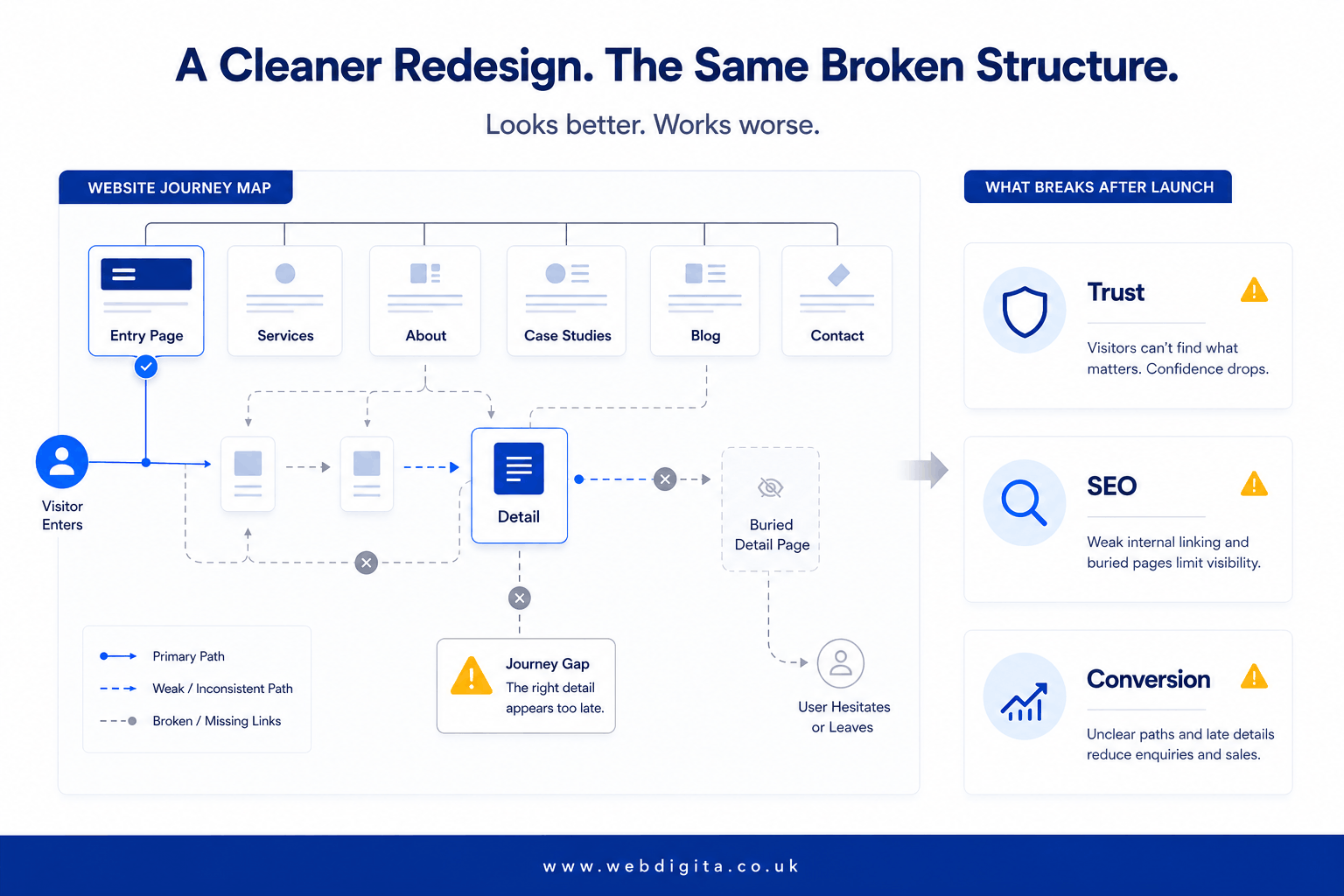
A common pattern is a service business sending paid and organic traffic to broad top-level pages while the real decision detail sits buried two clicks down with weak internal linking. The site looks cleaner after launch, but users still cannot tell which service fits their problem or what to do next. The visual hierarchy of the page is fine. The information hierarchy of the site is broken.
That same issue affects SEO directly. If service relationships, supporting content, and structural hierarchy are unclear, search engines get a weaker signal about which pages matter most and how authority should flow. If you are planning eCommerce development in London, this matters even more because category logic, product pathways, and commercial intent all need to align – not just the design system.
Trust is also damaged faster than most teams expect. When page roles blur, the site feels uncertain – and buyers notice that before they notice anything visual.
Red flags that show your redesign is solving the wrong problem
Red flags usually appear before the first design review. These are the signs I look for when a brief is still organised around pages and opinions rather than intent and decision flow.
WEBDIGITA IA Red Flag Test: if any of these are true, the brief is not ready for design.
- Stakeholders are requesting pages, but nobody has defined the role of each page in the journey.
- The navigation is being debated before user intent and service hierarchy are agreed.
- Different teams describe the same service in different ways.
- No one clearly owns conversion paths, internal linking, or supporting content relationships.
- Wireframes are moving ahead even though success criteria are still vague.
The repeated pattern we see in redesign work is that structure and decision paths were never solved before visual design started. Another round of mock-ups will not fix it. That is a brief problem – and it is worth resolving before any design investment is made.
What to solve before design starts
You do not need every detail locked before design begins, but you do need the structural decisions that give design something clear to express. Better visuals can amplify clarity. They cannot create it.
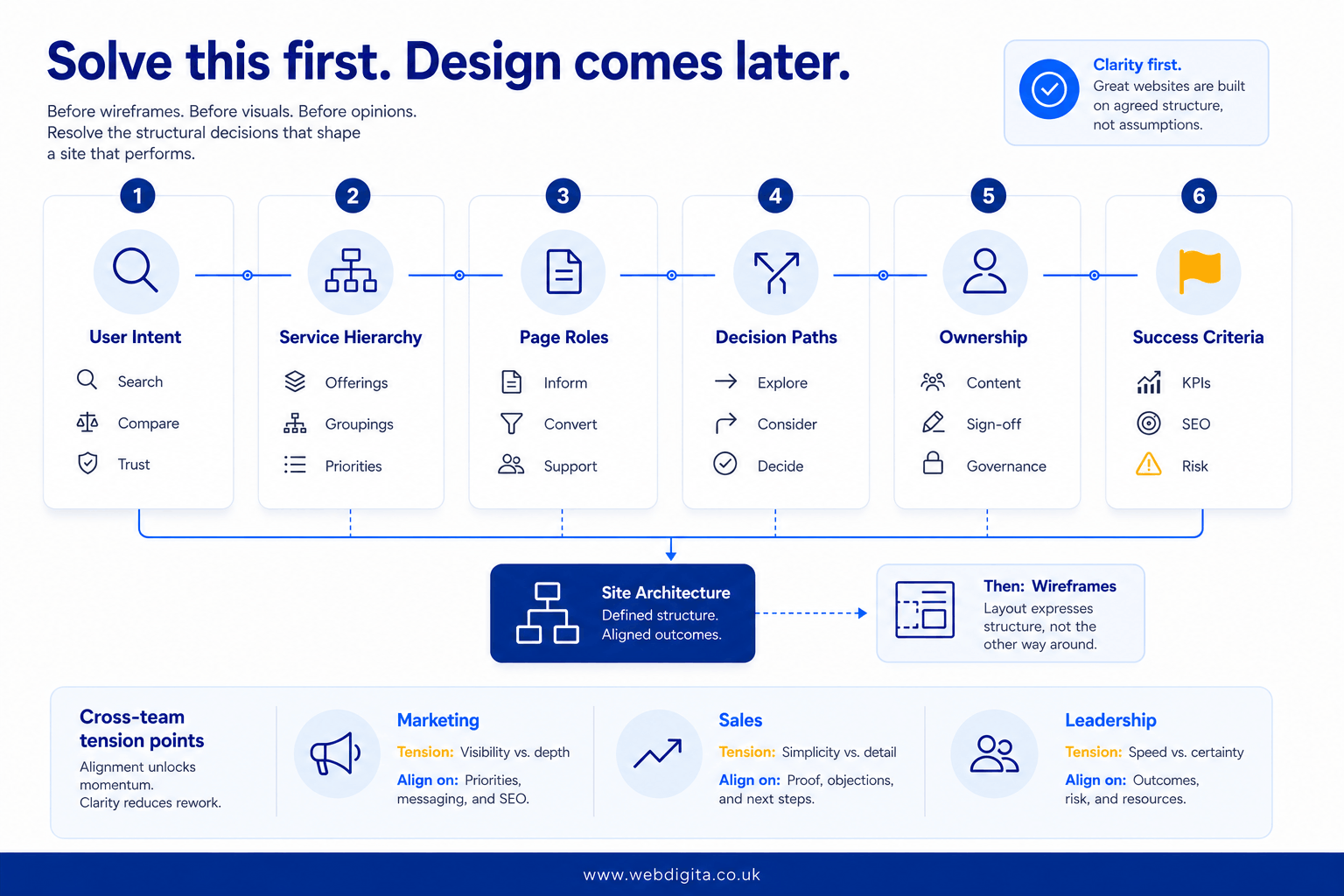
Resolve these first: user intent, service hierarchy, page roles, decision paths, stakeholder priorities, and success criteria. You should know which pages attract attention, which build confidence, which qualify demand, and which convert it. If you cannot articulate that sequence, the design system and the landing pages built from it are being asked to carry weight they cannot hold.
Ownership needs to be agreed at the same time. Who signs off architecture? Who owns content decisions? Who protects SEO implications? Who decides when a page is trying to do too much? In project work, this tension shows up when marketing wants simplicity, sales wants detail, and leadership wants everything on the top level. If it is not resolved early, the site inherits it.
If the redesign carries technical complexity or cross-team dependencies, Fractional CTO support can help you pressure-test architecture, delivery risk, and ownership before build commitments harden. And for a broader view of pre-redesign planning, the strategic groundwork service firms need before a high-stakes redesign is worth reading alongside this.
If you want to avoid redesigning confusion, solve the map before you style the interface. That is what good information architecture strategy is doing: giving the site a clearer logic so web design can signal confidence instead of covering uncertainty.
Questions teams ask before redesigning site structure
Common concerns about information architecture, decision paths, and avoiding structural mistakes during redesigns.
1. What is information architecture strategy and why does it matter for redesigns?
Information architecture strategy defines why each page exists, how pages relate to each other, and where they sit in the user journey. It matters because most redesigns fail when teams focus on visuals and page counts before agreeing on user intent, service hierarchy, and decision paths. A clear IA strategy protects lead flow, strengthens SEO, and makes conversion easier by giving design something coherent to express.
2. How is information architecture different from a sitemap?
A sitemap lists what pages exist. Information architecture explains why they exist, how they relate, and what role each page plays in helping users decide. A sitemap might show Home, Services, Case Studies, Contact. IA strategy shows which pages attract search demand, which build trust, which qualify buyers, and how users move from interest to action. Navigation is an output of IA, not the strategy itself.
3. What are the warning signs that a redesign brief is too shallow?
Warning signs include stakeholders requesting pages without defining page roles, navigation being debated before user intent is agreed, different teams describing the same service in conflicting ways, and wireframes moving ahead while success criteria remain vague. If no one clearly owns conversion paths or internal linking logic, the brief is still organised around opinions rather than decision flow.
4. Why do redesigns with good design still fail to improve conversion?
Because weak structure survives the redesign. The site may look cleaner, but if page roles are unclear, users land on the wrong page too early, or decision paths are blurred, trust weakens and conversion suffers. Good design amplifies clarity—it cannot create clarity from scratch. If the architecture is wrong, the new site just presents old confusion more neatly.
5. What should be resolved before design and wireframes begin?
Resolve user intent, service hierarchy, page roles, decision paths, stakeholder priorities, and success criteria. You should know which pages attract attention, which build confidence, which qualify demand, and which convert it. Also agree on ownership: who signs off architecture, who protects SEO, and who decides when a page is trying to do too much.
6. How does weak information architecture affect SEO after a redesign?
Weak IA gives search engines unclear signals about which pages matter most and how authority should flow through the site. If service relationships, supporting content, and hierarchy are blurred, rankings can drop even when the design improves. Internal linking, page purpose, and topical structure all need to align so search engines understand what the site is really about.
7. When should a business bring in external support for redesign planning?
Bring in external support when internal teams cannot agree on structure, when the redesign carries technical complexity or cross-team dependencies, or when stakeholder opinions are blocking clarity. A project discovery workshop or fractional CTO support can pressure-test architecture, surface hidden assumptions, and align teams before build commitments harden.
8. What happens if navigation is designed before page roles are agreed?
You end up with a menu that reflects internal naming preferences rather than user decision logic. The site may look organised but still confuse buyers because the structure does not match how people research, compare, or choose. Navigation should be designed after you have agreed on intent, hierarchy, and page purpose—not before.
Conclusion
If your redesign is moving toward wireframes but the team still cannot explain which pages attract, qualify, reassure, or convert, pause before approving the next stage. Better visuals will not fix unclear structure.
- Define page roles first: Know which pages answer early research questions, which build confidence, and which move users toward action.
- Align on hierarchy and intent: Agree on service relationships, decision paths, and stakeholder priorities before design expresses them.
- Protect conversion and SEO logic: Weak internal linking, blurred page purpose, and unclear pathways damage trust and search visibility even when the design looks sharp.
- Treat architecture as a commercial decision: Information architecture strategy is not just about tidying menus—it is about making the site easier to trust, navigate, and convert from.
Get the structure right before design begins
Our project discovery workshops help you resolve user intent, service hierarchy, page roles, and decision paths before wireframes start. We work with service firms and B2B teams in London who need to protect lead flow and align stakeholders early.
Explore our web design servicesNot ready for a workshop?