Key Takeaways
Enterprise sites lose clarity when internal teams compete for visibility on the same pages, not because they serve too many audiences. The fix is to map audiences by intent, decide which journeys deserve separation, and give each page a clear purpose and owner before platform or redesign decisions lock in weak audience logic.
Shared content is not always wrong. Company credibility and governance standards can support several audiences at once, but if the same page is expected to reassure investors, convert buyers, attract candidates and satisfy legal review, watch for muddled hierarchy and weak calls to action.
Good structure will not survive without governance. Give every key page an owner, a purpose and a rule for what does not belong there. Without those boundaries, the page becomes a committee surface and hidden dependencies build up quickly across CMS components, approvals and internal expectations.
High-intent sales leads should not wade through investor PDFs. And investor traffic should not be forced through sales conversion logic. When an enterprise site loses clarity, it rarely happens because the team ran out of pages – it happens because too many internal teams want equal visibility in the same places. Investor signals, sales messages, hiring content and legal detail start competing on the same pages, and the result is a site that serves internal politics better than it serves any specific user.
The fix is not to add more pages or give every stakeholder a bigger slot in the navigation. You need to map audiences by intent, decide which journeys deserve separation, control where overlap is allowed, and give each page a clear purpose and owner.
The short answer: an enterprise site serves multiple audiences well by separating them according to task and urgency, not by giving every stakeholder equal prominence everywhere. Primary commercial journeys must dominate core page real estate. Investors, HR and legal audiences need confident access to their content – but through dedicated routes, not by colonising sales and brand pages.
If you are making platform, website redesign or searching for the best web design agency, then audience structure matters early because weak intent logic becomes expensive once templates, CMS rules and approvals are already in motion.
This guide is for enterprise marketing leads, content owners and digital teams who need clearer audience hierarchy before redesign, governance or solution-evaluation decisions.
How to map audiences by intent, not by internal department
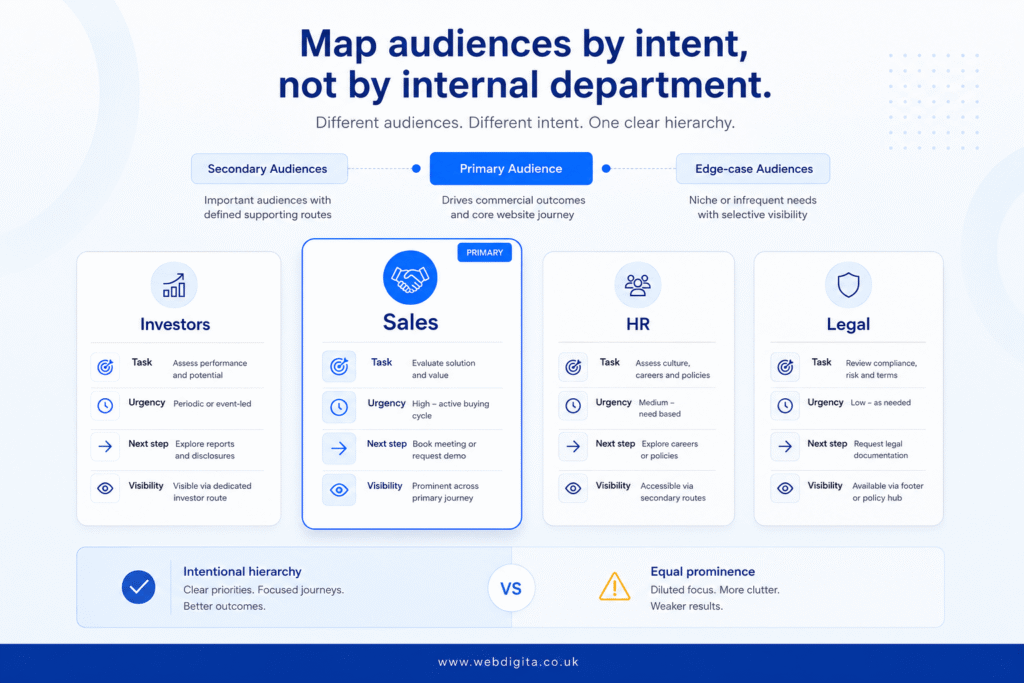
Start with what each audience is actually trying to do, not which internal team speaks for them. Investors want confidence. Candidates want culture and role clarity. Sales prospects want proof and a clear next step. Legal visitors want fast, precise access to policies or disclosures. Those are different tasks, different urgency levels and very different tolerances for friction.
If you are mapping a multi-stakeholder web design problem, sort audiences into primary, secondary and edge-case groups at site level. Ask which audience drives the core commercial journey, which groups need strong access but not constant prominence, and which visitors simply need a reliable route to specific information.
A common pattern worth catching early: a high-intent buyer lands on a product or solution page and sees recruitment banners, investor downloads and policy-heavy footer links competing for their attention. The page may still contain the right information, but the signal weakens and trust drops because the journey feels internally negotiated rather than intentionally designed.
Use these four questions as a per-section audit:
- Audience: who is this section really for?
- Task: what are they trying to complete right now?
- Urgency: is this a primary journey or a support journey?
- Next step: what action should the page make easiest?
How to stop pages from serving everyone at once
Dilution happens when one page tries to carry too many audiences, messages and next steps simultaneously. You are likely seeing it when a page looks busy but nobody in the room can agree what it is actually meant to do.
In my experience reviewing enterprise sites ahead of redesign, stakeholder dilution almost always appears in the same pattern: pages that were originally scoped for one audience have accumulated secondary-audience content through incremental requests, until no single audience gets a clean journey. The diagnostic question is not “what should we add?” – it is “what has crept in that does not belong here?”
Shared content is not always wrong. Company credibility, governance standards and brand trust can genuinely support several audiences at once. But if the same page is expected to reassure investors, convert buyers, attract candidates and satisfy legal review, watch for muddled hierarchy, weakened calls to action and the endless compromise edits that follow.
Equal prominence is not the same as equal importance. Treat demands for identical visibility as a governance issue, not a navigation requirement.
If you want to test whether a page is carrying the right audience load, ask what it would lose if one audience were removed from it. If the answer is “not much”, that audience probably needs a cleaner route elsewhere. If every audience feels essential to the same page, that is usually a sign of an unresolved internal politics conversation dressed up as a content question.
You may also want to review where stakeholder demands start creating user friction, because dilution tends to show up first as UX noise rather than as an obvious information architecture problem.

Not sure which audiences should own which parts of your site?
We can map your stakeholder needs, identify where overlap is weakening your main journey, and show you which sections need clearer ownership before you commit to templates or governance rules.
Takes 20 minutes. You get a clear view of what needs fixing first.
Intent-layer matrix for Investors, HR, Sales and Legal
Not every audience should collide with every content stream. You need a visibility strategy that protects the main commercial journey while still giving secondary audiences confident, reliable access.
WEBDIGITA Audience Intent Matrix: use this to decide what each audience should see, where that content should live and how visible it should be within the core user journey.
4-quadrant intent-layer matrix for Investors, HR, Sales and Legal
| Audience | Likely intent | Section purpose | Visibility level | Overlap risk |
|---|---|---|---|---|
| Investors | Assess stability, governance and performance signals | Dedicated investor area or clearly signposted corporate section | Selective site-wide visibility | High if mixed into sales pages |
| HR | Support recruitment, culture and role discovery | Careers section with clear entry points from brand pages | Moderate visibility | Medium if pushed into conversion pages |
| Sales | Evaluate offer, proof, fit and next step | Primary commercial journey and solution pages | Highest visibility | High if interrupted by non-buying content |
| Legal | Find policies, disclosures and compliance information fast | Utility navigation, footer and context-specific links | Low but reliable visibility | Low if isolated well, high if surfaced too aggressively |
If you are deciding what belongs in primary navigation, start with sales and brand-critical trust paths. Route investors, HR and legal with precision rather than volume. Low visibility in the global navigation does not mean low importance – it often means more deliberate, higher-quality placement.
Who owns what when stakeholder needs conflict
Good intent structure will not survive without governance. Once the site is live, the real pressure starts: campaign requests, executive asks, compliance updates, recruitment pushes and regional edits all compete for the same high-traffic templates. Without ownership rules, the audience logic you built during discovery quietly unravels.
My view, having seen this pattern across enterprise redesign and post-launch governance reviews, is that ownership failure is almost always more damaging than architecture failure. A slightly imperfect structure with clear ownership stays recoverable. A well-designed structure without owners becomes unusable within two or three release cycles.
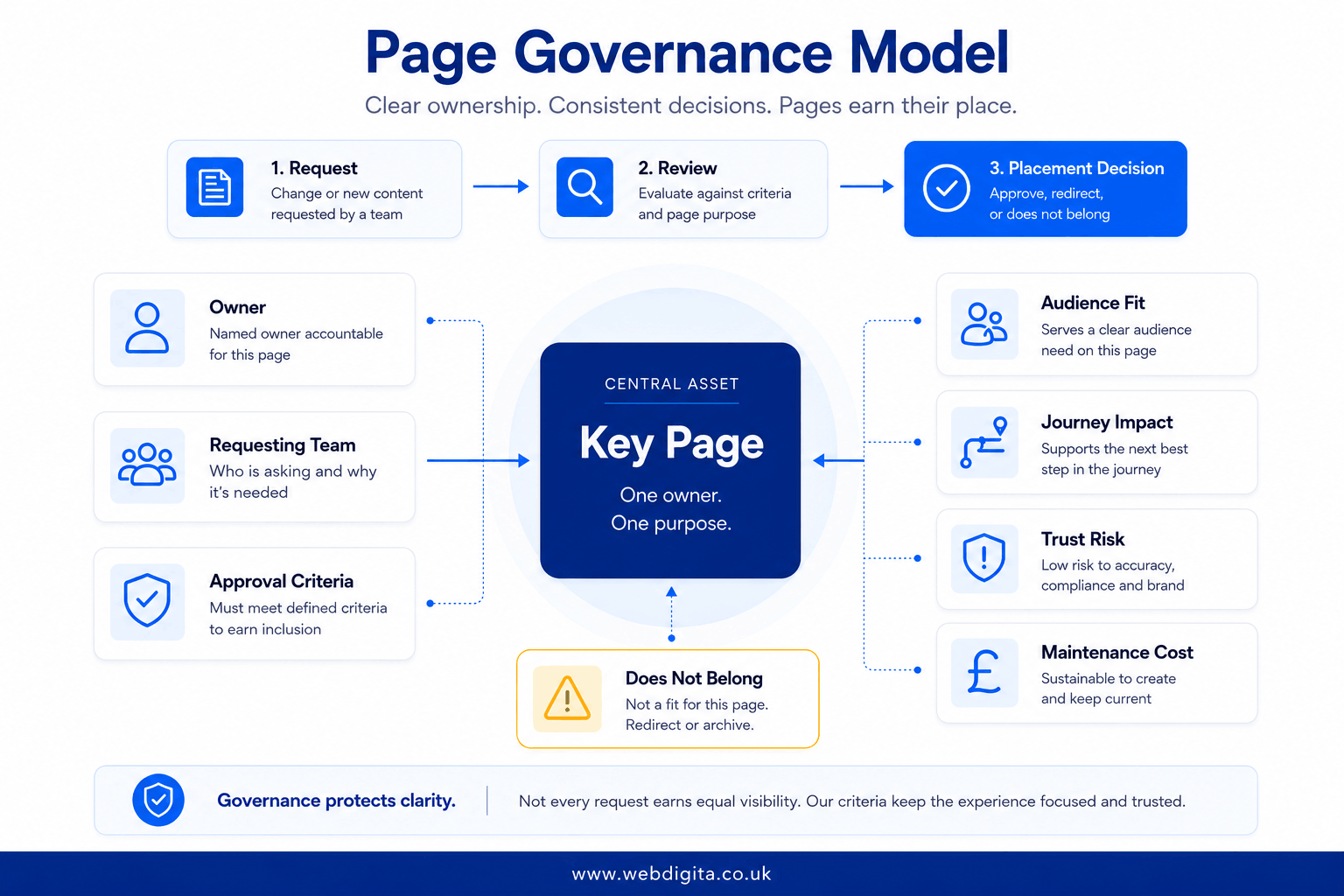
The practical fix is to build three rules into your governance model before launch:
- Every key page has a named owner – responsible for purpose, not just content. That owner can reject changes that conflict with the page’s primary audience and intent.
- Change requests are evaluated against agreed criteria – audience fit, journey impact, trust risk and maintenance cost. One team can request; a separate owner holds the approval decision against those criteria, not against seniority or urgency.
- Additions to high-traffic templates require sign-off – because those are the pages that accumulate the most secondary-audience content through incremental requests. Treating them as shared resource surfaces leads to the same dilution problem described above.
Decision ownership without criteria is just escalation by another name. If your team is resolving content disputes by asking “who wants this more?” rather than “which audience does this serve and how does it affect the primary journey?”, that is a governance gap, not a content gap.
If your site also carries complex product, catalogue or transactional journeys, then a structured eCommerce website maintenance service, so ownership rules continue through ongoing updates, not just at launch. If search visibility is part of the same internal complexity, this piece on managing search visibility across teams and templates covers how the same stakeholder dynamics play out in SEO governance.
Questions teams ask before mapping multi-stakeholder web design
Common questions about audience hierarchy, page ownership and governance when internal teams compete for visibility.
1. How do you decide which audience should get priority on a shared page?
Start with what each audience is trying to do, not which internal team speaks for them. Ask which audience drives the core commercial journey, which groups need strong access but not constant prominence, and which visitors simply need a reliable route to specific information. If the page would lose little by removing one audience, that audience probably needs a cleaner route elsewhere.
2. What is stakeholder dilution and how does it show up on enterprise sites?
Stakeholder dilution happens when one page tries to carry too many audiences, messages and next steps. It usually appears when pages look busy but nobody can agree what they are actually meant to do. You will see muddled hierarchy, weak calls to action and endless compromise edits when the same page is expected to serve investors, buyers, candidates and legal review at once.
3. Should investor content and sales content ever share the same page?
Shared content is not always wrong. Company credibility, governance standards and brand trust can support several audiences at once. But if the same page is expected to reassure investors and convert buyers, watch for muddled hierarchy and weak calls to action. If overlap is allowed, decide which audience owns the primary journey and route the other with precision rather than equal prominence.
4. How do you stop internal teams from adding content to high-traffic pages after launch?
Give every key page an owner, a purpose and a rule for what does not belong there. One team can request a change, but another should hold the final call on placement against agreed criteria: audience fit, journey impact, trust risk and maintenance cost. Without those boundaries, the page becomes a committee surface and hidden dependencies build up quickly.
5. What is the difference between low visibility and low importance for secondary audiences?
Low visibility does not mean low importance. It often means better placement. Investors, HR and legal visitors need reliable access, but they do not need constant prominence in the core commercial journey. Treat demands for identical visibility as a governance issue, not a navigation requirement, and route secondary audiences with precision rather than volume.
6. How do you map audiences by intent rather than by internal department?
Sort audiences into primary, secondary and edge-case groups at site level. Ask which audience drives the core commercial journey, which groups need strong access but not constant prominence, and which visitors simply need a reliable route to specific information. Map by task, urgency and tolerance for friction, not by which internal team speaks for them.
7. When should you separate audiences into different sections rather than sharing pages?
Separate audiences when their tasks, urgency levels and next steps are fundamentally different. Investors want confidence, candidates want culture and role clarity, sales prospects want proof and next steps, and legal visitors want precise access to policies. If the same page is expected to serve all four, watch for dilution and consider whether each audience needs a cleaner route.
Conclusion
- Map audiences by intent, not by internal department. Sort audiences into primary, secondary and edge-case groups at site level, and ask which audience drives the core commercial journey before deciding what belongs in primary navigation.
- Stop pages from serving everyone at once. If a page tries to carry too many audiences, messages and next steps, check whether shared content is genuinely shared in purpose or whether it has simply been merged to avoid a difficult internal decision.
- Assign page ownership and decision criteria. One team can request a change, but another should hold the final call on placement against agreed criteria: audience fit, journey impact, trust risk and maintenance cost.
- Protect the main journey while giving secondary audiences confident access. Low visibility does not mean low importance; it often means better placement, and good governance protects conversion quality, trust and future delivery effort.
If your site is trying to serve investors, sales, HR and legal without a clear hierarchy, the problem is structure
We help enterprise teams map audience intent, decide which journeys deserve separation, and build governance that protects conversion quality without blocking legitimate stakeholder needs. If you are planning a redesign, platform change or content review, that clarity matters early.
See how we approach enterprise web designOr if you prefer,