Key Takeaways
If an eCommerce project looks active but key inputs are still unstable, it is not build-ready yet.
- Weak requirements create expensive ambiguity. If scope, exclusions and edge cases are still unclear, development time gets burned on clarification and rework.
- Data and integration gaps are major blockers. Product structure, migration rules, payment setup, tax logic and system behaviour need confirming before build, not during it.
- Ownership matters as much as planning. If nobody clearly owns approvals, compliance, content or launch sign-off, decisions stall and dates slip.
- Late design changes and missing UAT planning are governance problems. They usually surface as delivery issues later, but the root cause sits upstream.
- The right response is not more activity. Lock scope, name owners, validate dependencies and sort high-impact risks before development starts.
Most eCommerce development delays are not caused by developers. They come from unresolved dependencies that nobody fixed before build started – unclear requirements, incomplete product data, integration assumptions that were never tested, and approval routes with no named owner.
The short answer: eCommerce projects stall because the inputs that build depends on are still incomplete when development is supposed to start. Requirements are soft, product data is unready, integrations are based on guesswork, and nobody owns sign-off end to end. That is a pre-build problem, not a development problem – and it is the most common reason projects run late and over budget.
Your project can look active – platform selected, workshops running, design files moving, and someone already asking for a launch date – and still be nowhere near build-ready. If you are reviewing eCommerce website development services in London or assessing agencies in your market, check whether the project inputs are actually stable enough for build to start before you commit.
What a stalled eCommerce project looks like before development starts
A stalled project burns time without reducing uncertainty. That distinction matters because one needs better pacing, while the other needs diagnosis.
I have seen so many clients get started on their eCommerce development project with genuinely unclear requirements – where they themselves do not know what they actually need. They lose sight of the commercial objective entirely. There have been instances where clients have restarted their eCommerce project from scratch on a completely different platform, not because the development was poor, but simply because requirements were never properly defined in the first place.
Repeated meetings, shifting dates, and unresolved core questions are warning signs – especially if nobody can show stable build inputs. The pattern to watch for is teams deep in checkout UX discussions, debating Shopify apps, Magento or WooCommerce modules, or CMS integration options while the basics – product structure, payment gateways, tax logic, inventory sync, and approval routes – are still unsettled.
- No agreed requirements that a developer could actually build from
- Dates move, but the same open questions stay open
- Design changes continue before scope or data is locked
- Content, product data, or compliance inputs are still “coming soon”
If you are seeing this pattern, do not call it normal project friction. Treat it as early momentum loss – because the cost usually surfaces later as rework, scope drift, delayed revenue, and a budget consumed by clarification work rather than delivery.
The pre-development blockers that do the most damage
More often than not, the most damaging blockers do not look significant at the start. They are the unresolved things everyone assumes will get sorted later – and later is usually when the invoice is larger and the options are fewer.
Weak requirements and unclear owners: If nobody owns the catalogue rules, checkout exceptions, CMS responsibilities, or launch sign-off, decisions bounce between teams. Ownership needs to be pinned down early, or the agency ends up building around guesswork and ambiguity. The practical test: ask who can approve scope, content, compliance, and integrations without triggering another internal loop.
Data, content, and integration unknowns: Bad product data is not a data entry problem. It affects architecture, templates, filters, search, merchandising, and migration effort. Across digital projects – from Shopify migrations to custom Magento builds and headless commerce implementations – content, data, and approvals consistently create more delay than coding does. This is not an edge case; it is the pattern. Treating data and content as admin tasks rather than delivery dependencies is one of the most costly assumptions a project team can make.
Challenge any plan that treats ERP links, payment gateways, tax tools, or inventory sync as straightforward before the edge cases are mapped. Vendor documentation is not the same as confirmed behaviour.
What this looks like in practice: Checkout work starts, then pauses because the payment provider setup is still unconfirmed, tax handling differs by market, and the CMS content model cannot support the promotional logic the business assumed was standard – because those assumptions were never tested before build.
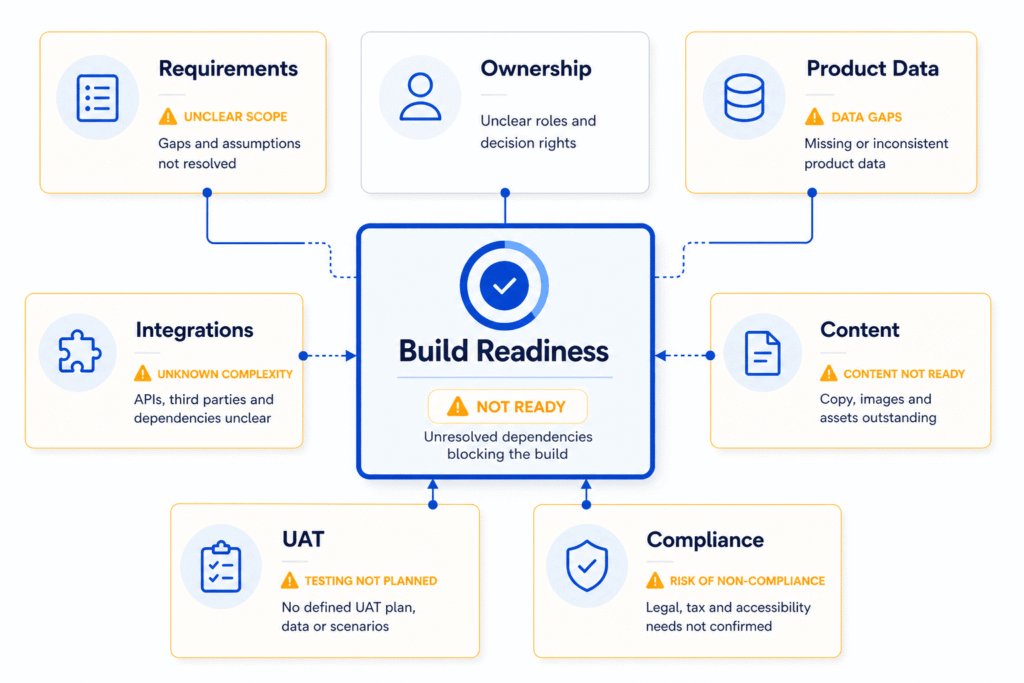
Late design changes, no UAT plan, hidden compliance needs: If the UI design is still changing after the tech stack is defined, expect rework. If UAT is not planned before build, expect late surprises. And if PCI compliance, accessibility requirements, returns handling, age verification, or sector-specific obligations only surface near launch, treat that as a governance failure – not bad luck.
If your team cannot answer those points with confidence, you are not behind on development. You are still in risk discovery.
Which delays sit with the client, the eCommerce agency, or both
My experience reviewing delivery blockers across eCommerce builds is that blame rarely helps – it takes time away from the more useful question: which delays are internal, which sit with the agency, and which are shared dependencies that need explicit management. If you are in the process of choosing an eCommerce development company, ask how they surface assumptions before build and how they handle unresolved inputs. I would push hard on this, because a good agency should challenge weak scoping, not quietly price around it and hope it behaves later.
| Blocker | Likely primary owner | Shared responsibility |
|---|---|---|
| Weak requirements | Both | Business defines needs, agency turns them into buildable scope |
| Content delays | Client side | Agency should flag deadlines and dependencies early |
| Product data problems | Client side | Agency should validate structure and migration risk |
| Integration unknowns | Both | Business owns system access, agency owns technical due diligence |
| Slow approvals | Client side | Both need a clear decision path |
| Late design changes | Both | Change control should be agreed before build |
If you need help exposing those gaps before they become scope arguments, an eCommerce project discovery workshop is often the most direct way to force clarity. Ask for a scoping process that makes assumptions visible, names owners, and shows what is still unknown before code starts.

Not sure if your project is actually build-ready yet
We can review requirements, ownership, data, integrations and approvals to show whether you have a delivery issue or a pre-build risk problem.
Useful before scope drift gets expensive
Risk heatmap: eCommerce project blockers most likely to stall momentum
You do not need to score every issue. You need to identify the few most likely to stop momentum and do the most damage if left unresolved.
| Pre-build blocker | Likelihood | Impact | What you should do now |
|---|---|---|---|
| Weak requirements | High | High | Lock core scope, edge cases, and exclusions before build approval |
| Product data gaps | High | High | Check data quality, structure, variants, and migration rules early |
| Integration unknowns | High | High | Confirm systems, access, API limits, and failure handling |
| Slow approvals | High | Medium | Name approvers and set decision deadlines |
| Hidden compliance needs | Medium | High | Review checkout, payments, accessibility, and policy obligations upfront |
| Missing UAT and launch governance | Medium | High | Define test ownership, sign-off criteria, and launch control before sprint work begins |
If several of your risks sit in the high-high area, do not start building to create a false sense of progress. Fix these first – development started on unstable inputs is always more expensive in the long run.
How to restart momentum before your eCommerce website gets expensive
Recovery is usually less about adding more people and more about removing uncertainty in the right order. Architecture decisions depend on scope. Templates depend on data structure. Integration work depends on confirmed system access and real API behaviour – not vendor documentation. Trying to unblock everything at once just creates new queues and diffuses accountability.
The first question to answer is whether you have a scoping problem, a resourcing problem, or both. A scoping problem means the inputs are still unclear and build should not start yet. A resourcing problem means the inputs are clear but delivery capacity is the constraint. These require different interventions, and confusing the two is why some recovery efforts make the situation worse before it improves.
What to resolve first, and in what order
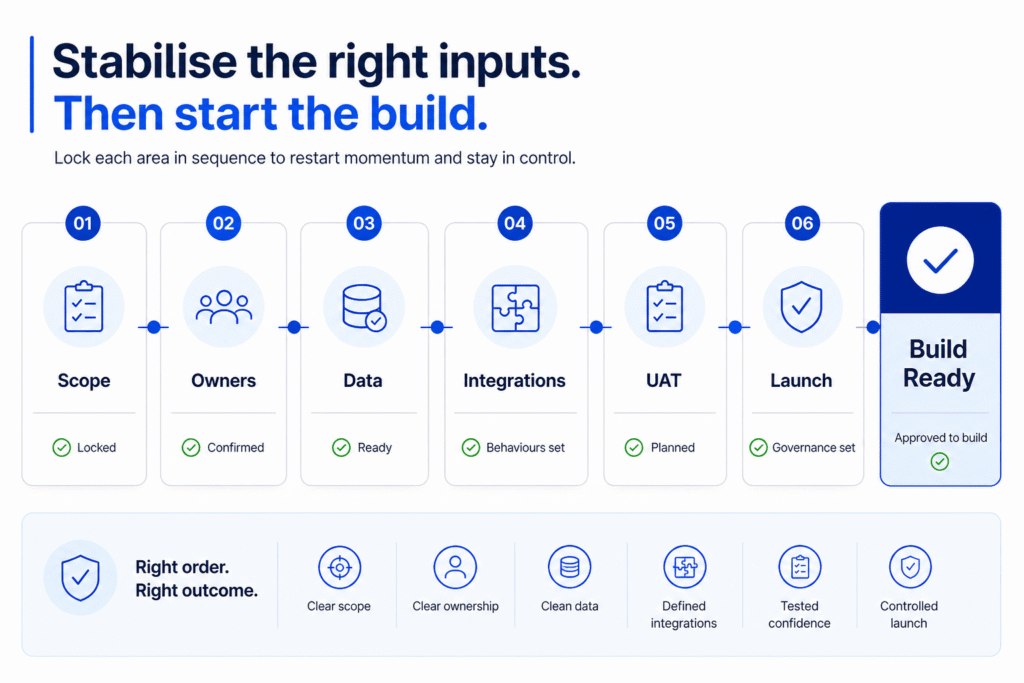
- Requirements and exclusions – Agree core scope, edge cases, and what is explicitly out of scope. This is the foundation everything else depends on.
- Named ownership – Assign owners for content, product data, approvals, integrations, and compliance before the agency can progress those workstreams.
- Product data readiness – Validate structure, variants, attributes, and migration logic. Data problems surface late and cost disproportionately when they do.
- Integration behaviour – Confirm actual API limits, edge cases, and failure handling directly with vendors. Vendor assumptions are not the same as confirmed behaviour.
- UAT plan and launch governance – Define who owns testing, what the pass criteria are, and how launch sign-off works. This cannot be retrofitted at the end of a sprint cycle.
If you cannot answer that list clearly, the project is not build-ready. It is also worth reviewing whether the provider is pricing discovery honestly or absorbing it silently into delivery – because discovery debt does not disappear; it resurfaces as scope disputes. For a deeper prep step, it is worth reviewing the scope before signing any quote.
A store that goes live with unresolved operational gaps usually hands those problems directly to support, maintenance, and marketing teams. If you are planning a handover, defining warranty boundaries, or thinking about ongoing store management, make those decisions before launch rather than after it. That is where a specialist eCommerce development agency adds the most value in delivery planning – as an active part of go-live governance, not an afterthought.
If you want a concrete next step, request an eCommerce project risk review before development starts. It will tell you whether you have a slow, well-defined project that needs a disciplined approach – or a stalled one that needs scoping, ownership, and dependency fixes first. If agency fit is also part of the problem, the next useful read is choosing the right eCommerce development agency for a complex build.
Questions buyers ask about stalled eCommerce development projects
These are the issues teams usually need to clarify before deciding whether a project is genuinely ready for build.
1. What usually causes an eCommerce development project to stall before build starts?
The usual cause is unresolved pre-build work, not a lack of development capacity. Soft requirements, incomplete product data, unclear integration behaviour, slow approvals and hidden compliance needs all stop momentum before code has a fair chance to move the project forward.
2. How can you tell whether a project is slow or genuinely stalled?
A stalled project keeps moving activity around without reducing uncertainty. If meetings continue, dates keep shifting and the same core questions about scope, data, integrations or approvals remain open, the project is stalled rather than simply running slowly.
3. Who is usually responsible for pre-build delays in eCommerce projects?
Responsibility usually sits on both sides, but not always equally. Client teams often own data, content, approvals and internal decision-making, while the agency should challenge weak scoping, expose assumptions early and validate technical risks before build begins.
4. Why are product data and integrations such common blockers?
Product data and integrations shape far more than admin setup. They affect templates, filters, search, merchandising, migration effort, checkout behaviour and operational reliability, so gaps in those areas quickly turn into architecture changes, delivery delays and rework.
5. What should be locked before eCommerce development starts?
Before development starts, the project should have agreed requirements, clear exclusions, named owners, validated product data, confirmed integration behaviour, compliance checks, a UAT plan and clear launch governance. Without those, the build is still carrying avoidable delivery and budget risk.
6. Is it a mistake to start development while some details are still unclear?
Yes, if the unclear details affect architecture, checkout, data structure, integrations or approvals. Small unknowns can be managed, but core build inputs should not stay vague. Starting too early often creates false momentum and leads to more expensive clarification later.
Conclusion
The real danger in a stalled eCommerce project is not slow progress. It is the illusion of progress while uncertainty stays untouched. Once build starts on soft requirements, weak data or untested integration assumptions, the cost of getting clarity rises quickly.
A better next step is to treat pre-build readiness as a commercial checkpoint, not an admin exercise. If scope, ownership, approvals, compliance and UAT are still loose, pause long enough to fix them properly. That usually protects budget, delivery confidence and launch quality far better than pushing development forward for the sake of momentum.
Need clearer scope, owners and dependencies before development starts
Our project discovery workshop helps you turn assumptions into buildable scope, expose blockers early, and define what must be locked before delivery begins.
View discovery workshopStill weighing up the fit