Key Takeaways
A serious discovery workshop should leave you with decisions that make build easier to scope, price and deliver.
- Notes are not enough. If discovery ends in whiteboards and shared understanding, risk has been recorded rather than reduced.
- The output should be delivery-ready. You should see clear requirements, mapped user journeys, platform trade-offs, integration dependencies, MVP boundaries and effort ranges with assumptions.
- Weak discovery shows up commercially. Quote movement, revision loops, hidden work and launch delays usually start with vague scope, not poor sprint management.
- Ownership matters as much as architecture. If content, data, operations or integration owners are missing, optimism gets baked into the plan.
- Do not start build without decision clarity. If scope, platform direction and major dependencies are still fuzzy, discovery is not finished.
Most eCommerce projects do not go off course in sprint three. They go wrong earlier – when discovery leaves a hidden dependency untouched, an integration assumption untested, or an MVP boundary vague enough to shift every estimate later. By the time build starts, the damage is already baked in.
The short answer: A serious eCommerce discovery workshop should produce prioritised requirements, a platform recommendation with trade-offs, an integration dependency map, a defined MVP scope, a risk register, content and data workstreams, success KPIs, effort ranges with stated assumptions, and a phased roadmap. Notes and “shared understanding” are not outputs. They are the starting point discovery is supposed to move past.
If you are choosing an agency or pressure-testing your own process, this is the standard I would use: a serious workshop should leave you with decisions you can act on, not a wall of notes and the comforting illusion of alignment. If you need eCommerce website development in London, that matters because build quality starts with scoping quality, not prettier sprint boards.
If discovery ends in notes, it has not done its job
A lot of workshops look busy. Stakeholders talk, boards fill up, someone says there is now alignment. Fine. But if the output is still ambiguous on requirements, architecture, integrations, ownership, or delivery constraints, you have not reduced risk. You have documented it.
What you should expect: discovery should convert raw discussion into decisions that narrow scope, expose failure modes, and make effort ranges more credible. Ask what changed after the workshop. If the answer is mostly better shared understanding, treat that as incomplete.
Discovery is not there to make the room feel aligned. It is there to make the build less guesswork.
Watch for the commercial fallout of weak output: quote movement, revision loops, rework, slower delivery, and a platform choice – Shopify, WooCommerce, Magento, or headless commerce – that carries operational overhead you did not spot early enough. Pretty workshop artefacts do not protect you from ugly implementation reality.
What a serious eCommerce discovery workshop should produce
You should come out of discovery with a small set of delivery-ready artefacts, each tied to a real decision. If you are still looking at raw notes, screenshots of whiteboards, and a vague recommendation to explore options, push back. That is activity, not output.
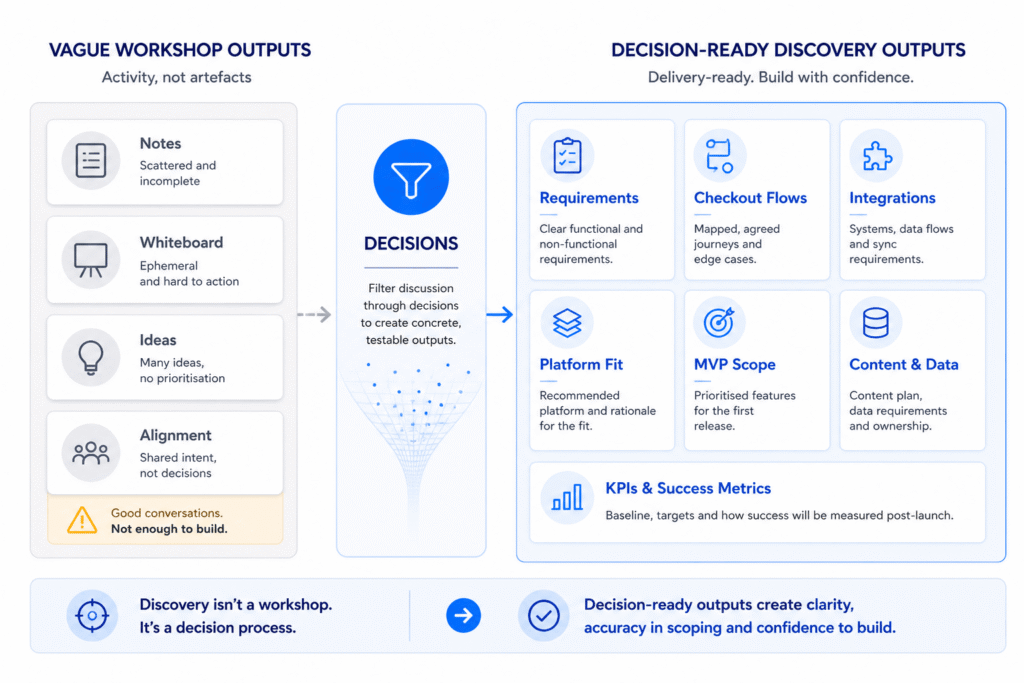
Requirements: not a wish list, but documented decisions on core features, constraints, assumptions, and non-negotiables. It also helps to compare workshop output against what should already be defined in the eCommerce brief – discovery should sharpen those inputs, not repeat them.
Journey and checkout flows: key user paths should be mapped far enough to expose scope-changing edge cases. Check guest checkout, returns, promotions, account flows, B2B rules where relevant, and where checkout UX or CMS integration creates hidden complexity.
Platform fit and integrations: you should have a reasoned view on Shopify, WooCommerce, Magento, or headless commerce based on your operating model, not fashion. Ask how payment gateways, inventory sync, ERP or CMS dependencies affect complexity. If integration mapping is hand-wavy, the estimate will be too.
MVP, content, data, and KPIs: discovery should define what is in launch scope, what is deferred, what content or product data work is needed, and which early trading KPIs matter. Do not assume migration, catalogue cleanup, or taxonomy work will somehow sort itself out during build. It never does.

Not sure your discovery output is ready for build
We can review your workshop outputs, flag scope gaps, and show what still needs deciding before estimates, platform choice, or delivery planning become reliable.
Useful if scope still feels a bit soft
The discovery output map: decisions, artefacts, and next-step deliverables
If you want a quick test, use this map. A proper project discovery workshop should produce outputs that unlock the next decision, not another round of vague discussion.
| Decision area | Artefact produced | What it enables next |
|---|---|---|
| Requirements | Prioritised requirements and constraints | Cleaner scope and fewer assumption gaps |
| Platform fit | Platform recommendation with trade-offs | Shortlist confidence and architecture direction |
| Integrations | Integration map and dependency notes | More realistic effort ranges and risk visibility |
| MVP scope | In scope, out of scope, deferred list | Phased delivery plan and budget control |
| Risk register | Known risks, failure modes, assumptions | Early mitigation and fewer surprises in build |
| Dependencies | Ownership and sequencing view | Better planning across teams and suppliers |
| Content and data | Migration and readiness workstream | Launch planning grounded in reality |
| Success KPIs | Launch and early trading measures | Clear acceptance criteria and reporting focus |
| Roadmap | Phased roadmap with next actions | Decision-ready handover into scoping or build |
| Effort ranges | Estimated ranges with assumptions | Budget planning with less quote ambiguity |
A quick decision-ready checklist
- Can you point to what is in MVP, what is deferred, and why?
- Can someone explain the platform choice in terms of trade-offs, not preference?
- Are integrations, data work, and ownership visible enough to affect scope and timing?
- Do the effort ranges show assumptions clearly enough for commercial review?
If you cannot answer yes to most of that, you should not treat discovery as complete.
What must be decided before build can start
By the end of discovery you should be able to make a few hard decisions with reasonable confidence: platform direction, MVP boundary, major dependencies, ownership by workstream, and effort ranges grounded in known constraints. You do not need perfect certainty. You need enough clarity to stop guessing.
In my experience running structured discovery workshops across strategy, architecture, and scope alignment, the pattern is consistent: sharper requirements, visible dependencies, and clear ownership directly reduce quote movement and revision loops. When that groundwork is missing, ambiguity hides in proposals and resurfaces mid-build as rework. That is not a sprint problem. It is a discovery problem – and it is almost always traceable to something that was left unresolved in the workshop.
Who needs to be in the room: bring the people who own commercial priorities, operations, content, technical delivery, and integrations. If the person who understands stock sync, fulfilment rules, or product data quality is missing, you are likely building optimism into the plan. Treat that as a warning sign.
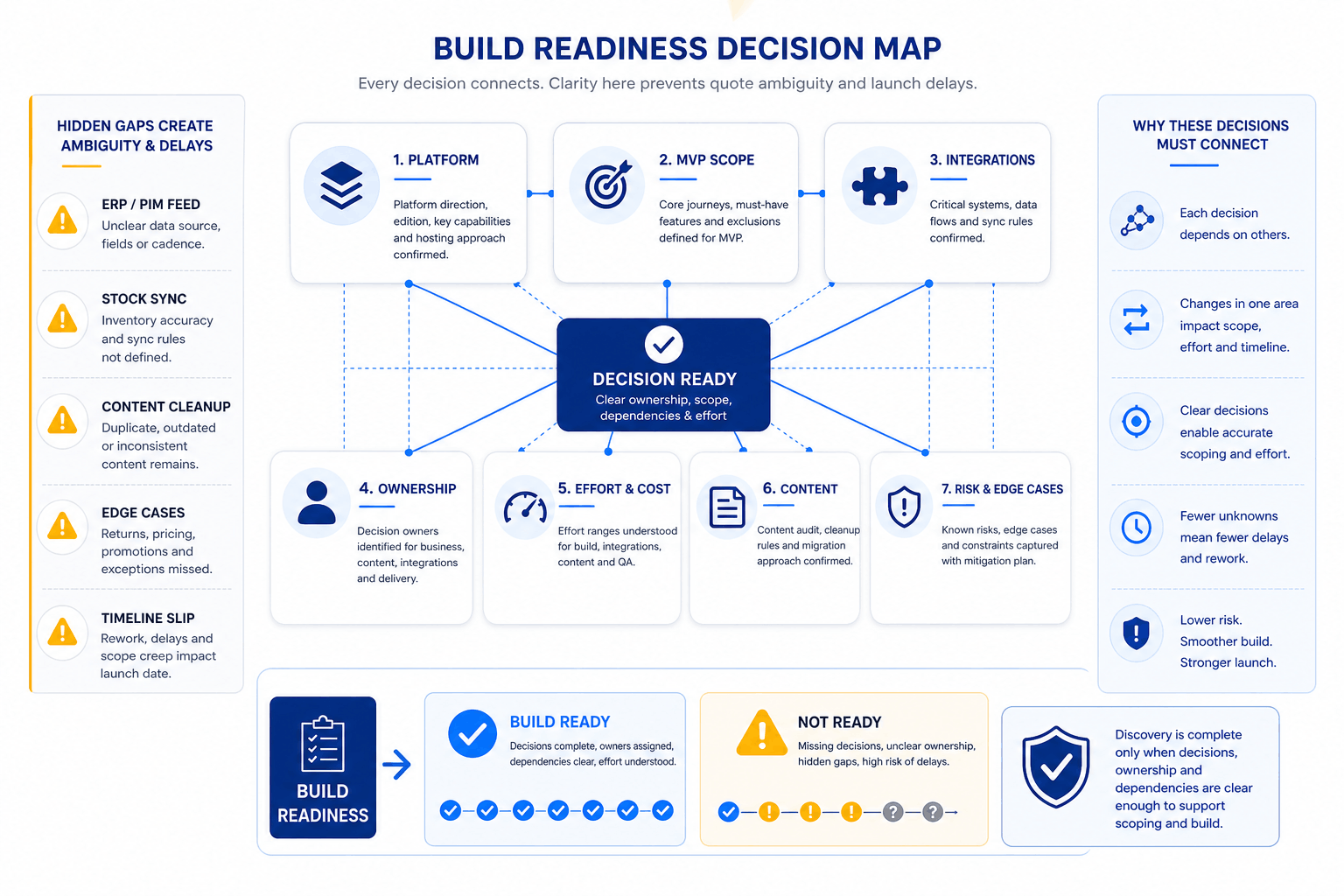
A common buyer-side failure looks like this: marketing wants a faster launch, operations assumes the ERP feed is stable, and nobody owns content cleanup. The workshop ends with broad agreement, then scoping starts and the catalogue structure turns out to be inconsistent, the inventory sync has edge cases, and launch dates slip while everyone argues about whose problem it is. If you are seeing that pattern, the workshop did not finish the job.
So ask for the next-step deliverable, not another round of facilitation. If WooCommerce is the likely fit, discovery should flow into a build plan that a WooCommerce development agency can scope cleanly. And if you are reviewing the commercial side, it also helps to review the scope before any quote is signed. Discovery should end with a delivery-ready plan. If it only creates more ambiguity with better formatting, I would not let build start yet.
Related reading: how to choose the right eCommerce development agency for a complex build.
Common questions about eCommerce discovery workshops
These are the questions buyers usually ask when they want to know whether discovery has genuinely reduced delivery risk.
1. What should an eCommerce discovery workshop produce?
An eCommerce discovery workshop should produce decision-ready outputs, not just notes. That usually includes prioritised requirements, mapped user journeys, platform trade-offs, integration dependencies, MVP scope, ownership by workstream, key risks and effort ranges with assumptions. The point is to make scoping and build more reliable, not simply to document discussion.
2. How do you know if discovery has actually been useful?
You know discovery has been useful when it changes what can be decided next. A useful workshop narrows scope, exposes hidden complexity, clarifies ownership and makes estimates more credible. If the main result is better alignment but major questions on platform, integrations or MVP are still open, discovery is incomplete.
3. Why do eCommerce projects go wrong before build starts?
eCommerce projects often go wrong before build starts because assumptions stay hidden during discovery. Common issues include vague MVP boundaries, untested integration assumptions, unclear ownership, weak content or data planning and platform decisions made without operational trade-offs. Those gaps usually surface later as quote changes, rework and delivery delays.
4. Who needs to be involved in an eCommerce discovery workshop?
The right people are the ones who own commercial priorities and operational reality. That usually means stakeholders from marketing, operations, content, technical delivery and integrations. If nobody in the room understands stock sync, fulfilment rules, ERP behaviour or product data quality, the workshop is likely to miss work that will affect scope and timing.
5. Should discovery define the MVP before development starts?
Yes, discovery should define the MVP before development starts. You do not need perfect certainty, but you do need a clear view of what is in scope, what is deferred and why. Without that boundary, estimates become unstable, priorities drift and teams end up arguing about scope during build instead of delivering against a shared plan.
6. How should platform choice be handled during discovery?
Platform choice should be handled as a trade-off decision, not a preference call. Discovery should test fit against your operating model, integration needs, content demands and delivery constraints. A credible recommendation explains why Shopify, WooCommerce, Magento or headless commerce fits the brief and what complexity each option introduces.
Conclusion
The real test of discovery is simple: does it leave you able to make hard delivery decisions with less guesswork? If not, the workshop may have felt productive, but it has not done the job that protects budget, timing and implementation quality.
Before build starts, make sure you can point to a defined MVP, visible dependencies, named ownership, platform rationale and effort ranges tied to assumptions. That is the level of clarity that reduces quote drift and avoids avoidable rework later. If those outputs are missing, ask for the missing decisions before you approve the next phase.
Need a discovery process that ends in delivery-ready decisions
Our project discovery workshops define requirements, platform fit, integrations, MVP scope, risks, and next-step deliverables so your build can be scoped with less ambiguity.
View discovery workshop serviceStill comparing options first