Key Takeaways
Headless eCommerce pricing in the UK depends more on what you are asking the architecture to do than the headless label itself. Most quotes look clean until integration complexity, migration risk and post-launch ownership appear.
- Integrations drive cost fastest: ERP, PIM, pricing tools and sync rules often add more cost than the front-end build, especially when data quality is weak or business logic is vague.
- Platform choice shapes delivery, not just price: Shopify reduces some back-end complexity but brings checkout constraints, WooCommerce can look cheaper early then charge back through plugin debt, and Magento suits heavier B2B needs but adds implementation overhead.
- Discovery and support sit outside most build quotes: expect discovery around £3k to £10k, and ongoing support from a few hundred to low thousands per month depending on release management, monitoring and framework updates.
- B2B complexity moves budgets quickly: account hierarchies, negotiated pricing, approval flows and role-based permissions are not small additions—they change the project class.
Treat any quote that lands neatly before proper scoping as provisional. The real budget includes discovery, build, migration, integrations, hosting and the support model after launch.
The quote for headless ecommerce development covers the build. It rarely covers what comes after. The front end gets a number while API gaps, migration complexity, ERP edge cases, hosting layers and post-launch support quietly wait for invoice two.
In the UK, headless ecommerce development cost typically ranges from a lean five-figure build to a six-figure replatform. The biggest price shifts come from integrations and business logic first, then front-end scope, migration, platform constraints, B2B complexity and the technical ownership you carry after launch. If you are comparing proposals or looking for eCommerce development in London, judge the architecture and delivery scope, not the headless label on the cover page.
This guide is for founders, eCommerce leads and commercial teams pricing a replatform, custom front end, ERP-connected build or B2B-heavy project before supplier selection.
What headless ecommerce development usually costs in the UK
A lean headless storefront is not priced like a full commerce transformation. Suppliers sometimes blur that line because it makes the quote look simpler than the delivery really is.
A lean headless build on an existing platform, with light design change and limited integrations, may sit around £20k to £40k. A more bespoke build with a custom React or Next.js front end, stronger CMS control and several third-party connections often lands around £40k to £80k. Add replatforming, ERP or PIM integration, migration, customer-specific logic or complex checkout behaviour, and you are usually into roughly £80k to £180k plus.
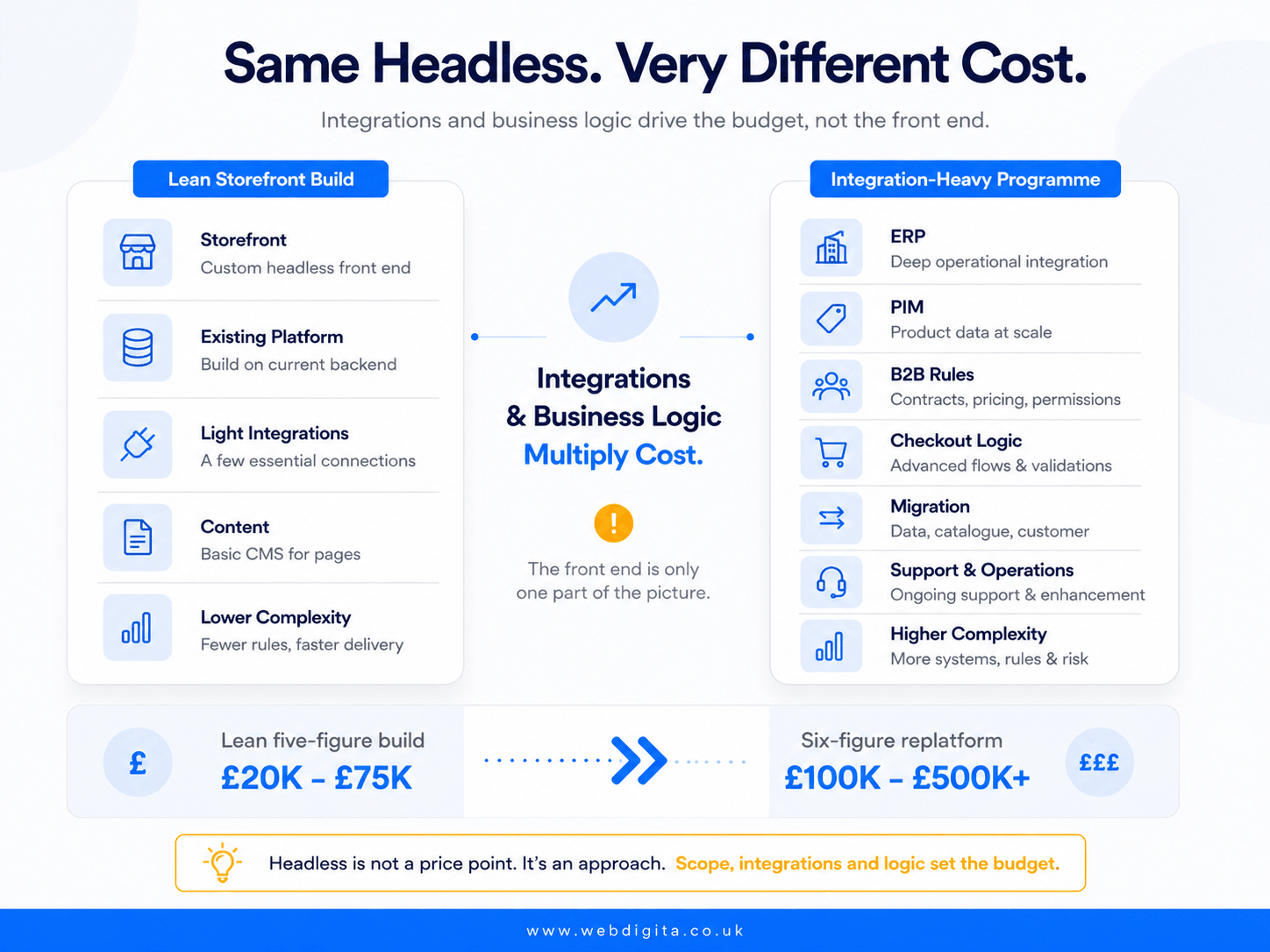
Before and after: a content-led storefront pulling product data from an existing platform is one budget. A multi-system build with ERP, PIM, B2B pricing rules and custom checkout flows is a different class of project. Teams get into trouble when they buy the second while still talking about it like the first.
Do not assume Shopify, WooCommerce or Magento alone sets the price. The platform matters, but the real cost sits in what you are asking the platform and front end to do together. If you want a wider view of what actually changes eCommerce development cost, the same rule applies here.
The cost drivers that push the quote up fastest
Most budgets move for the same reasons. The more useful question is which factors move them fastest.
In my experience reviewing builds across Shopify, Magento and WooCommerce, projects consistently look like front-end jobs right up until the integration assumptions get stress-tested – at which point they become integration programmes with a front end attached.
1. Integrations and business logic: this is usually the biggest cost driver. ERP, PIM, search, CMS, subscriptions, pricing tools and marketing platforms all bring API quality issues, field mapping, sync rules and failure modes. A project can look like a front-end rebuild until someone uncovers ERP stock ownership, customer pricing rules and order status sync. At that point, it is no longer a storefront job but an integration programme.
2. Front-end customisation: bespoke UX, flexible content models and custom component behaviour push cost up quickly. A polished demo is easy to produce. Stable, tested edge-case handling across devices, customer types and catalogue volumes is not.
3. Migration scope: catalogue, customer, order and content migration can be clean or expensive. If data quality is weak, migration stops being a line item and starts becoming a data repair programme.
4. Platform constraints: headless Shopify, headless WooCommerce and headless Magento or Adobe Commerce do not create the same delivery pattern. Shopify can reduce some back-end complexity, but app behaviour and checkout constraints still need careful handling. WooCommerce can look cheaper early on, then charge you back through plugin debt and hosting fragility. Magento and Adobe Commerce often suit heavier catalogue or B2B needs, but carry more implementation and support overhead.
5. B2B complexity: account hierarchies, negotiated pricing, approval flows and role-based permissions move cost fast. Vague B2B requirements at brief stage are not a minor gap – they are a warning sign that the project scope is not yet ready to price.
- Highest-impact warning signs: weak APIs, unclear data ownership, customer-specific pricing, approval workflows, multi-warehouse logic and late integration changes.
- Budget control move: treat unpriced migration assumptions and vague ERP rules as risk items, not footnotes.
- Scoping rule: if these areas are still fuzzy when a quote arrives, that quote is provisional regardless of how it is framed.
This is where a ecommerce project discovery work earns its keep – proper scoping exposes the dependencies before they become change requests.

Not sure if your headless quote covers the real scope
Most headless proposals price the front end but quietly skip the integration dependencies, migration risk and post-launch ownership layers. We run scoping workshops that map the full technical picture before any build commitment.
No obligation. Just a clearer view of what you are actually buying.
Cost driver matrix: project type, complexity and typical UK price range
Use this to sense-check a quote before proposal language muddies the picture.
| Project type | Typical complexity | What is usually included | Typical UK price range |
|---|---|---|---|
| Lean headless build | Low | Existing commerce platform, custom front end, limited integrations, modest content scope | £20k to £40k |
| Custom front-end build | Medium | React or Next.js storefront, bespoke UX components, CMS flexibility, search and marketing integrations | £40k to £80k |
| Replatform with migration | Medium to high | Platform move, front-end rebuild, catalogue and content migration, redirects, testing, operational setup | £80k to £130k |
| Integration-heavy or B2B eCommerce setup | High | ERP or PIM integration, customer-specific pricing, account logic, approval flows, complex data mapping | £120k to £180k+ |
Discovery can move a project up or down that range once the real dependencies are exposed. Treat any quote that lands neatly before that work as provisional, even if it is dressed up as certainty.
What the build quote usually misses after discovery and after launch
The build quote rarely covers the full ownership model. If you want a realistic budget, split discovery, launch delivery and post-launch support into separate cost lines.
Discovery cost: for most UK projects, discovery sits around £3k to £10k depending on scope. That usually covers architecture review, requirements mapping, integration checks, migration risk and acceptance criteria. It can feel like friction when you want a number quickly, but it is cheaper than building against assumptions. If you want to understand what a proper eCommerce discovery workshop should produce before build starts, that is where pricing risk usually gets reduced.
Ongoing monthly cost: headless often adds more systems, more deployment responsibility and more monitoring than a traditional build. A lean setup may need a few hundred pounds a month for hosting and routine support. A more active setup with release management, framework updates, API monitoring, bug fixing and incident handling can move into low thousands per month. Ask who owns those layers after launch and what sits outside warranty.
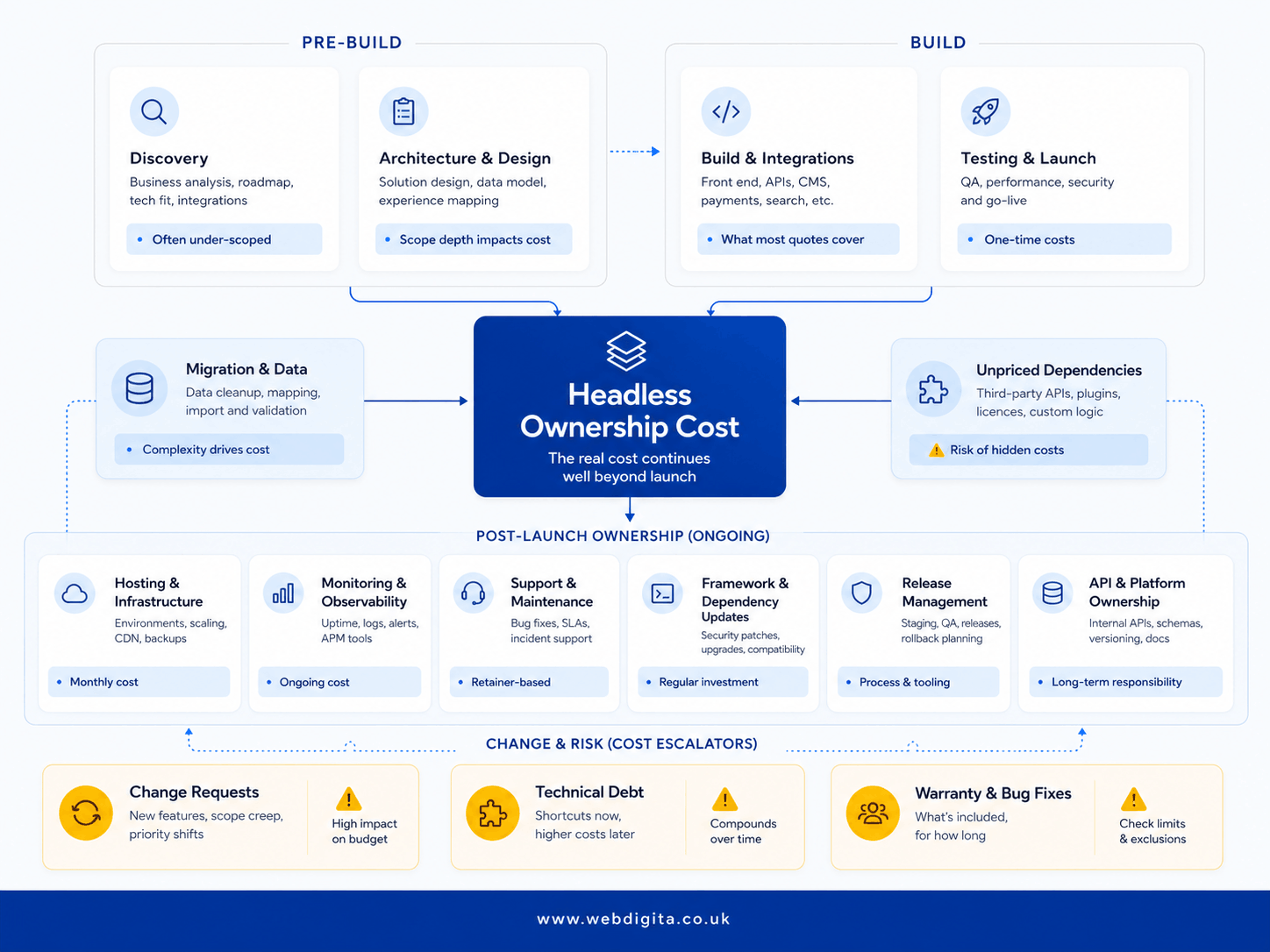
Mid-project changes: adding a new ERP rule, search tool or marketing integration halfway through is rarely a small tweak. It usually changes data mapping, testing scope and front-end behaviour. That is how scope drift turns into delay, rework and a second invoice.
When headless ecommerce is worth the extra cost
My view, having assessed builds where teams chose headless for the wrong reasons, is that the architecture earns its cost in a narrow set of conditions: when performance at scale genuinely matters, when content needs to be delivered across multiple channels or storefronts, when checkout optimisation requires logic the platform cannot support natively, or when ERP integration complexity makes a decoupled model the cleaner long-term choice.
If your store is operationally straightforward and the platform theme can already do the job, headless may only buy you extra maintenance overhead and a steeper hiring bar. The question is not whether headless is better – it is whether your business model requires what headless specifically enables.
- Ask for separate figures for discovery, build, migration, integrations, hosting and support.
- Ask who owns release management, monitoring and framework updates after launch.
- Check whether ERP, PIM, search and CMS assumptions are priced or merely mentioned.
- Treat a low quote without dependency mapping as a risk, not a win.
If you are close to supplier selection, price the support model as seriously as the build. For many businesses, the website maintenance team for their eCommerce website is where cost discipline starts, because brittle architecture either behaves after launch or starts charging rent.
And before you sign anything, review the eCommerce development scope checklist to review before signing any quote. It helps you check what the quote includes, what it quietly excludes, and whether the scope is ready to trust.
Questions buyers ask before pricing headless eCommerce development
Common questions about cost drivers, scoping and what sits outside the build quote
1. What is the typical cost of headless eCommerce development in the UK?
A lean headless build with light integrations typically costs around £20k to £40k. A custom front-end build with bespoke UX and several third-party connections often sits around £40k to £80k. Replatforming with migration, ERP or PIM integration, and complex checkout behaviour usually lands around £80k to £180k or more. The real cost depends on integrations, business logic, migration scope and post-launch support, not just the front-end framework.
2. What drives headless eCommerce development cost up fastest?
Integrations and business logic are usually the biggest cost drivers. ERP, PIM, pricing tools and sync rules bring API quality issues, field mapping and failure modes. B2B complexity such as account hierarchies, negotiated pricing and approval flows also moves cost quickly. Front-end customisation, migration scope and platform constraints add further cost, but integration complexity often outweighs them.
3. Does the platform choice affect headless eCommerce development cost?
Yes, but not always in the way teams expect. Shopify can reduce some back-end complexity but brings checkout constraints and app behaviour issues. WooCommerce can look cheaper early on, then charge back through plugin debt and hosting fragility. Magento or Adobe Commerce often suits heavier catalogue or B2B needs, but you should expect more implementation and support overhead. The platform matters, but the real cost sits in what you are asking it to do.
4. What does discovery cost for a headless eCommerce project in the UK?
Discovery for many UK headless projects typically costs around £3k to £10k depending on scope. That usually covers architecture review, requirements mapping, integration checks, migration risk assessment and acceptance criteria. Discovery exposes dependencies before they become change requests, reducing pricing risk and scope drift during build.
5. What ongoing costs should I expect after a headless eCommerce build?
Headless often adds more systems, deployment responsibility and monitoring than a traditional build. A lean setup may need a few hundred pounds per month for hosting and routine support. A more active setup with release management, framework updates, API monitoring, bug fixing and incident handling can move into low thousands per month. Ask who owns those layers after launch and what sits outside warranty before signing.
6. When is headless eCommerce worth the extra cost?
Headless is worth it when performance, content flexibility, multi-channel delivery or complex integration genuinely matter to the business model. If your store is operationally simple and the platform theme can already do the job, extra architecture may only buy you extra overhead. Judge the business case, not the technology label.
7. What should I check before signing a headless eCommerce development quote?
Ask for separate figures for discovery, build, migration, integrations, hosting and post-launch support. Ask who owns release management, monitoring and framework updates after launch. Check whether ERP, PIM, search and CMS assumptions are priced or merely mentioned. Treat a low quote without dependency mapping as a risk, not a win. A fixed quote before proper scoping is usually provisional, even if it is dressed up as certainty.
8. How does B2B complexity affect headless eCommerce development cost?
B2B complexity moves cost fast. Account hierarchies, negotiated pricing, approval flows and role-based permissions are not small additions—they change the project class. Vague B2B requirements are a warning sign, not a small issue. If these areas are still fuzzy during scoping, a fixed quote is usually theatre. Proper discovery should expose B2B logic before it becomes a mid-project change request.
Conclusion
Headless eCommerce development cost in the UK is rarely about the front-end framework. It is about how many systems need to talk to each other, how clean the data is, how complex the business rules are, and who owns the architecture after launch. A lean build with light integrations may sit around £20k to £40k, while a replatform with ERP connections, B2B logic and migration can move into £80k to £180k or more. The gap between those numbers is not the headless label—it is the engineering ownership the quote either prices properly or quietly defers.
Before you sign anything, ask for separate figures for discovery, build, migration, integrations and post-launch support. Ask who owns release management, monitoring and framework updates. Check whether ERP, PIM and CMS assumptions are priced or just mentioned. A low quote without dependency mapping is not a win—it is a risk you will pay for later. Price the support model as seriously as the build, because brittle architecture either behaves after launch or starts charging rent.
Ready to scope a headless build that accounts for the full ownership model
We deliver headless ecommerce projects with proper discovery, integration planning, migration support and post-launch ownership clarity. No vague quotes. No hidden dependencies. Just honest scoping and clean delivery.
See our eCommerce development workOr start with a