Key Takeaways
Churn is an outcome, not a diagnosis. Before you scale lifecycle activity, check whether the real issue is product expectation, reorder friction, fulfilment weakness, or bad timing.
- Separate normal buying behaviour from retention failure. Not every non-returning customer was likely to reorder quickly. Check whether your product category, buying cycle, and first-order experience justify the repeat purchase expectation.
- Use cohorts to expose where the problem starts. Compare first-order cohorts by month, product line, acquisition source, and discount dependency. Blended churn numbers hide whether the issue is getting worse or concentrated in one segment.
- Fix the leak before scaling retention spend. If the problem is product fit, delivery, support drag, or reorder friction, more email and automation just amplifies the bad experience. Match the fix to the cause.
- Watch for cross-branch symptoms. When churn spans product, experience, operations, and lifecycle, the issue usually sits between teams rather than inside one channel. Push on ownership and diagnosis before choosing the fix.
The most common mistake – you see repeat purchase softening, then throw more email, more offers, and more automation at it. That often protects the wrong metric while the real leak stays open in product fit, fulfilment, support, or the effort it takes to buy again.
Churn is usually a symptom of a weak first-order experience or a weak product-market fit, not a messaging problem. Customers do not come back when the product disappointed, reordering took effort, delivery created doubt, or support added friction. Fix the underlying experience before scaling retention activity – or you scale the irritation.
This guide is for eCommerce operators, founders, and growth leads who need retention diagnosis before changing lifecycle activity, platform priorities, or support ownership.
What churn usually hides beneath the surface
If you are trying to reduce churn in eCommerce, do not assume every non-returning customer has been lost for the same reason. Some buyers were never likely to reorder quickly, while others were pushed away by a weak first experience.
Start with the obvious question: should this customer have come back by now? If you sell replenishable products, a missed second order means something very different from a one-off gifting or occasional purchase category. Separate true retention failure from normal buying behaviour before you start fixing the wrong thing.
A common pattern is a brand with decent paid traffic and healthy first-order AOV that responds to weak repeat purchase by increasing email cadence. But if the product underwhelms, delivery disappoints, or reordering on mobile is awkward, more automation just scales the irritation. If you are also reviewing platform or UX issues, that is usually where broader eCommerce strategy support becomes part of the retention conversation, not just a build conversation.
Treat churn as a signal pointing to weak fit, broken expectations, poor post-purchase experience, or bad timing. Ignore generic advice that jumps straight to loyalty schemes or email flows before the first-order experience has been checked.
Where the real leak tends to be
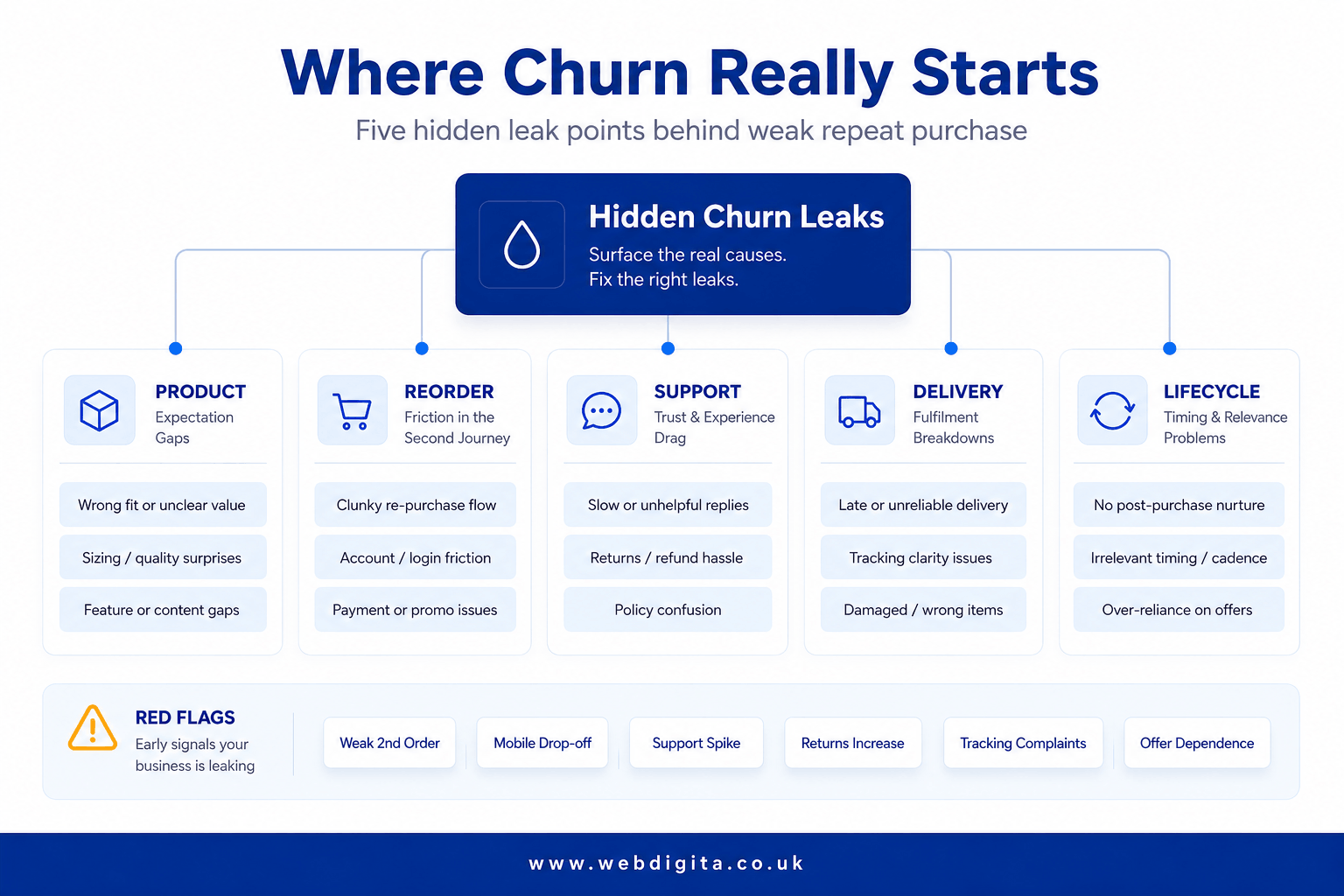
Most churn problems sit in a small number of buckets. Narrow the leak before spending more trying to patch everything at once.
Product expectation gaps: the promise was stronger than the real experience. That could be quality, sizing, ease of use, value for money, or simply a poor fit with the buyer need.
Reorder friction: customers cannot easily find past items, log back in, or complete a repeat order on mobile without effort. High LTV starts with a frictionless second purchase.
Support and trust drag: the first order created too much admin. Slow replies, awkward returns, unclear policies, or unresolved issues quietly kill the second purchase.
Delivery and fulfilment: late dispatch, poor packaging, missing updates, or unreliable stock handling are retention issues, not just operations issues.
Lifecycle timing: you are asking for the second order too early, too late, or with the wrong message for the actual replenishment cadence. Watch for that if your email automation looks active but repeat behaviour still feels flat.
- Product issue red flags: high first-order conversion but weak second-order rate, repeat complaints about fit, quality, or usefulness.
- Experience issue red flags: mobile users buy once but rarely return, repeat items are hard to find, account recovery is clumsy.
- Operational issue red flags: support tickets spike after delivery, returns create friction, stock or dispatch errors cluster around first orders.
- Lifecycle issue red flags: discount-led buyers return only on offers, replenishment reminders ignore real usage timing, and email engagement looks fine but orders do not follow.
If you are seeing several of these at once, do not guess. That is usually the point where a proper UX and journey review matters more than another campaign tweak, and a professional eCommerce UX audit can expose the friction that CRO analytics alone tends to hide.
A simple churn cause tree to diagnose the problem faster
You need a quick way to move from symptom to likely cause. Start with the visible behaviour, then test the branch before choosing the fix.
WEBDIGITA Churn Cause Diagnostic: use this to map what you are seeing to the most likely source of the leak before you change retention spend, UX, or operational ownership.
| Branch | What you see | What it usually points to | What you should check first |
|---|---|---|---|
| Product | Strong first-order take-up, weak second order, complaints about fit, value, sizing, or results | Expectation gap, weak product-market fit, over-promised proposition | Reviews, returns reasons, support themes, product-page promise versus real use |
| Experience | Customers buy once but do not browse again, mobile repeat rate is poor, repeat items are hard to locate | Reorder friction, account barriers, weak navigation, poor saved-basket or account flow | Mobile journey, account login, reorder path, search and category usability |
| Operational | Support demand rises after purchase, delivery complaints, stock confusion, damaged trust | Fulfilment weakness, support drag, returns friction, unreliable post-purchase execution | Dispatch times, tracking clarity, returns process, support response and ownership |
| Lifecycle | Automation runs, opens happen, repeat orders still lag, discount buyers behave differently | Bad timing, wrong segment logic, weak replenishment assumptions, over-reliance on offers | Replenishment window, segment rules, first-order source, discount dependency |
If the symptoms cross more than one branch, do not let teams work in silos. In my experience, churn almost always sits between product, CX, operations, and CRM rather than cleanly inside one channel – which means ownership needs to be decided before the fix is designed.

Not sure which part of the experience is causing churn?
We help eCommerce operators diagnose whether weak repeat purchase is a product issue, a reorder friction problem, or a post-purchase trust leak before you change lifecycle activity or platform priorities.
We work with brands that need clarity before changing retention spend.
Which cohorts and segments tell you the truth
Blended churn numbers are tidy, but they hide where the problem starts. You need to look at groups that behave differently, not averages that smooth the damage out.
Start with first-purchase cohorts. Compare customers by month or quarter of first order so you can see whether the issue is getting worse, improving, or tied to a specific operational period. Then split by product line, acquisition source, and first-order experience if you can. If you are unclear on what should be measured or how those segments should be defined, that is exactly where eCommerce project discovery support helps stop messy diagnosis turning into messy fixes.
The pattern that comes up repeatedly: a brand thinks it has a broad retention problem, but the real issue sits in one segment. High-AOV first buyers may return well, while discount-led buyers with low attribution quality vanish. Replenishment buyers may be healthy, while one product line creates complaints and drags LTV down across the brand.
- Compare first-order cohorts before and after any major change in product, fulfilment, support process, or acquisition mix.
- Check whether churn is concentrated in a product category, channel, or first-order discount segment.
- Separate replenishment buyers from low-fit one-time buyers so you do not misread natural behaviour as failure.
- Review second-order timing, not just whether a second order happened at all.
Ask which segment is actually worth saving, because not every one-time buyer is commercially valuable to retain. A sharp difference between acquisition sources is usually a warning sign that the promise made upstream does not match the experience delivered downstream.
How churn diagnosis should reshape your growth plan
Once you know what churn is really saying, the priority order becomes hard to argue with. Fix the leak first, then optimise the lifecycle around a better experience – not the other way around.
The clearest signal I have seen from diagnosing retention problems across eCommerce brands is this: churn dropped when the core product and post-purchase experience were fixed, not when marketing cadence increased. That pattern holds across categories. It means the businesses that focused retention budget on reducing reorder friction, tightening delivery reliability, and resolving the support issues buried in their CX data outperformed those that added more email automation on top of a leaking first-order experience.
That is why I would be wary of any growth plan that starts with lifecycle activity while the first-order experience is still creating doubt. More reminders send more people back into the same bad experience. The cost is not just wasted spend – it is attribution noise, suppressed LTV, and a harder reacquisition problem twelve months later when those buyers have moved on.
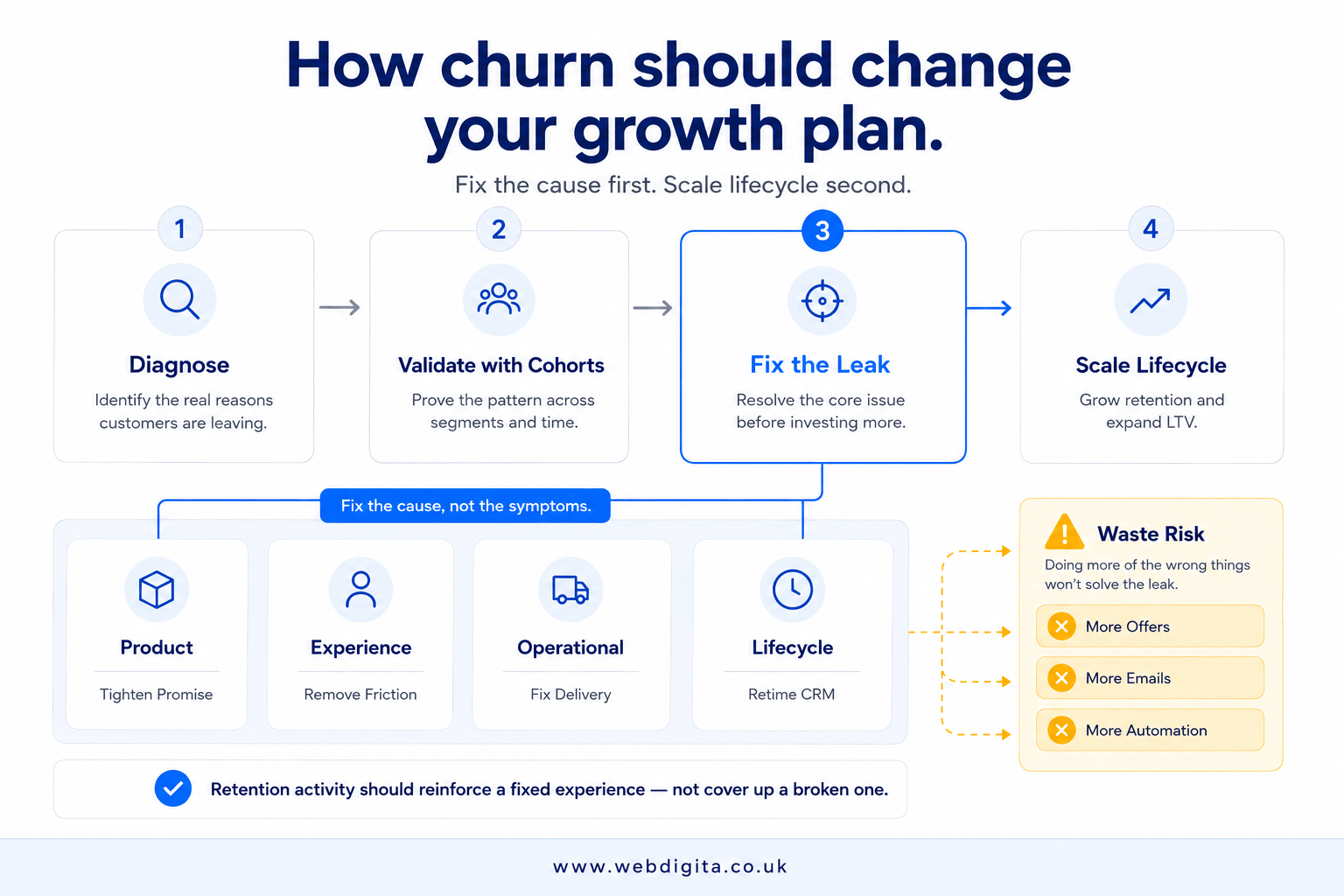
Match the fix to the diagnosed branch:
- Product expectation gap: tighten the on-site promise and improve the product reality before increasing paid traffic.
- Reorder friction: remove effort from the second purchase – account UX, mobile journey, repeat-item findability.
- Fulfilment or support drag: fix post-purchase operations before spending more to bring people back into a broken experience.
- Lifecycle timing: rebuild segment logic and replenishment windows around real usage data, not assumed cadence.
This is also why churn often sits inside the wider pattern of why eCommerce growth stalls after early success – the same underlying causes tend to show up in both places.
Leave with a simple decision rule: diagnose the branch, validate it with cohorts, then fix the underlying cause before scaling lifecycle activity. And if the issue spans platform behaviour, post-purchase operations, and ongoing store reliability, check whether your current setup has the right eCommerce maintenance support to keep retention improvements from slipping back again.
Questions buyers and operators ask about reducing eCommerce churn
Clear answers on diagnosing churn causes, fixing retention leaks, and avoiding the most common mistakes.
1. What is the most common reason eCommerce customers do not return after the first order?
The most common reason is a gap between expectation and experience. That could be product quality, sizing, delivery timing, support responsiveness, or simply a poor fit with the buyer need. If the first order underwhelms or creates effort, the second order rarely happens. Check reviews, returns reasons, and support themes before assuming the issue is lifecycle timing or email cadence.
2. How do I know if my churn problem is product-related or experience-related?
Product-related churn usually shows up as complaints about fit, quality, value, or results, combined with weak second-order rates despite strong first-order conversion. Experience-related churn tends to show poor mobile repeat rates, difficulty finding past items, or account login friction. If customers browse once but do not return, the issue is often reorder effort rather than product disappointment.
3. Should I focus on reducing churn or acquiring more new customers?
Fix churn first if your first-order experience is creating doubt, because scaling acquisition into a leaky retention model just increases waste. If your product, fulfilment, and support are solid but repeat purchase is still weak, then the issue is likely lifecycle timing or segment logic. Acquisition and retention are not either-or decisions, but churn diagnosis should come before scaling spend on either side.
4. What is the best way to segment customers when diagnosing churn?
Start with first-purchase cohorts by month or quarter so you can see whether the issue is getting worse or tied to a specific period. Then split by product line, acquisition source, first-order discount dependency, and replenishment likelihood. Compare high-AOV buyers to discount-led buyers, and separate replenishment categories from one-time purchase categories. Sharp differences between segments usually point to the real cause.
5. How much churn is normal for an eCommerce business?
There is no universal benchmark because churn depends on product type, buying cycle, and customer expectation. Replenishment products should see stronger repeat rates than occasional-purchase or gifting categories. If your second-order rate is weak relative to your product's natural replenishment window, that is a signal. Compare your cohorts over time rather than relying on industry averages that may not match your business model.
6. Can email automation reduce churn on its own?
No. Email automation can remind, nudge, and re-engage, but it cannot fix a weak product experience, reorder friction, or fulfilment problems. If the first-order experience damaged trust or created effort, more lifecycle activity just scales the irritation. Fix the underlying cause first, then use automation to support a stronger retention foundation.
7. What role does mobile experience play in eCommerce churn?
Mobile experience is often where reorder friction hides. If customers buy once on mobile but rarely return, check account login, saved basket behaviour, search usability, and the effort required to find past items. Poor mobile repeat rates usually point to experience issues rather than product issues. A clumsy mobile reorder path quietly kills second purchases.
8. How do I know if my churn problem is operational rather than marketing-related?
Operational churn shows up as support demand rising after purchase, delivery complaints, stock confusion, or returns friction. If customers are contacting support more than expected, or if fulfilment issues cluster around first orders, the problem is operational. Marketing cannot fix slow dispatch, poor packaging, or unreliable post-purchase execution. Check those areas before changing lifecycle spend.
Conclusion
Churn tells you something broke trust, fit, or effort in the first-order experience. The mistake is treating it as a lifecycle problem when the real issue sits in product expectation, reorder friction, fulfilment, or support drag.
Diagnose the branch first. Use cohorts to check whether the problem is concentrated in a product line, acquisition source, or discount segment. Separate replenishment buyers from low-fit one-time buyers so you do not misread natural behaviour as failure.
Fix the cause, then scale retention. If the leak is product or operational, more lifecycle activity just sends people back into the same bad experience. Match the fix to the real problem, validate it with cohorts, then optimise the automation around a stronger first-order foundation.
Fix the leak before you scale lifecycle activity around a broken experience
If churn is pointing to reorder friction, weak fulfilment, or product expectation gaps, more automation just scales the problem. We help eCommerce operators diagnose the real cause, then fix the platform, UX, or operational issue before retention spend becomes rework.
See how we build & support ecommerce StoresOr if you need a