Key Takeaways
Most AOV growth comes from tactics that look strong in dashboards but quietly damage contribution margin through discount cost, shipping subsidies, or fulfilment friction.
- Baseline order economics first: measure contribution margin per order, CAC payback, fulfilment cost by basket type, and return rate before testing any AOV lever.
- Favour basket architecture over blanket incentives: improve product compatibility, assortment logic, and segmented offers before reaching for percentage-off discounts or forced bundles.
- Segment by customer type and channel: new buyers, repeat customers, and high-LTV segments respond differently to basket-building tactics, so treating everyone the same usually erodes profit.
- Watch for margin leakage signals: if AOV rises while contribution stays flat, return rates increase, or paid channel conversion drops, the tactic is probably buying bigger baskets at a hidden cost.
- Test retention-linked offers over one-time incentives: strategies that improve long-term customer value typically outperform short-term basket inflation once you measure beyond the first order.
The strongest AOV strategies change basket quality and customer behaviour without training discount dependency or adding operational complexity that eats the upside.
I once worked with a brand hitting £4.2M in annual revenue. AOV had climbed 18% over two years. The founder was happy. The accountant was not. Contribution margin had dropped four points. Every bigger basket came with heavier parcels, an extra pick-pack step, or a discount that had quietly become structural. That is the trap. AOV goes up. Profit goes down. Everyone applauds.
The short answer: The AOV strategies that actually improve profit are the ones that raise contribution per order without subsidising basket size. In practice: fix basket architecture and product compatibility first, use segmentation to protect margin by channel and customer type, and treat discounts and thresholds as last resorts – not default levers. If a tactic only works with a discount attached, it is not an AOV strategy. It is a margin trade.
This guide is for eCommerce leaders, trading teams, and growth managers reviewing basket strategy, paid eCommerce traffic and revenue efficiency, or retention levers before choosing the next optimisation move. If you are looking at AOV as a growth lever – not a UX or checkout trick – this is where to start.
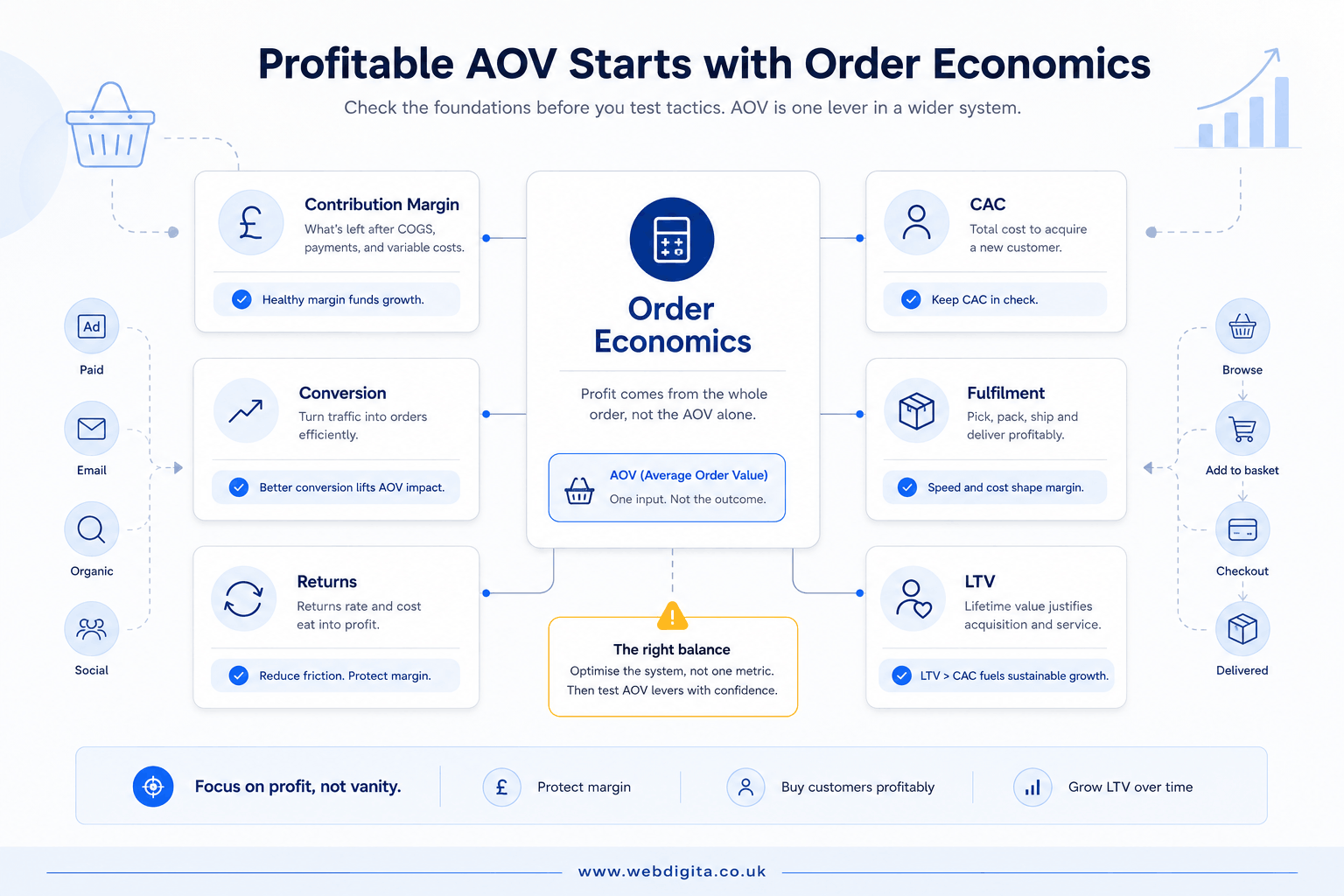
Start with order economics, not the AOV number
Before you touch offers, build a clean baseline. AOV on its own is a weak metric. It says nothing about discount cost, fulfilment drag, or whether the order was worth winning.
I have seen brands optimise AOV for six months, then discover their shipping subsidy was running at 9% of revenue. Nobody had checked.
Baseline these before testing anything:
- Contribution margin per order – not just gross revenue
- CAC and payback period by channel
- Conversion rate and checkout completion rate
- Fulfilment cost by basket type, weight, and pick-pack complexity
- Return rate by product mix or bundle type
- LTV by segment – so you know whether a bigger first basket actually improves long-term value or just inflates the first number
- Attribution by channel, so you are not attributing assisted revenue to the wrong lever
Watch for channel distortion. Paid traffic will not tolerate the same basket-building friction as returning email automation flows or branded search. And check inventory depth – pushing multi-item baskets on shallow stock creates operational problems faster than you expect.
If you want a wider margin lens on this, our piece on scaling eCommerce without eroding margin goes deeper into the commercial side of growth efficiency.
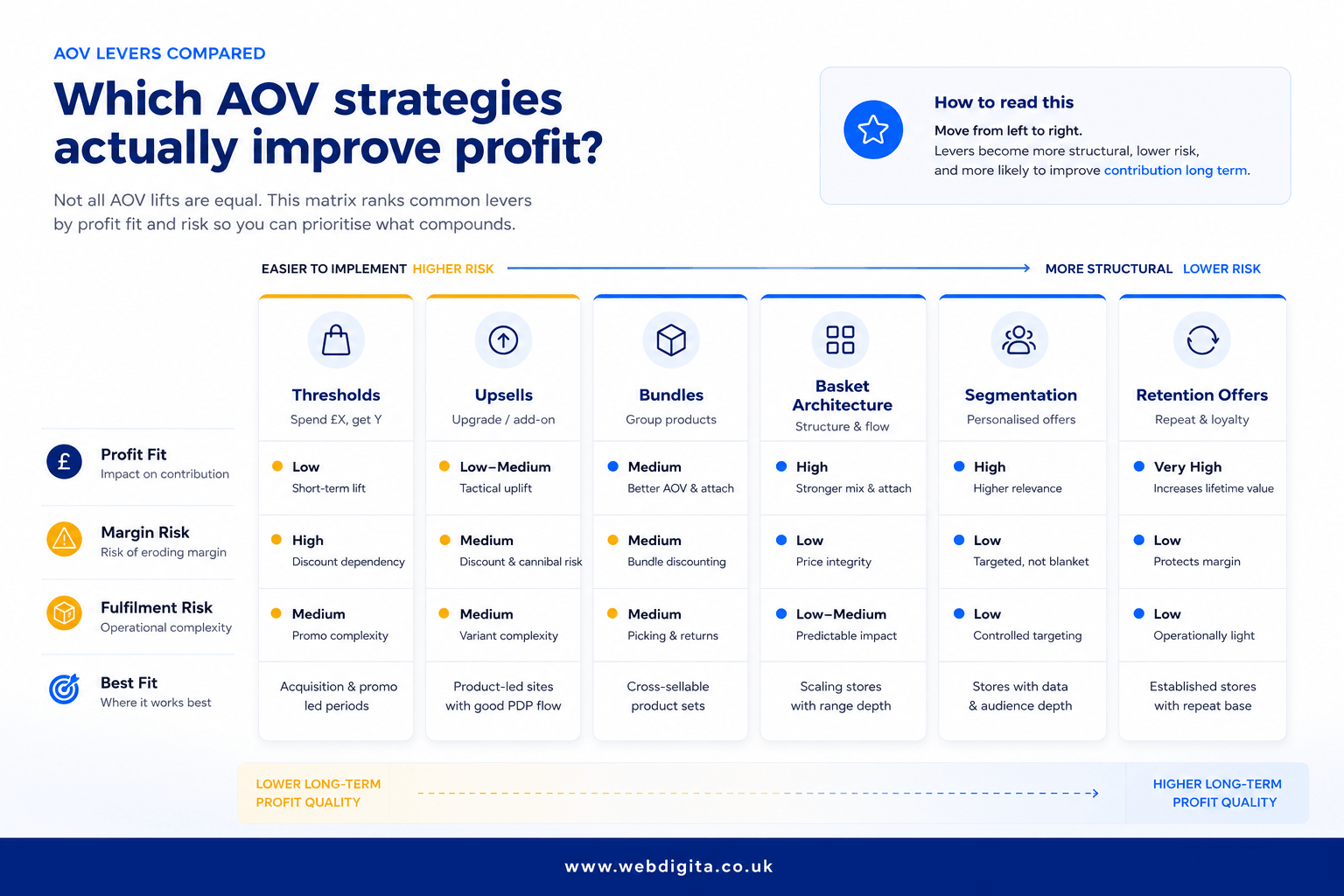
Which AOV levers usually improve profit – and which ones just buy bigger baskets
Not all levers are equal. Some reshape demand in a healthy way. Others subsidise larger baskets and leave you with more revenue but less money.
AOV Profit Fit Matrix: use this to judge whether a lever is likely to improve contribution or simply inflate basket size.
| Lever | Effort | Likely profit impact | Main risk | Best fit |
|---|---|---|---|---|
| Free shipping threshold | Low | Mixed | Shipping subsidy wipes out gain | Healthy margin, light parcels, clear gap between current AOV and threshold |
| Simple upsell or add-on | Low | Often positive | Low-fit add-ons increase returns or hesitation | Complementary products with strong attach logic |
| Bundle discount | Medium | Mixed to weak | Margin erosion and dead-stock clearance dressed as strategy | High-margin products with genuine compatibility |
| Basket architecture and assortment logic | Medium to high | Strong | Needs merchandising control and stock ownership | Brands with stable traffic and inconsistent basket composition |
| Segmented offers by customer type or channel | High | Strong | Bad data or weak execution creates complexity with no payoff | Clear differences between new, repeat, high-LTV, and promo-led buyers |
| Retention-linked offer design | High | Strongest long term | Short-term reporting consistently understates the value | Brands with repeat purchase potential and usable CRM data |
Favour levers that improve product compatibility and basket intent before you reach for discounts. I push hard on segmentation because treating every customer the same is where most AOV work falls apart. A new paid traffic buyer and a five-time retention customer should never see the same offer mechanics.
The proof of this sits in our own client work. Brands that restructure basket architecture – assortment logic, compatible product placement, landing page flows built around intent rather than volume – consistently improve both AOV and contribution margin together. Not because the offer was louder. Because the basket made more commercial sense to the buyer.
If the issue sits partly in journey friction rather than offer logic, speak with a eCommerce CRO expert as well. A profitable AOV move still needs the customer to complete the order without added hesitation.

Not sure which AOV levers will improve contribution rather than just basket size?
We can help you baseline order economics, map margin impact by lever, and identify which basket changes are worth testing first. Most brands chase AOV without checking whether the tactic improves profit or just subsidises bigger orders.
Quick diagnostic call to check your current AOV economics and next move.
What usually backfires when brands chase AOV too hard
Many AOV tactics work just well enough to look clever for a quarter. Then the margin leakage shows up – in shipping cost, weaker conversion quality, or a customer base trained to wait for the next incentive.
Discount addiction: if your basket growth depends on repeated percentage-off offers, you are not improving demand quality. You are paying customers to behave differently for a short window. That budget would work harder in segmentation, retention mechanics, or merchandising fixes.
Threshold traps: free shipping thresholds can help, but only when the gap is realistic and the basket mix still pays. The pattern I see repeatedly: brands set the threshold just above current AOV, then discover that heavier parcels and awkward product combinations have eaten the entire upside. Sometimes more.
Bigger baskets are not growth if contribution falls. That is just a nicer chart wrapped around worse economics.
Weak bundles and channel mismatch: if the bundle exists to move stock rather than solve a buying need, returns and dissatisfaction follow. And if you are pushing cold paid traffic into high-friction basket goals, do not be surprised when conversion drops faster than AOV rises. The attribution will look fine until it does not.
Watch for these signals:
- AOV rises while contribution per order stays flat or falls
- Return rate increases after bundle or add-on changes
- Paid channels show weaker conversion after threshold tests
- Operations teams report slower pick-pack or more order exceptions
- Email automation flows are carrying disproportionate revenue versus paid – possible sign that incentive mechanics are distorting channel attribution
If you see those signals, stop calling it optimisation. Recheck the economics first.
How to implement AOV strategy without discount dependency
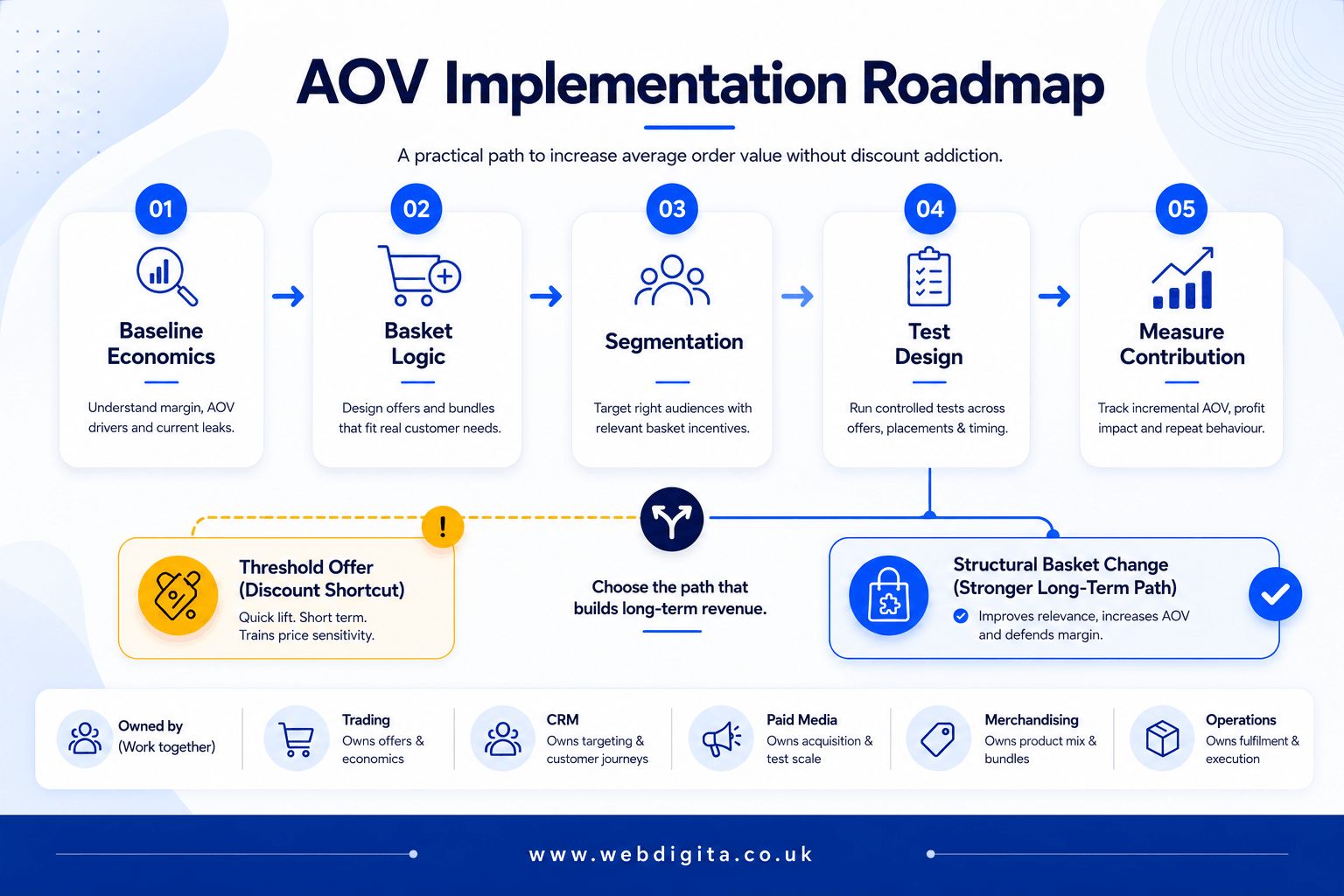
You do not need ten experiments running at once. You need a clear order of attack and owned accountability across trading, CRM, paid media, merchandising, and operations. In my experience, the brands that over-experiment on AOV usually lack that accountability structure – not ideas.
The implementation sequence that actually holds up:
- Fix assortment logic and add-on relevance first. If the basket does not make sense to the buyer, no offer will save it. Audit which products naturally attach and whether your merchandising surfaces them at the right point in the journey.
- Build segment-specific offers, not blanket ones. New acquisiton via paid traffic gets different offer mechanics than a high-LTV retention customer arriving via email. Separate the economics. Separate the tactics.
- Test thresholds only once margins and fulfilment costs are mapped. This should be the third move, not the first. Set the threshold where the parcel economics still work at the expected basket mix – not just where current AOV sits.
- Measure contribution, conversion, and fulfilment impact together. Not in separate team reports. Not in weekly GMV dashboards. Contribution per order is the number that matters.
- Treat retention as an AOV lever, not a separate function. A customer on their third order has different basket potential and different margin economics than a customer on their first. If your CRM is not informing your basket strategy, you are leaving the strongest AOV lever unused.
If the platform cannot support the merchandising, bundling, or threshold logic you need, the conversation also becomes one about technical capability.
AOV is a powerful lever. But only when it is treated as one input inside a profit-first growth system – not a vanity metric dressed up with better branding. If you want to understand where the actual upside sits in your current basket economics, that is exactly what a eCommerce revenue optimisation review is designed to surface.
If broader growth friction is part of the problem, it is worth reading why eCommerce growth stalls after early success. AOV is only one lever. Growth efficiency is the system it sits inside.
Questions buyers ask before changing AOV strategy
Common concerns about improving average order value without damaging margin or conversion quality.
1. What is a realistic AOV improvement without damaging margin?
A realistic AOV improvement depends on your current basket economics, but most profitable gains sit between 8% and 20% when driven by better product compatibility, segmentation, or retention-linked offers rather than blanket discounts. If you are relying on percentage-off incentives or free shipping subsidies to hit those numbers, contribution margin usually stays flat or falls. The strongest improvements come from structural changes to assortment logic, add-on relevance, and customer-specific offers that raise basket value without eroding per-order profit.
2. Should I use a free shipping threshold to increase AOV?
A free shipping threshold can work if the gap between current AOV and the threshold is realistic, your products are light enough that shipping cost does not wipe out the gain, and customers are not forced into awkward product combinations to qualify. If the threshold is set too high or your basket mix includes heavy or bulky items, you often end up subsidising larger orders without improving contribution. Test the economics carefully and watch for increased cart abandonment or weaker conversion on paid channels before rolling it out widely.
3. How do I know if my AOV strategy is actually profitable?
Measure contribution margin per order, not just gross revenue or AOV alone. Track fulfilment cost by basket type, return rate after bundle or add-on changes, conversion rate across channels, and CAC payback by segment. If AOV rises but contribution stays flat, return rates increase, or paid traffic conversion drops, the strategy is probably buying bigger baskets at a hidden cost. The best AOV strategies improve both basket size and per-order profit without damaging conversion quality or operational efficiency.
4. What is the difference between basket architecture and discount-led AOV tactics?
Basket architecture focuses on improving product compatibility, assortment logic, merchandising relevance, and customer segmentation to naturally increase basket size and quality. Discount-led tactics use percentage-off offers, free shipping thresholds, or bundle discounts to incentivise larger orders. The first approach typically improves contribution margin and long-term customer behaviour, while the second often inflates baskets temporarily but erodes profit and trains discount dependency. Most brands get better results from fixing basket structure before layering on incentives.
5. Which AOV levers work best for repeat customers versus new buyers?
Repeat customers typically respond better to retention-linked offers, loyalty rewards, subscription upsells, and product recommendations based on purchase history because they already trust the brand. New buyers usually need simpler basket logic, lower-friction add-ons, and clear value communication rather than complex bundles or high thresholds. Treating both segments the same often means over-discounting repeat buyers or creating too much friction for first-time purchasers. Segmented AOV strategies almost always outperform blanket tactics once you have usable customer data.
6. How do I avoid training customers to wait for discounts when testing AOV offers?
Avoid running repeated percentage-off promotions or blanket discount codes as your primary AOV lever. Instead, focus on structural improvements such as better product bundling, smarter add-on suggestions, segmented offers for specific customer types, and retention-linked incentives that reward behaviour rather than subsidise every order. If you do test discount-based tactics, limit them to specific channels, customer segments, or time windows rather than making them always-on. The goal is to improve basket economics through better merchandising and relevance, not train customers to expect a discount every time.
7. What role does platform capability play in AOV strategy?
Your platform needs to support the merchandising logic, bundling rules, segmentation triggers, and threshold mechanics required for profitable AOV tactics. If your store cannot handle dynamic product recommendations, customer-specific offers, or flexible shipping rules cleanly, most advanced AOV strategies will either fail technically or require expensive workarounds. Weak basket logic, poor add-on placement, or rigid checkout flows often limit what you can test. Before committing to a complex AOV strategy, check whether your platform can actually execute it without creating friction or operational mess.
8. Should I prioritise AOV or conversion rate first?
Prioritise conversion rate if your current checkout experience has clear friction, weak trust signals, or high abandonment. Prioritise AOV if conversion is stable but basket composition is weak, customers are buying single low-margin items, or you have clear opportunities to improve product compatibility and add-on relevance. In most cases, fixing conversion issues first gives you a cleaner baseline to test AOV tactics against. Pushing AOV strategies on top of a broken checkout usually makes both metrics worse.
Conclusion
The AOV strategies that improve profit are the ones that make baskets more commercially sensible, not just bigger. That means starting with contribution economics, favouring product compatibility and segmentation over blanket discounts, and measuring fulfilment impact alongside revenue. If a tactic needs heavy incentives or creates operational friction to work, it is probably buying short-term basket growth at the expense of long-term margin.
Before testing another threshold or bundle, check whether your current basket architecture, add-on logic, and customer segmentation are actually fit for purpose. Most brands have more upside in fixing assortment relevance and segment-specific offers than they do in layering another discount mechanic on top of weak fundamentals. Get the economics right first, then test the levers that reshape demand quality rather than subsidise it.
Ready to improve basket economics without relying on discounts or shipping subsidies?
We work with eCommerce brands to build profitable AOV strategies grounded in contribution margin, customer segmentation, and basket architecture. If your current approach depends on blanket incentives or threshold games, we can help you find a better path.
See our eCommerce development servicesOr start with