Key Takeaways
App AI optimises inside one tool, but a private decision layer keeps pricing, recommendations, segmentation and routing rules under your control across the entire stack. That matters when decisions affect margin, customer experience or governance.
Without a private layer, each app makes its own call from local signals. With one, they all act on the same rules, priorities and first-party data.
- Visibility: You can see, test and override the logic behind every important decision, not just the output.
- Consistency: Onsite, CRM and automation work from shared rules instead of creating disjointed customer experiences.
- Portability: Business logic stays with your team, making platform changes faster and less risky.
- Governance: Human approval, rollback rules and audit trails protect margin-sensitive or trust-critical actions.
Black-box AI is convenient until it makes a business decision your margin model never agreed to. Smart eCommerce brands build private AI decision layers because built-in app AI is designed to optimise inside one tool – not to protect your margin model, customer experience or governance across the stack.
A private layer keeps your business rules, CRM logic, lifecycle stage definitions, attribution workflows and fallback controls in your hands, while apps still handle execution. Without it, your pricing, recommendations and segmentation logic ends up scattered across vendor settings that are hard to inspect, test or reverse.
This guide is for eCommerce leaders, operations owners, CRM teams and merchandising teams weighing how much control to hand over to app AI before rollout.
What a private AI decision layer actually is
A private AI decision layer is a brand-owned logic layer that sits above or between your apps. In practice, that often means middleware or orchestration through tools such as n8n, where your rules decide what should happen before a platform, CRM or automation tool carries it out.
The key difference is straightforward. Without a private layer, your recommendation engine, CRM and automation platform may each make their own call from local signals. With a private layer, they all act on the same rules, priorities and first-party data signals.
That matters most when the decision affects margin, trust or customer experience. If you are working with a MarTech systems partner, it is worth settling this early – because once logic is scattered across apps, fixing it later gets slower and more expensive.
Why black-box app logic becomes a commercial problem
The issue is not that app AI is bad. It becomes risky when the decision matters commercially and nobody can explain why the tool acted the way it did.
Visibility matters. If your team cannot see why a product was promoted, a customer was routed or a lifecycle stage was changed, proper testing becomes difficult. You need to see the inputs, weighting and fallback rules, not just the output.
Local optimisation creates drift. One app may optimise for click-through, another for conversion, another for engagement. Each tool can look sensible in isolation while the overall customer journey becomes fragmented and commercially inconsistent.
The signals that usually tell us a private logic layer is overdue:
- Your team cannot explain or reverse important AI-led decisions quickly.
- Different tools are using different CRM logic and lifecycle stage definitions in the same journey.
- Margin-sensitive actions sit inside vendor settings nobody clearly owns.
- A platform change would mean rebuilding hidden business logic from scratch.
- Attribution workflows and data sync are inconsistent across tools.
Portability matters too. When business logic lives inside one vendor, switching tools gets harder than it should be. That is often part of why eCommerce growth stalls when systems and decisions become fragmented.
Where private AI decision logic matters most
We do not recommend building a private layer for every AI task. The calculus changes when the decision touches pricing, recommendations, segmentation or routing – especially when more than one system needs to act consistently.
Pricing rules should sit with merchandising, operations and finance – not inside an app setting. Recommendations need merchandising ownership too, particularly when stock position, returns risk or category margin strategy matters as much as click-through rate.
Here is where things typically break down. A customer sees premium product recommendations onsite, then receives discount-led follow-up emails because the CRM scored them differently using separate lifecycle stage logic. Each tool is acting sensibly by its own rules, but the brand experience – and the margin outcome – becomes incoherent. With a shared decision layer, onsite, CRM, automation and lead scoring workflows all act from the same ruleset.
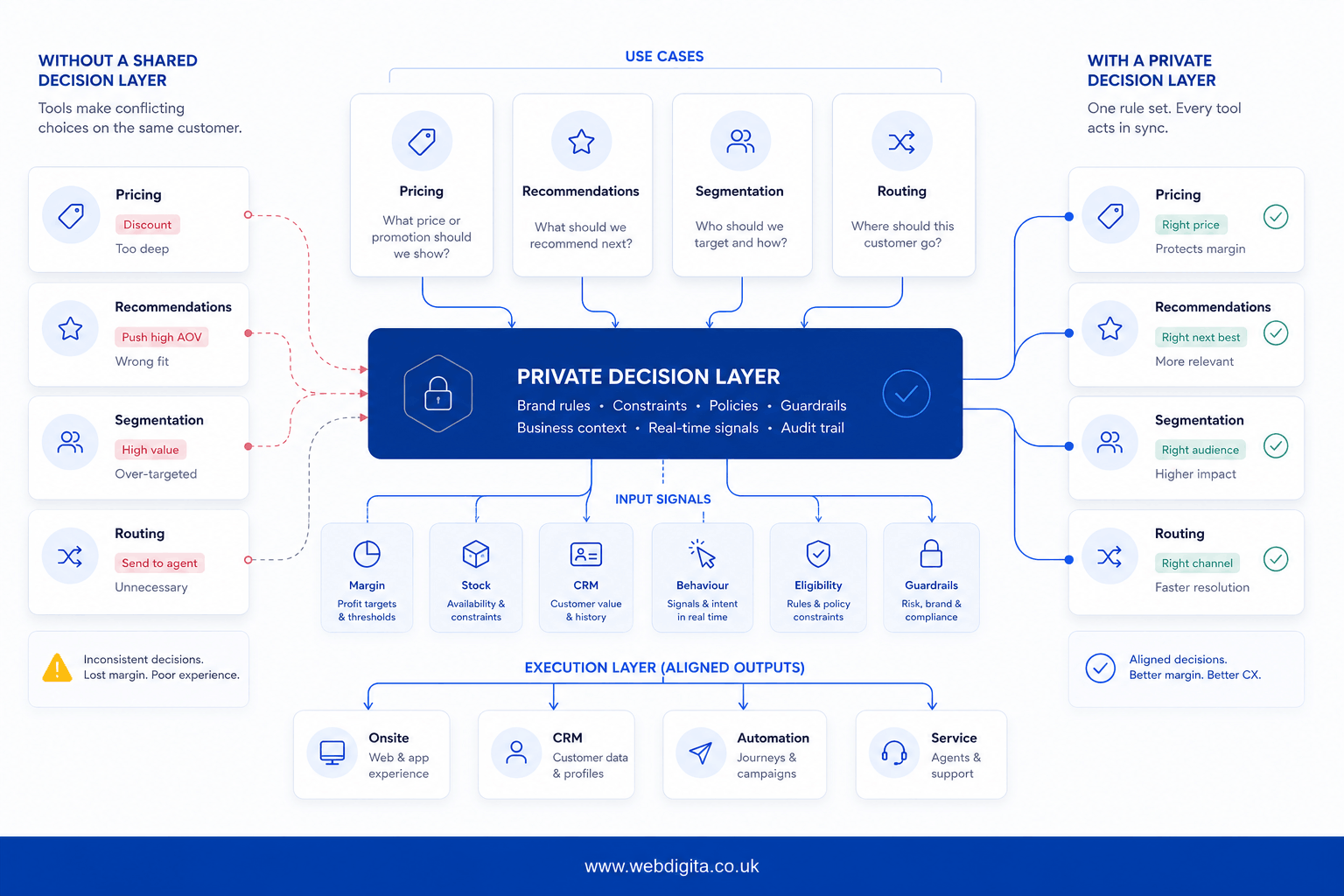
Segmentation and routing often sit with CRM and operations, with leadership setting the guardrails for service levels or sensitive customer groups. Lifecycle stages, value bands, channel source and eligibility rules should be defined once and reused everywhere – not rebuilt independently inside separate automation tools.
In our experience, better AI outcomes come when the business owns the decision rules and lets tools execute inside guardrails. When ownership is still unclear across teams, a project discovery workshop is often where those hidden assumptions surface before they turn into delivery problems.
This connects closely to AI merchandising decisions that protect margin, not just revenue – where the wrong optimisation target can look strong in-platform but weak commercially.

Not sure where your AI logic should live?
We help eCommerce teams map which decisions should stay inside apps and which ones need brand-owned control before rollout. Get a free personalised roadmap that shows where your AI governance gaps sit and what to fix first.
No sales pitch. Just a clear view of your AI decision architecture.
Private AI decision-layer architecture
You do not need a large custom platform to do this well. You need a clear flow of data, rules, approvals and execution, with the business owning the decision points that matter most.
Use this table to check where business logic should live before you let apps or LLMs act on customer-facing decisions.
Private AI decision-layer architecture:
| Layer | What sits here | What to check |
|---|---|---|
| Inputs | First-party data, CRM fields, stock, margin signals, customer behaviour | Check data quality, ownership and data sync reliability before adding AI |
| Business rules | Thresholds, exclusions, priorities, brand guardrails, approval rules | Define what AI must never override |
| Orchestration | Middleware or workflow layer such as n8n | Keep routing, logic and logging visible to your team |
| LLM support | Classification, summarising, lead scoring support, decision drafting | Do not let the model own final commercial decisions |
| Override and governance | Human approval, rollback rules, attribution audit trail, fallback actions | Know who can stop, change or review decisions quickly |
| Execution apps | eCommerce platform, CRM, HubSpot workflows, automation and merchandising tools | Let apps execute, but not silently redefine business policy |
Where human approval still matters
If the action affects price, eligibility, service level or a sensitive customer segment, keep a human checkpoint or a hard fallback rule. Full automation is not the goal – reliable automation is. One wrong decision passed silently through a HubSpot workflow or CRM automation can create avoidable cost or erode customer trust in ways that take months to reverse.
When to keep app AI – and when to build your own layer
Built-in app AI is often the right call for narrow, low-downside execution tasks. Testing subject lines, summarising support tickets, ranking low-risk content variants, classifying inbound leads for initial routing – none of these typically need a private layer.
Once decisions cross tools, affect margin, shape customer journeys or need a clear rollback path, the balance shifts. The four questions we use with clients to make that call:
- How expensive is a wrong decision? If the answer involves margin, customer trust or service failure, stronger controls are worth building.
- How many systems need to agree? If more than one tool is involved – CRM, automation, onsite merchandising – shared logic usually matters more than local app intelligence.
- Do you need rollback and explanation? If yes, black-box vendor settings are rarely sufficient. You need an attribution trail and defined fallback actions.
- Who owns the rule? Merchandising, CRM, operations, finance or leadership should be able to answer that clearly. If nobody can, the rule is living in the wrong place.
If you are running a live store, think beyond initial rollout. Rule changes, app updates and workflow drift over time are exactly why ongoing eCommerce maintenance matters once AI-driven logic becomes part of day-to-day trading.
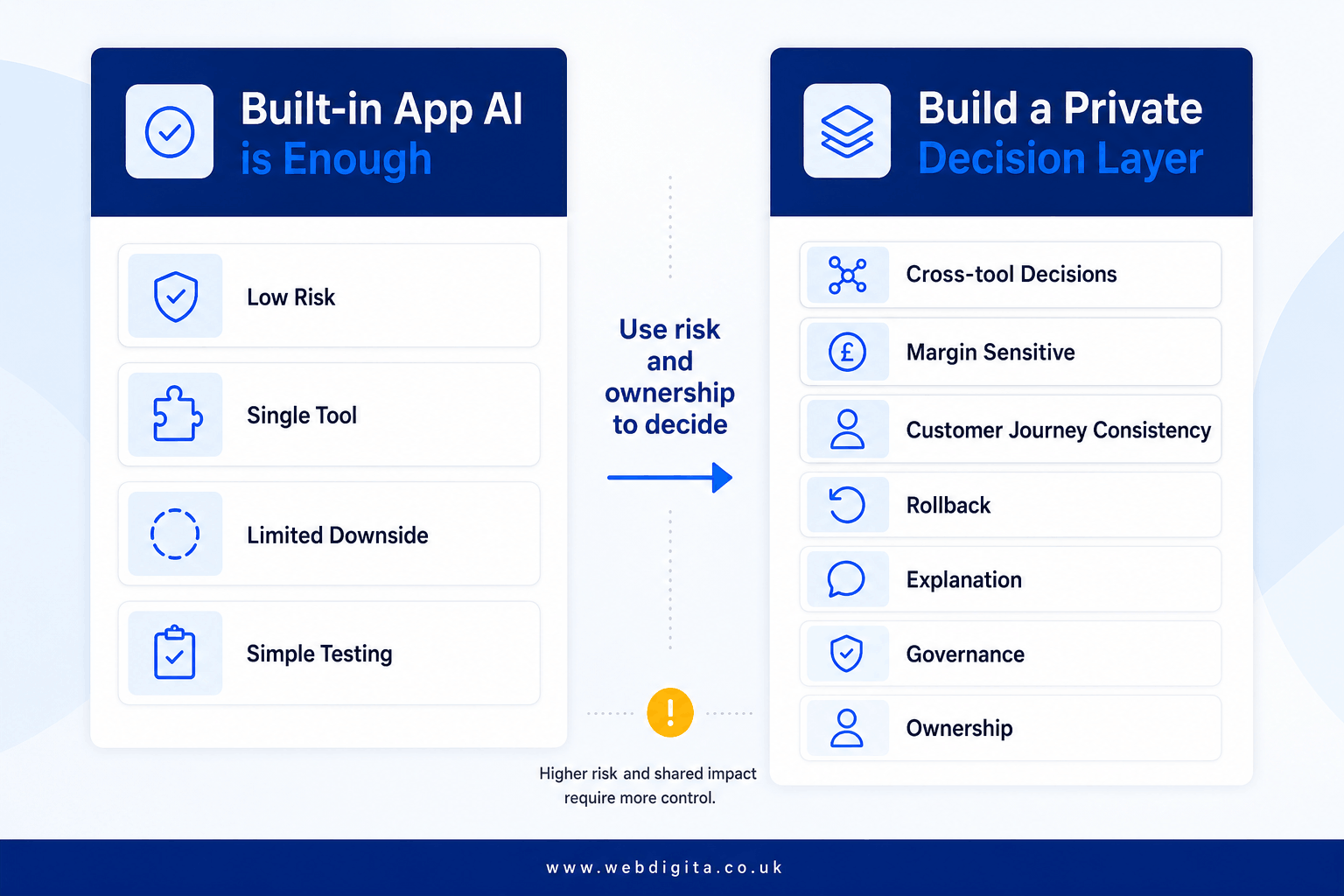
The answer is not all-or-nothing. Use built-in app AI for speed where risk is low. Build your own decision layer where the business needs consistency, CRM coherence, clear ownership and the ability to explain or reverse what happened. A practical first step is mapping which decisions can stay inside your tools and which ones your brand should own – before they are already live.
Questions teams ask before building a private AI decision layer
Practical answers on architecture, ownership, risk and when to keep logic in-house rather than inside app settings.
1. What is a private AI decision layer in eCommerce?
A private AI decision layer is a brand-owned logic layer that sits above or between your apps, usually through middleware or orchestration tools such as n8n. It ensures your rules decide what should happen before a platform, CRM or automation tool carries it out. The key difference is that all systems act on the same rules, priorities and first-party signals, rather than each app making its own call from local data.
2. When should you build your own decision layer instead of using built-in app AI?
Build your own layer when decisions cross multiple tools, affect margin, shape customer journeys or need clear rollback and explanation. If a wrong decision is expensive, if more than one system needs to agree, or if merchandising, CRM, operations or finance need to own the rule, a private layer usually makes sense. Use built-in app AI for narrow execution tasks with limited downside, such as subject line testing or low-risk content ranking.
3. What decisions should sit in a private layer rather than inside app settings?
Pricing rules, product recommendations, customer segmentation and routing decisions should usually sit in a private layer when they affect margin, trust or service levels. These decisions often need input from merchandising, operations, finance or leadership, and they need to work consistently across onsite, CRM and automation. If the decision matters commercially and involves more than one tool, it belongs in your layer, not buried inside vendor settings.
4. How do you keep human approval in an AI-driven decision layer?
Keep a human checkpoint or hard fallback rule for actions that affect price, eligibility, service level or sensitive customer segments. In practice, that means building approval workflows into your orchestration layer, setting thresholds that trigger manual review, and maintaining clear audit trails. Full automation is not worth much if one wrong decision creates avoidable cost or trust issues, so define what AI must never override before rollout.
5. What tools do you need to build a private AI decision layer?
You need middleware or orchestration tools such as n8n to route data, apply business rules and log decisions. You also need clean first-party data from your CRM, eCommerce platform and stock systems, plus clear ownership of thresholds, exclusions and priorities. You do not need a huge custom platform. The key is keeping routing, logic and logging visible to your team, with execution apps carrying out decisions rather than silently redefining business policy.
6. Why does black-box app AI become a commercial problem?
Black-box app AI becomes risky when the decision matters commercially and nobody can explain why the tool acted the way it did. Without visibility into inputs, weighting and fallback rules, proper testing becomes difficult. Local optimisation can also create drift, where one app optimises for clicks, another for conversion and another for engagement, making the overall customer journey feel disjointed. Portability suffers too, because switching tools means rebuilding hidden logic from scratch.
7. Can you use LLMs inside a private decision layer?
Yes, but use LLMs for classification, summarising, suggestion or decision support, not for owning final commercial decisions. The LLM can help interpret signals, rank options or draft recommendations, but your business rules, thresholds and approval logic should sit above it. That way, you keep the speed and flexibility of AI while protecting margin, customer experience and governance across the stack.
Conclusion
Built-in app AI works well for narrow execution tasks with limited downside. Once decisions cross tools, affect margin or shape customer journeys, the balance shifts towards shared rules, approvals and fallback paths your team can inspect and control.
Use built-in AI for speed where the risk is low, and build your own decision layer where the business needs consistency, control and clear ownership.
Map which decisions can stay inside tools and which ones your brand should own before rollout. If the action affects price, eligibility, service level or a sensitive customer segment, keep a human checkpoint or a hard fallback rule. The right architecture protects commercial logic while letting apps do what they do best: execute quickly inside guardrails you define.
Ready to build AI logic your team can actually inspect, test and override?
We help eCommerce brands build private AI decision layers that keep pricing, recommendations, segmentation and routing under your control while apps handle execution. Our MarTech systems work protects margin, customer experience and governance across your stack.
Explore MarTech systems workPrefer to talk first?