Key Takeaways
A proper eCommerce SEO process settles decisions rather than leaving them vague. Discovery should diagnose platform limits, indexation patterns, and team ownership before recommendations are made. Strategy should produce clear rules for category targeting, variant canonicals, faceted navigation, and out-of-stock handling before development starts.
Implementation handoff: Recommendations must become tickets with acceptance criteria, named owners, and validation steps across development, content, and merchandising. Without this, SEO ideas survive in decks but fail in release cycles.
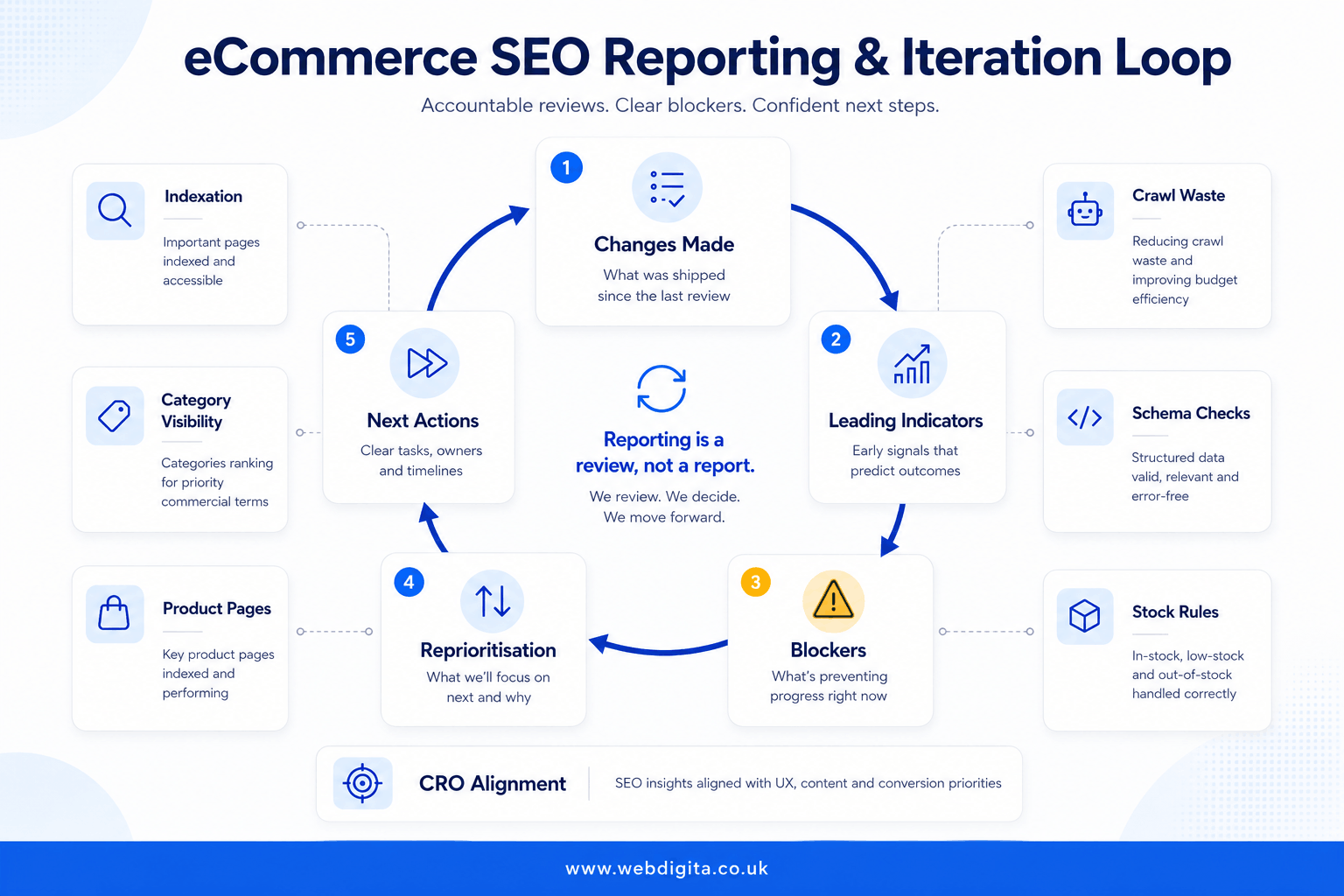
Reporting and iteration: The process does not stop at delivery. Review loops should track indexation quality, non-branded traffic movement, blocked actions, and reprioritised work as the catalogue and platform evolve over time.
Most eCommerce SEO projects go wrong not because of technical failure but because the process was skipped. I have audited enough stores to recognise the pattern: audit documents exist, keyword sheets exist, monthly reports arrive – and the store still has unresolved faceted navigation, messy variant canonicals, weak product templates, and no named owner for implementation. The work happened. The process did not.
Short Answer: A rigorous eCommerce SEO process runs through five phases: discovery, strategy, implementation planning, execution support, and measurement. Discovery produces a risk and dependency map, not just a crawl report. Strategy settles architecture decisions – canonical rules, faceted navigation policy, category targeting. Implementation translates those decisions into development tickets with acceptance criteria. Without that structure, recommendations rarely survive handoff into development or merchandising.
This guide is for eCommerce managers and buyers comparing agencies or consultants. It covers what should happen at each phase, what good output looks like, and – just as useful – what it looks like when a supplier is cutting corners. For context on the full technical scope of what eCommerce SEO services, covers that is useful groundwork before comparing suppliers.
What a real eCommerce SEO process includes before any recommendations are made
Discovery is supposed to be diagnosis. What I see consistently is a crawl export, a keyword list, and a loose findings deck – presented as a completed audit. It is not. That is access configuration billed as strategic work.
A serious technical audit on an eCommerce site needs to go further than page count, redirect errors, and missing meta descriptions. Here is what it actually needs to cover – and why each element matters for a store specifically, not a generic website.
Crawl budget and where it is going
On any store above 10,000 SKUs, crawl budget is a real constraint. Faceted navigation is usually the source of the problem: filter combinations – size, colour, price range, brand, material – can generate tens of thousands of unique URL permutations. Many of those URLs carry no distinct ranking value but consume Googlebot’s crawl allocation regardless. I have reviewed Magento stores where faceted navigation URLs made up over 80% of crawlable pages, while priority category and product pages were being crawled at a fraction of the rate they needed. A technical audit should show you the crawl coverage breakdown, where the budget is going, and which high-priority templates are being under-served.
Faceted navigation behaviour – in detail
Most eCommerce SEO audits surface faceted navigation as a risk area and stop there. A proper review looks at: which filter combinations create new URLs, which of those URLs are currently being indexed, what signals those indexed URLs carry (internal links, canonical tags, title tag duplication, thin content), and whether crawl directives across robots.txt, noindex tags, and canonical references are consistent or conflicting. Conflicting signals are more common than most audits catch – a page can be canonicalised to a parent URL and still appear in the index if it carries inbound internal links without the canonical being respected consistently. The platform matters too. Shopify handles faceted navigation differently than Magento or WooCommerce, and the correct remediation depends on platform-specific behaviour, not a generic recommendation lifted from an SEO playbook.
Variant canonical strategy
Colour, size, and specification variants create duplication that compounds on large catalogues. The audit should document what canonical structure is in place across the product range, whether it is functioning as intended (many are not – canonical tags get dropped during theme updates or platform migrations), and how Google is actually treating those URLs according to Search Console’s Index Coverage report. A sample-based spot check is not enough on a 5,000+ product store.
Product template quality and duplication patterns
Product pages on large catalogues often share near-identical content across variants or within categories. The audit should identify whether this is a template problem (the same boilerplate copy across thousands of pages), a content absence problem (thin pages with no descriptive content beyond product data and specs), or a site architecture problem (subcategory pages with near-identical H1s cannibalising each other for the same search terms). These have different fixes, and diagnosing the wrong one wastes the first three months of implementation.
Core Web Vitals by template type
Core Web Vitals performance should be measured and reported by page type, not at domain level. Product pages typically struggle with LCP (hero product images, often served from third-party CDNs without appropriate sizing), CLS (review widget iframes, cookie banners, or lazy-loaded images with missing dimensions), and INP (add-to-cart handlers and interactive elements that fire slowly under load). Category pages have their own patterns – usually infinite scroll or pagination-related layout instability. The deliverable should tell you which templates are failing, which elements are responsible, and which teams own those elements.
Platform dependencies and implementation constraints
This is what most agency audits skip because it requires talking to your developers, not just running tools. What can actually be changed on this platform, in this version, with this release cadence? A Shopify store on a locked theme has different constraints than a headless Magento 2 build. A strategy built without that input will collide with reality the moment implementation begins – usually on the second or third recommendation, when development comes back to say it cannot be done without a custom module and a six-week build.
A discovery phase should end with a prioritised risk and dependency map. Not a raw findings document. You want to see which issues are blocking others, which are low-effort and high-impact, and which require significant development resource before anything else can move. Without that sequencing, the strategy phase has nothing solid to build from.
If a supplier cannot answer these directly after discovery, the process is still at the activity stage:
- What, specifically, is consuming crawl budget on this site – and at what scale, not just in general terms?
- Have they reviewed faceted navigation URL generation, canonical tag consistency across the full product range, and product template duplication patterns – or just flagged them as areas of interest?
- Have they identified platform-specific constraints that will affect what can actually be implemented?
- Will the deliverable be a sequenced, dependency-ordered roadmap, or another findings document with no implementation logic?
How strategy should turn audit findings into architecture and page-level decisions
This is where weaker suppliers drift into theory. A strategy phase that ends without settled decisions is not a strategy – it is a document that defers every hard question into delivery. I have seen strategy decks that ran to 60 slides and still left every implementation question open. The developer opens it, asks which filter pages should be noindexed, gets told “it depends”, and either guesses or waits. Both outcomes are expensive.
Three categories of decision need to be made and documented before implementation begins.
Architecture and keyword targeting
Which pages should rank for which terms? Category page hierarchy and keyword mapping need to be explicit – not “category pages should target head terms” as a principle, but specific: this URL targets this keyword, that URL is a supporting page that feeds internal link equity upward to the primary. Without that level of specificity, internal linking structure cannot be designed correctly, and you end up with category pages competing against each other for overlapping terms. That is one of the most common causes of eCommerce organic traffic plateaus, and it is almost always a strategy gap, not a content gap.
Crawl and indexation rules for every URL pattern
Every filter parameter, pagination pattern, and URL variant needs a decision: crawl and index, crawl but noindex, or block from crawl entirely. That decision should be driven by search demand data and page quality signals, not blanket rules applied without investigation. If /colour/blue has meaningful search volume and can produce a quality, distinct landing page, it may be worth indexing. If /size/L/colour/blue/material/cotton generates a URL with no search demand, near-duplicate content, and zero inbound links, it belongs outside the index. The same logic applies to pagination pages, internal search result URLs, out-of-stock product pages, and seasonal categories. If product URLs disappear, redirect, or stay live without a documented rule, visibility and internal linking value erode faster than most teams notice. It is worth reviewing how to handle out-of-stock product pages without losing rankings before implementation begins, because the decisions made there feed directly into redirect and canonical strategy across the whole catalogue.
Content and template standards
What does a well-optimised category page look like on this specific store? What content elements are required at template level – introductory copy, FAQs, internal navigation links, schema markup? What keyword targets are being addressed, and at what word count? These standards need to be written down and agreed before any content or template work begins. Otherwise, every piece of content becomes a negotiation, quality is inconsistent, and the supplier ends up re-doing work that should have been right the first time.
By the end of strategy, there should be documented owners, dependencies, and a delivery order – not a list of themes that sounds good in a meeting. If scope is still unclear at that point, structured discovery support is a more honest next step than forcing a timeline on an open brief.

Not sure if your current SEO process is actually working?
We can review your existing audit, roadmap, and implementation status to identify what is stalling, what is missing, and what should happen next. No obligation, just a clear diagnostic view of where you are now.
Usually takes 30 minutes. You will leave with a clearer picture.
The process flow a supplier should be able to show you
If a supplier cannot map the work in a simple flow, the process is too vague. You should be able to see the phases, what goes in, what comes out, and a realistic timeline for each stage. Agencies that refuse to give timelines at phase level are usually protecting themselves from accountability, not managing genuine uncertainty.
eCommerce SEO process flow: phases, inputs, outputs, and likely timing
| Phase | What goes in | What comes out | Likely timing |
|---|---|---|---|
| Discovery | Access to GSC, GA4, crawl data, platform admin; goals, team structure, release cadence | Crawl budget analysis, faceted nav review, canonical audit, Core Web Vitals by template, dependency map, prioritised risk register | Usually 1 to 2 weeks |
| Strategy and prioritisation | Discovery findings, commercial priorities, catalogue structure, keyword demand data | Keyword-to-page mapping, crawl and indexation rules, content standards, canonical policy, internal linking framework, ownership matrix | Usually 1 to 2 weeks |
| Implementation planning | Approved strategy, developer availability, release schedule, platform constraints | Development tickets with acceptance criteria, content briefs, validation checklists, sequencing plan | Usually a few days to 1 week |
| Execution support | Development, content, and merchandising work in progress; blocked-item log | Validated changes, QA checks before release, blocked-item tracking, reprioritised backlog | Ongoing by sprint or release cycle |
| Measurement and iteration | Implementation status, GSC coverage reports, traffic and ranking movement, blocked-item log | Phase-linked reporting, reprioritised roadmap, next-cycle improvements | Monthly, with ongoing review |
That flow should be easy to explain. If outputs are missing at each stage, or if the supplier cannot tell you specifically what will be in the strategy deliverable before they start, you are buying activity rather than a managed process.
What good implementation and handoff look like in practice
Most SEO strategies fail here, not in the audit or the strategy deck. A recommendation document is not an implementation plan. The distance between those two things is where most of the value gets lost – recommendations that are technically sound but impossibly vague, handed to a development team who have three sprints of existing work and no time to interpret SEO instructions.
What recommendations need to become before development touches them
A recommendation that says “implement product schema” is not ready for development. A ticket that specifies the schema type (Product, with Offer, AggregateRating, and Review nodes), the template it applies to, the data fields that map to each schema property, the acceptance criteria, and how it will be validated before release – that is ready for development. Every recommendation needs to go through that translation. If the supplier is not producing that level of specificity, the development team is doing the strategy work – and they will do it inconsistently across the codebase.
Product schema: where it goes wrong in practice
Product schema errors are among the most common and most invisible issues in eCommerce SEO. The most frequent failures: missing required fields (price, availability, currency, review count), schema applied at the wrong template level so it appears on category pages without product context, and structured data that passes the Rich Results Test on a test URL but breaks on a live page because the data is dynamically populated after initial render. Schema should be validated using Google’s Rich Results Test on multiple live URLs after each template change, and the GSC Rich Results Coverage report should be checked monthly. Declaring schema “done” on the day a developer pushes the code is not sufficient.
Core Web Vitals: ownership is the problem, not the fix
Template code, third-party scripts, review widgets, and oversized media typically sit across three or four separate teams – front-end development, platform management, marketing technology, and eCommerce operations. Without a named owner for each issue type, Core Web Vitals improvements stall. LCP on product pages is usually the hero image: size, format, server response time, and CDN configuration all play a role, and those decisions sit across at least two teams. INP on product pages is usually the add-to-cart handler – that is a front-end development problem. CLS is usually a late-loading review widget, a cookie banner injected after first render, or media elements without explicit dimensions – those each have different owners. A supplier who puts “improve Core Web Vitals” in a recommendations deck without mapping that ownership is handing you a problem, not solving one. For a technical breakdown of which levers matter most, see what actually matters in Core Web Vitals for eCommerce SEO.
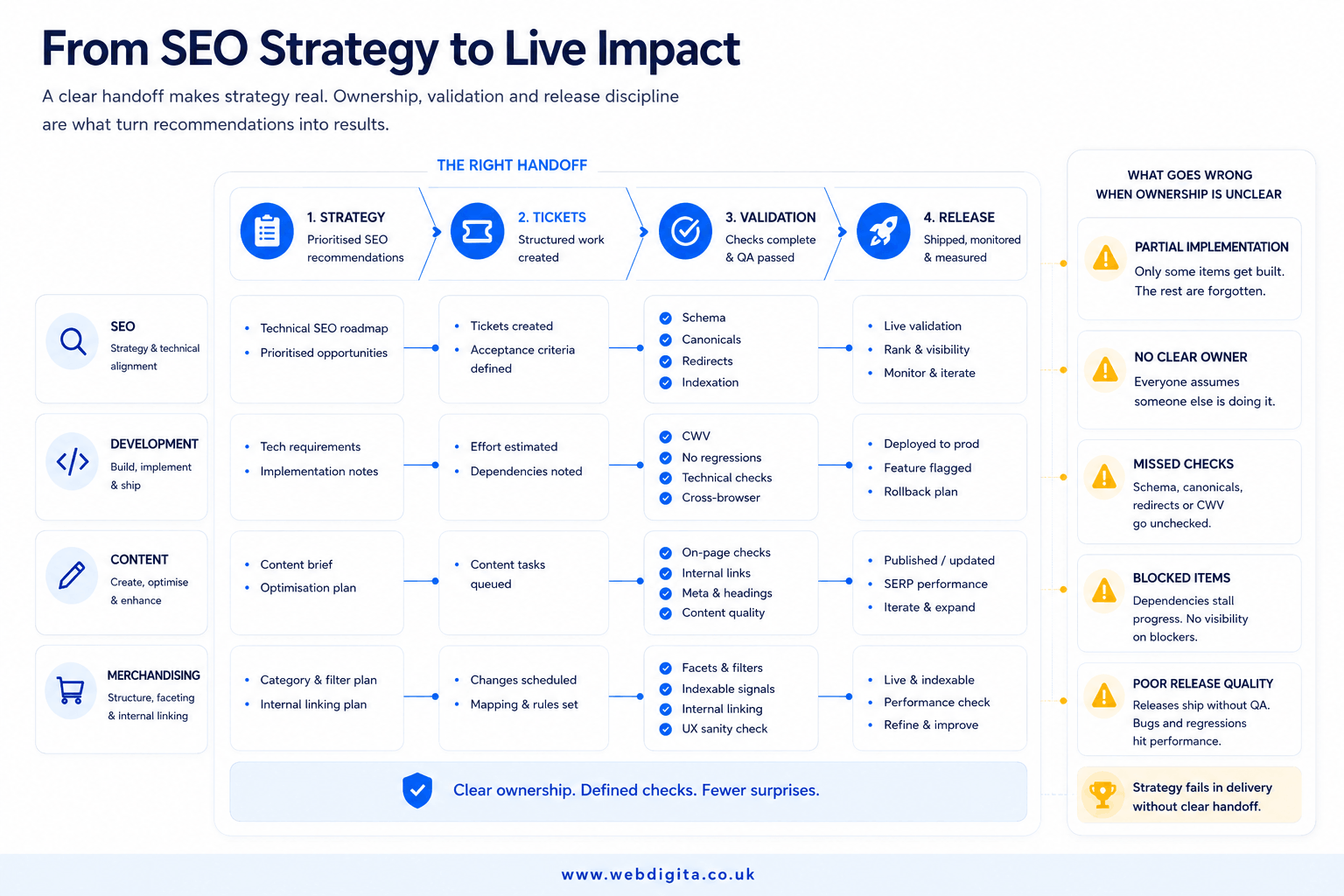
A pattern I see repeatedly: a supplier recommends schema changes, internal linking updates, and template improvements. Nobody defines how those changes get validated before release. SEO signs off the idea, development ships a partial version, merchandising assumes it is done. Six weeks later, a crawl shows the canonical tags are wrong on 30% of the product range and the schema is malformed on every page the developer could not reproduce in staging. Nobody catches it because nobody checked.
- What will become tickets with acceptance criteria, and who writes them – the supplier or the client’s development team?
- What counts as done for schema, canonical tags, redirect implementation, and indexation changes – and how is that validated before the release goes live?
- How will blocked items, platform constraints, and release delays be surfaced and tracked throughout the project?
- What gets prioritised first by impact, dependency, and risk – and who makes that call when implementation constraints force trade-offs?
A long backlog is not a plan. Good delivery separates quick wins from dependency-heavy work, keeps the blockers visible, and adjusts sequencing when platform or release constraints change.
How reporting, iteration, and supplier accountability should work after launch
If the process stops at delivery, it is incomplete. eCommerce SEO needs active review loops because the catalogue changes constantly, stock status changes, platform updates modify template behaviour, and crawl waste reappears over time without anyone noticing.
What to look for in the first 90 days – and why rankings are the wrong signal
In the first 30 days after implementation, ranking movement is mostly noise. The signals that matter are in Search Console. Is the Coverage report showing improvement in indexed pages on the templates you fixed? Is Googlebot’s crawl rate increasing, and is it being directed toward priority category and product templates rather than faceted navigation URLs? Are Core Web Vitals assessments passing at template level, and has the improvement been stable across the past 28 days? These are the indicators that tell you whether the technical changes are functioning as intended – before any ranking movement is visible.
By 60 days, indexation should be stabilising on the templates that were fixed, and early position movement should be visible on specific, lower-competition targets you mapped in strategy. If position movement is absent on those targets, the question is whether the changes were fully implemented, whether they were implemented correctly, or whether the keyword-to-page mapping was wrong in strategy. That distinction matters, because each has a different fix.
At 90 days, non-branded organic traffic on category pages that were targeted in strategy is the meaningful measure. Not overall domain traffic, not rankings for broad head terms – traffic to specific category URLs from non-branded queries. That is a signal you can trace directly to the work done.
What a useful monthly report looks like
A useful report tells you: what was implemented in this period, what is outstanding and why it is blocked, what the leading indicators show relative to implementation status, and what is proposed for next cycle. A report that leads with ranking charts and does not discuss implementation status is hiding something – either the work is behind schedule, the methodology is thin, or the supplier is hoping you will not ask.
Reporting should connect completed work to observable signals at each stage: indexation quality, non-branded traffic movement on targeted pages, category visibility in Search Console, product-page performance metrics, issue resolution rate, and the status of outstanding actions. If those connections are not being drawn, the report is activity documentation, not performance management.
Iteration means revisiting category keyword targets as search demand evolves, refining internal linking as catalogue structure changes, revalidating schema after platform updates, checking crawl waste as new filter combinations are added, and reviewing out-of-stock rules as the product range changes. If product-page traffic improves but conversion stays flat, that is usually the point where eCommerce SEO and eCommerce CRO need to work together rather than run as separate workstreams with separate reporting cycles.
Questions to ask a supplier before you commit
- What specific decisions will be made in discovery, and what will the output document contain?
- How will you handle faceted navigation URL policy, variant canonical strategy, category keyword mapping, and out-of-stock product handling – and will those decisions be documented?
- How will recommendations become tickets, and who writes the acceptance criteria?
- What will you report in the first 30 to 90 days besides rankings – and what signals are you tracking before ranking movement is visible?
- How will the roadmap change when implementation blockers or catalogue changes appear – and how will we be notified?
If a supplier can answer those clearly and specifically, the process exists in some meaningful form. If the answers are vague, or if they bridge from “we do a comprehensive audit” to “you will see results in three to six months” without explaining the steps in between, the process is probably not there. To understand what affects the cost of the engagement and how scope decisions drive pricing, it is worth reading what changes the cost of eCommerce SEO in the UK.
Questions buyers ask before choosing an eCommerce SEO supplier
Common questions about process, delivery, and accountability when comparing agencies or consultants.
1. What should discovery include for an eCommerce SEO project?
Discovery should include a joined-up view of business goals, platform limits, reporting access, indexation patterns, and team ownership. For eCommerce sites, that means checking crawlability, site architecture, faceted navigation behaviour, category structure, variant handling, product template issues, and Core Web Vitals pressure. The output should be a prioritised view of risks, dependencies, and opportunities with clear reasoning, not just raw findings.
2. How should strategy turn audit findings into actionable decisions?
Strategy should settle decisions rather than leave them hanging. You need clear rules for category page optimisation, keyword mapping, internal linking logic, variant canonicals, faceted navigation indexation, and out-of-stock handling before development starts. By the end of strategy, you should have owners, dependencies, and delivery order. If scope is still fuzzy, formal project discovery is often the better next step than forcing a timeline too early.
3. What does good implementation handoff look like in eCommerce SEO?
Good handoff means recommendations are translated into tickets with acceptance criteria and named owners across development, content, and merchandising. Product schema should be validated on live templates, not just mentioned in a deck. Core Web Vitals need shared ownership because template code, third-party scripts, and oversized media often sit outside the SEO team's control. Delivery should separate quick wins from dependency-heavy work so the team knows what can move now.
4. How should reporting work in the first 30 to 90 days of an eCommerce SEO project?
Early reporting should connect completed work with leading indicators such as indexation quality, non-branded traffic movement, category visibility, product-page performance, issue resolution, and blocked actions. You should expect to see what changed, what is still blocked, and what gets reprioritised next. Early reporting should stay grounded rather than jumping straight to broad ranking claims before the work has had time to settle.
5. Why do eCommerce SEO projects often stall during implementation?
Projects stall because the work happens in the wrong order, key decisions stay vague, and handoff into development or merchandising breaks down. A common example is when a supplier recommends schema, internal linking changes, and template improvements, but nobody defines how those changes will be checked before release. Then SEO signs off the idea, development ships a partial version, and merchandising assumes the rest is done.
6. What decisions should be made about faceted navigation before development starts?
You need an SEO decision on what should crawl, what should index, and what should stay out. Faceted navigation can create duplication quickly if nobody decides which filter combinations should be visible to search engines. This decision should happen during strategy, not halfway through delivery, because it affects crawl efficiency, index quality, and internal linking value across the site.
7. How should variant canonicals be handled on eCommerce sites?
Variant canonicals need a clear rule before implementation begins. Colour, size, and near-duplicate product versions can create duplication quickly if nobody decides what the main URL should be. The rule should be documented during strategy and validated during implementation so that development, merchandising, and SEO all understand which product URL should be the canonical version for each variant set.
8. What should happen if implementation blockers or platform limits appear during delivery?
The roadmap should adapt when blockers appear. Good delivery separates quick wins from dependency-heavy work and reports blocked items, platform limits, and release delays clearly. If a recommendation cannot be implemented as planned, the supplier should reprioritise the next action rather than leave the issue unresolved. Iteration means revisiting targets, refining internal linking, and reviewing rules as the catalogue and platform evolve.
Conclusion
- Ask what decisions will be made in discovery and what outputs you will receive, not just what will be audited.
- Confirm how faceted navigation, variant canonicals, category targeting, and out-of-stock URLs will be handled before implementation begins.
- Check how recommendations will become tickets, owners, and release-ready actions with clear acceptance criteria.
- Understand what will be reported in the first 30 to 90 days beyond rankings, including indexation quality, blocked items, and traffic movement.
- Clarify how the roadmap will adapt when implementation blockers, platform limits, or catalogue changes appear during delivery.
If your eCommerce SEO work keeps stalling between strategy and delivery, the process is probably the problem
We work with eCommerce teams who need a structured SEO process that survives platform limits, release cycles, and team handoffs. Our approach covers discovery, architecture decisions, implementation planning, and delivery support with clear ownership at every stage.
See how we run eCommerce SEOOr if you prefer,