Key Takeaways
Migration success depends on capturing legacy logic before moving data. Products, customers, and orders are only the visible layer—the real risk sits in pricing rules, customer groups, order states, and integration dependencies that nobody documented properly.
- Discovery before export: Document business rules, tax behaviour, URL patterns, and integration touchpoints before mapping fields, otherwise edge cases break during QA or after launch.
- Staged runs reduce risk: Repeated test migrations with reconciliation give better validation and rollback confidence than one-pass cutover, especially when millions of records and complex relationships are involved.
- Protect SEO and integrations: Map 100 percent of legacy URLs, test redirects before launch, and re-map ERP, PIM, CRM, and payment flows because new platforms change schemas, event timing, and API behaviour.
- Define ownership early: Assign clear owners for data entities, business rules, validation sign-off, cutover controls, and rollback triggers before the project moves from planning into delivery.
Migration failures are almost never about moving data. They are about undocumented business logic.
I have replatformed complex B2B stores – including multi-warehouse operations with bespoke pricing tiers and ERP integrations bolted on over a decade – without a single ranking loss. The pattern in every failure I have inherited from other agencies is the same: someone started with the export, not the audit.
The Short Answer: A safe eCommerce replatforming and data migration strategy starts with legacy logic capture – pricing rules, customer groups, order states, URL behaviour, tax exceptions, ERP workarounds – before a single field is mapped. You need controlled environment separation, auditable migration runs, staged transfer with reconciliation, and a tested rollback plan. If a provider’s pitch leads with export and import tooling, you are looking at a file move, not a migration plan.
This guide is for technical leads and founders who need sharper due diligence before partner selection, internal scoping, or brief review.
Start by documenting the old logic, not by exporting the data
Products, customers, and orders are only the visible layer. The harder part is the business logic attached to them – and you need that pinned down before anyone maps a field.
Ask for a discovery pass that documents pricing rules, customer groups, tax behaviour, order statuses, URL patterns, media relationships, B2B features, and every integration touchpoint. Skip that work and the mapping may look tidy on paper, then fall apart in edge cases during QA – or, worse, after launch.
The most common version of this I see: a legacy customer group that controls pricing, payment terms, and fulfilment rules simultaneously, with no clean equivalent in the new platform. You need to know whether that logic will be rebuilt, simplified, split across systems, or retired. Vague answers here are a warning sign.
The real risk rarely sits in the catalogue. It sits in old order states and account-level pricing rules that nobody owns clearly. That technical debt compounds fast because every undocumented dependency becomes rework, delay, or a nasty launch surprise.
Migration failures are usually logic failures first. The data only gets blamed later because that is when the damage becomes visible.
What the data mapping and transfer plan should include
A credible eCommerce platform migration plan moves in phases: source audit, schema mapping, transformation rules, staged migration runs, batched transfer, validation, and reconciliation. Each phase should reduce risk, not just move records.
Mapping has to cover structure and relationships – not only flat fields. Check how product variants, category links, media assets, customer history, addresses, order items, refunds, and legacy IDs will be handled. If the team cannot explain ID strategy and dependency order, push hard. Broken relationships are where large migrations start quietly failing.
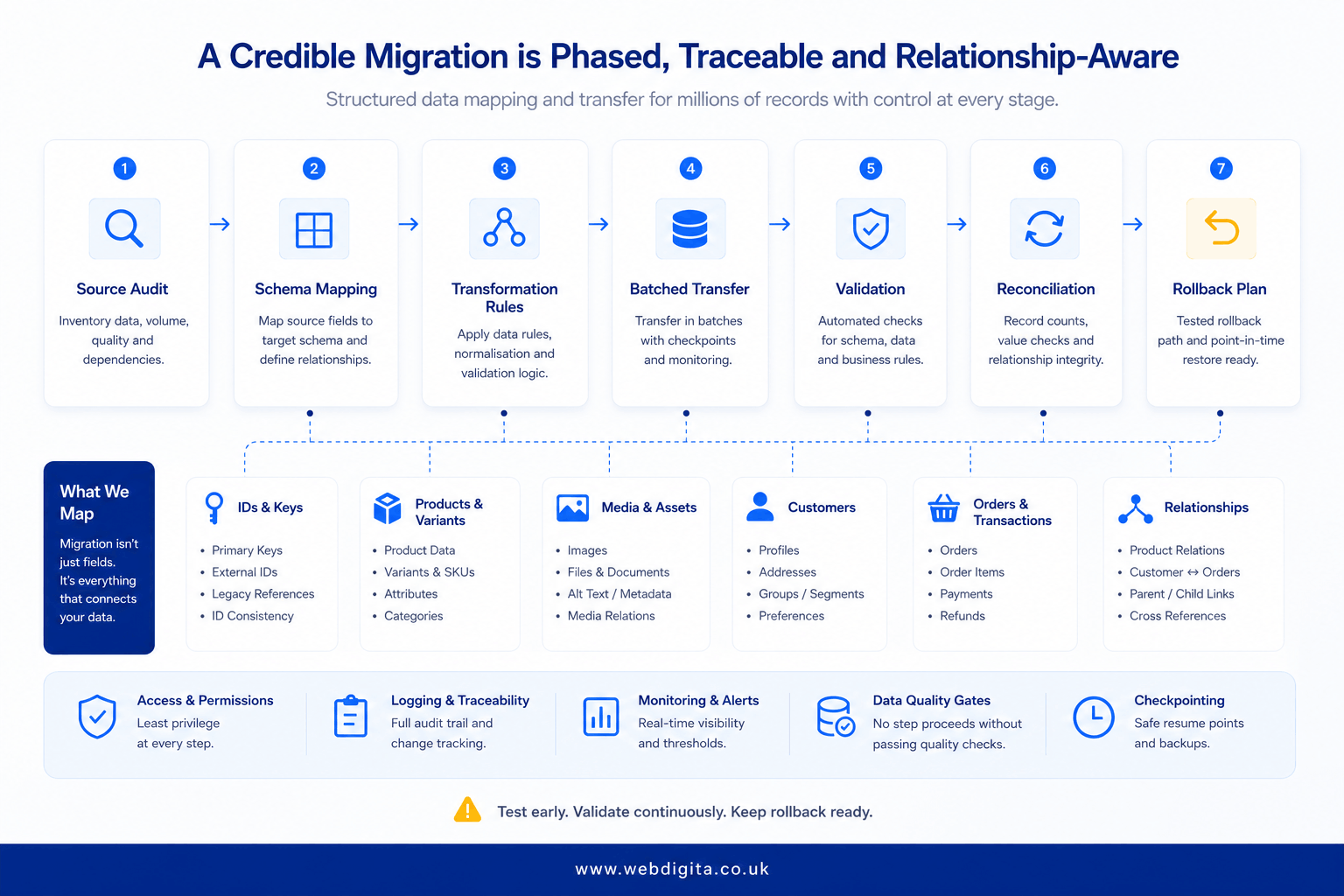
One-pass cutover sounds efficient. It is also where weak assumptions get expensive. A single big migration can reduce operational overlap, but staged runs give you better validation, stronger rollback confidence, and fewer surprises when millions of rows are involved. In most mid-market and complex B2B scenarios, I would rather see repeated test runs with reconciliation than one heroic weekend import followed by panic.
One-pass versus staged migration runs
If you are choosing between the two, ask what matters more: shorter cutover pressure or better control. The answer almost always tells you which partner is thinking operationally and which is thinking about project close.
| Migration element | What it is for | What breaks if skipped |
|---|---|---|
| Source audit | Confirms entities, volumes, anomalies, and dependencies | Scope drift, missed edge cases, bad estimates |
| Schema mapping | Defines how old structures and logic fit the new model | Broken relationships, missing fields, logic gaps |
| Batched transfer | Moves data in controlled chunks with monitoring | Timeouts, partial loads, weak traceability |
| Validation and reconciliation | Checks counts, relationships, and business behaviour | Silent data loss, wrong prices, unusable histories |
| Rollback planning | Sets trigger conditions and recovery steps | Longer outages, confused ownership, worse recovery |
Security should be explained in plain English. Environment separation, controlled access, encryption in transit and at rest, and auditability of who moved what and when. If that answer sounds hand-wavy, assume the operational controls are too.
If you want to tighten the brief before build starts, a eCommerce project discovery workshop is often where these assumptions get exposed properly – before they become change requests.

Not sure if your migration brief covers the right technical ground?
We can walk you through what a credible data migration plan should include, from legacy logic capture through to validation, rollback triggers, and post-launch QA. No sales pressure, just a clearer view of what good looks like.
Usually takes 45 minutes. You leave with a tighter scope.
Technical checklist: key requirements to define before project start
This is the point where missing ownership turns into scope drift. You should be able to name who owns each item before the project moves from planning into delivery.
WEBDIGITA eCommerce Migration Scope Checklist: Use this to pressure-test whether your brief is ready for a serious migration conversation, not just a hopeful estimate.
- Source systems in scope: Storefront, ERP, PIM, CRM, payment, shipping, search, reviews, and any middleware.
- Data entities: Products, variants, categories, customers, addresses, orders, invoices, credit notes, assets, and historical records.
- Business rules: Pricing logic, customer groups, tax rules, B2B workflows, account permissions, and order state handling.
- SEO ownership: Redirect mapping, metadata migration, hreflang where relevant, and launch-day crawl checks.
- Integration re-mapping: Changed schemas, event flows, sync direction, failure alerts, and retry logic.
- Validation ownership: Who signs off counts, relationships, pricing, account access, and order history.
- Cutover controls: Freeze window, content freeze, migration run sequence, and final decision owner.
- Rollback trigger: What failure threshold forces rollback, who calls it, and how data divergence will be handled.
- Post-launch QA: Who checks catalogue integrity, checkout, transactional emails, redirects, analytics, and support triage.
If any line above has no clear owner, that is launch risk now – not a week nine discovery.
How to protect SEO equity, integrations, and cutover stability
Data migration is only part of the job. You also need to protect the systems and signals wrapped around that data – SEO equity, integration flows, and cutover integrity – otherwise the store launches with clean tables and broken trading conditions.
SEO preservation starts with redirect strategy. Every legacy URL needs a mapped live destination, tested before launch and checked again after cutover. I have seen migrations where the platform team treated redirects as the SEO team’s problem and the SEO team treated them as the dev team’s problem. Nobody owned them. Rankings tanked. Google’s guidance on site moves with URL changes is worth reading, but the real fix is operational: assign one owner, test every redirect before cutover, and run a full crawl the morning after go-live.
Integration re-mapping is where I see the most underestimated scope. ERP, PIM, CRM, payment, and shipping flows often change materially because the new platform has different schemas, event timing, or API behaviour. Before development starts, mapping every integration touchpoint against the new platform’s event model is non-negotiable. Assume nothing carries over cleanly.
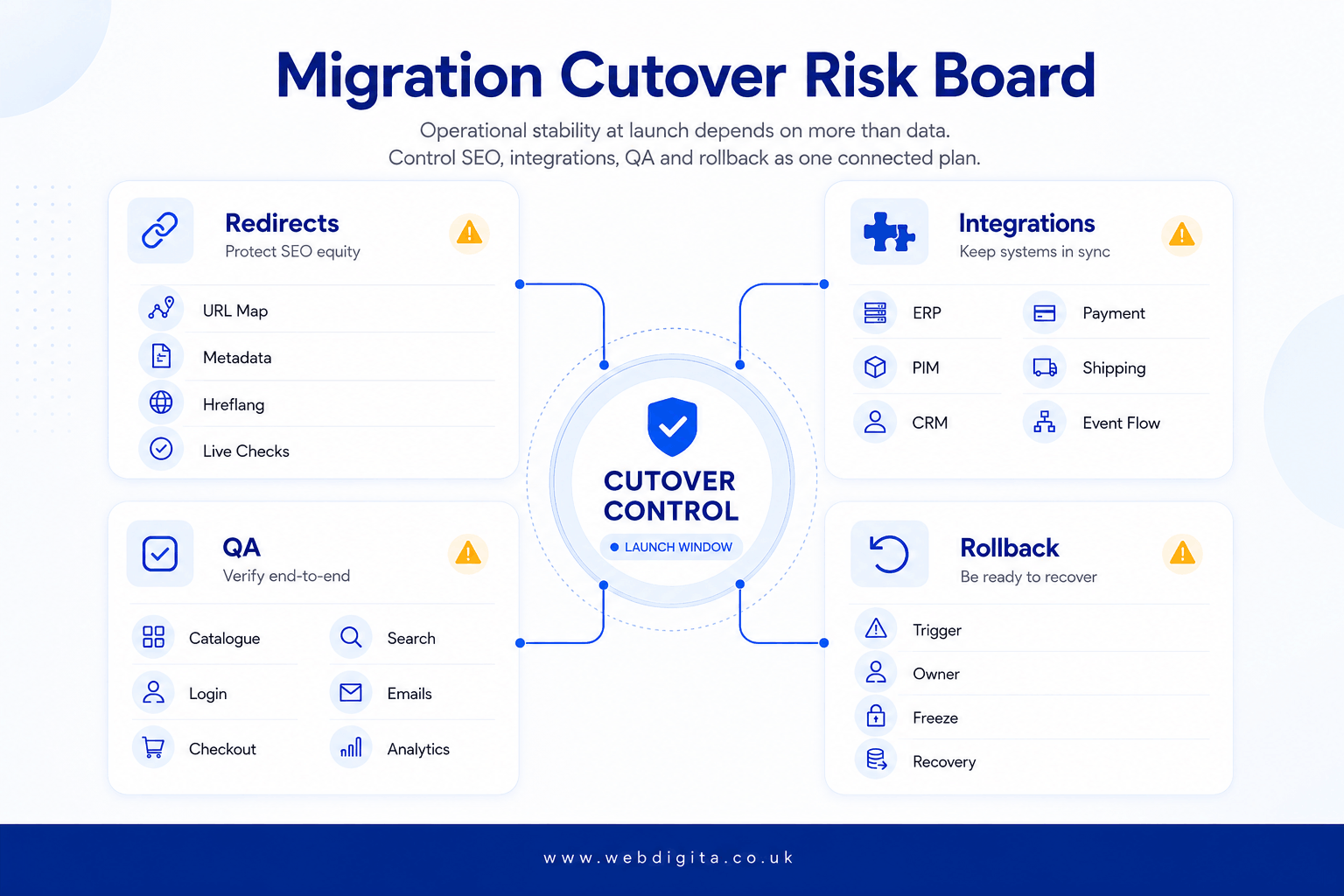
Post-migration QA should cover catalogue integrity, asset links, customer login, account permissions, order history, redirects, search, checkout, payment, tax, shipping, emails, analytics, and admin workflows. You also need a rollback plan with trigger conditions, a named decision owner, freeze logic, and a clear rule for managing data divergence if orders continue during cutover.
Evaluating providers gets simpler once you ask for this specificity. Walk them through their validation method, redirect testing, integration re-mapping, and rollback triggers. If the answers stay vague – or if post-launch support sounds like an afterthought – I would treat that as a red flag and ask what eCommerce maintenance looks like once the migration warranty period ends.
For a practical sense of how complexity translates to cost, read what actually drives eCommerce replatforming costs in the UK. It connects data complexity, integrations, SEO protection, and QA depth to real scope decisions.
Questions teams ask before eCommerce replatforming migration
Practical answers on data scope, logic capture, validation, SEO protection, and rollback planning for large-scale migrations.
1. What is the biggest risk in eCommerce data migration?
The biggest risk is undocumented business logic, not data volume. Pricing rules, customer groups, tax exceptions, order states, and integration dependencies often sit in the old platform without clear documentation. If you skip discovery and move straight to field mapping, edge cases break during QA or after launch because the new platform handles logic differently or has no like-for-like feature.
2. Should we use a one-pass cutover or staged migration runs?
Staged runs usually give better control, validation, and rollback confidence, especially when millions of records and complex relationships are involved. One-pass cutover reduces operational overlap but increases risk because weak assumptions get expensive fast. Repeated test migrations with reconciliation let you catch broken relationships, missing fields, and logic gaps before they become launch failures.
3. What data entities should be included in the migration scope?
You should include products, variants, categories, customers, addresses, orders, invoices, credit notes, media assets, and historical records. Beyond that, define business rules such as pricing logic, customer groups, tax behaviour, B2B workflows, account permissions, and order state handling. Also scope integration touchpoints including ERP, PIM, CRM, payment, shipping, search, and reviews.
4. How do we protect SEO during an eCommerce replatforming migration?
Map 100 percent of legacy URLs to live destinations, test redirects before launch, and check again after cutover. Migrate metadata properly, handle hreflang where relevant, and run crawl checks on launch day. If old URLs, metadata handling, or hreflang logic are messy, rankings can drop because the migration team treated SEO as somebody else's problem.
5. What should a rollback plan include?
A rollback plan should define trigger conditions, name a decision owner, set freeze logic, and explain how data divergence will be handled if orders continue during cutover. You need clear rules for what failure threshold forces rollback, who calls it, and how the team will recover without making the situation worse.
6. How do integrations change during eCommerce migration?
ERP, PIM, CRM, payment, and shipping integrations often change because the new platform has different schemas, event timing, or API behaviour. You cannot simply point an old integration at a new store and leave it alone. Re-map event flows, sync direction, failure alerts, and retry logic, then test thoroughly before cutover.
7. What validation checks should happen after migration?
Post-migration QA should cover catalogue integrity, asset links, customer login, account permissions, order history, redirects, search, checkout, payment, tax, shipping, transactional emails, analytics, and admin workflows. Check counts, relationships, and business behaviour, not just record volumes. Silent data loss and wrong prices are harder to fix after launch.
8. Who should own migration validation sign-off?
Assign clear owners for counts, relationships, pricing, account access, and order history before the project moves from planning into delivery. If any validation line has no clear owner, treat that as launch risk now rather than discovering it in week nine when scope drift turns into rework and delay.
Conclusion
- Treat migration as logic transfer, not file movement. The catalogue may look manageable, but the real complexity sits in pricing rules, customer groups, order states, and integration dependencies that break silently if not documented and mapped properly.
- Push for staged runs and reconciliation. One-pass cutover sounds efficient but staged migrations with validation give better control, stronger rollback confidence, and fewer nasty surprises when millions of rows are involved.
- Protect SEO and integration stability from day one. Map every legacy URL, test redirects before launch, re-map downstream systems, and define rollback triggers with a named decision owner before cutover starts.
- Use the checklist to pressure-test readiness. If any line has no clear owner, treat that as launch risk now rather than discovering it in week nine when scope drift turns into rework and delay.
If you need a migration partner who treats logic, relationships and rollback as seriously as the data itself
WEBDIGITA handles ecommerce replatforming and migration projects where the catalogue is large, the integrations are messy, and the business cannot afford a failed cutover. We document the old logic, map dependencies properly, run staged migrations with validation, and build rollback plans that actually work.
See how we handle ecommerce migrationsOr if you want to talk through your brief first,