Key Takeaways
Most replatform budgets break when hidden complexity surfaces late. Legacy debt, messy data, integration depth, and SEO migration scope drive cost far more than the platform name.
A migration-only job may cost a few thousand pounds to around £15,000, while a full replatform with integrations, custom logic, and SEO protection can move from £15,000 into the £35,000 to £70,000 range once real scope becomes visible.
Discovery is not admin overhead. It is where ERP rules, redirect debt, data quality issues, and custom workflows finally show up. Treat it as a separate budget line, and expect the real scope to emerge during that phase rather than after the build has started.
I’ve replatformed enough complex B2B stores to know this: eCommerce replatforming and migration projects rarely fail on execution. They fail on budget assumptions baked into the brief, before anyone scopes the logic nobody wants to touch – ERP rules buried in old middleware, catalogue data needing refactoring, redirect debt, customer pricing rules, subscriptions, tax edge cases, and workarounds nobody documented.
In the UK, a migration-only project with
- Limited custom work usually costs from around £3,000 up to £15,000.
- A standard replatform with moderate design, data, and SEO scope typically runs £15,000 to £35,000
- Integration-heavy replatform – ERP, CRM, subscriptions, multi-store, custom workflows – moves into the £35,000 to £70,000-plus range.
What actually pushes you up that scale is platform pair, legacy debt, data quality, and how much custom logic is hiding in the current build, not the platform’s name on the proposal. This is the budgeting frame to use before you compare quotes or sign off on discovery – not a number borrowed from someone else’s project.
What a UK ecommerce replatform usually costs before scope gets complicated
Start by separating migration-only work from a full replatform – I see this conflated constantly, and it is the fastest way to end up with one quote at £6,000 and another at £45,000 for what the buyer assumes is “the same job”.
A migration-only brief covers data transfer, basic setup, and limited theme work. In the UK, that typically lands from a few thousand pounds to around £10,000 to £15,000 if the store is genuinely clean – and “clean” is rarer than people think. A fuller replatform – design changes, rebuild work, integration mapping, SEO migration, QA, launch planning, stabilisation – is where budgets move into the £15,000 to £50,000 range, and higher once the architecture turns out to be more brittle than anyone admitted on the kickoff call.
Platform pair matters too. WooCommerce to Shopify is usually a tighter job than Magento to Shopify Plus, because Magento stores tend to carry more custom logic, integration baggage, and the kind of edge cases nobody documented. A custom platform to Magento can be heavier again – more behaviour has to be rebuilt rather than translated, because there is nothing to translate from.
A cheap migration quote is often only cheap because nobody has priced the hidden requirements yet.
That’s why, before you look at headline price, it’s worth understanding what a properly scoped ecommerce migration project actually involves. Do not assume SEO preservation, data migration validation, and operational continuity are included unless the quote says so in writing.
The eCommerce Migration cost drivers that change the price most
Replatforms get priced like website projects, but they behave like dependency projects – and that is where budgets go wrong. I’ve never seen a “simple” replatform stay simple once someone actually opens up the old codebase.
Legacy Debt: Custom modules, patched plugins, theme overrides, and undocumented rules all raise cost. What looks like a tidy migration turns into a rebuild the moment those behaviours stop mapping cleanly to the new stack – and they almost always do, somewhere.
Data Quality: Large catalogues are not automatically expensive, but messy ones are. Duplicate attributes, broken variants, poor category structure, and inconsistent customer records all create cleanup work before a data migration can be trusted. If you’re not sure where you stand, start with assessing data readiness before a platform migration.
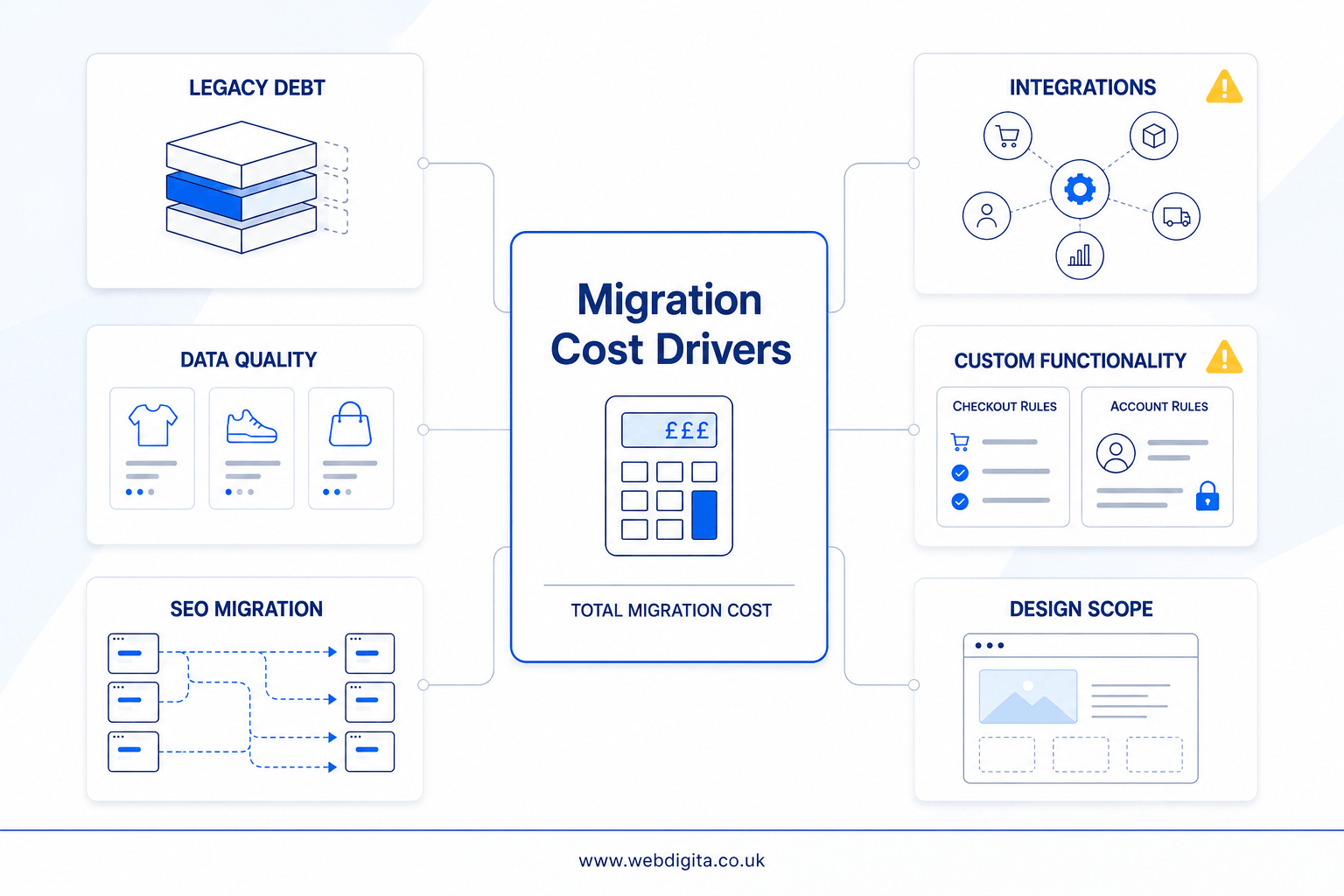
Integrations and SEO: ERP, PIM, CRM, shipping, subscriptions, and payment flows usually drive more effort than the storefront itself. SEO adds its own workload too – redirect strategy, URL mapping, hreflang configuration where it’s needed, plus metadata and post-launch checks. In my experience replatforming complex B2B stores without losing a single ranking position, the projects that protect organic revenue are the ones that treat the SEO work that protects revenue during migration as core scope from day one, not a line item bolted on at the end.
Design and custom functionality: keeping the front end close to the current store is usually cheaper than redesigning journeys at the same time. Custom B2B pricing, account rules, approval flows, or checkout logic also push cost up fast – these are exactly the kind of edge cases that break neat estimates, because nobody scopes “what happens when a trade account has three different price lists” until it’s already live.
Watch for these gaps in early quotes:
- Integration mapping: integrations are mentioned, but field mapping and failure handling are not. That usually becomes change requests later.
- SEO migration: reduced to “we’ll add some redirects”. That’s often how traffic loss and rushed rework after launch happen.
- Data migration: priced without cleanup or validation. That’s how bad records reach the new store.
- Custom functionality: marked “to be confirmed”. That usually means delayed delivery or post-launch defects.
Treat those as warning signs, not bargains – I’ve yet to see one of these get cheaper once the project starts.

Not sure what your migration actually needs to include?
Most replatform budgets break because the scope was guessed, not mapped. We run scoping audits that check your data quality, integration dependencies, SEO migration depth, and custom logic before you compare quotes or approve discovery.
Quick scoping call to map what actually needs pricing.
eCommerce Re-platforming : Cost driver matrix (Project Type, Complexity, and Typical UK Price Range)
Use a matrix like this to frame the scoping conversation, not to demand false precision from a quote based on a five-minute call. I’ve watched the same target platform price three different ways across three projects, purely because dependency depth was not visible until someone actually looked.
| Project type | Complexity | Typical UK price range |
|---|---|---|
| Migration-only with limited custom work | Low | £3,000 to £15,000 |
| Standard replatform with moderate design, data, and SEO scope | Medium | £15,000 to £35,000 |
| Integration-heavy replatform with ERP, CRM, subscriptions, or custom workflows | High | £35,000 to £70,000 |
| Multi-store, B2B-flavoured, or high-custom-logic migration | Very high | £70,000 and up |
These are scoping bands, not guaranteed quotes – and in my experience, projects rarely move down a band once discovery starts. They only move up. The usual triggers are:
- The platform pair carries more custom logic than the sales call suggested – Magento and older WooCommerce builds are repeat offenders.
- Data migration needs cleanup work that was not visible until someone actually queried the database.
- SEO migration depth gets reassessed once someone counts the indexed URLs and realises redirect strategy is not a checkbox, it is a project.
- Custom rules – pricing tiers, approval workflows, integration mapping for ERP or CRM – turn out to be load-bearing, not cosmetic.
If your scoping conversation has not touched all four of these, the number you have been given is a placeholder, not a quote.
Discovery, rollout model, and support costs that get missed early
Discovery is its own budget line, not admin around the edges – and it’s usually the line item clients try to cut first, which is backwards. In the UK, a proper discovery and audit phase runs from a few thousand pounds on a smaller move, and considerably more on complex programmes. That work covers architecture review, data audit, integration mapping, acceptance criteria, and migration risk checks – the things that determine whether the rest of the quote is real.
This is where things usually go wrong. A quote looks fine until discovery exposes ERP pricing rules by customer group, years of redirect debt, and order data that does not map cleanly to the new schema. The build did not suddenly become more expensive – the real scope just finally showed up.
If you’re still deciding the target stack, a project discovery workshop is worth having before build estimates harden into a number nobody can change. If the platform is not chosen yet, it’s worth reviewing platform selection costs before replatforming begins, because some of this cost is shaped long before migration starts.
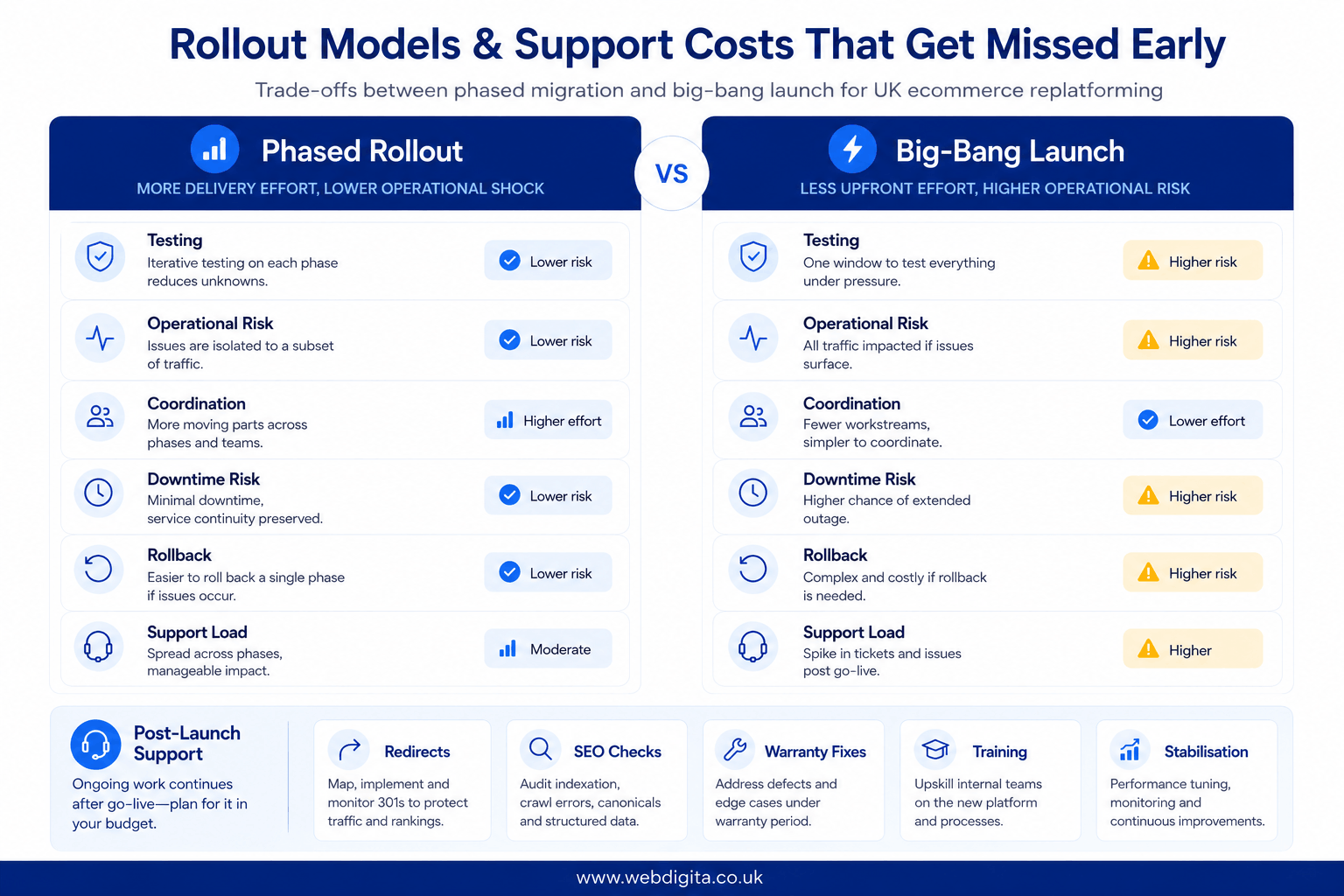
Rollout Trade-Off: A phased migration usually costs more in delivery effort – you are running parallel states, extra testing, and more coordination. But it earns its keep by reducing operational shock. Big-bang launches look cheaper on paper, but rollback, downtime, and defect risk are usually worse if the plan underneath is thin.
Post-launch support needs its own owner and budget, not a vague promise of “we’ll sort it after launch”. Check who handles warranty fixes, redirect monitoring, SEO checks, training, handover, backlog triage, and performance stabilisation after launch. Those costs do not disappear because the site went live – they just move from the proposal to your inbox.
How to scope store migration without getting an underpriced quote
Most overruns come from the same places: vague scope, weak integration detail, poor data quality, SEO left late, and custom rules nobody bothered to document. If you want a quote you can actually hold someone to, ask for deliverables, assumptions, exclusions, testing depth, redirect ownership, support window, rollback planning, and change control – in plain English, not “to be agreed”.
Also check the pricing model. Fixed pricing can work when scope is genuinely clear, which is rarer than agencies admit. On riskier migrations, I’d rather see milestone billing tied to discovery outputs than a confident fixed number built on guesswork – at least it’s honest about what is not known yet.
Ask one blunt question: what has actually been priced, and what has been parked in assumptions? If that answer is fuzzy, the quote is undercooked – I’ve never seen an exception. You should also know who supports the store after launch and where the warranty boundary ends. A sensible plan for eCommerce maintenance is part of the migration cost, because the first few weeks after go-live are where sync issues, edge cases, and hidden operational gaps surface – and they always surface.
Related Article: What a proper platform selection process should look like before migration.
Questions buyers ask before budgeting an ecommerce replatform
Practical answers to help you scope cost, risk, and delivery expectations before comparing quotes.
1. What is the difference between a migration and a full replatform?
A migration-only project typically covers data transfer, basic setup, and limited theme work, often costing a few thousand to around £15,000 in the UK. A full replatform includes design changes, rebuild work, integration mapping, SEO migration, QA, launch planning, and stabilisation, which usually moves the budget into the £15,000 to £50,000 range or higher depending on complexity. The key difference is scope depth, not just the platform pair.
2. Why do some ecommerce replatform quotes vary so much?
Quote variation usually reflects different assumptions about what is included. One agency may price only data transfer and basic setup, while another includes integration mapping, SEO migration, custom logic rebuild, testing, and post-launch support. Legacy debt, data quality, integration depth, and custom functionality all drive cost, but not every quote prices them upfront. Always check deliverables, assumptions, and exclusions before comparing headline numbers.
3. How much should I budget for discovery before a replatform?
In the UK, discovery and audit work may cost a few thousand pounds on a smaller migration, and more on complex programmes. This phase typically covers architecture review, data audit, integration mapping, acceptance criteria, and migration risk checks. Discovery is where hidden scope surfaces, so treat it as a separate budget line rather than admin overhead. Skipping it usually leads to underpriced quotes and expensive change requests later.
4. What cost drivers push a replatform into the higher price bands?
Integration depth, legacy custom modules, poor data quality, SEO migration scope, and custom B2B or checkout logic are the main cost drivers. A WooCommerce to Shopify migration with clean data and few integrations may stay in the lower range, while a Magento to Shopify Plus move with ERP, CRM, subscriptions, and custom pricing rules can push into the £35,000 to £70,000 range or higher. Platform pair matters less than dependency depth.
5. Should I choose fixed pricing or milestone billing for a replatform?
Fixed pricing works when scope is genuinely clear and risk is low. On riskier migrations with integration complexity, legacy debt, or uncertain data quality, milestone billing tied to discovery outputs is often more honest. It allows the budget to adjust as real scope emerges, rather than forcing change requests or cutting corners to protect a fixed number built on guesswork.
6. What post-launch costs should I plan for after a replatform?
Post-launch support should cover warranty fixes, redirect monitoring, SEO checks, training, handover, backlog triage, and performance stabilisation. The first few weeks after go-live are when sync issues, edge cases, and hidden operational gaps tend to surface. Budget for a defined support window and clarify who owns what after launch, because those costs do not disappear once the site is live.
7. Does a phased migration cost more than a big-bang launch?
Phased migration usually costs more in delivery effort because you are running parallel states, extra testing, and more coordination. However, it can reduce operational shock and rollback risk. Big-bang launches may look cheaper on paper, but downtime, defect risk, and post-launch firefighting can be worse if the plan is thin. Choose the rollout model based on operational risk tolerance, not just headline cost.
8. How does data quality affect replatform cost?
Large catalogues are not always expensive, but messy ones are. Duplicate attributes, broken variants, poor category structure, and inconsistent customer records create cleanup work before migration can be trusted. If your data is questionable, expect additional cost for auditing, refactoring, and validation. Bad data reaching the new platform usually leads to defects, poor search performance, and post-launch rework.
Conclusion
Replatform cost is shaped by what you already have, not just what you are moving to. The platform pair, integration depth, data quality, SEO migration scope, and custom logic all matter more than the target stack name.
- Discovery first: proper scoping exposes the real effort before estimates harden
- Integration and SEO depth: these usually drive more cost than the storefront rebuild
- Post-launch support: budget for warranty fixes, redirect monitoring, and stabilisation after go-live
- Pricing model: milestone billing tied to discovery outputs is often more honest than fixed pricing built on guesswork
If you are comparing quotes now, judge them on deliverables, assumptions, exclusions, and who owns what after launch. The cheapest proposal is rarely the safest one once hidden scope surfaces.
Ready to scope your ecommerce replatform without the guesswork?
We help UK ecommerce teams plan migrations that protect revenue, preserve SEO, and map integration dependencies before build starts. Our scoping process covers data audit, redirect planning, integration mapping, and custom logic review so you know what you are actually buying.
Precision-Plan Your Ecommerce Store MigrationPrefer to talk first?